Many custom options...


And formats...



Advent in Chinese / Japanese...
Buy an Advent calligraphy wall scroll here!
Personalize your custom “Advent” project by clicking the button next to your favorite “Advent” title below...
Switched to secondary search mode due to lack of results using primary.
These secondary results may not be very accurate. Try a different but similar meaning word or phrase for better results. Or...
Look up Advent in my Japanese Kanji & Chinese Character Dictionary(My dictionary is a different system then the calligraphy search you just tried)
If you want a special phrase, word, title, name, or proverb, feel free to contact me, and I will translate your custom calligraphy idea for you.
Adventure
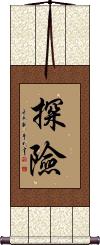
If you lead a life of adventure (like I do), a 探險 wall scroll is for you.
Alone, the first character can mean “to explore,” “to search out,” or “to scout.” The second character holds the meanings of “dangerous” and “rugged.” Together these two characters create the word that means “adventure” or “to explore.”
探険 is a modern Japanese Kanji version, but it more precisely means exploration or expedition rather than adventure. 探險 is the old/ancient Japanese version used before WWII. Let us know if you want the modern Japanese version instead.
See Also: Bon Voyage | Travel
Adventure
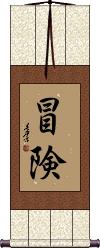
冒険 is a common Japanese way to say “Adventure.”
The first character can mean “to risk,” “to defy” or “to dare.” The second character means “inaccessible place” or “impregnable position.” Together, you get the idea of why these two characters mean adventure when put them together in Japanese.
Note: The second character is a morphed Japanese Kanji. The original Chinese version is also available and holds the same root meaning.
Adventure Lover

冒険野郎 is a Japanese title that means “adventure lover.”
This literally means something like “adventure wild man.”
This is a funny choice for a wall scroll, but it's a legitimate word in Japanese.
Adventure
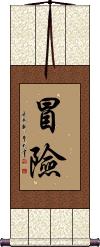
冒險 is another Chinese and Korean word for “Adventure.”
This is more of a “risk-taking” version of adventure.
The first character can mean “brave” and “bold.” The second character means “dangerous” and “rugged.” Together they can be defined as a word meaning “adventure” in Chinese and Korean.
Note: Some dictionaries translate these two characters as “take a risk.”
Adventurer
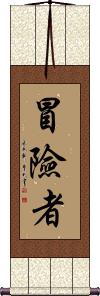
冒險者 is how to write adventurer in Chinese.
Adventurer
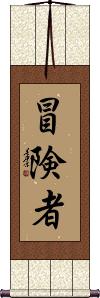
冒險者 is how to write adventurer in Japanese.
These search terms might be related to Advent:
Dawn
Dawn / Early Morning / Twilight
Faith is the Bird That Feels the Light When the Dawn is Still Dark
Fresh Start
New Beginning
The Night is Darkest Before the Dawn
Not the results for advent that you were looking for?
Below are some entries from our dictionary that may match your advent search...
| Characters If shown, 2nd row is Simp. Chinese |
Pronunciation Romanization |
Simple Dictionary Definition |
再来 see styles |
sarai さらい |
(n,vs,vi) (1) return; coming back; (n,vs,vi) (2) second coming (e.g. of Christ); second advent; reincarnation; (female given name) Sarai |
再臨 再临 see styles |
zài lín zai4 lin2 tsai lin sairin さいりん |
to come again (n,vs,vi) second coming; second advent |
出現 出现 see styles |
chū xiàn chu1 xian4 ch`u hsien chu hsien shutsugen しゅつげん |
to appear; to arise; to emerge; to show up (n,vs,vi) appearance; emergence; advent; arrival; showing up; coming to existence To manifest, reveal, be manifested, appear, e. g. as does a Buddha's temporary body, or nirmāṇakāya. Name of Udāyi 優陀夷 a disciple of Buddha to be reborn as Samantaprabhāsa; also of a son of Ajātaśatru. |
到來 到来 see styles |
dào lái dao4 lai2 tao lai |
to arrive; arrival; advent See: 到来 |
到来 see styles |
tourai / torai とうらい |
(n,vs,vi) arrival; coming; advent |
地藏 see styles |
dì zàng di4 zang4 ti tsang jizou / jizo じぞう |
Kṣitigarbha, the Bodhisattva of the Great Vow (to save all souls before accepting Bodhi); also translated Earth Treasury, Earth Womb, or Earth Store Bodhisattva (surname) Jizou Ti-tsang, J. Jizō, Kṣitigarbha, 乞叉底蘗沙; Earth-store, Earth-treasury, or Earthwomb. One of the group of eight Dhvani- Bodhisattvas. With hints of a feminine origin, he is now the guardian of the earth. Though associated with Yama as overlord, and with the dead and the hells, his role is that of saviour. Depicted with the alarum staff with its six rings, he is accredited with power over the hells and is devoted to the saving of all creatures between the nirvana of Śākyamuni and the advent of Maitreya the fifth century he has been especially considered as the deliverer from the hells. His central place in China is at Chiu-hua-shan, forty li south-west of Ch'ing-yang in Anhui. In Japan he is also the protector of travellers by land and his image accordingly appears on the roads; bereaved parents put stones by his images to seek his aid in relieving the labours of their dead in the task of piling stones on the banks of the Buddhist Styx; he also helps women in labour. He is described as holding a place between the gods and men on the one hand and the hells on the other for saving all in distress; some say he is an incarnation of Yama. At dawn he sits immobile on the earth 地 and meditates on the myriads of its beings 藏. When represented as a monk, it may be through the influence of a Korean monk who is considered to be his incarnation, and who came to China in 653 and died in 728 at the age of 99 after residing at Chiu-hua-shan for seventy-five years: his body, not decaying, is said to have been gilded over and became an object of worship. Many have confused 眞羅 part of Korea with 暹羅 Siam. There are other developments of Ti-tsang, such as the 六地藏 Six Ti-tsang, i. e. severally converting or transforming those in the hells, pretas, animals, asuras, men, and the devas; these six Ti-tsang have different images and symbols. Ti-tsang has also six messengers 六使者: Yama for transforming those in hell; the pearl-holder for pretas; the strong one or animals; the devīof mercy for asuras; the devī of the treasure for human beings; one who has charge of the heavens for the devas. There is also the 延命地藏 Yanming Ti-tsang, who controls length of days and who is approached, as also may be P'u-hsien, for that Purpose; his two assistants are the Supervisors of good and evil 掌善 and 掌惡. Under another form, as 勝軍地藏 Ti-tsang is chiefly associated with the esoteric cult. The benefits derived from his worship are many, some say ten, others say twenty-eight. His vows are contained in the 地藏菩薩本願經. There is also the 大乘大集地藏十電經 tr. by Xuanzang in 10 juan in the seventh century, which probably influenced the spread of the Ti-tsang cult. |
得有 see styles |
dé yǒu de2 you3 te yu tokuu |
advent |
来臨 see styles |
koromo ころも |
(n,vs,vi) (honorific or respectful language) attendance; presence; visit; coming; advent; (surname) Koromo |
来降 see styles |
raigou; raikou / raigo; raiko らいごう; らいこう |
(archaism) (See 降臨・1) advent; descent (of a god) |
登場 登场 see styles |
dēng chǎng deng1 chang3 teng ch`ang teng chang toujou / tojo とうじょう |
to go on stage; fig. to appear on the scene; used in advertising to mean new product (n,vs,vi) (1) (ant: 退場・2) entrance (on the stage); appearance (in a book, film, etc.); (n,vs,vi) (2) appearance (on the scene); arrival (on the market); emergence; introduction; advent |
訪れ see styles |
otozure おとずれ |
(1) visit; call; (2) arrival (e.g. of spring); advent; coming; appearance; (3) news; tidings; word |
鐼子 see styles |
fén zǐ fen2 zi3 fen tzu funsu |
xun-zi, a bowl (or bowls) within an almsbowl. Buddha's bowl consisted of four heavy deva-bowls which he received miraculously one on the other; they are to be recovered with the advent of Maitreya; v. 鍵M086767. |
降臨 降临 see styles |
jiàng lín jiang4 lin2 chiang lin kourin; gourin(ok) / korin; gorin(ok) こうりん; ごうりん(ok) |
to descend; to arrive; to come (noun/participle) (1) descent (to earth, esp. of a god); advent; epiphany; (noun/participle) (2) (honorific or respectful language) arrival (of an important person); appearance To descend, draw near from above, condescend, e.g. the Buddha, the spirits, etc. |
再降臨 see styles |
saikourin / saikorin さいこうりん |
Second Advent |
待降節 see styles |
taikousetsu / taikosetsu たいこうせつ |
Advent |
訓仮名 see styles |
kungana くんがな |
(See 音仮名・おんがな) kanji used to represent syllables, based on their "kun" readings (prior to the advent of kana) |
降臨節 降临节 see styles |
jiàng lín jié jiang4 lin2 jie2 chiang lin chieh |
Advent (Christian period of 4 weeks before Christmas) |
音仮名 see styles |
ongana おんがな |
(See 訓仮名・くんがな,万葉仮名・まんようがな) kanji used to represent syllables, based on their "on" readings (prior to the advent of kana) |
二佛中門 二佛中门 see styles |
èr fó zhōng mén er4 fo2 zhong1 men2 erh fo chung men nibutsu chūmon |
The period between the nirvāṇa of Śākyamuni and the future advent of Maitreya, i.e. the present period. |
好機到来 see styles |
koukitourai / kokitorai こうきとうらい |
(yoji) advent of a golden opportunity |
アドベント see styles |
adobento アドベント |
Advent |
耶穌降臨節 耶稣降临节 see styles |
yē sū jiàng lín jié ye1 su1 jiang4 lin2 jie2 yeh su chiang lin chieh |
Advent (Christian period of 4 weeks before Christmas) |
アドベント湾 see styles |
adobentowan アドベントわん |
(place-name) Advent Bay |
五十五善知識 五十五善知识 see styles |
wǔ shí wǔ shàn zhī shì wu3 shi2 wu3 shan4 zhi1 shi4 wu shih wu shan chih shih gojūgo zenchishiki |
similar to 五十三智識. 五十八戒 The ten primary commands and the forty-eight secondary commands of the 梵綱經. 五十六億七千萬歳 The perod to elapse between Śākyamuni's nirvana and the advent of Maitreya, 56, 070, 000 years. |
Variations: |
adobento; adorento アドベント; アドヴェント |
(See 待降節・たいこうせつ) Advent |
Variations: |
sairai さいらい |
(n,vs,vi) (1) return; coming back; (n,vs,vi) (2) second coming (e.g. of Christ); second advent; reincarnation |
Variations: |
adobentokarendaa; adobento karendaa / adobentokarenda; adobento karenda アドベントカレンダー; アドベント・カレンダー |
Advent calendar |
The following table may be helpful for those studying Chinese or Japanese...
| Title | Characters | Romaji (Romanized Japanese) | Various forms of Romanized Chinese | |
| Adventure | 探險 探险 / 探険 | tanken | tàn xiǎn / tan4 xian3 / tan xian / tanxian | t`an hsien / tanhsien / tan hsien |
| Adventure | 冒険 | bou ken / bo ken | ||
| Adventure Lover | 冒険野郎 | bou ken ya rou boukenyarou bo ken ya ro | ||
| Adventure | 冒險 冒险 | mào xiǎn / mao4 xian3 / mao xian / maoxian | mao hsien / maohsien | |
| Adventurer | 冒險者 冒险者 | mào xiǎn zhě mao4 xian3 zhe3 mao xian zhe maoxianzhe | mao hsien che maohsienche |
|
| Adventurer | 冒險者 冒険者 | boukensha / bokensha | ||
| In some entries above you will see that characters have different versions above and below a line. In these cases, the characters above the line are Traditional Chinese, while the ones below are Simplified Chinese. | ||||

Successful Chinese Character and Japanese Kanji calligraphy searches within the last few hours...



