Many custom options...


And formats...



Brings in Chinese / Japanese...
Buy a Brings calligraphy wall scroll here!
Personalize your custom “Brings” project by clicking the button next to your favorite “Brings” title below...
1. Patience Brings Peace of Mind
2. Dragon and Phoenix Brings Luck
3. The Karma/Fate/Destiny that Brings Lovers Together
6. Yuan Fen
7. Predestined Love / Love by Fate
8. Patience Yields Peace of Mind
9. The Mysterious Bond Between People
10. Strong / Robust
11. Doing good is the greatest source of happiness
12. Thankfulness
13. Confucius: Universal Education
15. Paramartha
17. Radiance
Patience Brings Peace of Mind
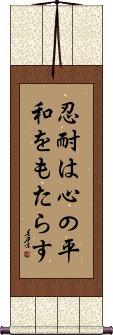
忍耐は心の平和をもたらす means “patience brings peace of mind,” in Japanese.
Note: Because this selection contains some special Japanese Hiragana characters, it should be written by a Japanese calligrapher.
Dragon and Phoenix Brings Luck
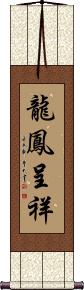
龍鳳呈祥 is often seen at weddings and other celebrations in China.
It suggests that the dragon and phoenix will bring you auspicious tidings.
The first character is a dragon.
The second is a phoenix.
The third is presents or brings.
And the last means auspicious, propitious, or luck.
Throughout China, the dragon and phoenix are symbols of good fortune. You will see these auspicious figures as decorative symbols on everything from buildings, furniture, wedding costumes, and sculptures in public parks to caskets and items used in ceremonies.
The Karma/Fate/Destiny that Brings Lovers Together
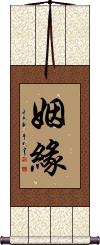
姻緣 means “Destiny that brings lovers together.” It can also be translated technically as “Predestined matrimonial affinity” (wow, talk about taking the romance out of this word - that was from the Oxford C-E dictionary).
This speaks to the fate (or karma) that brings a husband and wife together. I would translate this as “Together by fate” or “Joined by destiny” but in the context of marriage. You could use this for non-married lovers, but the first character has a suggestion that this refers to those that are married.
The Red String
Thread of Lover's Destiny / Fate
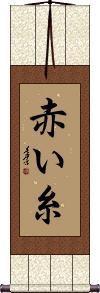
This literally translates as “the red string” or “the red thread” in Japanese, but the real meaning is much deeper...
In Japanese culture, it's believed that fate, destiny, or karma joins lovers by an unseen string, tied around one little finger of each. 赤い糸 is how soul mates find and are drawn to each other.
The Japanese concept of the red thread of fate, by most estimations, comes from Chinese folklore, where it's known as 姻緣紅線. The only difference is that in China, the celestial red thread is tied around the ankles of the lovers (versus what is usually represented as the pinky finger in Japan).
Fate / Chance Meeting
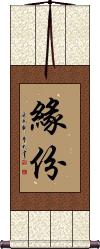
緣份 specifically represents the fate or destiny that brings two people together.
This is like the chance meeting of two people that leads sometime later to marriage.
This could also be the chance meeting of two business people who become partners and build a huge and successful company.
This idea is often associated with a fateful meeting leading to good fortune.
Some will define this word as “Destiny brings you two together” or “Meant to be.”
 Note: The second character can also be written without the left radical, as shown to the right. If you have a preference, please let use know in the special instructions for your project. There is no difference in meaning or pronunciation, just two (alternate) ways to write the same character.
See Also: Soulmates | Good Fortune
Yuan Fen
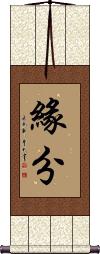
緣分 or Yuan Fen is the fate or chance that brings people together.
This can also mean a predestined affinity or relationship. Basically this is about destiny.
Predestined Love / Love by Fate
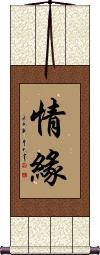
This Chinese word means predestined love or love affinity.
This can be fate, karma, or the bond that brings two lovers together.
Patience Yields Peace of Mind
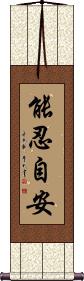
This ancient Chinese proverb can be translated as “Patience brings peace of mind,” “One who has patience finds peace,” and a few other ways.
The Mysterious Bond Between People
The invisible force that brings people together forever
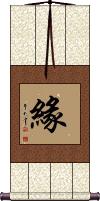
緣 represents the fate that brings and bonds people together.
緣 is a complicated single character. It can mean a lot of different things depending on how you read it.
In Japanese, it can mean fate, destiny, a mysterious force that binds two people together, a relationship between two people, bond, link, connection, family ties, affinity, opportunity, or chance (to meet someone and start a relationship). It can also mean “someone to rely on,” relative, reminder, memento, or the female given name, Yori.
It's the same in Chinese, where it's defined as cause, reason, karma, fate, or predestined affinity.
In the Buddhist context, it's Pratyaya. This is the concept of indirect conditions, as opposed to direct causes. It's when something happens (meeting someone) by circumstance or a contributing environment. Instead of a direct cause or act, it is a conditioning cause without direct input or action by the involved people.
Occasionally, this character is used in a facetious way to say hem, seam, or edge of clothing. In this case, it's the seam that brings or holds the clothing together.
 Note: Japanese will tend to use the variant of this Kanji shown to the right. If you want this version (and are ordering this from the Japanese master calligrapher), click on the Kanji at the right instead of the button above.
Strong / Robust
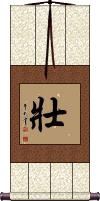
This “strong” character means “to strengthen” or robust. This brings images of a muscle-bound hulk of a weight lifter or bodybuilder to an Asian person who sees this character.
Note that in Korean and Japanese, this character is normally part of compound words, and is not seen alone too often.
 Note that the this character was simplified in Japan after WWII (also simplified in mainland China but not for calligraphy). If you want the modern Japanese/simplified version, please click on the Kanji shown to the right.
Doing good is the greatest source of happiness
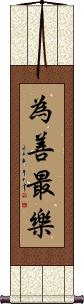
為善最樂 can be translated as “Doing good is the greatest source of happiness” or “doing good deeds brings the greatest joy.”
The origin is not known but is sometimes used in the context of Buddhism. However, this Chinese proverb or philosophy is a relatively mainstream idea of benevolence.
Thankfulness
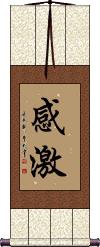
感激 is thankfulness or being grateful for what you have.
It is an attitude of gratitude for learning, loving, and being. Appreciate the little things that happen around you and within you every day. Think positively. Thankfulness brings contentment.
Different meaning in Japanese - more like "deep emotion," "impression," "inspiration" - not recommended for a Japanese audience.
Confucius: Universal Education
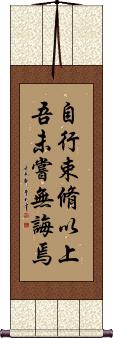
自行束脩以上吾未尝无诲焉 means, for anyone who brings even the smallest token of appreciation, I have yet to refuse instruction.
Another way to put it is: If a student (or potential student) shows just an ounce of interest, desire, or appreciation for the opportunity to learn, a teacher should offer a pound of knowledge.
This quote is from the Analects of Confucius.
This was written over 2500 years ago. The composition is in ancient Chinese grammar and phrasing. A modern Chinese person would need a background in Chinese literature to understand this without the aid of a reference.
Joyfulness / Happiness
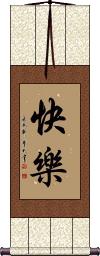
快樂 or joyfulness is an inner sense of peace and happiness.
You appreciate the gifts each day brings. Without joyfulness, when the fun stops, our happiness stops. Joy can carry us through hard times even when we are feeling very sad.
快樂 can also mean pleasure, enjoyment, delight, cheerfulness, or merry. In some ways, this is the essence that makes someone perceived as a charming person.
See Also: Happiness
Paramartha
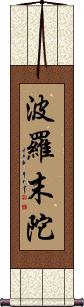
波羅末陀 is the Chinese and Japanese way to write the ancient Sanskrit word Paramārtha or परमार्थ which now means the highest truth, ultimate truth, ultimate reality, or fundamental meaning.
Paramārtha is the name of a famous Buddhist monk born in 499 CE. Paramārtha traveled the world (including Cambodia and territories that are now part of China) to spread the teachings of Buddhism by translating scriptures into the local languages so the truth could be understood by the masses.
So, we should all want to be a Paramārtha who brings the ultimate truth, knowledge, and enlightenment to others.
The Roar of the Lioness
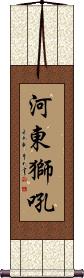
河東獅吼 is actually a proverb and joke about the plight and fear of a hen-pecked husband.
In ancient times, it was used to describe a wife who would berate her husband or go into jealous rages. However, this phrase currently brings about ideas of a husband that cowers in fear and cringes when his wife screams (or roars) at him.
Please only purchase this as a good-natured joke. If your wife or husband does not have a good sense of humor, it's probably not a good idea to hang this on your wall to irritate your mate.
Radiance
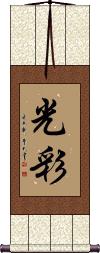
光彩 is the Chinese, Japanese Kanji, and old Korean Hanja for radiance.
Other meanings include luster, splendor/splendour, and brilliance.
光彩 is the radiance you see when a person's arrival brings happiness and joy to the room. Or the radiance on the face of a new bride etc.
If you delve into the dictionary, other forms of radiance will refer to isotopes emitting radiation. 光彩 is not related to radiation and is not the kind that causes cancer.
In Japanese, this can be several female given names such as Misa, Hikari, Hiiro, Teresa, or Arisa. And a more unisex given name of Kousai or Kosai.
Daodejing / Tao Te Ching - Chapter 9
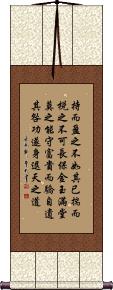
This text is the ninth chapter of the Daodejing / Tao Te Ching.
To hold until full is not as good as stopping.
An oversharpened sword cannot last long.
A room filled with gold and jewels cannot be protected.
Boasting of wealth and virtue brings your demise.
After finishing the work, withdraw.
持而盈之不如其已揣而梲之不可長保金玉滿堂莫之能守富貴而驕自遺其咎功遂身退天之道 is the Way of Heaven.
Dr. Muller's translation of all 81 Daodejing chapters
The text reads:
持而盈之、不如其已。揣而梲之、不可長保。 金玉滿堂、莫之能守。 富貴而驕、自遺其咎。 功遂身退、天之道。
This classical Chinese passage comes from the Mawangdui (馬王堆帛書) text.
This in-stock artwork might be what you are looking for, and ships right away...

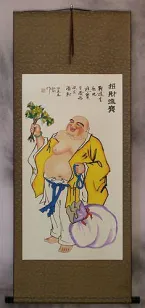
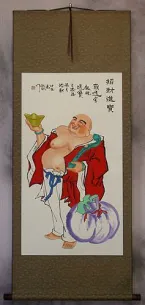
Gallery Price: $200.00
Your Price: $69.88
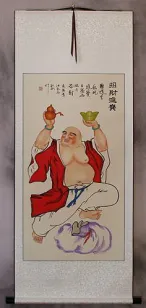
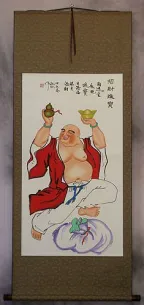
Gallery Price: $200.00
Your Price: $69.88

Gallery Price: $200.00
Your Price: $99.88
The following table may be helpful for those studying Chinese or Japanese...
| Title | Characters | Romaji (Romanized Japanese) | Various forms of Romanized Chinese | |
| Patience Brings Peace of Mind | 忍耐は心の平和をもたらす | nintai wa kokoro no heiwa o motarasu | ||
| Dragon and Phoenix Brings Luck | 龍鳳呈祥 龙凤呈祥 | lóng fèng chéng xiáng long2 feng4 cheng2 xiang2 long feng cheng xiang longfengchengxiang | lung feng ch`eng hsiang lungfengchenghsiang lung feng cheng hsiang |
|
| The Karma/Fate/Destiny that Brings Lovers Together | 姻緣 姻缘 | yīn yuán / yin1 yuan2 / yin yuan / yinyuan | yin yüan / yinyüan | |
| The Red String | 赤い糸 | akai ito / akaiito | ||
| Fate Chance Meeting | 緣份 / 緣分 缘份 / 缘分 | yuán fèn / yuan2 fen4 / yuan fen / yuanfen | yüan fen / yüanfen | |
| Yuan Fen | 緣分 缘分 | yuán fèn / yuan2 fen4 / yuan fen / yuanfen | yüan fen / yüanfen | |
| Predestined Love Love by Fate | 情緣 情缘 | qíng yuán qing2 yuan2 qing yuan qingyuan | ch`ing yüan chingyüan ching yüan |
|
| Patience Yields Peace of Mind | 能忍自安 | néng rěn zì ān neng2 ren3 zi4 an1 neng ren zi an nengrenzian | neng jen tzu an nengjentzuan |
|
| The Mysterious Bond Between People | 緣 / 縁 缘 | en | yuán / yuan2 / yuan | yüan |
| Strong Robust | 壯 壮 | sou / so | zhuàng / zhuang4 / zhuang | chuang |
| Doing good is the greatest source of happiness | 為善最樂 为善最乐 | wéi shàn zuì lè wei2 shan4 zui4 le4 wei shan zui le weishanzuile | wei shan tsui le weishantsuile |
|
| Thankfulness | 感激 | kangeki | gǎn jī / gan3 ji1 / gan ji / ganji | kan chi / kanchi |
| Confucius: Universal Education | 自行束脩以上吾未嘗無誨焉 (note 嘗 = 嚐) 自行束脩以上吾未尝无诲焉 | zì xíng shù xiū yǐ shàng wú wèi cháng wú huì yān zi4 xing2 shu4 xiu1 yi3 shang4 wu2 wei4 chang2 wu2 hui4 yan1 zi xing shu xiu yi shang wu wei chang wu hui yan | tzu hsing shu hsiu i shang wu wei ch`ang wu hui yen tzu hsing shu hsiu i shang wu wei chang wu hui yen |
|
| Joyfulness Happiness | 快樂 快乐 | kai raku / kairaku | kuài lè / kuai4 le4 / kuai le / kuaile | k`uai le / kuaile / kuai le |
| Paramartha | 波羅末陀 波罗末陀 | ha ra ma da haramada | bō luó mò tuó bo1 luo2 mo4 tuo2 bo luo mo tuo boluomotuo | po lo mo t`o polomoto po lo mo to |
| The Roar of the Lioness | 河東獅吼 河东狮吼 | hé dōng shī hǒu he2 dong1 shi1 hou3 he dong shi hou hedongshihou | ho tung shih hou hotungshihhou |
|
| Radiance | 光彩 | kousai / kosai | guāng cǎi guang1 cai3 guang cai guangcai | kuang ts`ai kuangtsai kuang tsai |
| Daodejing Tao Te Ching - Chapter 9 | 持而盈之不如其已揣而梲之不可長保金玉滿堂莫之能守富貴而驕自遺其咎功遂身退天之道 持而盈之不如其已揣而梲之不可长保金玉满堂莫之能守富贵而骄自遗其咎功遂身退天之道 | chí ér yíng zhī bù rú qí yǐ chuǎi ér zhī bù kě cháng bǎo jīn yù mǎn táng mò zhī néng shǒu fù guì ér jiāo zì yí qí jiù gōng suì shēn tuì tiān zhī dào chi2 er2 ying2 zhi1 bu4 ru2 qi2 yi3 chuai3 er2 棁 zhi1 bu4 ke3 chang2 bao3 jin1 yu4 man3 tang2 mo4 zhi1 neng2 shou3 fu4 gui4 er2 jiao1 zi4 yi2 qi2 jiu4 gong1 sui4 shen1 tui4 tian1 zhi1 dao4 chi er ying zhi bu ru qi yi chuai er 棁 zhi bu ke chang bao jin yu man tang mo zhi neng shou fu gui er jiao zi yi qi jiu gong sui shen tui tian zhi dao | ch`ih erh ying chih pu ju ch`i i ch`uai erh chih pu k`o ch`ang pao chin yü man t`ang mo chih neng shou fu kuei erh chiao tzu i ch`i chiu kung sui shen t`ui t`ien chih tao chih erh ying chih pu ju chi i chuai erh chih pu ko chang pao chin yü man tang mo chih neng shou fu kuei erh chiao tzu i chi chiu kung sui shen tui tien chih tao |
|
| In some entries above you will see that characters have different versions above and below a line. In these cases, the characters above the line are Traditional Chinese, while the ones below are Simplified Chinese. | ||||

Successful Chinese Character and Japanese Kanji calligraphy searches within the last few hours...



