Many custom options...


And formats...



Chant in Chinese / Japanese...
Buy a Chant calligraphy wall scroll here!
Personalize your custom “Chant” project by clicking the button next to your favorite “Chant” title below...
1. Mantra to Buddha / Nembutsu
3. Namu Myoho Renge Kyo / Homage to Lotus Sutra
10. Reiki Precepts by Usui Mikao
11. Om
Mantra to Buddha / Nembutsu
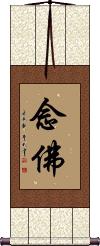
念佛 is used primarily in Japanese, where it is romanized as nenbutsu.
The meaning is to pray to Buddha, chant the name of Buddha, or repeat the name of Buddha. This can be an audible or inaudible chant.
Amitabha Buddha
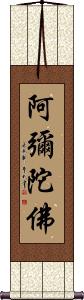
This title can mean the Buddha of the Western paradise.
But it's more a chant that means “May the lord Buddha preserve us!” or “Merciful Buddha!.”
阿彌陀佛 is also a translation to Chinese, Japanese, and Korean for “Amitâbha Buddha.”
Asian Buddhists will often greet and say goodbye to each other with this phrase/chant/title.
Namu Myoho Renge Kyo / Homage to Lotus Sutra
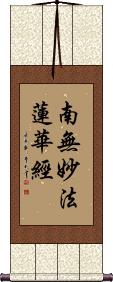
南無妙法蓮華經 is sometimes translated as the “Devotion to the Law of the Lotus Flower Scripture.”
This is a meditation chant and homage to the Lotus Sutra, used by Nichiren Buddhists in Japan.
This is also a chant used in China by certain sects of Buddhism that celebrate the deity Guanyin.
Also romanized as “Nam Myōhō Renge Kyō” or without accents as “Nam Myoho Renge Kyo.”


Original
Traditional
Version
The last character was originally written as seen on the left. Sometimes, you will see it written in the Japanese variant form as shown on the right. If you want this Japanese variant, click on the "Modern Japanese Variant" text instead of the button up by the main title of this entry.
Hon Sha Ze Sho Nen
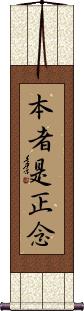
本者是正念 is a phrase or chant used by Reiki practitioners.
There are several ways to translate this, but mine would be “Original Nature is Mindfulness.”
Namo Guanshiyin Pusa
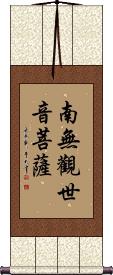
南無觀世音菩薩 means homage to the Bodhisattva Avalokitêśvara in Chinese and Japanese.
The 4th character of this homage or chant can be dropped, making it 南無觀音菩薩 or “Namo Guanyin Pusa.”
Sing / Singing
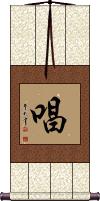
唱 is how to refer to singing or song in Chinese.
In Japanese, the meaning is similar but more closely means chant, recite or yell. Best if your audience is Chinese.
Om Mani Padme Hum
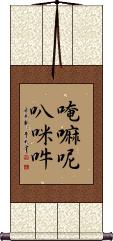
唵嘛呢叭咪吽 is the Avalokiteshvara mantra in Mandarin Chinese.
This chant is usually romanized as “Om Mani Padme Hum” from Sanskrit.
From Tibetan, it's “Om Mani Peme Hung.”
Wing Chun Fist Maxims
Wing Chun Kuen Kuit
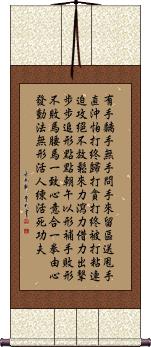
This text is the chant or poem of Wing Chun.
I call it a “chant” because it was meant to be a somewhat rhythmic poem to help practitioners memorize many aspects of Wing Chun.
1 有手黐手,無手問手
2 來留區送, 甩手直沖
3 怕打終歸打, 貪打終被打
4 粘連迫攻, 絕不放鬆
5 來力瀉力, 借力出擊
6 步步追形, 點點朝午
7 以形補手, 敗形不敗馬
8 腰馬一致, 心意合一
9 拳由心發, 動法無形
10 活人練活死功夫
You will see this referred to as “Wing Chun Kuem Kuit.” This Cantonese romanization is popular in the west (and there is no official way to romanize Cantonese, so many variations exist). In Mandarin, it would be, “Yong Chun Quan Jue.” The last character (kuit or kyut from Cantonese, jue or chüeh from Mandarin) kind of means “secrets of the art.” It's a short way to write 口訣, meaning “mnemonic chant” or “rhyme for remembering.”
In the west (especially in the military), we often use acronyms to remember things. There are no initials to make acronyms in Chinese, so in ancient times, chants like this are used to remember vast amounts of information.
I will presume you already know the meaning of the 10 maxims, so I will skip that to keep this calligraphy entry from getting too large.
Some think 练拳者必记 is the title but that just says, “(When) training (the) fist, people should remember:.” Therefore, I've not included that in the calligraphy. However, you can put a note in the special instructions if you want it added.
Note: On a traditional calligraphy wall scroll, the characters will be written in vertical columns, starting from the right, and proceeding left.
Note: This is an except and variation from a huge 口訣. These 10 maxims are used extensively in Wing Chun training, and you’ll find them all over the internet. Just know there is a much longer version out there, along with several variations and excepts like this one. If you know of, or want a different version, just contact me, and I will add it for you.
Namo Shakyamuni Buddha
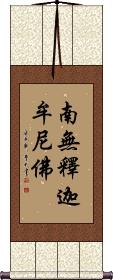
南無釋迦牟尼佛 is a Buddhist chant or prayer of respect to the Shakyamuni Buddha.
Some will translate this as the Buddhist vow.
The first two characters, 南無, are sometimes translated as “amen”; others will translate it as “belief in” or “homage to.”
To expand on this, 南無 can also mean “taking of refuge in” while representing devotion or conviction. 南無 as with most religious concepts or words, different people or denominations will have varying definitions.
Reiki Precepts by Usui Mikao
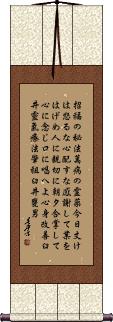
These are the precepts of Reiki that are attributed to Usui Mikao.
Here is a breakdown of the characters and a rough translation:
招福の秘法, 萬病の霊薬。
Invite blessings of [the] secret method, 10,000 illnesses of spiritual medicine.
今日丈けは: 怒るな, 心配すな, 感謝して, 業をはげめ, 人に親切に。
At least for today: Do not be angry, do not worry, be grateful, work with diligence, and be kind to people.
朝夕合掌して, 心に念じ, 口に唱へよ, 心身改善。
Morning [and] evening perform gassho (join hands), [with your] heart/mind in silent prayer, [with your] mouth chant, [thusly] mind [and] body [will] reform/improve.
臼井靈氣療法! -肇祖, 臼井甕男。
Usui Reiki Ryōhō! -Founder, Usui Mikao.
The middle portion of this is often titled, “The Five Principles of Reiki” and makes a nice calligraphy selection by itself. The Japanese text presented here can be considered the more verbose version.
Note: Because this selection contains some special Japanese Hiragana characters, it should be written by a Japanese calligrapher.
Om
Meditation Chant
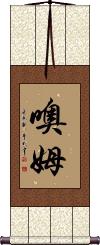
噢姆 is how to write the phonetic way to say “om” in Chinese.
噢姆 is “om” as in the meditation sound used in yoga, Buddhism, and other meditation styles.
These search terms might be related to Chant:
Heart Sutra Mantra
Mantra to Buddha / Nembutsu
Melody / Song
Sing / Singing
The following table may be helpful for those studying Chinese or Japanese...
| Title | Characters | Romaji (Romanized Japanese) | Various forms of Romanized Chinese | |
| Mantra to Buddha Nembutsu | 念佛 | nenbutsu | niàn fó / nian4 fo2 / nian fo / nianfo | nien fo / nienfo |
| Amitabha Buddha | 阿彌陀佛 阿弥陀佛 | amida butsu amidabutsu | ē mí tuó fó e1 mi2 tuo2 fo2 e mi tuo fo emituofo | o mi t`o fo omitofo o mi to fo |
| Namu Myoho Renge Kyo Homage to Lotus Sutra | 南無妙法蓮華經 / 南無妙法蓮華経 南无妙法莲华经 | na mu myou hou ren ge kyou namumyouhourengekyou na mu myo ho ren ge kyo | nán wú miào fǎ lián huá jīng nan2 wu2 miao4 fa3 lian2 hua2 jing1 nan wu miao fa lian hua jing nanwumiaofalianhuajing | nan wu miao fa lien hua ching nanwumiaofalienhuaching |
| Hon Sha Ze Sho Nen | 本者是正念 | hon sha ze shou nen honshazeshounen hon sha ze sho nen | ||
| Namo Guanshiyin Pusa | 南無觀世音菩薩 南无观世音菩萨 | namu kanzeon bosatsu namukanzeonbosatsu | nán wú guān shì yīn pú sà nan2 wu2 guan1 shi4 yin1 pu2 sa4 nan wu guan shi yin pu sa nanwuguanshiyinpusa | nan wu kuan shih yin p`u sa nanwukuanshihyinpusa nan wu kuan shih yin pu sa |
| Sing Singing | 唱 | chàng / chang4 / chang | ch`ang / chang | |
| Om Mani Padme Hum | 唵嘛呢叭咪吽 | ǎn ma ní bā mī hōng an3 ma5 ni2 ba1 mi1 hong1 an ma ni ba mi hong anmanibamihong | an ma ni pa mi hung anmanipamihung |
|
| Wing Chun Fist Maxims | 有手黐手無手問手來留區送甩手直沖怕打終歸打貪打終被打粘連迫攻絕不放鬆來力瀉力借力出擊步步追形點點朝午以形補手敗形不敗馬腰馬一致心意合一拳由心發動法無形活人練活死功夫 有手黐手无手问手来留区送甩手直冲怕打终归打贪打终被打粘连迫攻绝不放松来力泻力借力出击步步追形点点朝午以形补手败形不败马腰马一致心意合一拳由心发动法无形活人练活死功夫 | |||
| Namo Shakyamuni Buddha | 南無釋迦牟尼佛 南无释迦牟尼佛 | namu shakamuni butsu namushakamunibutsu | nán wú shì jiā móu ní fó nan2 wu2 shi4 jia1 mou2 ni2 fo2 nan wu shi jia mou ni fo nanwushijiamounifo | nan wu shih chia mou ni fo nanwushihchiamounifo |
| Reiki Precepts by Usui Mikao | 招福の秘法萬病の霊薬今日丈けは怒るな心配すな感謝して業をはげめ人に親切に朝夕合掌して心に念じ口に唱へよ心身改善臼井靈氣療法肇祖臼井甕男 | shou fuku no hihou man byou no rei yaku kyou da ke wa oko ru na shin pai su na kan sha shi te gyou wo ha ke me hito ni shin setsu ni asayuu gasshou shite kokoro ni nenji kuchi ni tonae yo shin shin kaizen usui rei ki ryou hou cho so usu i mika o sho fuku no hiho man byo no rei yaku kyo da ke wa oko ru na shin pai su na kan sha shi te gyo wo ha ke me hito ni shin setsu ni asayu gasho shite kokoro ni nenji kuchi ni tonae yo shin shin kaizen usui rei ki ryo ho cho so usu i mika o | ||
| Om | 噢姆 | mū / o1 mu1 / o mu / omu | ||
| In some entries above you will see that characters have different versions above and below a line. In these cases, the characters above the line are Traditional Chinese, while the ones below are Simplified Chinese. | ||||

Successful Chinese Character and Japanese Kanji calligraphy searches within the last few hours...



