Many custom options...


And formats...



Commit in Chinese / Japanese...
Buy a Commit calligraphy wall scroll here!
Sacrifice / Devotion / Dedication
(complete bodily devotion)
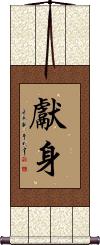
獻身 is used to describe being so devoted to something that you will make sacrifices for that goal/thing/person.
You can also translate this word as any of the following:
Sacrifice one's life for...
To dedicate oneself to...
Self-devotion
Dedication
Devote to...
Self-sacrifice
Giving your whole body to...
This can be a dedication to or for someone but is often used as a dedication or making sacrifices for your country, public service, or a cause. For instance, an Olympic athlete makes great sacrifices to train in his/her sport for their country and compatriots.

 While the form shown to the upper-left is considered an ancient Japanese version, in modern Japan, they use the simplified version of the first Kanji (shown to the right). Click on the Kanji at the right instead of the button above if you want this modern Japanese version.
If you are looking for a more religious meaning of devotion, see Faith.
See Also: Confidence | Dedication
Not the results for commit that you were looking for?
Below are some entries from our dictionary that may match your commit search...
| Characters If shown, 2nd row is Simp. Chinese |
Pronunciation Romanization |
Simple Dictionary Definition |
十戒 see styles |
shí jiè shi2 jie4 shih chieh jukkai じゅっかい |
More info & calligraphy: Ten Commandments(1) (Buddhist term) the 10 precepts; (2) Ten Commandments; Decalogue; Decalog; (surname) Jukkai Śikṣāpada. The ten prohibitions (in Pāli form) consist of five commandments for the layman: (1) not to destroy life 不殺生 pāṇātipātāveramaṇi; (2) not to steal 不倫盜 adinnādānāver; (3) not to commit adultery 不婬慾 abrahmacaryaver.; (4) not to lie 不妄語musāvādāver.; (5) not to take intoxicating liquor 不飮酒 suramereyya-majjapamādaṭṭhānāver. Eight special commandments for laymen consist of the preceding five plus: (6) not to eat food out of regulated hours 不非時食 vikāla-bhojanāver.; (7) not to use garlands or perfumes 不著華鬘好香塗身 mālā- gandha-vilepana-dhāraṇa-maṇḍana-vibhūṣanaṭṭhānā; (8) not to sleep on high or broad beds (chastity) 不坐高廣大牀 uccāsayanā-mahāsayanā. The ten commandments for the monk are the preceding eight plus: (9) not to take part in singing, dancing, musical or theatrical performances, not to see or listen to such 不歌舞倡伎不往觀聽 nacca-gīta-vādita-visūkadassanāver.; (10) to refrain from acquiring uncoined or coined gold, or silver, or jewels 不得捉錢金銀寶物 jātarūpa-rajata-paṭīggahaṇāver. Under the Māhayāna these ten commands for the monk were changed, to accord with the new environment of the monk, to the following: not to kill, not to steal, to avoid all unchastity, not to lie, not to slander, not to insult, not to chatter, not to covet, not to give way to anger, to harbour no scepticism. |
獻身 献身 see styles |
xiàn shēn xian4 shen1 hsien shen |
More info & calligraphy: Sacrifice / Devotion / DedicationSee: 献身 |
戒 see styles |
jiè jie4 chieh kai; ingoto(ok) かい; いんごと(ok) |
to guard against; to exhort; to admonish or warn; to give up or stop doing something; Buddhist monastic discipline; ring (for a finger) (1) (かい only) {Buddh} admonition; commandment; (2) sila (precept) śīla, 尸羅. Precept, command, prohibition, discipline, rule; morality. It is applied to the five, eight, ten, 250, and other commandments. The five are: (1) not to kill; (2 ) not to steal; (3) not to commit adultery; (4) not to speak falsely; (5) not to drink wine. These are the commands for lay disciples; those who observe them will be reborn in the human realm. The Sarvāstivādins did not sanction the observance of a limited selection from them as did the 成實宗 Satyasiddhi school. Each of the five precepts has five guardian spirits, in all twenty-five, 五戒二十五神. The eight for lay disciples are the above five together with Nos. 7, 8, and 9 of the following; the ten commands for the ordained, monks and nuns, are the above five with the following: (6) not to use adornments of flowers, nor perfumes; (7) not to perform as an actor, juggler, acrobat, or go to watch and hear them; (8) not to sit on elevated, broad, and large divans (or beds); (9) not to eat except in regulation hours; (10) not to possess money, gold or silver, or precious things. The 具足戒full commands for a monk number 250, those for a nun are 348, commonly called 500. Śīla is also the first of the 五分法身, i.e. a condition above all moral error. The Sutra of Brahma's Net has the following after the first five: (6) not to speak of the sins of those in orders; (7) not to vaunt self and depreciate others; (8) not to be avaricious; (9) not to be angry; (10) not to slander the triratna. |
投 see styles |
tóu tou2 t`ou tou tou / to とう |
to throw (something in a specific direction: ball, javelin, grenade etc); to cast (a ballot); to cast (a glance, a shadow etc); to put in (money for investment, a coin to operate a slot machine); to send (a letter, a manuscript etc); to throw oneself into (a river, a well etc to commit suicide); to go to; to seek refuge; to place oneself into the hands of; (coll.) to rinse (clothes) in water (1) {baseb} pitching ability; (counter) (2) {sports} counter for throws (of a javelin, bowling ball, etc.); (counter) (3) {fish} counter for casts (of a line) To cast, throw into, surrender, tender. |
歸 归 see styles |
guī gui1 kuei ki |
to return; to go back to; to give back to; (of a responsibility) to be taken care of by; to belong to; to gather together; (used between two identical verbs) despite; to marry (of a woman) (old); division on the abacus with a one-digit divisor Return to, give oneself up to; commit oneself to, surrender; cf. 三歸 śaraṇa-gamana. |
犯 see styles |
fàn fan4 fan han はん |
to violate; to offend; to assault; criminal; crime; to make a mistake; recurrence (of mistake or something bad) (suffix) perpetrators of (some) crime; (some type of) crime To offend against, break (as a law). |
亂倫 乱伦 see styles |
luàn lún luan4 lun2 luan lun |
to violate moral principles; depravity; (esp.) to commit incest; incest |
了斷 了断 see styles |
liǎo duàn liao3 duan4 liao tuan |
to bring to a conclusion; to resolve (a dispute etc); to put an end to (once and for all); to break off (a relationship); to commit suicide; resolution (of a matter) |
作る see styles |
tsukuru つくる |
(transitive verb) (1) to make; to produce; to manufacture; to build; to construct; (2) to prepare (food term); to brew (alcohol); (3) to raise; to grow; to cultivate; to train; (4) to till; (5) to draw up (a document); to make out; to prepare; to write; (6) to create (an artistic work, etc.); to compose; (7) to coin (a phrase); to organize; to organise; to establish; to found; (8) to have (a child); (9) to make up (one's face, etc.); (10) to fabricate (an excuse, etc.); (11) to form (a line, etc.); (12) to set (a record); (13) to commit (a sin, etc.) |
作案 see styles |
zuò àn zuo4 an4 tso an |
to commit a crime |
佞む see styles |
kadamu かだむ katamu かたむ |
(Godan verb with "mu" ending) (1) (archaism) to deceive; to fool; to lie; (2) to commit adultery |
働く see styles |
hataraku はたらく |
(v5k,vi) (1) to work; to labor; to labour; (v5k,vi) (2) to function; to operate; to be effective; to work (i.e. ... works); to come into play; (v5k,vi) (3) to commit (e.g. a crime); to perpetrate; to do; to act; to practise; to practice; (v5k,vi) (4) {ling} to be conjugated |
初作 see styles |
chū zuò chu1 zuo4 ch`u tso chu tso shosa |
to to begin to commit (a crime) |
創る see styles |
tsukuru つくる |
(transitive verb) (1) to make; to produce; to manufacture; to build; to construct; (2) to prepare (food term); to brew (alcohol); (3) to raise; to grow; to cultivate; to train; (4) to till; (5) to draw up (a document); to make out; to prepare; to write; (6) to create (an artistic work, etc.); to compose; (7) to coin (a phrase); to organize; to organise; to establish; to found; (8) to have (a child); (9) to make up (one's face, etc.); (10) to fabricate (an excuse, etc.); (11) to form (a line, etc.); (12) to set (a record); (13) to commit (a sin, etc.) |
匿流 see styles |
tokuryuu; tokuryuu / tokuryu; tokuryu トクリュウ; とくりゅう |
(kana only) (abbr. of 匿名・流動型犯罪グループ) ad hoc group formed to commit crimes |
及ぶ see styles |
oyobu およぶ |
(v5b,vi) (1) to reach; to amount to; to befall; to happen to; to extend; to go on (for, until); (v5b,vi) (2) to be up to the task; to come up to; (v5b,vi) (3) to compare with; to be a match (for); (v5b,vi) (4) (See 犯罪に及ぶ) to commit (a crime); (v5b,vi) (5) (usu. used in the negative) (See には及ばない・1) to require (to do) |
召す see styles |
mesu めす |
(transitive verb) (1) (honorific or respectful language) to call; to summon; to send for; to invite; (transitive verb) (2) (honorific or respectful language) to eat; to drink; (transitive verb) (3) (honorific or respectful language) to put on; to wear; (transitive verb) (4) (honorific or respectful language) to buy; to purchase; (transitive verb) (5) (honorific or respectful language) to take (a bath); (v5s,vi) (6) (honorific or respectful language) to ride; to get in (a vehicle); to take; (transitive verb) (7) (honorific or respectful language) to catch (a cold); (transitive verb) (8) (honorific or respectful language) (as お年を召す) to put on (years); to get old; (v5s,vi) (9) (honorific or respectful language) (as お気に召す) to strike one's fancy; to please one; (transitive verb) (10) (honorific or respectful language) (See 召される・1) to do; (transitive verb) (11) (honorific or respectful language) (as お腹を召す) to commit seppuku; (aux-v,v5s) (12) (honorific or respectful language) (after -masu stem of verb) indicates respect |
吞金 see styles |
tūn jīn tun1 jin1 t`un chin tun chin |
to commit suicide by swallowing gold |
委託 委托 see styles |
wěi tuō wei3 tuo1 wei t`o wei to itaku いたく |
to entrust; to trust; to commission (noun/participle) consign (goods (for sale) to a firm); entrust (person with something); commit |
常犯 see styles |
cháng fàn chang2 fan4 ch`ang fan chang fan |
to commit (an error) often; common (mistake) |
幹案 干案 see styles |
gàn àn gan4 an4 kan an |
(Singapore, Malaysia) to commit an offence |
弒君 弑君 see styles |
shì jun shi4 jun1 shih chün |
regicide; to commit regicide |
弒母 弑母 see styles |
shì mǔ shi4 mu3 shih mu |
matricide; to commit matricide |
引決 引决 see styles |
yǐn jué yin3 jue2 yin chüeh |
to commit suicide |
得罪 see styles |
dé zui de2 zui5 te tsui tokuzai |
to offend sb; to make a faux pas; a faux pas; see also 得罪[de2 zui4] commit a crime |
成す see styles |
nasu なす |
(transitive verb) (1) to form; to make; to constitute; (transitive verb) (2) to build up (e.g. a fortune); to create; to establish; (transitive verb) (3) to accomplish; to achieve; to win (fame); to gain; (transitive verb) (4) (as ...と〜) to change (into); to convert; (transitive verb) (5) (kana only) (also written as 為す) to do; to commit; to carry out; to bring about; (suf,v5s) (6) (kana only) (after the -masu stem of a verb) to do intentionally |
成犯 see styles |
chéng fàn cheng2 fan4 ch`eng fan cheng fan jōbon |
commit a sin |
投繯 投缳 see styles |
tóu huán tou2 huan2 t`ou huan tou huan |
to hang oneself; to commit suicide by hanging |
提審 提审 see styles |
tí shěn ti2 shen3 t`i shen ti shen |
to commit sb for trial; to bring sb for interrogation |
放火 see styles |
fàng huǒ fang4 huo3 fang huo houka / hoka ほうか |
to set on fire; to commit arson; to create a disturbance (n,vs,vi,adj-no) arson; setting fire |
Click here for more commit results from our dictionary
The following table may be helpful for those studying Chinese or Japanese...
| Title | Characters | Romaji (Romanized Japanese) | Various forms of Romanized Chinese | |
| Sacrifice Devotion Dedication | 獻身 献身 | ken shin / kenshin | xiàn shēn xian4 shen1 xian shen xianshen | hsien shen hsienshen |
| In some entries above you will see that characters have different versions above and below a line. In these cases, the characters above the line are Traditional Chinese, while the ones below are Simplified Chinese. | ||||

Successful Chinese Character and Japanese Kanji calligraphy searches within the last few hours...



