Many custom options...


And formats...



Delight in Chinese / Japanese...
Buy a Delight calligraphy wall scroll here!
Personalize your custom “Delight” project by clicking the button next to your favorite “Delight” title below...
Joyfulness / Happiness
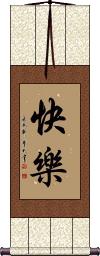
快樂 or joyfulness is an inner sense of peace and happiness.
You appreciate the gifts each day brings. Without joyfulness, when the fun stops, our happiness stops. Joy can carry us through hard times even when we are feeling very sad.
快樂 can also mean pleasure, enjoyment, delight, cheerfulness, or merry. In some ways, this is the essence that makes someone perceived as a charming person.
See Also: Happiness
Happiness / Joyful / Joy
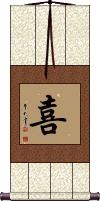
喜 is the Chinese, Japanese Kanji, and Korean Hanja for the kind of happiness known in the west as “joy.”
喜 can also be translated as rejoice, enjoyment, delighted, pleased, or “take pleasure in.” Sometimes it can mean “to be fond of” (in a certain context).
If you write two of these happiness/joy characters side by side, you create another character known in English as “double happiness,” which is a symbol associated with weddings and happy marriages.
There is another version of this character that you will find on our website with an additional radical on the left side (exactly same meaning, just an alternate form). The version of happiness shown here is the commonly written form in China, Japan and South Korea (banned in North Korea).
See Also: Contentment | Happiness | Joy
Happy
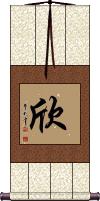
欣 is the type of happiness that you feel on the inside. It is the feeling of being released and delighted as well as being in a state of contentment. 欣 is more the internal happiness that perhaps only shows by the smile on your face. It can also be translated as “to take pleasure in” or “to rejoice.”
Note: 欣 is often used in compound words - especially in Korean Hanja.
As Japanese Kanji, this is so rare, that most Japanese people are not aware of its existence.
See Also: Happiness
Joyful
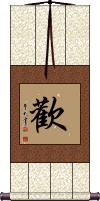
歡 means joyous, happy, delightful, and pleased.
歡 represents external happiness that may have you clapping and cheering.
Please note: The other happiness/joyful which looks like "喜" is more popular.
歡 is the ancient/old version in China and Japan. After WWII in Japan, they started using 歓. Just let us know if you want this modern version instead of the ancient one.
See Also: Happiness
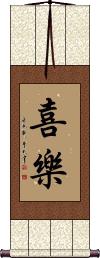
Pleasant Feeling
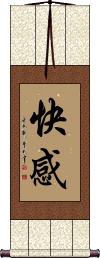
快感 is a Chinese, Japanese, and old Korean word meaning pleasure, thrill, delight, joy, pleasurable sensation, or pleasant feeling.
Fast
Fast, as in a race car
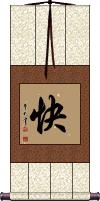
快 is the single character for “fast” in Chinese.
This applies to race cars, airplanes, rockets, etc.
This can also mean rapid, quick, speed, rate, soon, to make haste, clever, or sharp (of knives or wits). In some context it can mean cheerful or happy.
This is not a common choice for a wall scroll but if you're a speed freak, this may work for you.
Note: In Japanese, this usually has a meaning of pleasure, cheerful, delight, enjoyment, or the female given name Yoshi.
1 Corinthians 13:4-8
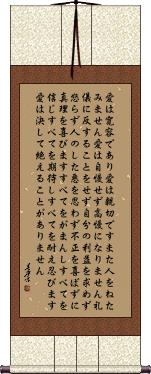
Here is 1st Corinthians 13:4-8 (just the first sentence of verse 8) in Japanese.
In the familiar NIV, this would read:
Love is patient, love is kind. It does not envy, it does not boast, it is not proud.
It does not dishonor others, it is not self-seeking, it is not easily angered, it keeps no record of wrongs.
Love does not delight in evil but rejoices with the truth.
It always protects, always trusts, always hopes, always perseveres.
Love never fails...
The Japanese text is from the 新改訳聖書 (Shinkaiyaku) or New Japanese Bible. Popular among most Protestant denominations in modern Japan.
Note: Because this selection contains some special Japanese Hiragana characters, it should be written by a Japanese calligrapher.
This in-stock artwork might be what you are looking for, and ships right away...

Gallery Price: $120.00
Your Price: $49.88

Gallery Price: $120.00
Your Price: $49.88

Gallery Price: $72.00
Your Price: $39.88


Gallery Price: $472.20
Your Price: $198.88
The following table may be helpful for those studying Chinese or Japanese...
| Title | Characters | Romaji (Romanized Japanese) | Various forms of Romanized Chinese | |
| Joyfulness Happiness | 快樂 快乐 | kai raku / kairaku | kuài lè / kuai4 le4 / kuai le / kuaile | k`uai le / kuaile / kuai le |
| Happiness Joyful Joy | 喜 | ki / yorokobi | xǐ / xi3 / xi | hsi |
| Happy | 欣 | kin | xīn / xin1 / xin | hsin |
| Joyful | 歡 欢 / 歓 | kan | huān / huan1 / huan | |
| Joy | 喜樂 喜乐 | kiraku | xǐ lè / xi3 le4 / xi le / xile | hsi le / hsile |
| Pleasant Feeling | 快感 | kaikan | kuài gǎn / kuai4 gan3 / kuai gan / kuaigan | k`uai kan / kuaikan / kuai kan |
| Fast | 快 | yoshi | kuài / kuai4 / kuai | k`uai / kuai |
| 1 Corinthians 13:4-8 | 愛は寛容であり愛は親切ですまた人をねたみません愛は自慢せず高慢になりません礼儀に反することをせず自分の利益を求めず怒らず人のした悪を思わず不正を喜ばずに真理を喜びますすべてをがまんしすべてを信じすべてを期待しすべてを耐え忍びます愛は決して絶えることがありません | ai wa kan youdeari ai wa shinsetsudesu mata hito o netamimasen ai wa jiman sezu kouman ni narimasen reigi ni hansuru koto o sezu jibun no rieki o motomezu okorazu hito no shita aku o omowazu fusei o yorokobazu ni shinri o yorokobimasu subete o gaman shi s ai wa kan yodeari ai wa shinsetsudesu mata hito o netamimasen ai wa jiman sezu koman ni narimasen reigi ni hansuru koto o sezu jibun no rieki o motomezu okorazu hito no shita aku o omowazu fusei o yorokobazu ni shinri o yorokobimasu subete o gaman shi s | ||
| In some entries above you will see that characters have different versions above and below a line. In these cases, the characters above the line are Traditional Chinese, while the ones below are Simplified Chinese. | ||||

Successful Chinese Character and Japanese Kanji calligraphy searches within the last few hours...



