Many custom options...


And formats...



Not what you want?
Try other similar-meaning words, fewer words, or just one word.
Each Time in Chinese / Japanese...
Buy an Each Time calligraphy wall scroll here!
Personalize your custom “Each Time” project by clicking the button next to your favorite “Each Time” title below...
2. Each Time You Stumble and Fall, You Gain Experience and Wisdom
3. The Buddha is in Each Sentient Being
One Good Deed Each Day
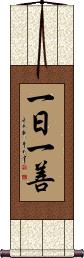
一日一善 is a Chinese, Japanese Kanji, and old Korean Hanja phrase that suggests doing a good deed each day or doing one good turn a day.
It literally reads, “One Day, One Good (Deed).”
Each Time You Stumble and Fall, You Gain Experience and Wisdom
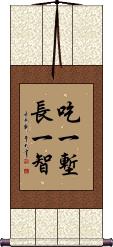
吃一塹長一智 is a Chinese proverb that means “Fall into a moat, and you will gain wisdom from the experience.”
It really suggests that the failures, troubles, frustrations, and setbacks that you encounter in your life are actually helping you to find wisdom. Some would also translate this proverb as “Learn from your mistakes” or “Learn from your experience.”
If you are studying Chinese, you will recognize the first character as “eat,” but in this case, it means to “experience” (as used in this proverb, it is suggesting that you have fallen into a moat and/or had a hard time crossing it).
Translated character by character, this whole proverb is, “Experience one moat, gain one wisdom/knowledge.”
Note: This can be pronounced in Korean, but it's not a commonly used phrase.
The Buddha is in Each Sentient Being
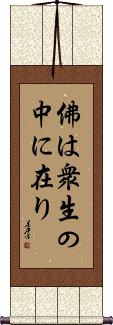
佛は衆生の中に在り is “Butsu wa shujo no naka ni ari” and means that the Buddha (potential for Buddhahood) exists in all beings in the universe.
So yes, your dog has the potential to be a Buddha (but only in a future reincarnation as a human). But all things, from the tiny cricket to the humpback whale have Buddha nature within them. If one takes the time to look and contemplate, one will see the Buddha in all things.
In Japan, sometimes the Buddha character is written 仏 instead of 佛, so you might see the whole phrase written as 仏は衆生の中に在り.
Note: Because this selection contains some special Japanese Hiragana characters, it should be written by a Japanese calligrapher.
Progress Day by Day
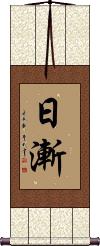
This Chinese word means to progress, increase, or change day by day.
It suggests something getting better one day at a time or with each passing day.
Unselfish: Perfectly Impartial
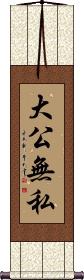
大公無私 is a Chinese proverb that comes from an old story from some time before 476 BC. About a man named Qi Huangyang, who was commissioned by the king to select the best person for a certain job in the Imperial Court.
Qi Huangyang selected his enemy for the job. The king was very confused by the selection, but Qi Huangyang explained that he was asked to find the best person for the job, not necessarily someone that he liked or had a friendship with.
Later, Confucius commented on how unselfish and impartial Qi Huangyang was by saying, “Da Gong Wu Si” which, if you look it up in a Chinese dictionary, is generally translated as “Unselfish” or “Just and Fair.”
If you translate each character, you'd have something like
“Big/Deep Justice Without Self.”
Direct translations like this leave out a lot of what the Chinese characters really say. Use your imagination, and suddenly you realize that “without self” means “without thinking about yourself in the decision” - together, these two words mean “unselfish.” The first two characters serve to drive the point home that we are talking about a concept that is similar to “blind justice.”
One of my Chinese-English dictionaries translates this simply as “just and fair.” So that is the short and simple version.
Note: This can be pronounced in Korean, but it's not a commonly used term.
See Also: Selflessness | Work Unselfishly for the Common Good | Altruism
Better Late Than Never
It's Never Too Late Too Mend
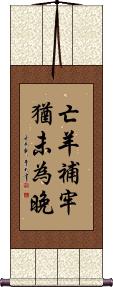
Long ago in what is now China, there were many kingdoms throughout the land. This time period is known as “The Warring States Period” by historians because these kingdoms often did not get along with each other.
Sometime around 279 B.C. the Kingdom of Chu was a large but not particularly powerful kingdom. Part of the reason it lacked power was the fact that the King was surrounded by “yes men” who told him only what he wanted to hear. Many of the King's court officials were corrupt and incompetent which did not help the situation.
The King was not blameless himself, as he started spending much of his time being entertained by his many concubines.
One of the King's ministers, Zhuang Xin, saw problems on the horizon for the Kingdom, and warned the King, “Your Majesty, you are surrounded by people who tell you what you want to hear. They tell you things to make you happy and cause you to ignore important state affairs. If this is allowed to continue, the Kingdom of Chu will surely perish, and fall into ruins.”
This enraged the King who scolded Zhuang Xin for insulting the country and accused him of trying to create resentment among the people. Zhuang Xin explained, “I dare not curse the Kingdom of Chu but I feel that we face great danger in the future because of the current situation.” The King was simply not impressed with Zhuang Xin's words.
Seeing the King's displeasure with him and the King's fondness for his court of corrupt officials, Zhuang Xin asked permission from the King that he may take leave of the Kingdom of Chu, and travel to the State of Zhao to live. The King agreed, and Zhuang Xin left the Kingdom of Chu, perhaps forever.
Five months later, troops from the neighboring Kingdom of Qin invaded Chu, taking a huge tract of land. The King of Chu went into exile, and it appeared that soon, the Kingdom of Chu would no longer exist.
The King of Chu remembered the words of Zhuang Xin and sent some of his men to find him. Immediately, Zhuang Xin returned to meet the King. The first question asked by the King was “What can I do now?”
Zhuang Xin told the King this story:
A shepherd woke one morning to find a sheep missing. Looking at the pen saw a hole in the fence where a wolf had come through to steal one of his sheep. His friends told him that he had best fix the hole at once. But the Shepherd thought since the sheep is already gone, there is no use fixing the hole.
The next morning, another sheep was missing. And the Shepherd realized that he must mend the fence at once. Zhuang Xin then went on to make suggestions about what could be done to reclaim the land lost to the Kingdom of Qin, and reclaim the former glory and integrity of the Kingdom of Chu.
The Chinese idiom shown above came from this reply from Zhuang Xin to the King of Chu almost 2,300 years ago.
It translates roughly into English as...
“Even if you have lost some sheep, it's never too late to mend the fence.”
This proverb, 亡羊补牢犹未为晚, is often used in modern China when suggesting in a hopeful way that someone change their ways, or fix something in their life. It might be used to suggest fixing a marriage, quitting smoking, or getting back on track after taking an unfortunate path in life among other things one might fix in their life.
I suppose in the same way that we might say, “Today is the first day of the rest of your life” in our western cultures to suggest that you can always start anew.
Note: This does have Korean pronunciation but is not a well-known proverb in Korean (only Koreans familiar with ancient Chinese history would know it). Best if your audience is Chinese.
This in-stock artwork might be what you are looking for, and ships right away...

Gallery Price: $60.00
Your Price: $36.88
Gallery Price: $60.00
Your Price: $39.88
Gallery Price: $178.00
Your Price: $98.88

Gallery Price: $61.00
Your Price: $33.88


Gallery Price: $162.00
Your Price: $89.88

Gallery Price: $60.00
Your Price: $36.88

Gallery Price: $90.00
Your Price: $49.88

Gallery Price: $31.00
Your Price: $16.88


Gallery Price: $200.00
Your Price: $69.88
Not the results for each time that you were looking for?
Below are some entries from our dictionary that may match your each time search...
| Characters If shown, 2nd row is Simp. Chinese |
Pronunciation Romanization |
Simple Dictionary Definition |
劫 see styles |
jié jie2 chieh kou; gou; kou / ko; go; ko こう; ごう; コウ |
to rob; to plunder; to seize by force; to coerce; calamity; abbr. for kalpa 劫波[jie2 bo1] (1) (こう, ごう only) {Buddh} kalpa (eon, aeon); (2) (kana only) {go} (usu. コウ) ko; position that allows for eternal capture and recapture of the same stones 刧 A kalpa, aeon, age; also translit. ka; 'a fabulous period of time, a day of Brahmā or 1, 000 Yugas, a period of four hundred and thirty-two million years of mortals, measuring the duration of the world; (a month of Brahmā is supposed to contain thirty such kalpas; according to the Mahābhārata twelve months of Brahmā constitute his year, and one hundred such years his lifetime; fifty years of Brahmā are supposed to have elapsed... ).' M. W. An aeon of incalculable time, therefore called a 大時節 great time-node. v. 劫波.; The three asaṃkhyeya kalpas, the three countless aeons, the period of a bodhisattva's development; also the past 莊嚴劫, the present 賢劫, and the future 星宿劫 kalpas. There are other groups. 三劫三千佛 The thousand Buddhas in each of the three kalpas. |
一向 see styles |
yī xiàng yi1 xiang4 i hsiang hitomukai ひとむかい |
a period of time in the recent past; (indicating a period of time up to the present) all along; the whole time (adverb) (1) (See 一向に・1) completely; absolutely; totally; (adverb) (2) (in a negative sentence) (not) at all; (not) a bit; (not) in the least; (adverb) (3) earnestly; intently; determinedly; (4) (abbreviation) (See 一向宗) Jōdo Shinshū; (surname) Hitomukai One direction, each direction; with single mind, the mind fixed in one direction undistracted; e.g. 一向淸淨無有女人 (The land of that Buddha is) everywhere pure; no women are there. |
九世 see styles |
jiǔ shì jiu3 shi4 chiu shih guse |
In past, present, and future worlds, each has its own past, present, and future, hence nine worlds or ages. |
交加 see styles |
jiāo jiā jiao1 jia1 chiao chia |
(of two or more things) to occur at the same time; to be mingled; to accompany each other |
刹那 see styles |
chàn à chan4 a4 ch`an a chan a setsuna せつな |
(n-adv,n-t) moment (san: ksana); instant; juncture; (female given name) Setsuna kṣaṇa. An indefinite space of time, a moment, an instant; the shortest measure of time, as kalpa is the longest; it is defined as 一念 a thought; but according to another definition 60 kṣaṇa equal one finger-snap, 90 a thought 念, 4,500 a minute; there are other definitions. In each kṣaṇa 900 persons are born and die. |
劫波 see styles |
jié bō jie2 bo1 chieh po kōhi |
kalpa (loanword) (Hinduism) kalpa; also劫簸; 劫跛; v. 劫. Aeon, age. The period of time between the creation and recreation ofa world or universe; also the kalpas offormation, existence, destruction, and non-existence, which four as acomplete period are called mahākalpa 大劫. Eachgreat kalpa is subdivided into four asaṇkhyeya-kalpas (阿僧企耶 i.e. numberless,incalculable): (1) kalpa of destructionsaṃvarta; (2)kalpaof utter annihilation, or empty kalpa 増滅劫; 空劫 saṃvarta-siddha; (3) kalpa of formation 成劫 vivarta; (4) kalpa ofexistence 住劫 vivartasiddha; or they may betaken in the order 成住壤空. Each of the four kalpas is subdivided into twenty antara-kalpas, 小劫 or small kalpas, so that a mahākalpaconsists of eighty small kalpas. Each smallkalpa is divided into a period of 増 increaseand 減 decrease; the increase period is ruled over by the four cakravartīs in succession, i.e. the four ages of iron,copper, silver, gold, during which the length of human life increases by oneyear every century to 84,000 years, and the length of the human body to8,400 feet. Then comes the kalpa of decreasedivided into periods of the three woes, pestilence, war, famine, duringwhich the length of human life is gradually reduced to ten years and thehuman body to 1 foot in height. There are other distinctions of the kalpas. A small kalpa isrepresented as 16,800,000 years, a kalpa as336,000,000 years, and a mahākalpa as1,334,000,000 years. There are many ways of illustrating the length of akalpa, e.g. pass a soft cloth over a solid rock40 li in size once in a hundred years, whenfinally the rock has been thus worn away a kalpa will not yet have passed; or a city of 40 li, filled with mustard seeds, one being removed everycentury till all have gone, a kalpa will notyet have passed. Cf. 成劫. |
各回 see styles |
kakukai; kakkai かくかい; かっかい |
each time |
度に see styles |
tabini(p); tanbini たびに(P); たんびに |
(adverb) (kana only) each time; every time; whenever (something happens); on the occasion of |
度毎 see styles |
tabigoto たびごと |
(adverb) each time; every time |
數九 数九 see styles |
shǔ jiǔ shu3 jiu3 shu chiu |
nine periods of nine days each after winter solstice, the coldest time of the year |
時分 时分 see styles |
shí fēn shi2 fen1 shih fen jibun じぶん |
time; period during the day; one of the 12 two-hour periods enumerated by the earthly branches 地支 (1) time; hour; season; (2) suitable time; opportunity; chance Time-division of the day, variously made in Buddhist works: (1) Three periods each of day and night. (2) Eight periods of day and night, each divided into four parts. (3) Twelve periods, each under its animal, as in China. (4) Thirty hours, sixty hours, of varying definition. |
毎々 see styles |
maimai まいまい |
(adv,n) each time; frequently; always |
毎回 see styles |
maikai まいかい |
(n,adv) every time; each round |
毎度 see styles |
maido まいど |
(adv,n) (1) each time; every time; always; often; (interjection) (2) (familiar language) (abbreviation) (usu. to (regular) customers entering or leaving) (See 毎度ありがとうございます) thank you for your continued patronage; thank you for your support; greetings!; welcome!; hello!; (interjection) (3) (when visiting another person's home; Hokuriku dialect) hello; I'm coming in; (surname) Maido |
毎毎 see styles |
maimai まいまい |
(adv,n) each time; frequently; always |
每逢 see styles |
měi féng mei3 feng2 mei feng |
every time; on each occasion; whenever |
相隔 see styles |
xiāng gé xiang1 ge2 hsiang ko sō kyaku |
separated by (distance or time etc) separated from each other |
都度 see styles |
tsudo つど |
each (every) time; whenever |
お百度 see styles |
ohyakudo おひゃくど |
hundred times worship (e.g. walking back and forth a hundred times before a shrine offering a prayer each time) |
その度 see styles |
sonotabi そのたび |
(exp,n) (See その都度) each time |
たんび see styles |
tanbi たんび |
(n,n-suf,ctr) time (three times, each time, etc.); times |
一つ宛 see styles |
hitotsuzutsu ひとつづつ |
(adv,adj-no) one by one; one each; one at a time |
六成就 see styles |
liù chéng jiù liu4 cheng2 jiu4 liu ch`eng chiu liu cheng chiu roku jōjū |
Six perfections (some say five, some seven) found in the opening phrase of each sutra: (1) 'Thus' implies perfect faith; (2) ' have I heard, ' perfect hearing; (3) 'once, 'the perfect time; (4) 'the Buddha, ' the perfect lord or master; (5) 'on Mt. Gṛdhrakūṭa, ' the perfect place; (6) 'with the great assembly of bhikṣus, ' the perfect assembly. |
度ごと see styles |
tabigoto たびごと |
(adverb) each time; every time |
御百度 see styles |
ohyakudo おひゃくど |
hundred times worship (e.g. walking back and forth a hundred times before a shrine offering a prayer each time) |
數九天 数九天 see styles |
shǔ jiǔ tiān shu3 jiu3 tian1 shu chiu t`ien shu chiu tien |
nine periods of nine days each after winter solstice, the coldest time of the year |
重なる see styles |
kasanaru かさなる |
(v5r,vi) (1) to be piled up; to lie on top of one another; (v5r,vi) (2) to come one after another; to happen over and over; to pile up (e.g. stress); to accumulate; (v5r,vi) (3) to overlap (each other); to occur at the same time; to happen simultaneously |
その都度 see styles |
sonotsudo そのつど |
(expression) each time it happens; at all such times |
一つずつ see styles |
hitotsuzutsu ひとつずつ |
(adv,adj-no) one by one; one each; one at a time |
一つづつ see styles |
hitotsuzutsu ひとつづつ |
(adv,adj-no) one by one; one each; one at a time |
Click here for more each time results from our dictionary
The following table may be helpful for those studying Chinese or Japanese...
| Title | Characters | Romaji (Romanized Japanese) | Various forms of Romanized Chinese | |
| One Good Deed Each Day | 一日一善 | ichi nichi ichi zen ichinichiichizen | yī rì yī shàn yi1 ri4 yi1 shan4 yi ri yi shan yiriyishan | i jih i shan ijihishan |
| Each Time You Stumble and Fall, You Gain Experience and Wisdom | 吃一塹長一智 吃一堑长一智 | chī yí qiàn, zhǎng yí zhì chi1 yi2 qian4 zhang3 yi2 zhi4 chi yi qian zhang yi zhi chiyiqianzhangyizhi | ch`ih i ch`ien chang i chih chihichienchangichih chih i chien chang i chih |
|
| The Buddha is in Each Sentient Being | 佛は衆生の中に在り | butsu wa shujou no naka ni ari butsuwashujounonakaniari butsu wa shujo no naka ni ari | ||
| Progress Day by Day | 日漸 日渐 | rì jiàn / ri4 jian4 / ri jian / rijian | jih chien / jihchien | |
| Unselfish: Perfectly Impartial | 大公無私 大公无私 | dà gōng wú sī da4 gong1 wu2 si1 da gong wu si dagongwusi | ta kung wu ssu takungwussu |
|
| Better Late Than Never | 亡羊補牢猶未為晚 亡羊补牢犹未为晚 | wáng yáng bǔ láo yóu wèi wéi wǎn wang2 yang2 bu3 lao2 you2 wei4 wei2 wan3 wang yang bu lao you wei wei wan | wang yang pu lao yu wei wei wan wangyangpulaoyuweiweiwan |
|
| In some entries above you will see that characters have different versions above and below a line. In these cases, the characters above the line are Traditional Chinese, while the ones below are Simplified Chinese. | ||||

Successful Chinese Character and Japanese Kanji calligraphy searches within the last few hours...



