Many custom options...


And formats...



Etiquette in Chinese / Japanese...
Buy an Etiquette calligraphy wall scroll here!
Personalize your custom “Etiquette” project by clicking the button next to your favorite “Etiquette” title below...
Courtesy / Etiquette
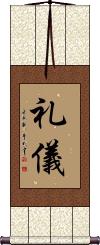
In Japanese, 礼儀 means “manners,” “courtesy,” or “etiquette.”
This also clearly means etiquette in Chinese, though the first Japanese Kanji has been “modernized” and happens to be the same as the modern Simplified Chinese version. Therefore, this word will be understood by both Japanese and Chinese people but best if your audience is mostly Japanese (Chinese people would generally prefer the ancient Traditional Chinese version).
Courtesy / Etiquette
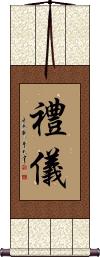
In Chinese, old Korean Hanja, and old Japanese Kanji, 禮儀 means “etiquette” or “courtesy.”
You'll also find a Japanese entry on our website, which uses a modern/simplified first Kanji. The characters shown here compose the best choice if your audience is Chinese or Korean - but also acceptable if you want an ancient-style Japanese scroll (in modern Japanese, it has the same pronunciation, but is written 礼儀).
Note: This can also be translated as propriety, decorum, or formality.
Welcome Home
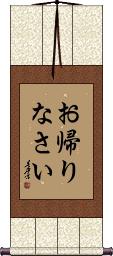
お帰りなさい is a common Japanese way to say, “welcome home.”
This is said by a person greeting another as they return home. It's a typical phrase that is almost said by reflex as part of Japanese courtesy or etiquette.
Sometimes written as 御帰りなさい (just the first character is Kanji instead of Hiragana).
Note: Because this selection contains some special Japanese Hiragana characters, it should be written by a Japanese calligrapher.
Chidokan
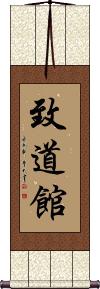
致道館 is the name Chidokan.
Chidōkan was established in 1805. The original Chidōkan school was located in Tsuruoka, Japan.
The original school taught a combination of traditional Chinese literature, Ogasawara-ryū etiquette, Chinese medicine and martial arts alongside Confucianism.
Joushiki Wo Koeru
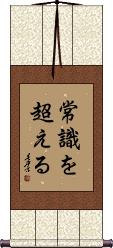
This Japanese phrase, “常識を超える” or “Jōshiki Wo Koeru” means “beyond common sense.”
常識 alone can be translated as “common sense,” “good sense,” “common knowledge”,“general knowledge,” “common practice,” “accepted practice,” or “social etiquette.”
The rest of the phrase indicates exceeding, overtaking, surpassing, transcending, or an idea of going beyond something.
More ways to translate this whole phrase:
Over what was known.
Surpassing common sense.
Beyond the ordinary.
Going beyond conventional knowledge.
Beyond conventional wisdom.
Note: Because this selection contains some special Japanese Hiragana characters, it should be written by a Japanese calligrapher.
Taekwondo Tenets / Spirit of Taekwon-do
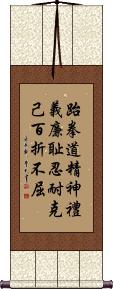
跆拳道精神禮義廉耻忍耐克己百折不屈 is General Choi's writing that is often called “The Tenets of Taekwon-do.”
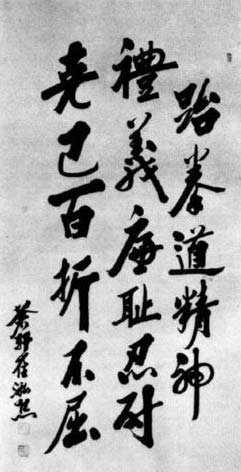
The actual title would be translated as “Taekwondo Spirit” or “The Spirit of Taekwondo.” It was originally written in Korean Hanja (Chinese characters used in Korea for about 1600 years).
General Choi's original calligraphy is shown to the right. Your custom calligraphy will be unique, and not an exact match, as each calligrapher has their own style.In modern times, the common form of written Korean is Hangul (a phonetic character set). The table below shows the text in Hangul and Hanja along with a pronunciation guide and a brief English translation:
| Traditional Korean Hanja | Modern Korean Hangul | Pronunciation | English |
| 跆拳道精神 | 태권도정신 | tae gweon do jeong sin | Taekwondo Spirit |
| 禮儀 | 예의 | ye yi | Courtesy / Etiquette / Propriety / Decorum / Formality |
| 廉耻 | 염치 | yeom ci | Integrity / Sense of Honor |
| 忍耐 | 인내 | in nae | Patience / Perseverance / Endurance |
| 克己 | 극기 | geug gi | Self-Control / Self-Denial / Self-Abnegation |
| 百折不屈 | 백절불굴 | baeg jeor bur gur | Indomitable Spirit (Undaunted even after repeated attacks from the opponent) |
| Note that the pronunciation is the official version now used in South Korea. However, it is different than what you may be used to. For instance, “Taekwon-do” is “tae gweon do.” This new romanization is supposed to be closer to actual Korean pronunciation. | |||
Not the results for etiquette that you were looking for?
Below are some entries from our dictionary that may match your etiquette search...
| Characters If shown, 2nd row is Simp. Chinese |
Pronunciation Romanization |
Simple Dictionary Definition |
礼 see styles |
reiji / reji れいじ |
More info & calligraphy: Respect |
禮 礼 see styles |
lǐ li3 li rai らい |
More info & calligraphy: Respect(personal name) Rai Worship, offerings, rites; ritual, ceremonial, decorum, courtesy, etiquette. |
禮儀 礼仪 see styles |
lǐ yí li3 yi2 li i |
More info & calligraphy: Courtesy / Etiquette |
マナー see styles |
manaa / mana マナー |
More info & calligraphy: Manor |
儀 仪 see styles |
yí yi2 i tadashi ただし |
apparatus; rites; appearance; present; ceremony (1) ceremony; (2) matter; affair; case; (suffix) (3) (used in letters, official notices, etc. after a person's name, personal pronoun, etc.) with regard to; as for; as concerns; (given name) Tadashi Manner, mode, style; ceremony, etiquette. |
お礼 see styles |
orei / ore おれい |
(1) (polite language) thanks; gratitude; (2) (polite language) manners; etiquette; (3) (polite language) bow; (4) (polite language) reward; gift; (5) (polite language) ceremony; ritual |
不埒 see styles |
furachi ふらち |
(noun or adjectival noun) insolence; misconduct; rudeness; breach of etiquette |
不埓 see styles |
furachi ふらち |
(noun or adjectival noun) insolence; misconduct; rudeness; breach of etiquette |
作法 see styles |
zuò fǎ zuo4 fa3 tso fa sahou(p); sakuhou / saho(p); sakuho さほう(P); さくほう |
course of action; method of doing something; practice; modus operandi (1) (さほう only) manners; etiquette; propriety; (2) manner of production (esp. of prose, poetry, etc.); way of making Karma, which results from action, i.e. the "deeds" of body or mouth; to perform ceremonies. |
儀礼 see styles |
girei / gire ぎれい |
(1) courtesy; etiquette; formality; protocol; (2) (religious) observance; ritual; rite; (given name) Girei |
儀節 仪节 see styles |
yí jié yi2 jie2 i chieh |
etiquette; ceremonial protocol |
六藝 六艺 see styles |
liù yì liu4 yi4 liu i |
the Confucian Six Arts, namely: rites or etiquette 禮|礼[li3] (禮儀|礼仪[li3 yi2]), music 樂|乐[yue3] (音樂|音乐[yin1 yue4]), archery 射[she4] (射箭[she4 jian4]), charioteering 御[yu4] (駕車|驾车[jia4 che1]), calligraphy or literacy 書|书[shu1] (識字|识字[shi2 zi4]), mathematics or reckoning 數|数[shu4] (計算|计算[ji4 suan4]); another name for the Six Classics 六經|六经[Liu4 jing1] |
典礼 see styles |
tenrei / tenre てんれい |
(noun - becomes adjective with の) ceremony; etiquette; courtesy; (Catholic) liturgy; (given name) Tenrei |
古格 see styles |
gǔ gé gu3 ge2 ku ko kokaku こかく |
convention; usage; old customs; old etiquette ancient precedent |
嗜み see styles |
tashinami たしなみ |
(1) (kana only) taste (in goods, etc.); (2) (kana only) manners; etiquette; (3) (kana only) modesty; restraint; prudence; (4) (kana only) knowledge, experience (of the arts, etc.); accomplishments; (5) (kana only) taking care of one's personal appearance |
失儀 失仪 see styles |
shī yí shi1 yi2 shih i |
discourteous; failure of etiquette |
常識 常识 see styles |
cháng shí chang2 shi2 ch`ang shih chang shih joushiki / joshiki じょうしき |
common sense; general knowledge common sense; good sense; common knowledge; general knowledge; common practice; accepted practice; social etiquette |
形跡 形迹 see styles |
xíng jì xing2 ji4 hsing chi keiseki / keseki けいせき |
manner; bearing; trace; mark; trail; etiquette traces; evidence |
御礼 see styles |
onrei / onre おんれい orei / ore おれい |
(1) (polite language) thanks; gratitude; (2) (polite language) manners; etiquette; (3) (polite language) bow; (4) (polite language) reward; gift; (5) (polite language) ceremony; ritual |
指箸 see styles |
sashibashi さしばし |
pointing towards somebody or something with one's chopsticks (a breach of etiquette) |
横箸 see styles |
yokobashi よこばし |
joining both chopsticks together and using them as a spoon (breach of chopstick etiquette) |
涙箸 see styles |
namidabashi なみだばし |
dripping liquid (soup, sauce, etc.) from the tips of one's chopsticks (a breach of etiquette) |
点前 see styles |
tatemae たてまえ |
tea ceremony procedures; tea ceremony etiquette |
礼儀 see styles |
reigi / regi れいぎ |
manners; courtesy; etiquette |
礼典 see styles |
reisuke / resuke れいすけ |
etiquette; ritual; (given name) Reisuke |
礼式 see styles |
reishiki / reshiki れいしき |
etiquette; manners |
礼楽 see styles |
raira らいら |
etiquette and music; (female given name) Raira |
礼法 see styles |
reihou / reho れいほう |
etiquette; courtesy; manners |
禮俗 礼俗 see styles |
lǐ sú li3 su2 li su |
etiquette; custom |
禮制 礼制 see styles |
lǐ zhì li3 zhi4 li chih |
etiquette; system of rites |
Click here for more etiquette results from our dictionary
The following table may be helpful for those studying Chinese or Japanese...
| Title | Characters | Romaji (Romanized Japanese) | Various forms of Romanized Chinese | |
| Courtesy Etiquette | 礼儀 / 禮儀 礼仪 | rei gi / reigi | lǐ yì / li3 yi4 / li yi / liyi | li i / lii |
| Courtesy Etiquette | 禮儀 礼仪 | lǐ yì / li3 yi4 / li yi / liyi | li i / lii | |
| Welcome Home | お帰りなさい | okaerinasai | ||
| Chidokan | 致道館 | chi dou kan chidoukan chi do kan | zhì dào guǎn zhi4 dao4 guan3 zhi dao guan zhidaoguan | chih tao kuan chihtaokuan |
| Joushiki Wo Koeru | 常識を超える | jou shiki wo ko e ru joushikiwokoeru jo shiki wo ko e ru | ||
| Taekwondo Tenets Spirit of Taekwon-do | 跆拳道精神禮義廉耻忍耐克己百折不屈 跆拳道精神礼义廉耻忍耐克己百折不屈 | tái quán dào jīng shén lǐ yì lián chǐ rěn nài kè jǐ bǎi zhé bù qū tai2 quan2 dao4 jing1 shen2 li3 yi4 lian2 chi3 ren3 nai4 ke4 ji3 bai3 zhe2 bu4 qu1 tai quan dao jing shen li yi lian chi ren nai ke ji bai zhe bu qu | t`ai ch`üan tao ching shen li i lien ch`ih jen nai k`o chi pai che pu ch`ü tai chüan tao ching shen li i lien chih jen nai ko chi pai che pu chü |
|
| In some entries above you will see that characters have different versions above and below a line. In these cases, the characters above the line are Traditional Chinese, while the ones below are Simplified Chinese. | ||||

Successful Chinese Character and Japanese Kanji calligraphy searches within the last few hours...



