Many custom options...


And formats...



Evils in Chinese / Japanese...
Buy an Evils calligraphy wall scroll here!
One Justice Can Overpower 100 Evils
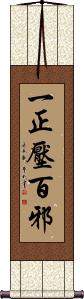
一正压百邪 is an ancient Chinese proverb and idiom that means “One Justice Can Overpower a Hundred Evils.”
While this proverb is famous in China, it has been around so long that its origins have been forgotten.
It could be something that Confucius or one of his disciples said, but no one can say for sure.
Not the results for evils that you were looking for?
Below are some entries from our dictionary that may match your evils search...
| Characters If shown, 2nd row is Simp. Chinese |
Pronunciation Romanization |
Simple Dictionary Definition |
法輪 法轮 see styles |
fǎ lún fa3 lun2 fa lun noriwa のりわ |
More info & calligraphy: Eternal Wheel of Life{Buddh} (See 輪宝,転法輪) the teachings of Buddha (as likened to the Dharmachakra, originally a wheel-like weapon used to destroy the evils of mankind); Buddhist doctrine; (surname) Noriwa dharmacakra, the Wheel of the Law, Buddha-truth which is able to crush all evil and all opposition, like Indra's wheel, and which rolls on from man to man, place to place, age to age. 轉法輪To turn, or roll along the Law-wheel, i.e. to preach Buddha-truth. |
膿 脓 see styles |
nóng nong2 nung umi; nou / umi; no うみ; のう |
pus (1) pus; (2) (うみ only) corruption; rot; evils Pus. |
七支 see styles |
qī zhī qi1 zhi1 ch`i chih chi chih shichishi |
The seven (spreading) branches—three sins of the body and four of speech, 身三 killing, robbing, adultery; 口四 lying, slander, abuse, double-tongue (or vain conversation). These are the first seven of the ten evils 十惡. |
三悪 see styles |
sanaku; sannaku; sanmaku さんあく; さんなく; さんまく |
(1) (abbreviation) {Buddh} (See 三悪道・さんあくどう) the world of hungry spirits and the world of animals; three evil worlds hell; (2) (さんあく only) three evils (prostitution, drugs and venereal diseases) |
二惡 二恶 see styles |
èr è er4 e4 erh o niaku |
two evils |
党弊 see styles |
touhei / tohe とうへい |
party evils |
八纏 八缠 see styles |
bā chán ba1 chan2 pa ch`an pa chan hachiden |
The eight entanglements, or evils: to be without shame; without a blush; envious; mean; unregretful; sleepy (or indolent); ambitious; stupid (or depressed). |
匡正 see styles |
kuāng zhèng kuang1 zheng4 k`uang cheng kuang cheng tadamasa ただまさ |
to correct; to amend; to redress (evils) (noun, transitive verb) correction (of a fault, mistake, flaw, etc.); remedy; rectification; redress; reform; (personal name) Tadamasa |
十惡 十恶 see styles |
shí è shi2 e4 shih o jūaku |
Daśākuśala. The ten "not right" or evil things are killing, stealing, adultery, lying, double-tongue, coarse language, filthy language, covetousness, anger, perverted views; these produce the ten resultant evils 十惡業 (道) Cf. 十善; 十戒. |
口四 see styles |
kǒu sì kou3 si4 k`ou ssu kou ssu kushi |
The four evils of the mouth, lying, double tongue, ill words, and exaggeration; cf. 十惡. |
四土 see styles |
sì tǔ si4 tu3 ssu t`u ssu tu shido しど |
{Buddh} four realms (in Tendai Buddhism or Yogacara) The four Buddha-kṣetra, or realms, of Tiantai: (1) 凡聖居同土 Realms where all classes dwell— men, devas, Buddhas, disciples, non-disciples; it has two divisions, the impure, e. g. this world, and the pure, e. g. the 'Western' pure-land. (2) 方便有餘土 Temporary realms, where the occupants have got rid of the evils of 見思 unenlightened views and thoughts, but still have to be reborn. (3) 實報無障礙土 Realms of permanent reward and freedom, for those who have attained bodhisattva rank. (4) 常寂光土 Realm of eternal rest and light (i. e. wisdom) and of eternal spirit (dharmakāya), the abode of Buddhas; but in reality all the others are included in this, and are only separated for convenience, sake. |
宿悪 see styles |
shukuaku しゅくあく |
{Buddh} old evils; evils committed in a previous existence |
寧可 宁可 see styles |
nìng kě ning4 ke3 ning k`o ning ko neika |
preferably; one would prefer to...(or not to...); would rather; (would) be better to; (to pick) the lesser of two evils would rather |
忍鎧 忍铠 see styles |
rěn kǎi ren3 kai3 jen k`ai jen kai ningai |
(忍辱鎧) Patience as armour, protecting against evils; also the kaṣāya, monk's robe. |
意三 see styles |
yì sān yi4 san1 i san shinzou / shinzo しんぞう |
(personal name) Shinzou The three evils which belong to intellect — lobha, dveṣa, moha, i.e. desire, dislike, delusion. |
時弊 时弊 see styles |
shí bì shi2 bi4 shih pi jihei / jihe じへい |
ills of the day; contemporary problems evils of the times |
木叉 see styles |
mù chā mu4 cha1 mu ch`a mu cha mokusha もくしゃ |
(given name) Mokusha 木蛇; 波羅提木叉 mokṣa, prātimokṣa 波羅提木叉; mokṣa is deliverance, emancipation; prati, 'towards, 'implies the getting rid of evils one by one; the 250 rules of the Vinaya for monks for their deliverance from the round of mortality. |
百弊 see styles |
hyakuhei / hyakuhe ひゃくへい |
all evils |
諸悪 see styles |
shoaku しょあく |
various evils; every kind of evil; all evils |
邪見 邪见 see styles |
xié jiàn xie2 jian4 hsieh chien jaken じゃけん |
evil point of view Heterodox views, not recognizing the doctrine of moral karma, one of the five heterodox opinions and ten evils 五見十惡. |
下輩觀 下辈观 see styles |
xià bèi guān xia4 bei4 guan1 hsia pei kuan gehai kan |
A meditation of the Amitābha sect on the 下品 q. v.; it is the last of sixteen contemplations, and deals with those who have committed the five rebellious acts 五逆 and the ten evils 十惡, but who still can obtain salvation; v. 無量壽經. 下輩下生觀 idem. |
五十惡 五十恶 see styles |
wǔ shí è wu3 shi2 e4 wu shih o gojū aku |
fifty evils |
轉格欄 转格栏 see styles |
zhuǎn gé lán zhuan3 ge2 lan2 chuan ko lan tenkyakuran |
The circuit of the central Lhasa temple, made by prostrations every third step, to get rid of evils or obtain blessings. |
隨煩惱 随烦恼 see styles |
suí fán nǎo sui2 fan2 nao3 sui fan nao zui bonnō |
Sequent, or associated kleśa-trials, or evils, either all of them as always dogging the footsteps; or, especially those which follow the six 隨眠 q.v. Also called 隨惑. |
不共無明 不共无明 see styles |
bù gòng wú míng bu4 gong4 wu2 ming2 pu kung wu ming fugū mumyō |
Distinctive kinds of unenlightenment, one of the two kinds of ignorance, also styled 獨頭無明; particular results arising from particular evils. |
五十展轉 五十展转 see styles |
wǔ shí zhǎn zhuǎn wu3 shi2 zhan3 zhuan3 wu shih chan chuan gojū tenden |
The fiftieth turn, i. e. the great-ness of the bliss of one who hears the Lotus Sutra even at fiftieth hand: how much greater that of him who hears at first hamd ! 五十功德 idem 五十展轉 and 五十轉五十惡 The fifty evils produced by the five skandhas, i. e. 色 seventeen, 受 eight, 想 eight, 行 nine, 識 eight. |
切中時弊 切中时弊 see styles |
qiè zhòng shí bì qie4 zhong4 shi2 bi4 ch`ieh chung shih pi chieh chung shih pi |
to hit home on the evils of the day (idiom); fig. to hit a current political target; to hit the nub of the matter |
十善正法 see styles |
shí shàn zhèng fǎ shi2 shan4 zheng4 fa3 shih shan cheng fa jūzen shōbō |
(十善) The ten good characteristics, or virtues, defined as the non-committal of the 十惡 ten evils, q. v. Tiantai has two groups, one of ceasing 止 to do evil, the other of learning to do well 行. |
悲憤慷慨 see styles |
hifunkougai / hifunkogai ひふんこうがい |
(noun/participle) (yoji) indignant lamentation over the evils of the times |
悲歌慷慨 see styles |
hikakougai / hikakogai ひかこうがい |
(noun/participle) (yoji) indignant lamentation over the evils of the times |
Click here for more evils results from our dictionary
The following table may be helpful for those studying Chinese or Japanese...
| Title | Characters | Romaji (Romanized Japanese) | Various forms of Romanized Chinese | |
| One Justice Can Overpower 100 Evils | 一正壓百邪 一正压百邪 | yī zhèng yā bǎi xié yi1 zheng4 ya1 bai3 xie2 yi zheng ya bai xie yizhengyabaixie | i cheng ya pai hsieh ichengyapaihsieh |
|
| In some entries above you will see that characters have different versions above and below a line. In these cases, the characters above the line are Traditional Chinese, while the ones below are Simplified Chinese. | ||||

Successful Chinese Character and Japanese Kanji calligraphy searches within the last few hours...



