Many custom options...


And formats...



Fait in Chinese / Japanese...
Buy a Fait calligraphy wall scroll here!
Personalize your custom “Fait” project by clicking the button next to your favorite “Fait” title below...
Switched to secondary search mode due to lack of results using primary.
These secondary results may not be very accurate. Try a different but similar meaning word or phrase for better results. Or...
Look up Fait in my Japanese Kanji & Chinese Character Dictionary(My dictionary is a different system then the calligraphy search you just tried)
If you want a special phrase, word, title, name, or proverb, feel free to contact me, and I will translate your custom calligraphy idea for you.
2. Confidence / Faithful Heart
3. Religious Devotion / Faith in God / Religious Faith
5. Faith / Trusting in the Unseen
6. Faith is the bird that feels the light when the dawn is still dark
9. Faith
10. Faithfulness
12. Good Intentions / Good Will / Good Faith
13. Faithful / Honorable / Trustworthy / Fidelity / Loyalty
14. Integrity: Sincere Honest and Faithful
15. Firm Belief / Strong Faith
17. Loyalty / Faithful / Devoted
18. Semper Fidelis / Always Faithful
19. Faith Dojo
Believe / Faith / Trust
śraddhā
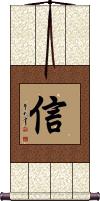
信 can mean to believe, truth, faith, fidelity, sincerity, trust, and confidence in Chinese, old Korean Hanja, and Japanese Kanji.
This single character is often part of other words with similar meanings.
It is one of the five basic tenets of Confucius.
In Chinese, it sometimes has the secondary meaning of a letter (as in the mail) depending on context but it will not be read that way when seen on a wall scroll.
In the Buddhist context, this is śraddhā (faith through hearing or being taught).
Confidence / Faithful Heart
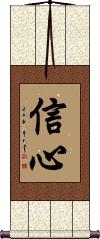
信心 is a Chinese, Japanese, and Korean word that means confidence, faith, or belief in somebody or something.
The first character means faith, and the second can mean heart or soul. Therefore, you could say this means “faithful heart” or “faithful soul.”
In Korean especially, this word has a religious connotation.
In the old Japanese Buddhist context, this was a word for citta-prasāda (clear or pure heart-mind).
In modern Japan (when read by non-Buddhists), this word is usually understood as “faith,” “belief,” or “devotion.”
See Also: Self-Confidence
Religious Devotion / Faith in God / Religious Faith
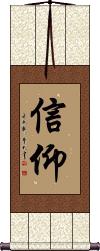
信仰 means firm belief, faith, persuasion, conviction, and sometimes religion or creed in Chinese, Japanese Kanji, and old Korean Hanja.
This clearly fits the religious connotation of the English word “devotion.”
This is often used to refer to a person of faith or a religious person.
This can be directly translated as “firm belief,” “creed,” “conviction,” or simply as “religious,” depending on context.
Some will also use this to mean “trust in God” in Japanese (though the term for God is not actually in this title).
It should be noted that this word is a little strange alone on a wall scroll.
While this can be pronounced in Japanese, it’s not a great selection for a wall scroll if your audience is Japanese.
See Also: Trust | Devotion | Trust | Trust in God
Extreme Faithfulness
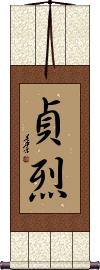
貞烈 is the Japanese Kanji for “Extreme Faithfulness.”
The first Kanji means “firm adherence to one's principles,” chastity (of a woman), chaste, etc.
The second Kanji means ardent, intense, fierce, stern, upright, to give one's life for a noble cause, exploits, achievements, virtuous, and in some contexts, heroic.
Now you get the idea why this refers to someone who is extremely faithful (to a cause, themselves, their religious beliefs, or their philosophy.
Faith / Trusting in the Unseen
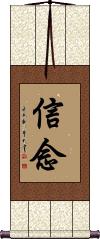
信念 expresses the idea of “having a belief” or “trusting in the unseen.”
信念 could also be translated as beliefs or convictions.
Note: Also considered to be one of the Seven Heavenly Virtues.
See Also: Devotion | Dedication | Trust
Faith is the bird that feels the light when the dawn is still dark
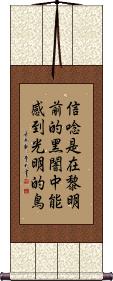
信唸是在黎明前的黑闇中能感到光明的鳥 is a philosophical poem/quote from Indian Poet and Philosopher, Rabindranath Tagore.
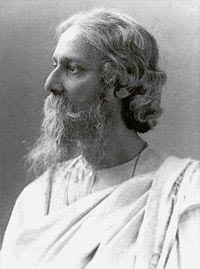
Rabindranath Tagore, 1915
This quote is not sourced, and therefore several variations exist in English. Some suggest the original was in the Bengali language.
This, of course, is the Chinese translation that has the meaning of, “Faith is the bird that feels the light and sings when the dawn is still dark.”
More about Rabindranath Tagore
Faith Hope Love
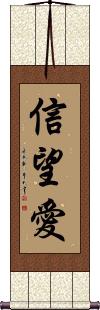
信望愛 is a Chinese list of words meaning faith, hope, and love.
This is not a typical phrase in Chinese but rather just random words strung together. There's no bad meaning, it's just not typical Chinese grammar.
Faith Hope Love
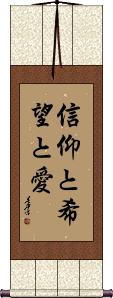
信仰と希望と愛 is a Japanese list of words (not really a phrase) meaning faith, hope, and love.
Some have associated this word list with Corinthians 13:13, though there are no specific religious connotations in this word list, and it's not directly from that Japanese Bible verse.
Note: Because this selection contains some special Japanese Hiragana characters, it should be written by a Japanese calligrapher.
Faith Love Peace
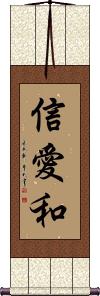
信愛和 is a word list that reads, “Faith Love Peace.”
This is not a natural phrase in Chinese or Japanese, as it lacks a subject, verb, or object. But if this is what you want, here it is.
Faith
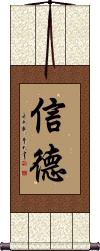
信德 is a term used often in Buddhism to express faith.
信德 is sometimes translated as the merit of the believing heart, faith of virtue, the power of faith, or virtuous faith.
In this context:
信 = Faith
德 = Virtue
Faithfulness
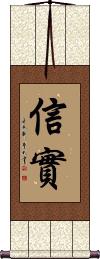
信實 means trustworthy, reliable, to believe something, to be true, and/or to be faithful.
Devout / Godly / Faithful
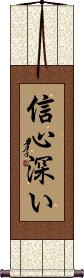
信心深い is a Japanese word that means deeply religious, devout, godly, and/or faithful.
Good Intentions / Good Will / Good Faith
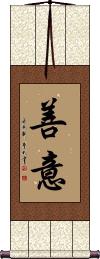
善意 is a word that means good intentions, goodwill, or to things done in good faith in Chinese, Japanese, and old Korean Hanja.
It's the reason you do good deeds or the desire you have inside yourself to do the right thing.
This can also be translated as benevolence, kindness, virtuous mind, positive mindset, or favorable sense.
善意 is also used in the legal context for things done in good faith (regardless of outcome).
In Japanese, this can be the personal name Yoshi or Yoshii.
Faithful / Honorable / Trustworthy / Fidelity / Loyalty
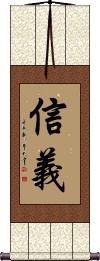
信義 is a word often used to describe a person with an honest and loyal reputation.
Simply put, this applies to somebody you can trust (with your life).
In Chinese, this is often defined as good faith, honor, trust, and justice.
In Korean, this word means fidelity, truthfulness, or faithfulness.
In Japanese: faith, fidelity, and loyalty. It's also a Japanese male given name when pronounced “Nobuyoshi.”
Integrity: Sincere Honest and Faithful
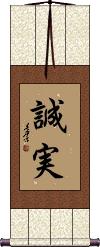
誠実 is the Japanese version of integrity which can also be defined as a combination of “sincere, honest, and faithful.”
Some may also define this as “loyal” or “loyalty.” In some contexts, it can mean “genuine.” Yes, all of this meaning in just one Japanese word!
Firm Belief / Strong Faith
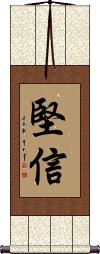
堅信 means to believe firmly, with firm faith, or without any doubt.
Japanese Christians sometimes use this term to mean the rite of confirmation.
This can also be the Japanese given name Kenshin.
Love Faith Strength
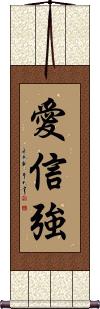
愛信強 is the shortest way to write the word list, “love faith strength.”
The first character is love, the second is faith or believe, and the third means strong or strength.
It should be noted that word lists like this are not as natural sounding in Chinese as word lists can be in English. it’s more common to have a full phrase (with subject, verb, and object) or single words on calligraphy wall scrolls in Asia.
Love Faith Strength
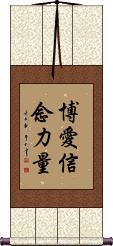
博愛信念力量 is the verbose way to write the word list, “love faith strength.”
It should be noted that word lists like this are not as natural sounding in Chinese as word lists can be in English. it’s more common to have a full phrase (with subject, verb, and object) or single words on calligraphy wall scrolls in Asia.
Loyalty / Faithful / Devoted
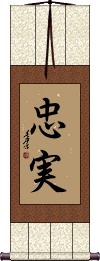
忠実 is a Japanese way to write “Loyalty” - it also contains the ideas of being faithful, devoted, true, and obedient.
The second character is a modified form only used in the Japanese lexicon; however, Chinese speakers can easily guess the meaning.
This is also a virtue of the Samurai Warrior
See our page with just Code of the Samurai / Bushido here
Semper Fidelis / Always Faithful
U.S. Marines Slogan
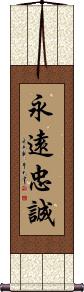
永遠忠誠 is the clearest and most natural way to translate “Semper Fidelis” or “Always Faithful” into Mandarin Chinese. 永遠忠誠 is meant explicitly for U.S. Marines who often use the shortened term “Semper Fi.”
The first two characters are a word that always means, forever, and/or eternally.
The last two characters are a word that means fidelity, loyal, and/or devotion.
I spent 10 years in the Marines, so it was a no-brainer to add this to our calligraphy database.
Semper Fidelis / Always Faithful
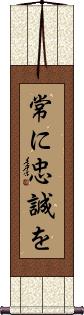
常に忠誠を is “Semper Fidelis” or “Always Faithful” in Japanese. This is specifically meant for U.S. Marines who often use the shortened term “Semper Fi.”
The first two Kanji mean “always” or “constantly.” The last three Kanji mean “faithful,” “loyal,” “devoted,” and/or “diligent.” It's most often read as “faithful.”
Note: Because this selection contains some special Japanese Hiragana characters, it should be written by a Japanese calligrapher.
Semper Fidelis / Always Faithful
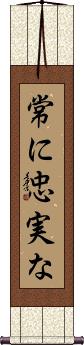
常に忠実な is an alternate way to write “Semper Fidelis” or “Always Faithful” in Japanese.
Note: Because this selection contains some special Japanese Hiragana characters, it should be written by a Japanese calligrapher.
Faith Dojo

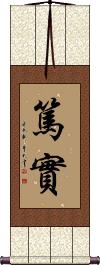
Sincerity and Faithfulness
Trust / To Have Faith
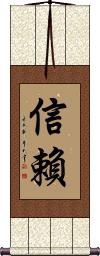
信賴 can also be translated as confidence, reliance, or dependence; thus, it can also mean “to rely on” or “to depend on.”
Trust is having faith in someone or something. It is a positive attitude about life. You are confident that the right thing will happen without trying to control or make it happen. Even when difficult things happen, trust helps us to find the gift or lesson in it.
 There is a slight deviation in the Japanese Kanji form of the second character. If you want the modern Japanese version, please click on the special Kanji shown to the right instead of the button above. Note that the traditional Chinese form is still readable and understood by Japanese people.
See Also: Confidence | Truth | Honor
Trust in God / Faith in God
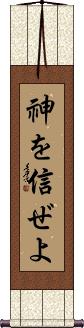
神を信ぜよ is a way to express “Trust in God” in Japanese.
The first character is “God.”
The second character is a particle that links the ideas here.
The last three characters are a word that means “to believe,” “to believe in,” “to place trust in,” “to confide in,” and “to have faith in.”
Basically, this is the Japanese phrase for “Have faith in God,” “Belief in God,” or “Trust in God.”
Note: Because this selection contains some special Japanese Hiragana characters, it should be written by a Japanese calligrapher.
The following table may be helpful for those studying Chinese or Japanese...
| Title | Characters | Romaji (Romanized Japanese) | Various forms of Romanized Chinese | |
| Believe Faith Trust | 信 | shin | xìn / xin4 / xin | hsin |
| Confidence Faithful Heart | 信心 | shin jin / shinjin | xìn xīn / xin4 xin1 / xin xin / xinxin | hsin hsin / hsinhsin |
| Religious Devotion Faith in God Religious Faith | 信仰 | shin kou / shinkou / shin ko | xìn yǎng / xin4 yang3 / xin yang / xinyang | hsin yang / hsinyang |
| Extreme Faithfulness | 貞烈 | tei retsu / teiretsu | ||
| Faith Trusting in the Unseen | 信念 | shinnen | xìn niàn / xin4 nian4 / xin nian / xinnian | hsin nien / hsinnien |
| Faith is the bird that feels the light when the dawn is still dark | 信唸是在黎明前的黑闇中能感到光明的鳥 信念是在黎明前的黑暗中能感到光明的鸟 | xìn niǎn shì zài lí míng qián de hēi àn zhōng néng gǎn dào guāng míng de niǎo xin4 nian3 shi4 zai4 li2 ming2 qian2 de hei1 an4 zhong1 neng2 gan3 dao4 guang1 ming2 de niao3 xin nian shi zai li ming qian de hei an zhong neng gan dao guang ming de niao | hsin nien shih tsai li ming ch`ien te hei an chung neng kan tao kuang ming te niao hsin nien shih tsai li ming chien te hei an chung neng kan tao kuang ming te niao |
|
| Faith Hope Love | 信望愛 信望爱 | xìn wàng ài xin4 wang4 ai4 xin wang ai xinwangai | hsin wang ai hsinwangai |
|
| Faith Hope Love | 信仰と希望と愛 | shinkou to kibou to ai shinkoutokiboutoai shinko to kibo to ai | ||
| Faith Love Peace | 信愛和 信爱和 | shin ai wa shinaiwa | xìn ài hé xin4 ai4 he2 xin ai he xinaihe | hsin ai ho hsinaiho |
| Faith | 信德 | shin toku / shintoku | xìn dé / xin4 de2 / xin de / xinde | hsin te / hsinte |
| Faithfulness | 信實 信实 | nobuzane | xìn shí / xin4 shi2 / xin shi / xinshi | hsin shih / hsinshih |
| Devout Godly Faithful | 信心深い | shinjinbukai | ||
| Good Intentions Good Will Good Faith | 善意 | zen i / zeni | shàn yì / shan4 yi4 / shan yi / shanyi | shan i / shani |
| Faithful Honorable Trustworthy Fidelity Loyalty | 信義 信义 | shingi | xìn yì / xin4 yi4 / xin yi / xinyi | hsin i / hsini |
| Integrity: Sincere Honest and Faithful | 誠實 誠実 | sei jitsu / seijitsu | ||
| Firm Belief Strong Faith | 堅信 坚信 | ken shin / kenshin | jiān xìn / jian1 xin4 / jian xin / jianxin | chien hsin / chienhsin |
| Love Faith Strength | 愛信強 爱信強 | ài xìn qiáng ai4 xin4 qiang2 ai xin qiang aixinqiang | ai hsin ch`iang aihsinchiang ai hsin chiang |
|
| Love Faith Strength | 博愛信念力量 博爱信念力量 | bó ài xìn niàn lì liàng bo2 ai4 xin4 nian4 li4 liang4 bo ai xin nian li liang boaixinnianliliang | po ai hsin nien li liang poaihsinnienliliang |
|
| Loyalty Faithful Devoted | 忠實 忠実 | chuujitsu / chuugi chujitsu / chugi | ||
| Semper Fidelis Always Faithful | 永遠忠誠 永远忠诚 | yǒng yuǎn zhōng chéng yong3 yuan3 zhong1 cheng2 yong yuan zhong cheng yongyuanzhongcheng | yung yüan chung ch`eng yungyüanchungcheng yung yüan chung cheng |
|
| Semper Fidelis Always Faithful | 常に忠誠を | tsune ni chuu sei wo tsunenichuuseiwo tsune ni chu sei wo | ||
| Semper Fidelis Always Faithful | 常に忠実な | tsune ni chuu jitsu na tsunenichuujitsuna tsune ni chu jitsu na | ||
| Faith Dojo | 信道場 | shin dō jō shindōjō | xìn dào chǎng xin4 dao4 chang3 xin dao chang xindaochang | hsin tao ch`ang hsintaochang hsin tao chang |
| Sincerity and Faithfulness | 篤實 笃实 | dǔ shí / du3 shi2 / du shi / dushi | tu shih / tushih | |
| Trust To Have Faith | 信賴 信赖 | shinrai | xìn lài / xin4 lai4 / xin lai / xinlai | hsin lai / hsinlai |
| Trust in God Faith in God | 神を信ぜよ | kami wo shin ze yo kamiwoshinzeyo | ||
| In some entries above you will see that characters have different versions above and below a line. In these cases, the characters above the line are Traditional Chinese, while the ones below are Simplified Chinese. | ||||

Successful Chinese Character and Japanese Kanji calligraphy searches within the last few hours...



