Many custom options...


And formats...



Fart in Chinese / Japanese...
Buy a Fart calligraphy wall scroll here!
Personalize your custom “Fart” project by clicking the button next to your favorite “Fart” title below...
Happu Fudo
Unmoved by the Eight Winds

八風不動 is the short version, popularized in Japanese Zen Buddhism, of the original Chinese phrase 八風吹不動.
Literal meaning: “Unmoved by the Eight Winds”
The origin is Chinese, but it was later adopted into Japanese Zen. Here’s a little backstory:
The original famous anecdote is from Song Dynasty China, involving the poet-official 蘇東坡 (Su Dongpo / Su Shi, 1037–1101) and Zen master 佛印 (Foyin).
Su Dongpo wrote 八風吹不動,一屁打過江
“The Eight Winds cannot move me; Yet one fart blows me across the river.”
Foyin’s irreverent reply exposed Su Dongpo’s ego, which is kind of a classic Zen teaching story.
Unmoved by the Eight Winds

八風吹不動 is an ancient Buddhist phrase from about 1000 years ago.
Literal meaning: “The Eight Winds cannot move [me].”
The original famous anecdote is from Song Dynasty China, involving the poet-official 蘇東坡 (Su Dongpo / Su Shi, 1037–1101) and Zen master 佛印 (Foyin).
Su Dongpo wrote 八風吹不動,一屁打過江
“The Eight Winds cannot move me; Yet one fart blows me across the river.”
Foyin’s irreverent reply exposed Su Dongpo’s ego, which is kind of a classic Zen/Chan teaching story.
利 gain
衰 loss
毀 disgrace
譽 praise
稱 honor
譏 ridicule
苦 suffering
樂 pleasure
“The Eight Winds cannot move [him / the mind].”
“Unmoved by the Eight Winds.”
“The Eight Winds do not move me.”
“Not moved by the Eight Winds.”
“Unshaken by the Eight Winds.”
“Unaffected by the Eight Winds.”
“Unmoved by worldly forces.”
“Steadfast against the Eight Winds.”
“Remaining unmoved amid the Eight Winds.”
There is a shorter Japanese Zen version, 八風不動, which drops the middle character. Often romanized as happū fudō. The romanization of 八風吹不動 is arguably happū fukedomo ugokazu or happū sui fudō.
The farts of others stink, but one’s own smells sweet
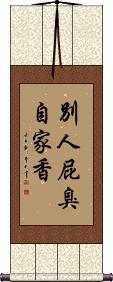
别人屁臭自家香 literally translates as:
Other people's flatulence stinks, [but] one's own is fragrant.
Figuratively, this means:
Some people criticize defects in others that they (seem to) treasure in themselves.
Not the results for fart that you were looking for?
Below are some entries from our dictionary that may match your fart search...
| Characters If shown, 2nd row is Simp. Chinese |
Pronunciation Romanization |
Simple Dictionary Definition |
屁 see styles |
pì pi4 p`i pi he へ |
fart; flatulence; nonsense; (usu. in the negative) what; (not) a damn thing (1) fart; gas; wind; (2) (See 屁でもない) worthless thing; insignificant thing |
出物 see styles |
demono でもの |
(1) rash; boil; eruption (skin); (2) secondhand article; bargain; good buy; (3) fart |
悶屁 闷屁 see styles |
mēn pì men1 pi4 men p`i men pi |
silent fart |
打屁 see styles |
dǎ pì da3 pi4 ta p`i ta pi |
(coll.) to fart; (coll.) to shoot the breeze |
放く see styles |
koku こく |
(transitive verb) (1) (kana only) (colloquialism) to expel (from the body); to let off (a fart); to let out; (transitive verb) (2) (kana only) (vulgar) to utter (a lie, nonsense, etc.); to say; to spout (bullshit); (transitive verb) (3) (kana only) (vulgar) (See びっくらこいた) to do |
放屁 see styles |
fàng pì fang4 pi4 fang p`i fang pi houhi / hohi ほうひ |
to fart; to break wind; to talk nonsense; Utter rubbish! (n,vs,vi) breaking wind; farting; (given name) Houhi |
放氣 放气 see styles |
fàng qì fang4 qi4 fang ch`i fang chi |
to release breath; to deflate; to fart |
瓦斯 see styles |
wǎ sī wa3 si1 wa ssu gasu ガス |
gas (loanword) (ateji / phonetic) (1) (kana only) gas (state of matter, e.g. poison gas, natural gas) (dut:, eng:); (2) (kana only) gasoline; gas; petrol; (3) (kana only) dense fog; thick fog; (4) (kana only) (abbreviation) gas stove; gas cooker; gas range; (5) (kana only) (colloquialism) flatulence; gas; wind; fart |
老拙 see styles |
lǎo zhuō lao3 zhuo1 lao cho |
old fart (usually in self-reference); geezer |
蔫屁 see styles |
niān pì nian1 pi4 nien p`i nien pi |
silent fart |
響屁 响屁 see styles |
xiǎng pì xiang3 pi4 hsiang p`i hsiang pi |
loud fart |
マン屁 see styles |
manpe マンぺ |
(vulgar) (slang) pussy fart; queef |
出溜屁 see styles |
chū liu pì chu1 liu5 pi4 ch`u liu p`i chu liu pi |
silent fart |
垂れる see styles |
tareru たれる |
(v1,vi) (1) to hang; to droop; to dangle; to sag; to lower; to pull down; (transitive verb) (2) to give (e.g. lesson, instruction, scolding) (to someone of lower status); to confer; to grant; to bestow; (v1,vi) (3) to drip; to ooze; to trickle; to drop; (transitive verb) (4) to leave behind (at death); (transitive verb) (5) (derogatory term) to say; to utter; (transitive verb) (6) to excrete (urine, feces, etc.); to let out (a fart) |
毒瓦斯 see styles |
dú wǎ sī du2 wa3 si1 tu wa ssu |
poisonous gas; stinking fart |
老不死 see styles |
lǎo bù sǐ lao3 bu4 si3 lao pu ssu |
(derog.) old but still alive; old fart; old bastard |
透かす see styles |
sukasu すかす |
(transitive verb) (1) to look through; (transitive verb) (2) to hold up to the light; (transitive verb) (3) to make an opening; to leave space; to space (lines); to prune (trees); (transitive verb) (4) (colloquialism) to fart without making a sound |
鳴らす see styles |
narasu ならす |
(transitive verb) (1) to ring; to sound; to chime; to beat; to snort (nose); to snap (fingers); to crack (joints); (transitive verb) (2) to be popular; to be esteemed; to be reputed; (transitive verb) (3) to state; to insist; to complain; (transitive verb) (4) (archaism) to fart (loudly) |
へこき虫 see styles |
hekokimushi へこきむし |
fart bug |
へこき蟲 see styles |
hekokimushi へこきむし |
fart bug |
一発放つ see styles |
ippatsuhanatsu いっぱつはなつ |
(Godan verb with "tsu" ending) to break wind; to let off a fart; to have a shot |
屁をこく see styles |
heokoku へをこく |
(exp,v5k) to fart; to break wind |
屁をひる see styles |
heohiru へをひる |
(v5r,exp) to fart; to break wind |
屁を放く see styles |
heokoku へをこく |
(exp,v5k) to fart; to break wind |
屁を放る see styles |
heohiru へをひる |
(v5r,exp) to fart; to break wind |
屁放き虫 see styles |
hekokimushi へこきむし |
fart bug |
掇臀捧屁 see styles |
duō tún pěng pì duo1 tun2 peng3 pi4 to t`un p`eng p`i to tun peng pi |
to hold up buttocks and praise a fart (idiom); to use flatter to get what one wants; to toady; boot-licking |
屁(rK) |
onara(p); onara おなら(P); オナラ |
(kana only) wind; gas; fart |
脫褲子放屁 脱裤子放屁 see styles |
tuō kù zi fàng pì tuo1 ku4 zi5 fang4 pi4 t`o k`u tzu fang p`i to ku tzu fang pi |
lit. to take off trousers to fart; fig. to do something absolutely unnecessary; fig. to make things too complicated |
透かしっ屁 see styles |
sukashippe すかしっぺ |
(kana only) (colloquialism) silent fart |
Click here for more fart results from our dictionary
The following table may be helpful for those studying Chinese or Japanese...
| Title | Characters | Romaji (Romanized Japanese) | Various forms of Romanized Chinese | |
| Happu Fudo | 八風不動 八风不动 | happuu fudou happuufudou hapu fudo | bā fēng bù dòng ba1 feng1 bu4 dong4 ba feng bu dong bafengbudong | pa feng pu tung pafengputung |
| Unmoved by the Eight Winds | 八風吹不動 八风吹不动 | happuu sui fudou happuusuifudou hapu sui fudo | bā fēng chuī bù dòng ba1 feng1 chui1 bu4 dong4 ba feng chui bu dong bafengchuibudong | pa feng ch`ui pu tung pafengchuiputung pa feng chui pu tung |
| The farts of others stink, but one’s own smells sweet | 別人屁臭自家香 别人屁臭自家香 | bié rén pì chòu zì jiā xiāng bie2 ren2 pi4 chou4 zi4 jia1 xiang1 bie ren pi chou zi jia xiang bierenpichouzijiaxiang | pieh jen p`i ch`ou tzu chia hsiang pieh jen pi chou tzu chia hsiang |
|
| In some entries above you will see that characters have different versions above and below a line. In these cases, the characters above the line are Traditional Chinese, while the ones below are Simplified Chinese. | ||||

Successful Chinese Character and Japanese Kanji calligraphy searches within the last few hours...



