Many custom options...


And formats...



Fighting in Chinese / Japanese...
Buy a Fighting calligraphy wall scroll here!
Personalize your custom “Fighting” project by clicking the button next to your favorite “Fighting” title below...
See also: Bushido - Code of the Samurai Warrior
2. Boxing
4. Attack When The Enemy Has Low Morale
5. Hand-to-Hand Fighting / Grappling
7. Furinkazan
8. Undaunted After Repeated Setbacks
10. Shinkage-Ryu
11. Fight for a Goal
12. War
Fighting Spirit
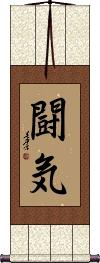
闘気 is an alternate Japanese title for “fighting spirit.”
This one is more like “fighting energy.” The second character is “ki,” the same “ki” in Aikido. This “ki” is the spiritual energy that all martial arts practitioners must master and focus on.
Fighting Spirit
Alternate Japanese version
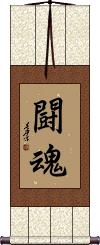
闘魂 is an alternate title with the meaning “fighting spirit” or “the will to fight.”
Fighting Spirit
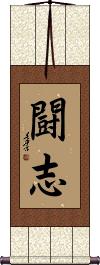
This literally means “fighting spirit” or “the will to fight.”
As in the spirit that a warrior, soldier, athlete, or fighter must possess.
Fighting Spirit
The Will to Fight
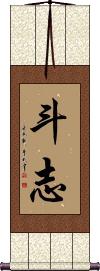
斗志 literally means fighting spirit in Chinese.
As in the spirit that a warrior, soldier, athlete, or fighter must possess.
 Note: There is more than one way to write the first character of this word. It is sometimes written like the version shown to the right (yes, it's completely different but has the same meaning & pronunciation). If you have a preference, please let us know in the special instructions about your order.
Boxing
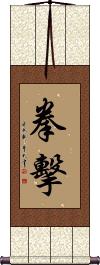
拳擊 is the term used in Chinese to refer to the original Olympic sport of combat and fighting.
If you like to strap on your boxing gloves and go a few rounds or are just a fan of boxing, this could make a nice wall scroll for you.
Note that Japanese use the same first character (which means fist) but a different Kanji for the second. Please see our Japanese boxing entry for that version.
Strive / Struggle
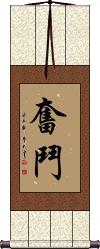
奮鬥 means strive (as in to put great effort into something or a cause).
It can also be translated as a struggle.
 The second character of this word can also be written as shown to the right. Yes.
it’s
very different. If you want this alternate version, just let us know when you place your order (in the special instructions).
The second character of this word can also be written as shown to the right. Yes.
it’s
very different. If you want this alternate version, just let us know when you place your order (in the special instructions).
Strive / Struggle
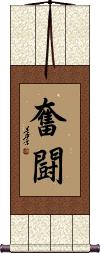
奮闘 is the Japanese version of a word that means strive (as in to put great effort into something or a cause).
It can also be translated as a struggle. There's a very similar version used in Chinese with the same meaning.
Attack When The Enemy Has Low Morale
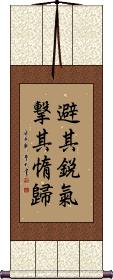
避其鋭氣擊其惰歸 is a Chinese proverb that literally translates as: Avoid [your enemy's] fighting spirit [and] attack [when] his [morale is] declining.
Figuratively, this means: Avoid the enemy when his morale is high and strike him when his morale is flagging.
Hand-to-Hand Fighting / Grappling
Kakuto
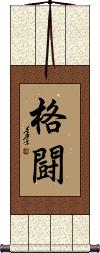
挌闘 is a Japanese word that means hand-to-hand fighting, grappling, or scuffling.
In the old days, this might refer to a street fight but now it can apply to martial arts and MMA techniques or bouts.
Sometimes written as 挌闘 instead of 格闘 (first Kanji varies slightly)
Value of Warrior Generals
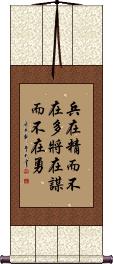
兵在精而不在多將在謀而不在勇 is a proverb that informs how it is better to have warriors of quality, rather than just a large quantity of warriors in your army/force.
This literally means: [Just as] warriors [are valued for their] quality and not [just] for quantity, [so] generals [are valued] for their tactics, not [just] for [their] bravery.
See Also: 兵在精而不在多
Furinkazan
military strategy
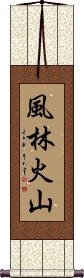
風林火山 is the battle strategy and proverb of Japanese feudal lord Takeda Shingen (1521-1573 AD).
This came from the Art of War by Chinese strategist and tactician Sun Tzu (Sunzi).
You can think of this as an abbreviation to remind officers and troops how to conduct battle.
風林火山 is a word list: Wind, Forest, Fire, Mountain.
The more expanded meaning is supposed to be...
“Swift as the wind, quiet as the forest, fierce as fire, and immovable as a mountain”
“As fast as the wind, as quiet as the forest, as daring as fire, and immovable as the mountain”
“Move as swift as the wind, stay as silent as a forest, attack as fierce as fire, undefeatable defense like a mountain”
“Move swiftly like the wind, stay silent like the forest, attack fiercely like fire, take a tactical position on the mountain”
See Also: Art of War
Undaunted After Repeated Setbacks
Persistence to overcome all challenges
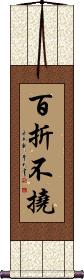
百折不撓 is a Chinese proverb that means “Be undaunted in the face of repeated setbacks.”
More directly translated, it reads, “[Overcome] a hundred setbacks, without flinching.” 百折不撓 is of Chinese origin but is commonly used in Japanese and somewhat in Korean (same characters, different pronunciation).
This proverb comes from a long, and occasionally tragic story of a man that lived sometime around 25-220 AD. His name was Qiao Xuan, and he never stooped to flattery but remained an upright person at all times. He fought to expose the corruption of higher-level government officials at great risk to himself.
Then when he was at a higher level in the Imperial Court, bandits were regularly capturing hostages and demanding ransoms. But when his own son was captured, he was so focused on his duty to the Emperor and the common good that he sent a platoon of soldiers to raid the bandits' hideout, and stop them once and for all even at the risk of his own son's life. While all of the bandits were arrested in the raid, they killed Qiao Xuan's son at first sight of the raiding soldiers.
Near the end of his career, a new Emperor came to power, and Qiao Xuan reported to him that one of his ministers was bullying the people and extorting money from them. The new Emperor refused to listen to Qiao Xuan and even promoted the corrupt Minister. Qiao Xuan was so disgusted that in protest, he resigned from his post as minister (something almost never done) and left for his home village.
His tombstone reads “Bai Zhe Bu Nao” which is now a proverb used in Chinese culture to describe a person of strong will who puts up stubborn resistance against great odds.
My Chinese-English dictionary defines these 4 characters as “keep on fighting despite all setbacks,” “be undaunted by repeated setbacks,” and “be indomitable.”
Our translator says it can mean “never give up” in modern Chinese.
Although the first two characters are translated correctly as “repeated setbacks,” the literal meaning is “100 setbacks” or “a rope that breaks 100 times.” The last two characters can mean “do not yield” or “do not give up.”
Most Chinese, Japanese, and Korean people will not take this absolutely literal meaning but will instead understand it as the title suggests above. If you want a single big word definition, it would be indefatigability, indomitableness, persistence, or unyielding.
See Also: Tenacity | Fortitude | Strength | Perseverance | Persistence
Fight / Beat Someone
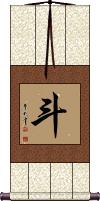
斗 is how to express the act of fighting in Chinese.
Generally, this means fighting against someone or some force whether physically or metaphorically.
Note: There is more than one way to write this character. You will notice variations on the next page after you click “Select and Customize.” If you have a preference, please let us know when you place your order.
Please note that there is a secondary pronunciation and meaning of this character. It can also mean “measuring cup” or in Japanese “sake dipper” or even “The Big Dipper.” In Japanese and Korean, this does not have the fighting meaning associated with it. You should, therefore, select this character only if your audience is Chinese, or you are a big fan of sake dippers or The Big Dipper (as that is how it will be read by Japanese and Korean people).
Shinkage-Ryu
Style of Japanese sword fighting
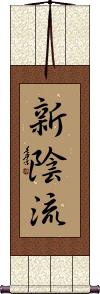
新陰流 is the title for “Shinkage-Ryu,” and the style of Japanese fencing or sword fighting.
Fight for a Goal
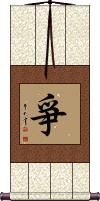
爭 is the way to express the idea of fighting for a goal.
This can also mean struggling or arguing. 爭 is okay for a Chinese audience, and while it is a word in Korean, this character is seldom seen alone in Korean grammar.
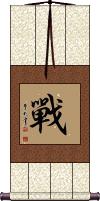
戰 means war, battle, or fight.
戰 is often used to title various wars. For instance, if you add the character for “2” before this character, you have the Chinese title for WWII.
In certain contexts, someone can use this word to mean campaign, game, or match.
Written as 戦 in modern Japanese.
 Note: In Japan, they tend to use the form shown to the right. If you pick the Japanese master calligrapher, you may get/request this version. It should also be noted that this Kanji is seldom used alone in Japanese.
Fight to the End / Fight Until the Bitter End
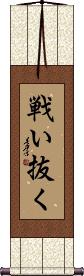
戦い抜く means “To fight to the bitter end” in Japanese.
Note: Because this selection contains some special Japanese Hiragana characters, it should be written by a Japanese calligrapher.
If you cannot bite, do not show your teeth
If you cannot fight, don't start one
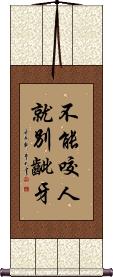
不能咬人就别龇牙 is a Chinese proverb that literally translates as: [if you] can't bite people, don't bare [your] teeth.
Figuratively, this means: Don't show your anger if you can't do anything about the situation.
Some will also say this means “Don't start a fight that you cannot win.” Others will say it means that you must be willing to back up your words (perhaps with your fists).
The following table may be helpful for those studying Chinese or Japanese...
| Title | Characters | Romaji (Romanized Japanese) | Various forms of Romanized Chinese | |
| Fighting Spirit | 闘氣 闘気气 | tou ki / touki / to ki | ||
| Fighting Spirit | 闘魂 | tou kon / toukon / to kon | ||
| Fighting Spirit | 闘誌 闘志 | tou shi / toushi / to shi | ||
| Fighting Spirit | 斗志 | dòu zhì / dou4 zhi4 / dou zhi / douzhi | tou chih / touchih | |
| Boxing | 拳擊 拳击 | quán jī / quan2 ji1 / quan ji / quanji | ch`üan chi / chüanchi / chüan chi | |
| Strive Struggle | 奮鬥 / 奮斗 奋斗 / 奋鬥 | fèn dòu / fen4 dou4 / fen dou / fendou | fen tou / fentou | |
| Strive Struggle | 奮闘 / 奮鬥 奋斗 / 奋鬥 | fun tou / funtou / fun to | ||
| Attack When The Enemy Has Low Morale | 避其鋭氣擊其惰歸 避其锐气击其惰归 | bì qí ruì qì jī qí duò guī bi4 qi2 rui4 qi4 ji1 qi2 duo4 gui1 bi qi rui qi ji qi duo gui biqiruiqijiqiduogui | pi ch`i jui ch`i chi ch`i to kuei pichijuichichichitokuei pi chi jui chi chi chi to kuei |
|
| Hand-to-Hand Fighting Grappling | 格闘 / 挌闘 格闘 | kakutou / kakuto kakuto / kakuto | ||
| Value of Warrior Generals | 兵在精而不在多將在謀而不在勇 兵在精而不在多将在谋而不在勇 | bīng zài jīng ér bú zài duō jiàng zài móu ér bú zài yǒng bing1 zai4 jing1 er2 bu2 zai4 duo1 jiang4 zai4 mou2 er2 bu2 zai4 yong3 bing zai jing er bu zai duo jiang zai mou er bu zai yong | ping tsai ching erh pu tsai to chiang tsai mou erh pu tsai yung | |
| Furinkazan | 風林火山 风林火山 | fuu rin ka zan fuurinkazan fu rin ka zan | fēng lín huǒ shān feng1 lin2 huo3 shan1 feng lin huo shan fenglinhuoshan | |
| Undaunted After Repeated Setbacks | 百折不撓 百折不挠 | hyaku setsu su tou hyakusetsusutou hyaku setsu su to | bǎi zhé bù náo bai3 zhe2 bu4 nao2 bai zhe bu nao baizhebunao | pai che pu nao paichepunao |
| Fight Beat Someone | 斗 | dòu / dou4 / dou | tou | |
| Shinkage-Ryu | 新陰流 | shin kage ryuu shinkageryuu shin kage ryu | ||
| Fight for a Goal | 爭 争 | zhēng / zheng1 / zheng | cheng | |
| War | 戰 / 戦 战 | sen | zhàn / zhan4 / zhan | chan |
| Fight to the End Fight Until the Bitter End | 戦い抜く | tataka-i nu-ku tataka-inu-ku | ||
| If you cannot bite, do not show your teeth | 不能咬人就別齜牙 不能咬人就别龇牙 | bù néng yǎo rén jiù bié zī yá bu4 neng2 yao3 ren2 jiu4 bie2 zi1 ya2 bu neng yao ren jiu bie zi ya bunengyaorenjiubieziya | pu neng yao jen chiu pieh tzu ya | |
| In some entries above you will see that characters have different versions above and below a line. In these cases, the characters above the line are Traditional Chinese, while the ones below are Simplified Chinese. | ||||

Successful Chinese Character and Japanese Kanji calligraphy searches within the last few hours...



