Many custom options...


And formats...



Hardship in Chinese / Japanese...
Buy a Hardship calligraphy wall scroll here!
Personalize your custom “Hardship” project by clicking the button next to your favorite “Hardship” title below...
1. To Know Hardship, One Must Experience It
2. You must endure a harsh winter to appreciate the warmth of springtime
3. Tempering Makes Strong Steel
4. Goat / Sheep
5. In the Abyss of Infinite Bitterness - Turn to the Shore
6. The Pain of Separation from Your Loves
7. Overcome
8. If you have not been a monk, how can you know what it is like to be a vegetarian?
To Know Hardship, One Must Experience It
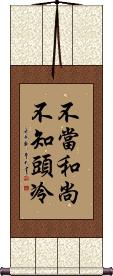
不當和尚不知頭冷 is a Chinese proverb that literally translates as: [One who has] not been a monk [does] not know [the feeling of a] cold head.
I need to explain that a Chinese Buddhist monk always has a shaved head, and thus a cold head in winter.
Figuratively, this means: One cannot know the true meaning of hardship until one has experienced it oneself.
This is an idiom in Chinese, so the figurative meaning is what people perceive when they hear or read this phrase. Just as in English, when someone says, "The grass is always greener," one will think about the idea of jealousy, rather than the quality of one’s lawn.
You must endure a harsh winter to appreciate the warmth of springtime
You must know hardship to appreciate happiness
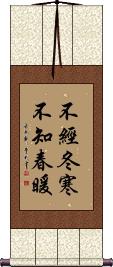
This literally translates as: Without having experienced the cold of winter, one cannot appreciate the warmth of spring.
Figuratively, this means: One cannot truly appreciate happiness without having gone through hardship.
There are many contrasts in life. One simply cannot fully know what joy is without having experienced misery, difficulty, and pain. How could you explain “light” if you did not have “darkness” to compare it to?
Embrace hardship, as it makes the good times seem even better.
Tempering Makes Strong Steel
Hardship Develops Strong Character
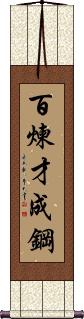
百煉才成鋼 / 百煉纔成鋼 literally translates as: Only after much tempering is steel produced.
Figuratively, this means: True character must be tested in hardship.
This is a mild form of saying, “Whatever doesn't kill me, makes me stronger.”
Goat / Sheep
Year of the Goat / Zodiac Sign
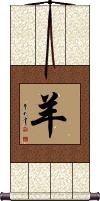
羊 is the character for goat or sheep in Chinese, old Korean, and Japanese.
If you were born in the year of the goat (sheep), you . . .
Are sophisticated and considerate
Can always find the best solution to problems.
Are tolerant.
Are not afraid of hardship.
Know how to save money (thrifty).
See also our Chinese Zodiac page.
In the Abyss of Infinite Bitterness - Turn to the Shore
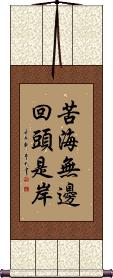
苦海無邊, 回頭是岸 can be translated almost directly as “The sea of bitterness has no bounds, turn your head to see the shore.”
Often this proverb refers to how Buddhist enlightenment can allow one to shed off the abyss of worldly suffering. But it can apply to other religions. If you find yourself trapped in the hardship of this worldly life, take a new turn, and seek a path to salvation.
The Pain of Separation from Your Loves
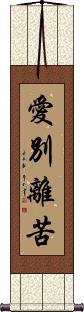
愛別離苦 is a Buddhist term that refers to “the pain of separation from loved ones,” or “the suffering of being separated from those whom one loves.”
If you translate each character separately, you get, “love(s) separated [and] departed [yields] pain.”
The pain character can also be defined as anguish; suffering; distress; anxiety; worry; trouble; difficulty; hardship; bitterness; to suffer; anguish; distress; anxiety; worry; trouble; difficulty; bitterness; unhappiness; or misery.
Overcome
Overcoming Hardships
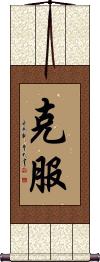
In Chinese, Japanese Kanji, and old Korean Hanja, 克服 means “overcome” (as in overcoming hardships, etc.). It can also mean to conquer, to put up with, or to endure.
This can be a conquest over a problem, disease, handicap, poverty, or illness. Other definitions include overcoming, bringing under control, subjugation, or victory over something.
This can be used as an inspirational wall scroll to remind someone to try to overcome difficulties that may arise in life.
If you have not been a monk, how can you know what it is like to be a vegetarian?
Only by experiencing hardship will allow you understand the plight of others
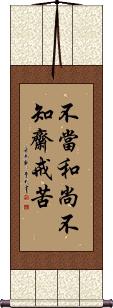
不當和尚不知齋戒苦 literally translates as:
[One who has] not been a monk [does not] know the suffering of [being on a] vegetarian diet.
This is a bit like the “walk a mile in another man's shoes” saying. Basically, it's about you cannot fully understand the plight of others until you experience it yourself.
The following table may be helpful for those studying Chinese or Japanese...
| Title | Characters | Romaji (Romanized Japanese) | Various forms of Romanized Chinese | |
| To Know Hardship, One Must Experience It | 不當和尚不知頭冷 不当和尚不知头冷 | bù dāng hé shàng bù zhī tóu lěng bu4 dang1 he2 shang4 bu4 zhi1 tou2 leng3 bu dang he shang bu zhi tou leng | pu tang ho shang pu chih t`ou leng pu tang ho shang pu chih tou leng |
|
| You must endure a harsh winter to appreciate the warmth of springtime | 不經冬寒不知春暖 不经冬寒不知春暖 | bù jīng dōng hán bù zhī chūn nuǎn bu4 jing1 dong1 han2 bu4 zhi1 chun1 nuan3 bu jing dong han bu zhi chun nuan | pu ching tung han pu chih ch`un nuan pu ching tung han pu chih chun nuan |
|
| Tempering Makes Strong Steel | 百煉才成鋼 / 百煉纔成鋼 百炼才成钢 | bǎi liàn cái chéng gāng bai3 lian4 cai2 cheng2 gang1 bai lian cai cheng gang bailiancaichenggang | pai lien ts`ai ch`eng kang pailientsaichengkang pai lien tsai cheng kang |
|
| Goat Sheep | 羊 | hitsuji | yáng / yang2 / yang | |
| In the Abyss of Infinite Bitterness - Turn to the Shore | 苦海無邊回頭是岸 苦海无边回头是岸 | kǔ hǎi wú biān huí tóu shì àn ku3 hai3 wu2 bian1 hui2 tou2 shi4 an4 ku hai wu bian hui tou shi an kuhaiwubianhuitoushian | k`u hai wu pien hui t`ou shih an kuhaiwupienhuitoushihan ku hai wu pien hui tou shih an |
|
| The Pain of Separation from Your Loves | 愛別離苦 爱别离苦 | ai betsu ri ku aibetsuriku | ài bié lí kǔ ai4 bie2 li2 ku3 ai bie li ku aibieliku | ai pieh li k`u aipiehliku ai pieh li ku |
| Overcome | 克服 / 剋服 克服 | koku fuku / kokufuku | kè fú / ke4 fu2 / ke fu / kefu | k`o fu / kofu / ko fu |
| If you have not been a monk, how can you know what it is like to be a vegetarian? | 不當和尚不知齋戒苦 不当和尚不知斋戒苦 | bù dāng hé shang bù zhī zhāi jiè kǔ bu4 dang1 he2 shang bu4 zhi1 zhai1 jie4 ku3 bu dang he shang bu zhi zhai jie ku | pu tang ho shang pu chih chai chieh k`u pu tang ho shang pu chih chai chieh ku |
|
| In some entries above you will see that characters have different versions above and below a line. In these cases, the characters above the line are Traditional Chinese, while the ones below are Simplified Chinese. | ||||

Successful Chinese Character and Japanese Kanji calligraphy searches within the last few hours...



