Many custom options...


And formats...



Head in Chinese / Japanese...
Buy a Head calligraphy wall scroll here!
Personalize your custom “Head” project by clicking the button next to your favorite “Head” title below...
1. To Know Hardship, One Must Experience It
2. Halo
4. Tiara
5. Soke / Shuke
6. Red Demon
8. First Born
9. Unicorn
10. In the Abyss of Infinite Bitterness - Turn to the Shore
12. Unicorn
14. Courage to do what is right
15. Woman
16. Beauty Shop / Beauty Salon
17. Push or Knock
19. Inspiration
20. Immovable Mind
21. Islam
To Know Hardship, One Must Experience It
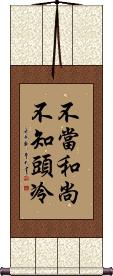
不當和尚不知頭冷 is a Chinese proverb that literally translates as: [One who has] not been a monk [does] not know [the feeling of a] cold head.
I need to explain that a Chinese Buddhist monk always has a shaved head, and thus a cold head in winter.
Figuratively, this means: One cannot know the true meaning of hardship until one has experienced it oneself.
This is an idiom in Chinese, so the figurative meaning is what people perceive when they hear or read this phrase. Just as in English, when someone says, "The grass is always greener," one will think about the idea of jealousy, rather than the quality of one’s lawn.
Halo
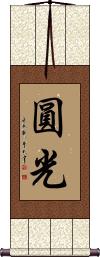
圓光 is one of many ways to express “halo” in Chinese.
圓光 means radiance emanating from the head.
This can refer to the halo surrounding the head of a Buddha.
This is occasionally used to mean “halo” in Japanese, but it is more commonly the surname Enkō in Japan.
You may want to check our dictionary for many more versions of halo.
Griffin / Gryphon
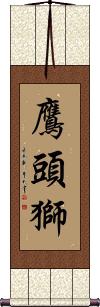
鷹頭獅 is the Chinese title for a Griffin.
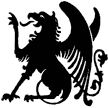 This refers to the legendary creature with the head, talons, and wings of an eagle and the body of a lion. Sometimes also spelled Gryphon or Griffon. From the Greek γρύφων or γρύπων, or Latin Gryphus.
This Chinese title, 鷹頭獅, literally means “Eagle Head Lion.”
Tiara
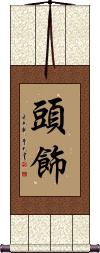
Soke / Shuke
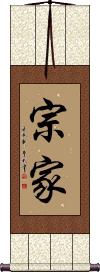
宗家 is a Japanese word that means “head of the family” or “originator.”
In Chinese, this is an honor name for Shandao (善導), a writer of commentaries on the sutras of the Pure Land sect of Buddhism.
Red Demon
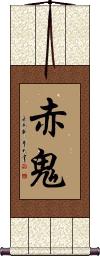
赤鬼 is the title of the red-horned demon or red ogre.
In the Buddhist context, these are the red demons of purgatory. These demons are unique, as one will have the head of a bull, another with that of a horse, etc.
The Aura of Buddha
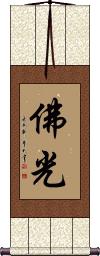
佛光 means Buddha's teachings, or Buddha's Light.
This often refers to the aura around the head of Buddha.
Alternate meanings include Spiritual Enlightenment (from Buddha), Buddha's Halo, Light of the Buddha, or Buddha's Glory.
First Born
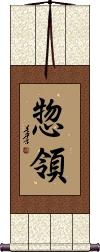
惣領 is a Japanese title for the eldest child, the oldest child, firstborn child, or child who carries on the family name.
In more ancient times, this was used to refer to the head of a warrior clan. It can also be a place name or given name “Souryou” or “Soryo” in Japanese.
Unicorn
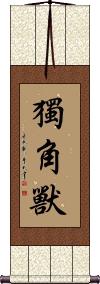
獨角獸 is the Chinese name for the western unicorn (a horse with a spiral horn emerging from the head).
獨角獸 is an unusual title for a Chinese wall scroll, but it's OK if you really love unicorns.
Chinese have their own ancient unicorn-like creature called a “qilin” (or kirin in Japanese).
In the Abyss of Infinite Bitterness - Turn to the Shore
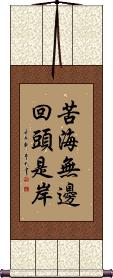
苦海無邊, 回頭是岸 can be translated almost directly as “The sea of bitterness has no bounds, turn your head to see the shore.”
Often this proverb refers to how Buddhist enlightenment can allow one to shed off the abyss of worldly suffering. But it can apply to other religions. If you find yourself trapped in the hardship of this worldly life, take a new turn, and seek a path to salvation.
Mind Your Own Business
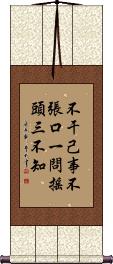
不干己事不张口一问摇头三不知 literally translates as [About] matters [that] don't concern [you], do not open [your] mouth, [and] when questioned, always shake [your] head “No.”
Figuratively, this means: It is best to remain reticent about other people's affairs and to refuse to make any comment on matters that don't concern you.
Unicorn
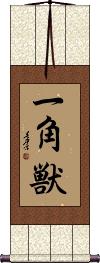
一角獣 is the Japanese name for the western unicorn (a horse with a spiral horn emerging from the head). This can also refer to a narwhal, depending on context.
一角獣 is an unusual title for a Japanese wall scroll but it's OK if you really love unicorns.
Japanese have their own ancient unicorn-like creature called a “kirin” (or qilin in the original Chinese).
Monshu / Gate Keeper
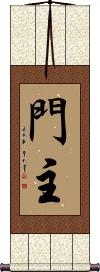
In modern Japanese, 門主 is the title of a head priest of a temple or monastery.
This can also refer to the spiritual leader of the sect and/or direct descendant of its founder.
In the past, this could refer to the founder of a Buddhist sect.
The literal meaning of 門主 is gatekeeper or keeper of the gate.
In the Chinese Buddhist dictionary, this entry comes up as the controller of a gate or sect. However, this term is not commonly used in Chinese.
Courage to do what is right
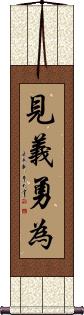
見義勇為 means the courage to do what is right in Chinese.
This could also be translated as “Never hesitate to do what is right.”
This comes from Confucian thought:
Your courage should head in an honorable direction. For example, you should take action when the goal is to attain a just result as, without honorable intent, a person’s gutsy fervor can easily lead them astray.
One who flaunts courage but disregards justice is bound to do wrong; someone who possesses courage and morality is destined to become a hero.
Some text above paraphrased from The World of Chinese - The Character of 勇
See Also: Work Unselfishly for the Common Good | Justice | Bravery
Woman
The ancient way to say Woman
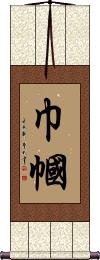
巾幗 is the very old way to say woman in Chinese.
A common title in ancient China, this actually refers to the scarf or head wrapping worn by virtually all women at that time.
巾幗 is kind of a cool way to say Woman now. The actual gender character alone on a wall scroll would actually look like a fancy sign for the woman's restroom (WC).
 If you are curious, the character to the right means female or woman. Knowing 女 is useful information if you are a woman searching for a toilet in China or Japan.
Beauty Shop / Beauty Salon
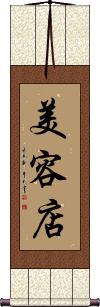
美容店 is how to write “Beauty Shop” or “Beauty Salon.”
If you own such a business, this will make a nice wall scroll to hang up - and many of your Asian customers will be able to read and appreciate it.
When traveling in China, you will see signs like this in the window of any place that offers full services of hair styling, manicures, pedicures, and often shampoo with head and back massage.
However, as a handmade wall scroll, this becomes a very fancy piece of artwork that shows the high class of your business (a great sign for your window if you don't get direct sunlight).
Push or Knock
To weigh one's words
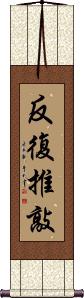
During the Tang Dynasty, a man named Jia Dao (born in the year 779), a well-studied scholar and poet, went to the capital to take the imperial examination.
One day as he rides a donkey through the city streets, a poem begins to form in his mind. A portion of the poem comes into his head like this:
“The bird sits on the tree branch near a pond,
A monk approaches and knocks at the gate...”
At the same time, he wondered if the word “push” would be better than “knock” in his poem.
As he rides down the street, he imagines the monk pushing or knocking. Soon he finds himself making motions of pushing and shaking a fist in a knocking motion as he debates which word to use. He is quite a sight as he makes his way down the street on his donkey with hands and fists flying about as the internal debate continues.
As he amuses people along the street, he becomes completely lost in his thoughts and does not see the mayor's procession coming in the opposite direction. Jia Bao is blocking the way for the procession to continue down the road, and the mayor's guards immediately decide to remove Jia Bao by force. Jia Bao, not realizing that he was in the way, apologizes, explains his poetic dilemma and awaits his punishment for blocking the mayor's way.
The mayor, Han Yu, a scholar and author of prose himself, finds himself intrigued by Jia Dao's poem and problem. Han Yu gets off his horse and addresses Jia Bao, stating, “I think knock is better.” The relieved Jia Bao raises his head and is invited by the mayor to join the procession, and are seen riding off together down the street, exchanging their ideas and love of poetry.
In modern Chinese, this 反復推敲 idiom is used when someone is trying to decide which word to use in their writing or when struggling to decide between two things when neither seems to have a downside.
Kowtow - The deepest bow
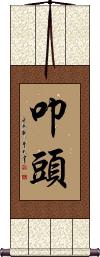
叩頭 is the term that seems to be known worldwide as kowtow.
In Japanese and Chinese, it simply means a deep bow, especially one so low that one's head touches the ground in submission. However, in western culture, it has sometimes come to mean “giving in” or “surrendering to someone else's will.” Sometimes even said of a person who stoops to flattery at the expense of their dignity.
I don't know if you would really want this on a wall scroll, but enough people have searched for this term on our website that I guess it was time to add it. It just feels strange to see such a word on a wall scroll, so please order with caution. 叩頭 is antiquated in both Japanese and Chinese. The act is seldom done anymore and is seen as an ancient ritual.
Inspiration
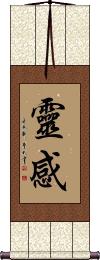
靈感 is the Chinese word closest to hitting the mark for the English word inspiration.
In a more extended context, I have even seen this translated as “brain wave.”
The first character means alert, departed soul, efficacious, quick, effective, or intelligent.
The second character means to feel, to move, to touch, or to affect.
The combined meaning of these two characters changes a bit, but I think it's nice to know the individual meanings to give you a better understanding of where a word comes from.
You could describe this word as “the thought that pops into your head just before you patent the greatest widget ever invented that everyone in the world will want.”
At least, that's the idea.
This term can also mean “intelligent thought” if you translate it directly from each character. If you are looking for inspiration or need to be inspired, this is the word for you.
 When the first character was absorbed into Japanese from Chinese, an alternate form became the standard in Japan. The Kanji shown to the right is the form currently used in Japan. This is still considered an alternate form in China to this day.
it’s
readable by both Chinese and Japanese people but if your audience is Japanese, I recommend the Kanji shown to the right - just click on that Kanji to order that version.
When the first character was absorbed into Japanese from Chinese, an alternate form became the standard in Japan. The Kanji shown to the right is the form currently used in Japan. This is still considered an alternate form in China to this day.
it’s
readable by both Chinese and Japanese people but if your audience is Japanese, I recommend the Kanji shown to the right - just click on that Kanji to order that version.
Immovable Mind
fudoshin
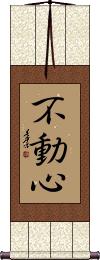
不動心 is one of the five spirits of the warrior (budo) and is often used as a Japanese martial arts tenet.
Under that context, places such as the Budo Dojo define it this way: An unshakable mind and an immovable spirit is the state of fudoshin. It is courage and stability displayed both mentally and physically. Rather than indicating rigidity and inflexibility, fudoshin describes a condition that is not easily upset by internal thoughts or external forces. It is capable of receiving a strong attack while retaining composure and balance. It receives and yields lightly, grounds to the earth, and reflects aggression back to the source.
Other translations of this title include unwavering mind, immovable mind, unwavering composure, imperturbability, steadfastness, keeping a cool head in an emergency, or keeping one's calm (during a fight).
The first two Kanji alone mean immobility, firmness, fixed, steadfastness, motionless, and idle.
The last Kanji means heart, mind, soul, or essence.
Together, these three Kanji create a title defined as “immovable mind” within the context of Japanese martial arts. However, in Chinese, it would mean “motionless heart,” and in Korean Hanja, “wafting heart” or “floating heart.”
Islam
(phonetic version)
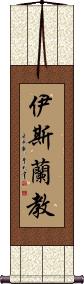
伊斯蘭教 both means and sounds like “Islam” in Mandarin Chinese.
The first three characters sound like the word “Islam,” and the last character means “religion” or “teaching.” It's the most general term for “Islam” in China. The highest concentration of Muslims in China is Xinjiang (the vast region in northwest China that was called The East Turkistan Republic until 1949 and is sometimes called Chinese Turkistan, Uyghuristan). Here you will find Uygurs, Kazakhs, Kyrgyz, and others that are descendants of Turkmen (possibly mixed with Persians and Arabs). Many of their ancestors were traders who traveled the silk road to buy and sell spices and silk and exchange other goods from the Orient and the Middle East.
I spent some time in Xinjiang and got to know this community. They are strong people who can endure much. They are friendly and love to have a good time. I was a stranger but was treated by villagers (near China's border with Afghanistan) as if I was a good friend.
However, I have heard that it's best not to cross them, as in this land, the law is the blade, and everything is “eye for an eye.” The Chinese government has little control in Xinjiang, with almost no police officers except in the capital of Urumqi (so it's a 60-hour roundtrip train ride to seek the aid of law enforcement in most cases).
While few seem devout, there are at least small mosques in every village. And you will never see a man or woman outside without a head covering.
It should be noted that these people are all citizens of China, but they are officially of the Caucasian race. A visit to Xinjiang will change your idea of what it means to be Chinese.
Past experience is the teacher for the future
Past events not forgotten serve as teachers for later events.
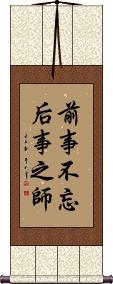
The most literal translation to English of this ancient 前事不忘后事之师 Chinese proverb is:
“Past events not forgotten serve as teachers for later events.”
However, it's been translated several ways:
Don't forget past events, they can guide you in the future.
Benefit from past experience.
Past experience, if not forgotten, is a guide for the future.
Past calamity is my teacher.
A good memory for the past is a teacher for the future.
The remembrance of the past is the teacher of the future.
If one remembers the lessons of the past; They will serve as a guide to avoid mistakes in the future.
The origin:
This proverb comes from the 5th century B.C., just before the Warring States Period in the territory now known as China.
The head of the State of Jin, Zhi Bo, seized power in a coup. He did this with help from the armies of the State of Han and Wei. Instead of being grateful for the help from Han and Wei, he treacherously took the land of Han and Wei. Never satisfied, Zhi Bo employed the armies of Han and Wei to attack and seize the State of Zhao.
The king of Zhao took advice from his minister Zhang Mengtan and secretly contacted the Han and Wei armies to reverse their plans and attack the army of Zhi Bo instead. The plan was successful, and the State of Zhao was not only saved but was set to become a powerful kingdom in the region.
Zhang Mengtan immediately submitted his resignation to a confused king of Zhao. When asked why, Zhang Mengtan said, “I've done my duty to save my kingdom, but looking back at past experience, I know sovereign kings are never satisfied with the power or land at hand. They will join others and fight for more power and more land. I must learn from past experiences, as those experiences are the teachers of future events.”
The king could not dispute the logic in that statement and accepted Zhang Mengtan's resignation.
For generations, the State of Zhao continued to fight for power and land until finally defeated and decimated by the State of Qin (which led to the birth of the Qin Dynasty in 221 B.C.).
These search terms might be related to Head:
A Journey of 1000 Miles Begins With a Single Step
A Journey of 1000 Miles Feels Like One
Accept the Situation and Move On
Accept Your Mistake and Move On
Advance Bravely / Indomitable Spirit
Better to Travel 10,000 Miles Than Read 10,000 Books
Confucius: Golden Rule / Ethic of Reciprocity
Control of Power
Do Not Fear the Task: Cooperation Will Lead to Success
Forgiveness (From the Top Down)
Fresh Start
Go Kan Ryu
Go With the Flow
Go-Dan / 5th Degree Black Belt
Golden Rule
Highest Quality / Top Notch
I Control My Own Destiny
It is the Journey, Not the Destination
Journey / Travel
Journey of Life
Journey to the West
Leadership / Ability to Lead
Life is a Journey
Move on / Change Way of Thinking
New Beginning
Pleasant Journey
Read 10,000 Books, Travel 10,000 Miles
Release / Let Go
Rule
Self-Control
Self-Restraint / Self-Control
Speed Control
The Destination is Nothing Without the Journey
The Game of Weiqi / Weichi / Go
Top Quality / First Class
Will-Power / Self-Control
The following table may be helpful for those studying Chinese or Japanese...
| Title | Characters | Romaji (Romanized Japanese) | Various forms of Romanized Chinese | |
| To Know Hardship, One Must Experience It | 不當和尚不知頭冷 不当和尚不知头冷 | bù dāng hé shàng bù zhī tóu lěng bu4 dang1 he2 shang4 bu4 zhi1 tou2 leng3 bu dang he shang bu zhi tou leng | pu tang ho shang pu chih t`ou leng pu tang ho shang pu chih tou leng |
|
| Halo | 圓光 圆光 | Enkou / Enko | yuán guāng yuan2 guang1 yuan guang yuanguang | yüan kuang yüankuang |
| Griffin Gryphon | 鷹頭獅 鹰头狮 | yīng tóu shī ying1 tou2 shi1 ying tou shi yingtoushi | ying t`ou shih yingtoushih ying tou shih |
|
| Tiara | 頭飾 头饰 | tóu shì / tou2 shi4 / tou shi / toushi | t`ou shih / toushih / tou shih | |
| Soke Shuke | 宗家 | Shuuke / Shuke | zōng jiā / zong1 jia1 / zong jia / zongjia | tsung chia / tsungchia |
| Red Demon | 赤鬼 | akaoni | chì guǐ / chi4 gui3 / chi gui / chigui | ch`ih kuei / chihkuei / chih kuei |
| The Aura of Buddha | 佛光 | bukkou / buko | fó guāng / fo2 guang1 / fo guang / foguang | fo kuang / fokuang |
| First Born | 惣領 | souryou / soryo | ||
| Unicorn | 獨角獸 独角兽 | dú jiǎo shòu du2 jiao3 shou4 du jiao shou dujiaoshou | tu chiao shou tuchiaoshou |
|
| In the Abyss of Infinite Bitterness - Turn to the Shore | 苦海無邊回頭是岸 苦海无边回头是岸 | kǔ hǎi wú biān huí tóu shì àn ku3 hai3 wu2 bian1 hui2 tou2 shi4 an4 ku hai wu bian hui tou shi an kuhaiwubianhuitoushian | k`u hai wu pien hui t`ou shih an kuhaiwupienhuitoushihan ku hai wu pien hui tou shih an |
|
| Mind Your Own Business | 不干己事不張口一問搖頭三不知 不干己事不张口一问摇头三不知 | bù gān jǐ shì bù zhāng kǒu yī wèn yáo tóu sān bù zhī bu4 gan1 ji3 shi4 bu4 zhang1 kou3 yi1 wen4 yao2 tou2 san1 bu4 zhi1 bu gan ji shi bu zhang kou yi wen yao tou san bu zhi | pu kan chi shih pu chang k`ou i wen yao t`ou san pu chih pu kan chi shih pu chang kou i wen yao tou san pu chih |
|
| Unicorn | 一角獣 | ikkakujuu / ikakuju | ||
| Monshu Gate Keeper | 門主 门主 | monshu | mén zhǔ / men2 zhu3 / men zhu / menzhu | men chu / menchu |
| Courage to do what is right | 見義勇為 见义勇为 | jiàn yì yǒng wéi jian4 yi4 yong3 wei2 jian yi yong wei jianyiyongwei | chien i yung wei chieniyungwei |
|
| Woman | 巾幗 巾帼 | jīn guó / jin1 guo2 / jin guo / jinguo | chin kuo / chinkuo | |
| Beauty Shop Beauty Salon | 美容店 | měi róng diàn mei3 rong2 dian4 mei rong dian meirongdian | mei jung tien meijungtien |
|
| Push or Knock | 反復推敲 反复推敲 | fǎn fù tuī qiāo fan3 fu4 tui1 qiao1 fan fu tui qiao fanfutuiqiao | fan fu t`ui ch`iao fanfutuichiao fan fu tui chiao |
|
| Kowtow - The deepest bow | 叩頭 叩头 | koutou / koto | kòu tóu / kou4 tou2 / kou tou / koutou | k`ou t`ou / koutou / kou tou |
| Inspiration | 靈感 灵感 | reikan | líng gǎn / ling2 gan3 / ling gan / linggan | ling kan / lingkan |
| Immovable Mind | 不動心 | fu dou shin fudoushin fu do shin | ||
| Islam | 伊斯蘭教 伊斯兰教 | yī sī lán jiào yi1 si1 lan2 jiao4 yi si lan jiao yisilanjiao | i ssu lan chiao issulanchiao |
|
| Past experience is the teacher for the future | 前事不忘后事之師 前事不忘后事之师 | qián shì bú wàng hòu shí zhī shī qian2 shi4 bu2 wang4 hou4 shi2 zhi1 shi1 qian shi bu wang hou shi zhi shi | ch`ien shih pu wang hou shih chih shih chien shih pu wang hou shih chih shih |
|
| In some entries above you will see that characters have different versions above and below a line. In these cases, the characters above the line are Traditional Chinese, while the ones below are Simplified Chinese. | ||||

Successful Chinese Character and Japanese Kanji calligraphy searches within the last few hours...



