Many custom options...


And formats...



Not what you want?
Try other similar-meaning words, fewer words, or just one word.
Hi Pi G Punch in Chinese / Japanese...
Buy a Hi Pi G Punch calligraphy wall scroll here!
Personalize your custom “Hi Pi G Punch” project by clicking the button next to your favorite “Hi Pi G Punch” title below...
Switched to secondary search mode due to lack of results using primary.
These secondary results may not be very accurate. Try a different but similar meaning word or phrase for better results. Or...
Look up Hi Pi G Punch in my Japanese Kanji & Chinese Character Dictionary(My dictionary is a different system then the calligraphy search you just tried)
If you want a special phrase, word, title, name, or proverb, feel free to contact me, and I will translate your custom calligraphy idea for you.
Ch'ang Hon Taekwondo
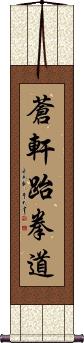
蒼軒跆拳道 is the title “Chang Hon Taekwon-Do” written in old Korean Hanja.
This literally means “Pale Blue Kick Fist/Punch Way.”
The rather awkward official romanization is “cang heon tae gweon do.”
Occasionally, you will see the first Hanja character written as 苍 instead of 蒼. it’s just a different way to write the same character. If you want 苍 instead of 蒼, just let me know.
Dim Mak
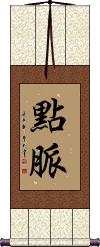
Dim Mak or 點脈 is a martial arts term that refers to hitting a pressure point.
It is often theorized that hitting just the right (or wrong) pressure point can cause instant death. Hence, I have seen Dim Mak mistranslated as “death punch” or “touch of death.” But really, this is just the point (點) of pulse or meridian (脈) - aka pressure point.
See Also: 點穴
Eagle Claw Overturning Fist
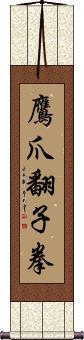
鷹爪翻子拳 is the title of a Chinese martial arts style known as “Ying Zhua Fan Zi Quan” or “Eagle Claw Overturning Fist.”
This style was derived from a combination of 鷹爪派 (Eagle Claw School) and 子母拳 (Son-Mother Fist). The title “son-mother” may seem odd, but it refers to a fist or punches seemingly coming out of another fist or punch. In modern times, 子母彈 is a title for “cluster bomb” (bombs coming out of another bomb).
Hello / Ni Hao
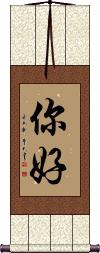
你好 is the day-to-day way to say hello in Chinese.
The characters literally mean, “You good?” It's the equivalent of “What's up?” in English, where nobody expects an actual answer.
This explanation is here for educational purposes only. 你好 is an oral word that is not appropriate for a scroll (not a bad meaning, just very odd for a wall scroll).
Hishiryo / Not-Thinking
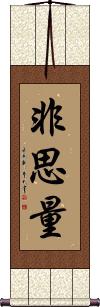
Hishiryō (非思量) literally means not-thinking.
Hishiryo can be described as a state of mind beyond thinking and non-thinking during the practice of Zazen.
Shiryō (思量) means “thinking,” and hi (非) is a prefix for negation and opposition.
Therefore, hishiryo amounts to “unthink” or “not the matter of thinking.” The word hishiryo appears in Dogen Zenji’s Fukanzazengi, Shobogenzo Zazengi, Shobogenzo Zazenshin, and Keizan Zenji’s Zazen Yojinki. It is one of the most important words used to describe zazen. Hishiryo in these writings comes from a dialogue between Yakusan Igen (745-828) and an unnamed monk, which is described in Keitoku, Dentoroku, and other Zen texts.
The above is an abridged except from School of Shodo: Hishiryo
I suggest you visit that page for a full explanation.
Taekwondo
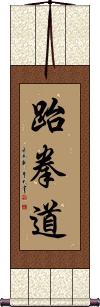
跆拳道 is one of the most widespread types of martial arts in the world as well as being an Olympic sport. Taekwondo was born in Korea with influences of Chinese and Japanese styles combined with traditional Korean combat skills. Some will define it as the “Korean art of empty-handed self-defense.”
In the simplest translation, the first character means “kick,” the second character can mean either “fist” or “punching,” and the third means “way” or “method.” Altogether, you could say this is the “Kick Punch Method.” When heard or read in various Asian languages, all will automatically think of this famous Korean martial art. It is written the same in Japanese Kanji, Chinese, and Korean Hanja characters - so the appearance of the characters is universal. However, you should note that there is another way to write this in modern Korean Hangul characters, which looks like the image to the right. 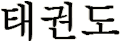
We suggest the original Korean Hanja (Chinese characters) for a wall scroll, but if you need the Hangul version, you must use master calligrapher Cao Bin: Order Taekwondo in Korean Hangul
Note: Taekwondo is sometimes Romanized as Tae-Kwondo, Tae Kwon Do, Taekwon-do, Taegwondo, Tae Gweon Do, Tai Kwon Do, Taikwondo, Taekwando, Tae Kwan Do and in Chinese Taiquandao, Tai Quan Dao, Taichuando, or Tai Chuan Tao.
Fundamental Principles of Tai Chi Chuan
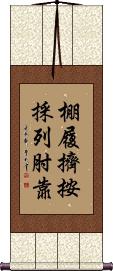
Peng, Lu, Ji, An, Cai, Lie, Zhou, and Kao are the eight fundamentals or forces of Tai Chi Chuan or Taiqiquan.
棚 (Peng) refers to the outward (or upward) expansion of energy.
履 (Lu) is often referred to as “rollback.” Lu is the ability to absorb, yield/deflect incoming force.
擠 (Ji) is often thought of as a “forward press.” However, it is also best described as a “squeezing out of space.”
按 (An) is a downward movement of energy, best translated as “(relaxed) sinking.”
採 (Cai or Tsai) translated as “downward pluck.” Cai is a combination of Lu and An.
列 (Lie or Lieh) is “Split” and is a combination of Peng and Ji.
肘 (Zhou) Elbowing.
靠 (Kao) Shouldering (for when the arms are bound/distance is too close to punch).
Source: https://combativecorner.wordpress.com/2015/12/03/the-8-energies-and-5-movements-of-taijiquan/
The following table may be helpful for those studying Chinese or Japanese...
| Title | Characters | Romaji (Romanized Japanese) | Various forms of Romanized Chinese | |
| Ch'ang Hon Taekwondo | 蒼軒跆拳道 苍轩跆拳道 | |||
| Dim Mak | 點脈 点脉 | diǎn mài / dian3 mai4 / dian mai / dianmai | tien mai / tienmai | |
| Eagle Claw Overturning Fist | 鷹爪翻子拳 鹰爪翻子拳 | yīng zhuǎ fān zi quán ying1 zhua3 fan1 zi5 quan2 ying zhua fan zi quan yingzhuafanziquan | ying chua fan tzu ch`üan yingchuafantzuchüan ying chua fan tzu chüan |
|
| Hello Ni Hao | 你好 | nǐ hǎo / ni3 hao3 / ni hao / nihao | ||
| Hishiryo Not-Thinking | 非思量 | hi shi ryou hishiryou hi shi ryo | fēi sī liáng fei1 si1 liang2 fei si liang feisiliang | fei ssu liang feissuliang |
| Taekwondo | 跆拳道 | te kon do / tekondo | tái quán dào tai2 quan2 dao4 tai quan dao taiquandao | t`ai ch`üan tao taichüantao tai chüan tao |
| Fundamental Principles of Tai Chi Chuan | 棚履擠按採列肘靠 棚履挤按采列肘靠 | péng lǚ jǐ àn cǎi liè zhǒu kào peng2 lv3 ji3 an4 cai3 lie4 zhou3 kao4 peng lv ji an cai lie zhou kao penglvjiancailiezhoukao | p`eng lü chi an ts`ai lieh chou k`ao peng lü chi an tsai lieh chou kao |
|
| In some entries above you will see that characters have different versions above and below a line. In these cases, the characters above the line are Traditional Chinese, while the ones below are Simplified Chinese. | ||||

Successful Chinese Character and Japanese Kanji calligraphy searches within the last few hours...



