Many custom options...


And formats...



Not what you want?
Try other similar-meaning words, fewer words, or just one word.
Hu Ku Ba Ri in Chinese / Japanese...
Buy a Hu Ku Ba Ri calligraphy wall scroll here!
Personalize your custom “Hu Ku Ba Ri” project by clicking the button next to your favorite “Hu Ku Ba Ri” title below...
Switched to secondary search mode due to lack of results using primary.
These secondary results may not be very accurate. Try a different but similar meaning word or phrase for better results. Or...
Look up Hu Ku Ba Ri in my Japanese Kanji & Chinese Character Dictionary(My dictionary is a different system then the calligraphy search you just tried)
If you want a special phrase, word, title, name, or proverb, feel free to contact me, and I will translate your custom calligraphy idea for you.
1. Amparo
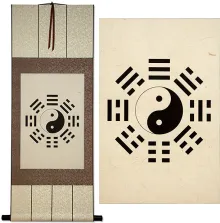
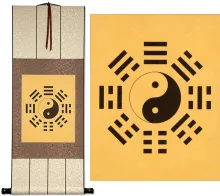
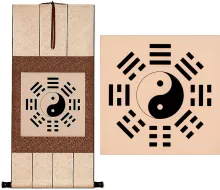
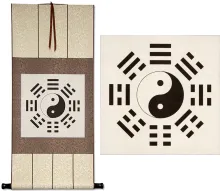
3. Ba Gua
4. Ba Gua Zhang
5. Ba Ji Quan
6. Birth / Life
8. Chun Ku Do
9. Benevolent and Skilled Doctor
10. Daddy / Father
11. Hu
12. A Journey of 1000 Miles Begins with a Single Step
13. Ku
14. Ku-Dan
15. Nashi
17. Japanese Snapping Turtle / Chinese Soft Shell Turtle
18. A Journey of 1000 Miles Feels Like One
19. Woo
Amparo
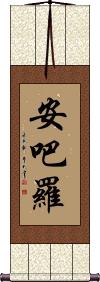
安吧羅 is the transliteration to Mandarin Chinese for the Latin / Spanish name Amparo.
Asahi / Morning Sun
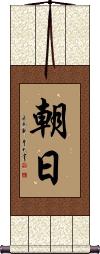
朝日 is a version of the Japanese name Asahi.
This can also be Ahisa, Asuka, Ashita, or Asaka. This means morning sun and is the name of the famous beer company in Japan.
This would be read as “Zhao Ri” in Mandarin where it means morning sun but is also known to be the Asahi company (maker of beer and other beverages).
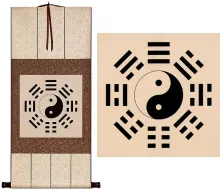
Ba Gua
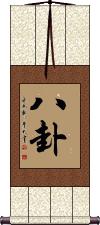
八卦 is the Chinese title for Bagua or Ba Gua.
Simply put, this represents the eight elements often seen around the yin-yang symbol.
Ba Gua Zhang
Martial arts style
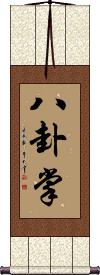
八卦掌 is the title Baguazhang, a form of Chinese boxing.
Literally translated, this means “Eight Trigrams Palm.”
You will also see this romanized as “Ba Gua Zhang,” “Bagua Zhang,” or “Pa Kua Chang” (same characters, just different spacing or romanization used in mainland China versus Taiwan).
八卦掌 is also known in Japan as hakkeshou or hakkesho.
Ba Ji Quan
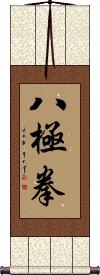
八極拳 is “Ba Ji Quan” or “Eight Extremes Fist.”
Some also translate this as “Eight Extremities Fist,” though I don't feel that's accurate.
八極拳 (Bājíquán) is a Chinese martial art that features explosive, short-range power and is famous for its elbow strikes. It originated in the Hebei Province in Northern China but spread to Taiwan and other places.
The full title is 開門八極拳 (Kāimén Bājíquán), which means Open-Door Bajiquan.
Other romanizations include: BaJiQuan, Pa Chi Ch`üan, or Pa Chi Chuan.
In Japan, this is known as Hakkyokuken.
Birth / Life
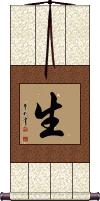
生 is a Chinese word that means “to be born” and “to give birth.”
Also, it's often used to refer to life itself, and sometimes “to grow.”
生 is used in a lot of compound words such as “yi sheng,” which means “doctor” (literally “healer of life”), “sheng ri” which means “birthday” (literally “birth-day”), and “xue sheng” which means student (literally “studying life” or “learner [about] life”). Few Chinese people will think of the literal meaning when this uses words like doctor and student - but it is interesting to note.
生 has the same root meaning in Korean Hanja and Japanese. However, in Japanese, there are many possible pronunciations, and this can be used to mean “raw” or “unprocessed” (as in draft beer). Therefore, not be the best if your audience is Japanese.
See Also: Vitality
Black Tiger Fist
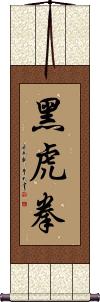
黑虎拳 is Hei Hu Quan or “Black Tiger Fist” - a school of Chinese Martial Arts.
Chun Ku Do

天國道 (or 천국도) is Chun Kuk Do, Korean and American martial arts hybrid system created by Chuck Norris.
Note: Chun Ku Do is now known as the Chuck Norris System.
If you want this in Korean Hangul, please click on the Korean Hangul, please click here instead of the button above: 천국도
Benevolent and Skilled Doctor
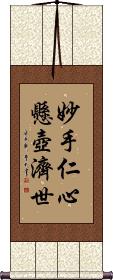
妙手仁心悬壶济世 is a phrase that celebrates the benevolence, skill, and service to his/her patients.
Here's a breakdown of the characters:
妙手 miào shǒu admirable skill in curing disease (when used in reference to doctors).
仁心 rén xīn kindheartedness, charity, benevolent heart.
悬壶济世 xuán hú jì shì practice medicine or pharmacy to help the people or the public.
Daddy / Father
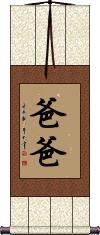
爸爸 is the colloquial way to say “Daddy” in Chinese.
Sometimes Chinese people will refer to their father with just one of these characters, “Ba,” which would be like “Dad.” With both characters, “Baba,” it's more like “Daddy.”
爸爸 is really a weird selection for a wall scroll, so consider this entry to be for educational purposes only (don't order this).

胡 is a common Chinese surname with ancient origins, often linked to noble lineages (like Duke Hu of Chen, a descendant of Emperor Shun), or the ancient State of Hu.
Other rare surnames such as 虎 (tiger), and 黃 or 許 romanize as Hu in some dialects.
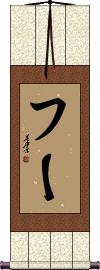
フー is the name Hu in Japanese Katakana.
Note: Because this title is entirely Japanese Katakana, it should be written by a Japanese calligrapher.
A Journey of 1000 Miles Begins with a Single Step
senri no michi mo ippo kara
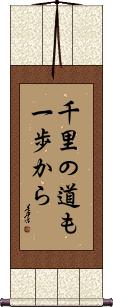
千里の道も一歩から is the Japanese version of an ancient Chinese proverb that means “a journey of a thousand miles begins with a single step.”
Some will also translate this as a 1000-mile road starts with one brick (a small amount).
In this case, the real measurement is an ancient Chinese “li” or 里, which is romanized as “ri” in Japanese. It's about half a kilometer, so three 里 would be a western mile. A journey of 333 miles begins with a single step, just doesn't sound as natural.
Note: Because this selection contains some special Japanese Hiragana characters, it should be written by a Japanese calligrapher.

顧 is one of several surnames that can romanize as Ku from Chinese; with the meaning, “to look after.”
Other Ku surnames include:
庫 (warehouse - possibly from officials managing them in ancient Zheng).
苦 (bitter).
丘/邱 (hill or mound).

ク is the name Ku in Japanese Katakana.
Note: Because this title is entirely Japanese Katakana, it should be written by a Japanese calligrapher.
Ku-Dan

九段 is a Japanese Kanji word that means “ninth degree” (in martial arts, go, shogi, etc.).
九段 is the ninth black belt rank in Japanese martial arts.
The first Kanji means nine or ninth in Japanese.
The second Kanji means step, grade, rank, or level.
Nashi
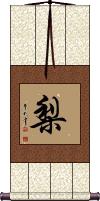
This Japanese Kanji means pear.
This refers specifically to the Pyrus pyrifolia and more specifically the culta variety. This is also known as the Japanese pear, Asian pear, sand pear, or apple pear.
梨 is also a female given name or surname in Japan that beyond Nashi, can be romanized as Rin, Rika, Ri, Nashisaki, or Shina.
In Chinese, this is pronounced like lee or li and just means pear.
Satori / Enlightenment
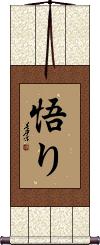
悟り is the Japanese term for enlightenment which can also mean to perceive, discern, realize, understand, or comprehend.
The first character has the same meaning in Chinese and Korean but has deeper significance in Japanese culture and language. This version of Satori incorporates the Japanese secondary character (Hiragana, not Kanji) that adds the “ri” to Satori. It's unnecessary to have the second character, as it does not add to the meaning as much as clarity for the context in which you are using this term.
Japanese Snapping Turtle / Chinese Soft Shell Turtle
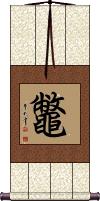
鼈 refers to a species of turtle.
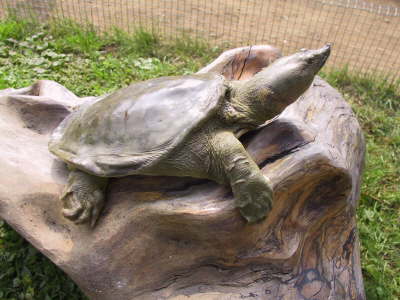
鼈 is Trionyx Sinensis.
鼈 refers to different turtles in different languages. See individual language notes below:
Japanese: 鼈 means “snapping turtle” or “mud turtle.” But rarely used as a single Kanji like this in Japanese.
Chinese: 鼈 means soft-shelled turtle. A specific species, Trionyx Sinensis is native to Asia.
In China, this species is related to the “wang ba,” a soft-shelled turtle sometimes known in English as a banjo turtle (due to its long neck, and general shape). Unfortunately, there is a word, “wang ba dan” which means the egg of this species of turtle. That term has come to mean “bastard” in Chinese (a turtle hatches from an abandoned egg, and does not know who his mother or father is). 鼈 is not a good selection for a wall scroll if your audience is Chinese.
In Korean, this character can be pronounced (though most Koreans would have to look it up in a dictionary). It has not been in common use in Korea for at least a few hundred years.
General notes: You may notice that the bottom half of this character is the same as some other turtle-related titles. That bottom half is actually an ancient character that means “toad.”  Though not seen in this way today, most turtle-related characters hold the meaning of “a toad with a shell” in their ancient origin. That toad character is rarely used alone anymore but you can see what it looks like in the image to the right.
A Journey of 1000 Miles Feels Like One
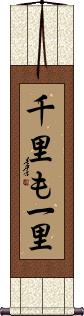
千里も一里 is a Japanese proverb that states “A journey of a thousand miles feels like only one mile.” It is understood that in the proverb, this applies when going to see the one you love.
Note that the “mile” or 里 used in this proverb is an old Chinese “li” (pronounced “ri” in Japanese). It's not actually a mile, as the measurement is really closer to 500 meters (it would take 3 of these to get close to a western mile). Still, 1000里 (333 miles) is a long way.

伍 is a Cantonese surname that can romanize as Woo.
There is more than one Woo: The surname "Woo" (우/吳/胡/禹/武) is common in East Asia, primarily Chinese and Korean, stemming from various characters with different origins, often romanized from Cantonese (like 吳 Wú or 胡 Hú) or Korean (like 禹), meaning leadership, history, or related to ancient states and figures like Yu the Great, symbolizing diligence and heritage.
This in-stock artwork might be what you are looking for, and ships right away...
Gallery Price: $90.00
Your Price: $49.88
Gallery Price: $90.00
Your Price: $49.88
Gallery Price: $90.00
Your Price: $49.88
Gallery Price: $90.00
Your Price: $49.88
The following table may be helpful for those studying Chinese or Japanese...
| Title | Characters | Romaji (Romanized Japanese) | Various forms of Romanized Chinese | |
| Amparo | 安吧羅 安吧罗 | ān ba luó an1 ba luo2 an ba luo anbaluo | an pa lo anpalo |
|
| Asahi Morning Sun | 朝日 | asahi | zhāo rì zhao1 ri4 zhao ri zhaori | chao |
| Ba Gua | 八卦 | bā guà / ba1 gua4 / ba gua / bagua | pa kua / pakua | |
| Ba Gua Zhang | 八卦掌 | hakkeshou / hakesho | bā guà zhǎng ba1 gua4 zhang3 ba gua zhang baguazhang | pa kua chang pakuachang |
| Ba Ji Quan | 八極拳 八极拳 | hakkyo ku ken hakkyokuken hakyo ku ken | bā jí quán ba1 ji2 quan2 ba ji quan bajiquan | pa chi ch`üan pachichüan pa chi chüan |
| Birth Life | 生 | shou / iku / sho / iku | shēng / sheng1 / sheng | |
| Black Tiger Fist | 黑虎拳 | hēi hǔ quán hei1 hu3 quan2 hei hu quan heihuquan | hei hu ch`üan heihuchüan hei hu chüan |
|
| Chun Ku Do | 天國道 天国道 | ten goku dou tengokudou ten goku do | tiān guó dào tian1 guo2 dao4 tian guo dao tianguodao | t`ien kuo tao tienkuotao tien kuo tao |
| Benevolent and Skilled Doctor | 妙手仁心懸壺濟世 妙手仁心悬壶济世 | miào shǒu rén xīn xuán hú jì shì miao4 shou3 ren2 xin1 xuan2 hu2 ji4 shi4 miao shou ren xin xuan hu ji shi | miao shou jen hsin hsüan hu chi shih | |
| Daddy Father | 爸爸 | bà ba / ba4 ba / ba ba / baba | pa pa / papa | |
| Hu | 胡 | hú / hu2 / hu | ||
| Hu | フー | fuu / fu | ||
| A Journey of 1000 Miles Begins with a Single Step | 千里の道も一歩から | sen ri no michi mo i-ppo ka ra senrinomichimoi-ppokara sen ri no michi mo i-po ka ra | ||
| Ku | 顧 顾 | gù / gu4 / gu | ku | |
| Ku | ク | ku | ||
| Ku-Dan | 九段 | ku dan / kudan | ||
| Nashi | 梨 | nashi | lí / li2 / li | |
| Satori Enlightenment | 悟り | satori | ||
| Japanese Snapping Turtle Chinese Soft Shell Turtle | 鼈 | suppon / supon | biē / bie1 / bie | pieh |
| A Journey of 1000 Miles Feels Like One | 千里も一里 | sen ri mo ichi ri senrimoichiri | ||
| Woo | 伍 | wǔ / wu3 / wu | ||
| In some entries above you will see that characters have different versions above and below a line. In these cases, the characters above the line are Traditional Chinese, while the ones below are Simplified Chinese. | ||||

Successful Chinese Character and Japanese Kanji calligraphy searches within the last few hours...



