Many custom options...


And formats...



Independent in Chinese / Japanese...
Buy an Independent calligraphy wall scroll here!
Personalize your custom “Independent” project by clicking the button next to your favorite “Independent” title below...
1. Independent Spirit / Independent Heart
3. Independence
4. Standing by Oneself / Walking by Oneself
6. Brunei
7. Riko
8. Samoa
9. Hitori
10. Strong Woman
11. Appreciation of Truth by Meditation
12. Nothingness
Independent Spirit / Independent Heart
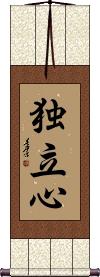
獨立心 means independent spirit or independent heart in Japanese.
The first two characters mean independent or independence. The third character means spirit, heart, or mind.
獨立心 is a Japanese term, although Chinese people could guess the meaning (the characters make sense individually in Chinese but are not often used this way). Also, the first character would be written 獨 in Traditional Chinese versus 独 which is the Simplified Chinese and modern Japanese version.
Independent Spirit
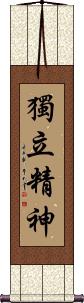
獨立精神 means independent spirit in Chinese.
The first two characters mean independent, independence, or to stand alone.
The last two characters mean spirit, spiritual, vigor, vitality, drive, mind, consciousness, thought, essence, heart, or soul.
With this information, you can make your translation combination such as “independent heart,” “stand-alone spirit,” or more creatively, “the drive to stand alone” in English. There are a lot of ways to interpret 獨立精神.
Independence
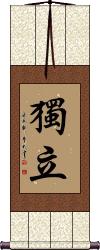
Besides meaning “to be independent,” this can also mean “to stand alone,” self-reliance or self-support.
 Modern Japanese use a simplified version of the first character of independence.
it’s
the same simplified version currently used in mainland China, so understood by most Chinese and all Japanese people. Click on the character to the right if you want the simplified/Japanese version.
Modern Japanese use a simplified version of the first character of independence.
it’s
the same simplified version currently used in mainland China, so understood by most Chinese and all Japanese people. Click on the character to the right if you want the simplified/Japanese version.
Standing by Oneself / Walking by Oneself
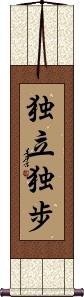
獨立獨步 is a Japanese proverb that, Dokuritsu-Doppo, is an indication of independence, self-reliance, standing on one's own two feet, or making one's way in life.
American Samoa
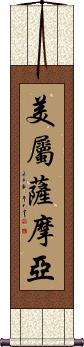
This is the Chinese name for the territory of American Samoa (formerly known as Eastern Samoa).
This should not be confused with Independent Somoa which is to the west.
If you want just a general “Samoa” title, just use the plain “Samoa” entry, as it does not actually designate western, eastern, American, or independent.
See Also: Oceania
Brunei
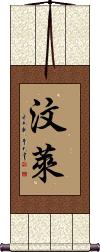
汶萊 is the Chinese name for Brunei Darussalam, an independent sultanate in northwest Borneo.
Sometimes also written as 文萊 or 文莱.
Riko
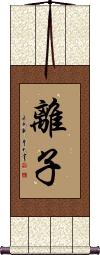
離子 is one of several Japanese female given names that romanize as Riko.
This one vaguely means independent child. Though it can also refer to an ion (a departing particle).
Samoa
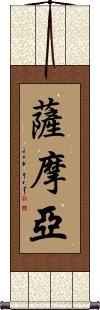
薩摩亞 is the Chinese name for the country of Samoa (formerly known as Western Samoa).
The official name is the Independent State of Samoa. Not to be confused with American Somoa which is to the southeast.
See Also: Oceania
Hitori
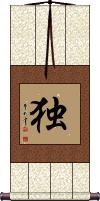
This is the Japanese given name 独 which romanizes as Hitori or Doku.
Originally this was written as 獨 but was simplified/modernized in Japan at some point.
独 can also be an abbreviation for Germany.
The actual meaning is alone, independent, single, sole, only, or solitary.
This is also a Simplified Chinese character, but most Chinese calligraphers would prefer to write the Traditional Chinese of 獨 instead of 独.
Strong Woman
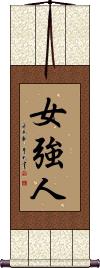
女強人 is the best way to say “strong woman” or “strong and independent woman” in Chinese.
Grammar in China is a bit different, so these three characters literally read as “female strength person” or “woman strong person.” This might sound funny in English, but this is a natural-sounding title in Chinese.
Appreciation of Truth by Meditation
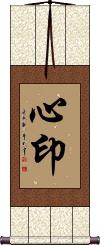
心印 is a Buddhist concept that simply stated is “appreciation of truth by meditation.”
It's a deep subject, but my understanding is that you can find truth through meditation, and once you've found the truth, you can learn to appreciate it more through further meditation. This title is not commonly used outside of the Buddhist community (your Asian friends may or may not understand it). The literal translation would be something like “the mind seal,” I've seen this term translated this way from Japanese Buddhist poetry. But apparently, the seal that is stamped deep in your mind is the truth. You just have to meditate to find it.
Soothill defines it this way: Mental impression, intuitive certainty; the mind is the Buddha-mind in all, which can seal or assure the truth; the term indicates the intuitive method of the Chan (Zen) school, which was independent of the spoken or written word.
Reference: Soothill-Hodous Dictionary of Chinese Buddhism
See Also: Zen
Nothingness
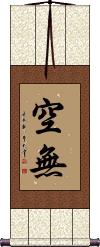
空無 is “nothingness” in a Buddhist context.
The first character means empty but can also mean air or sky (air and sky have no form).
The second character means have not, no, none, not, or to lack.
Together these characters reinforce each other into a word that means “absolute nothingness.”
I know this is a term used in Buddhism, but I have not yet figured out the context in which it is used. I suppose it can be the fact that Buddhists believe that the world is a non-real illusion, or perhaps it's about visualizing yourself as “nothing” and therefore leaving behind your desire and worldliness.
Buddhist concepts and titles often have this element of ambiguity or, rather, “mystery.” Therefore, such ideas can have different meanings to different people, and that's okay. If you don't get it right in this lifetime, there will be plenty more lifetimes to master it (whatever “it” is, and if “it” really exists at all).
Soothill defines this as “Unreality, or immateriality, of things, which is defined as nothing existing of independent or self-contained nature.”
These search terms might be related to Independent:
...And This Above All to Thine Own Self Be True
Changing Oneself / Self Reformation
Consciousness of Self
Fair / Impartial
Free Spirit
Free Will
Impartial and Fair to the Brotherhood and Sisterhood of the World
Inner Strength / Self-Improvement
Introspection / Self-Awareness
Jiko No Kansei / Self-Completion
Live Free or Die
Peaceful / Tranquil / Calm / Free From Worry
Power of Oneself / Self-Sufficient
Prideful Mind / Self-Respecting Heart
Self Actualization
Self Awareness Becomes a Buddha
Self Consciousness
Self Sacrifice
Self-Confidence
Self-Control
Self-Defense
Self-Discipline / Will-Power
Self-Discipline and Martial Virtue
Self-Discipline Martial Arts
Self-Improvement
Self-Love / Love Yourself / Love Oneself
Self-Reliance
Self-Respect / Self-Esteem
Self-Restraint / Self-Control
Soldier / Private
To Be Free / Freedom
To Thine Own Self Be True
Unselfish: Perfectly Impartial
Unyielding Self-Reliance
Will-Power / Self-Control
The following table may be helpful for those studying Chinese or Japanese...
| Title | Characters | Romaji (Romanized Japanese) | Various forms of Romanized Chinese | |
| Independent Spirit Independent Heart | 獨立心 独立心 | dokuritsushin | ||
| Independent Spirit | 獨立精神 独立精神 | dú lì jīng shén du2 li4 jing1 shen2 du li jing shen dulijingshen | tu li ching shen tulichingshen |
|
| Independence | 獨立 独立 | dokuritsu | dú lì / du2 li4 / du li / duli | tu li / tuli |
| Standing by Oneself Walking by Oneself | 獨立獨步 独立独步 | do kuritsu do ppo dokuritsudoppo do kuritsu do po | ||
| American Samoa | 美屬薩摩亞 美属萨摩亚 | měi shǔ sà mó yà mei3 shu3 sa4 mo2 ya4 mei shu sa mo ya meishusamoya | ||
| Brunei | 汶萊 汶莱 | wèn lái / wen4 lai2 / wen lai / wenlai | ||
| Riko | 離子 | riko | lí zǐ / li2 zi3 / li zi / lizi | li tzu / litzu |
| Samoa | 薩摩亞 萨摩亚 | sà mó yà sa4 mo2 ya4 sa mo ya samoya | ||
| Hitori | 独 | hitori / doku | dú / du2 / du | tu |
| Strong Woman | 女強人 女强人 | nǚ qiáng rén nv3 qiang2 ren2 nv qiang ren nvqiangren | nü ch`iang jen nüchiangjen nü chiang jen |
|
| Appreciation of Truth by Meditation | 心印 | shin nin / shinnin | xīn yìn / xin1 yin4 / xin yin / xinyin | hsin yin / hsinyin |
| Nothingness | 空無 空无 | kuu mu / kuumu / ku mu | kōng wú / kong1 wu2 / kong wu / kongwu | k`ung wu / kungwu / kung wu |
| In some entries above you will see that characters have different versions above and below a line. In these cases, the characters above the line are Traditional Chinese, while the ones below are Simplified Chinese. | ||||

Successful Chinese Character and Japanese Kanji calligraphy searches within the last few hours...



