Many custom options...


And formats...



Not what you want?
Try other similar-meaning words, fewer words, or just one word.
Live Without in Chinese / Japanese...
Buy a Live Without calligraphy wall scroll here!
Personalize your custom “Live Without” project by clicking the button next to your favorite “Live Without” title below...
2. No Regrets
6. Freedom from Anger and Worry Yields Longevity
Live Without Regret
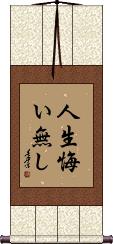
人生悔い無し is how to say “live without regrets” in Japanese.
Note: Because this selection contains some special Japanese Hiragana characters, it should be written by a Japanese calligrapher.
See Also: Live for Today
Live Without Regret
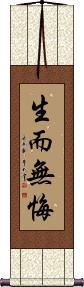
生而無悔 is how to say “live without regrets” in Mandarin Chinese.
Note: There is some debate about whether this makes sense in Japanese. It would be read, "nama ji mu ke," and be understood in Japanese. But, a Japanese person will probably think it’s Chinese (not Japanese).
See Also: Live for Today
No Regrets
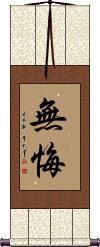
無悔 is how to say “no regrets” in Mandarin Chinese.
This also makes sense in Japanese, though not the most common way to express “no regrets” in Japanese.
See Also: Live for Today
No Regrets
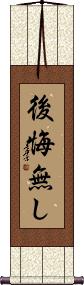
Die Without Regret
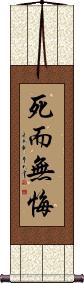
死而無悔 is how to say “die with no regrets” in Mandarin Chinese.
This proverb comes from the Analects of Confucius.
See Also: No Regrets
Live Free or Die
Give me liberty or give me death
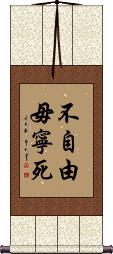
不自由毋寧死 means “Give me liberty or give me death” in Chinese.
This is also the best way to say, “Live free or die.”
The characters break down this way:
不 = Not; none; without.
自由 = Freedom; liberty; freewill; self-determination.
毋寧 = Rather; would rather; rather be.
死 = Dead; death.
This will go nicely next to your “Don't tread on me” flag. This phrase is known well enough in China that it's listed in a few dictionaries. Though I doubt you will find too many Chinese citizens willing to yell this on the steps of the capital in Beijing.
See Also: Death Before Dishonor
Immortal / Immortality
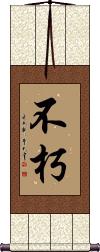
不朽 means immortal or immortality in Chinese, Japanese Kanji, and old Korean Hanja.
The literal translation is “without decay” or “never rotting.” This title speaks of something or someone who never dies and thus never rots or decays.
This can also be translated as everlasting, eternal, or imperishable.
Freedom from Anger and Worry Yields Longevity
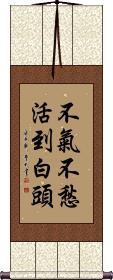
不气不愁活到白头 is a Chinese proverb that means “Without anger or worry, you will have a long life, until after all your hair is white.”
It more literally reads, “Don't get angry or worried [and you will] live [long] till [all your] hair [becomes] white.”
The Single Life
Dokushin-Kizoku
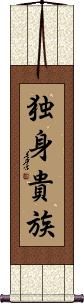
独身贵族 is a Japanese proverb that means “Single Aristocrat” or “Single Noble.”
The understood meaning is that single people can live freely without a spouse or kids to support them. To put it in an old cliché, they are footloose and fancy-free.
If you are a bachelor or bachelorette with few responsibilities and just a thirst for freedom and a worry-free life, this could be your title.
A sly rabbit has three openings to its den
-or- The crafty rabbit has three different entrances to its lair
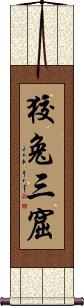
狡兔三窟 speaks to the cunning character of a sly rabbit. Such a rabbit will not have just one hole but rather a few entrances and exits from his liar.
About 2,250 years ago, a rich man told his assistant to go and buy something wonderful that he did not yet possess. He was a man that already had everything, so the assistant went to a local village that owed a great deal of money to the rich man. The assistant told the village elders that all debts were forgiven. All the villagers rejoiced and praised the rich man's name. The assistant returned to the rich man and told him he had purchased “benevolence” for him. The rich man was mildly amused but perhaps slightly confused by the action.
Sometime later, the rich man fell from the favor of the Emperor and was wiped out without a penny to his name. One day he was walking aimlessly and stumbled into the village where the debts had been forgiven. The villagers recognized the man and welcomed him with open arms, clothed, fed him, and gave him a place to live.
Without trying, the man had become like the sly and cunning rabbit. When his exit was blocked, he had another hole to emerge from - and was reborn. This story and idiom come from a book titled “The Amendment” - it's unclear whether this man actually existed or not. But the book did propel this idiom into common use in China.
Still today, this idiom about the rabbit is used in China when suggesting “backup plans,” alternate methods, and anyone with a good escape plan.
Frightful Demon / Asura
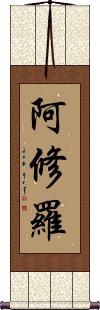
This demon title comes from the ancient Sanskrit word Asura.
阿修羅 is often used in Buddhism when describing various demons. Sometimes defined as “Fighting and battling a giant demon.”
In the context of Buddhism: This title originally meant a spirit, spirits, or even the gods (perhaps before 1700 years ago). It now generally indicates titanic demons, enemies of the gods, with whom, especially Indra, they wage constant war. They are defined as “not devas,” “ugly,” and “without wine.” There are four classes of asuras, separated according to their manner of rebirth. They can be egg-born, womb-born, transformation-born, and spawn- or water-born. Their abode is in the ocean, north of Sumeru but certain of the weaker dwell in a western mountain cave. They have realms, rulers, and palaces, as have the devas.
In terms of power, Asuras rank above humans but below most other deities. They live near the coastal foot of Mount Sumeru (on the northern side). Their domain is partially or wholly in the ocean.
This in-stock artwork might be what you are looking for, and ships right away...

Gallery Price: $61.00
Your Price: $33.88

Gallery Price: $202.00
Your Price: $111.88

Gallery Price: $106.00
Your Price: $58.88
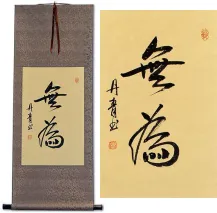
Gallery Price: $79.00
Your Price: $43.88

Gallery Price: $168.00
Your Price: $92.88

Gallery Price: $31.00
Your Price: $16.88
Gallery Price: $52.00
Your Price: $28.88

Gallery Price: $200.00
Your Price: $122.88
The following table may be helpful for those studying Chinese or Japanese...
| Title | Characters | Romaji (Romanized Japanese) | Various forms of Romanized Chinese | |
| Live Without Regret | 人生悔い無し | jinsei kui nashi jinseikuinashi | ||
| Live Without Regret | 生而無悔 生而无悔 | shēng ér wú huǐ sheng1 er2 wu2 hui3 sheng er wu hui shengerwuhui | sheng erh wu hui shengerhwuhui |
|
| No Regrets | 無悔 无悔 | mu ke / muke | wú huǐ / wu2 hui3 / wu hui / wuhui | |
| No Regrets | 後悔無し | kou kai na shi koukainashi ko kai na shi | ||
| Die Without Regret | 死而無悔 死而无悔 | sǐ ér wú huǐ si3 er2 wu2 hui3 si er wu hui sierwuhui | ssu erh wu hui ssuerhwuhui |
|
| Live Free or Die | 不自由毋寧死 不自由毋宁死 | bú zì yóu wú nìng sǐ bu2 zi4 you2 wu2 ning4 si3 bu zi you wu ning si buziyouwuningsi | pu tzu yu wu ning ssu putzuyuwuningssu |
|
| Immortal Immortality | 不朽 | fukyuu / fukyu | bù xiǔ / bu4 xiu3 / bu xiu / buxiu | pu hsiu / puhsiu |
| Freedom from Anger and Worry Yields Longevity | 不氣不愁活到白頭 不气不愁活到白头 | bù qì bù chóu huó dào bái tóu bu4 qi4 bu4 chou2 huo2 dao4 bai2 tou2 bu qi bu chou huo dao bai tou buqibuchouhuodaobaitou | pu ch`i pu ch`ou huo tao pai t`ou puchipuchouhuotaopaitou pu chi pu chou huo tao pai tou |
|
| The Single Life | 独身貴族 / 獨身貴族 独身贵族 | do kushin ki zoku dokushinkizoku | ||
| A sly rabbit has three openings to its den | 狡兔三窟 | jiǎo tù sān kū jiao3 tu4 san1 ku1 jiao tu san ku jiaotusanku | chiao t`u san k`u chiaotusanku chiao tu san ku |
|
| Frightful Demon Asura | 阿修羅 阿修罗 | ashura | ē xiū luó e1 xiu1 luo2 e xiu luo exiuluo | o hsiu lo ohsiulo |
| In some entries above you will see that characters have different versions above and below a line. In these cases, the characters above the line are Traditional Chinese, while the ones below are Simplified Chinese. | ||||

Successful Chinese Character and Japanese Kanji calligraphy searches within the last few hours...



