Many custom options...


And formats...



Not what you want?
Try other similar-meaning words, fewer words, or just one word.
Live Your Live in Chinese / Japanese...
Buy a Live Your Live calligraphy wall scroll here!
Personalize your custom “Live Your Live” project by clicking the button next to your favorite “Live Your Live” title below...
3. Optimism / Happy With Your Fate
8. Birth / Life
13. Freedom from Anger and Worry Yields Longevity
14. Love Life
15. Madly in Love
20. Banzai
21. Dignity / Honor / Sanctity / Integrity
22. The Single Life
23. Thug Life
24. Clarity
25. Choose Life
26. Tiger Rumor
Living / Live Life
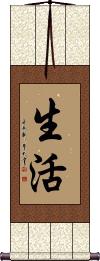
生活 means life, living, to live, or the state of being alive. It can also refer to your daily existence or livelihood. It can also be a suggestion to just “Live life.”
生活 is also the term used in other titles such as “healthy living” or Lance Armstrong's “Livestrong” campaign (Chinese title for Livestrong only).
If you need a reminder that you are alive and to take a breath, this might be the perfect wall scroll for you.
Live For The Day
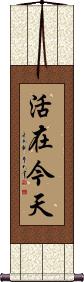
活在今天 is not an eastern concept, so it does not translate into a phrase that seems natural on a wall scroll.
However, if this is your philosophy, the characters shown here do capture your idea of living for today or living in the moment. 活在今天 says “Live in today,” and they are grammatically correct in Chinese.
Note: This kind of makes sense in Korean Hanja but the grammar is Chinese, so it’s not that natural in Korean.
Optimism / Happy With Your Fate
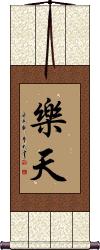
樂天 is about being optimistic and also making the best of whatever life throws at you.
This is hard to define. One dictionary defines this as “acceptance of fate and happy about it.” There is one English word equivalent, which is sanguinity or sanguinary.
You can also say that this means “Be happy with whatever Heaven provides,” or “Find happiness in whatever fate Heaven bestows upon you.” 樂天 suggests being an optimist in life.
Note: This is sometimes a given name in China.
 Please note that Japanese tend to write the first character in a slightly-different form (as seen to the right). Let us know if you have a preference when you place your order.
Live in Prosperity
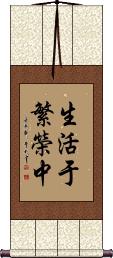
生活于繁榮中 means “live in prosperity.” It's kind of a suggestion to be prosperity the center of your world.
This is the way some people want to live (and you should always live for what you love). However, this phrase does not suggest a peaceful life - rather one that is always busy. It's not for everyone, but it might be for you.
See Also: Prosperity
Live for What You Love
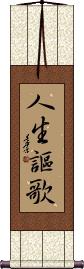
人生謳歌 means “live for what you love” in Japanese.
The first two characters mean “human life” or simply “living.” The last two characters mean “merit,” “prosperity,” or “what you enjoy.” This phrase can suggest working or staying busy for your own goals (in your career).
See Also: Prosperity
Live Free or Die
Give me liberty or give me death
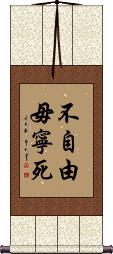
不自由毋寧死 means “Give me liberty or give me death” in Chinese.
This is also the best way to say, “Live free or die.”
The characters break down this way:
不 = Not; none; without.
自由 = Freedom; liberty; freewill; self-determination.
毋寧 = Rather; would rather; rather be.
死 = Dead; death.
This will go nicely next to your “Don't tread on me” flag. This phrase is known well enough in China that it's listed in a few dictionaries. Though I doubt you will find too many Chinese citizens willing to yell this on the steps of the capital in Beijing.
See Also: Death Before Dishonor
Life is Short
A 100-year-old is but a traveler passing through this life
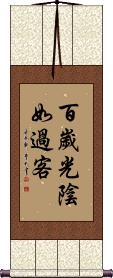
百歲光陰如過客 directly translates as: [Even a] hundred-year-old [person] is [just a] traveler passing by.
The simple message is, “Human life is short.” Of course, there is an unspoken suggestion that you should make the best of your time here on earth.
Birth / Life
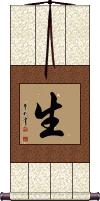
生 is a Chinese word that means “to be born” and “to give birth.”
Also, it's often used to refer to life itself, and sometimes “to grow.”
生 is used in a lot of compound words such as “yi sheng,” which means “doctor” (literally “healer of life”), “sheng ri” which means “birthday” (literally “birth-day”), and “xue sheng” which means student (literally “studying life” or “learner [about] life”). Few Chinese people will think of the literal meaning when this uses words like doctor and student - but it is interesting to note.
生 has the same root meaning in Korean Hanja and Japanese. However, in Japanese, there are many possible pronunciations, and this can be used to mean “raw” or “unprocessed” (as in draft beer). Therefore, not be the best if your audience is Japanese.
See Also: Vitality
Life is a Journey
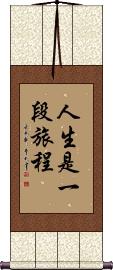
人生是一段旅程 is a proverb that means “Life is a Journey.”
If this matches your philosophy, this might be the perfect Chinese calligraphy for you.
Realize Your Dreams
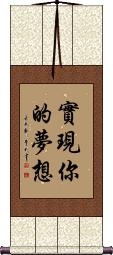
實現你的夢想 means “realize your dreams” or “live your dreams” in Chinese.
實現 means to achieve, to implement, to realize, or to bring about.
The characters 你的 effectively mean “your.”
夢想 means to dream, imagine, or have a vision.
Learning is Eternal
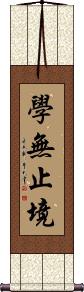
This Chinese philosophy tells of how we continue to learn throughout our lives.
This proverb can be translated in a few ways such as “Study has no end,” “Knowledge is infinite,” “No end to learning,” “There's always something new to study,” or “You live and learn.”
The deeper meaning: Even when we finish school we are still students of the world gaining more knowledge from our surroundings with each passing day.
See Also: An Open Book Benefits Your Mind | Wisdom | Learn From Wisdom
Death Before Dishonor
Better to be broken jade than unbroken pottery
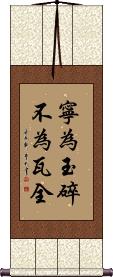
寧為玉碎不為瓦全 is the long version of a Chinese proverb that means “rather be shattered piece of jade than an unbroken piece of pottery.”
A little more explanation:
Death is implied with the “broken” meaning. Jade is one of the most precious materials in Chinese history, and in this case, is compared with one's honor and self-worth. Pottery is just something you eat off of, it has no deep value, just as a person who has lost their honor, or had none to begin with.
Thus, this means “better to die with honor than to live in shame” or words to that effect.
寧為玉碎不為瓦全 is often translated in English as “Death Before Dishonor,” the famous military slogan.
I would also compare this to the English proverb, “Better to die on your feet than to live on your knees.”
This is an idiom. It therefore doesn’t directly say exactly what it means. If you think about the English idiom, "The grass is always greener," it does not directly say "jealousy" or "envy" but everyone knows that it is implied.
Freedom from Anger and Worry Yields Longevity
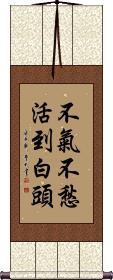
不气不愁活到白头 is a Chinese proverb that means “Without anger or worry, you will have a long life, until after all your hair is white.”
It more literally reads, “Don't get angry or worried [and you will] live [long] till [all your] hair [becomes] white.”
Love Life
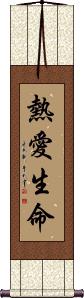
熱愛生命 is the Chinese phrase for “Love Life” or “Love of Life.”
If you love your life or want a reminder on your wall to keep you loving your life each day, this is the selection for you.
To clarify, this is different than “A life full of love,” or “love while you live.” With this phrase, you are loving the state of being alive.
Note: Korean pronunciation is included above, though use of this phrase in Korean has not been verified.
Madly in Love
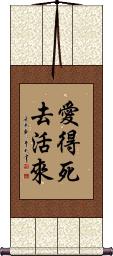
爱得死去活来 is a Chinese phrase that means “to be madly in love.”
It almost literally means “Love as if your life depended on it,” or “Love you to death, just to live.”
Tanjun / Simplicity
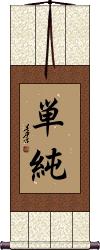
単純 or Tanjun is a Japanese word that means simplicity, simple, and/or uncomplicated.
Do you want to live the “tanjun lifestyle”? Maybe this wall scroll will remind you to uncomplicate your life.
Death Before Dishonor
Better to be broken jade than unbroken pottery
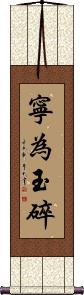
寧為玉碎 is the short version of a longer Chinese proverb which means “rather be shattered piece of jade than an unbroken piece of pottery.”
寧為玉碎 says the “rather be a broken piece of jade” part (the second half is implied - everyone in China knows this idiom).
A little more explanation:
Death is implied with the “broken” meaning. Jade is one of the most precious materials in Chinese history, and in this case, is compared with one's honor and self-worth. Pottery is just something you eat off of; it has no deep value, just as a person who has lost their honor or had none to begin with.
Thus, this means “better to die with honor than to live in shame” or words to that effect.
This is often translated in English as “Death Before Dishonor,” the famous military slogan.
I would also compare this to the English proverb, “Better to die on your feet than to live on your knees.”
Death Before Surrender
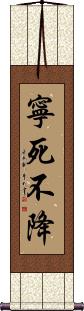
寧死不降 is an ancient Chinese proverb that can be translated as “Rather die than surrender,” “Prefer death over surrender,” “To prefer death to surrender,” or simply “No surrender.”
This is probably the closest proverb to the English proverb “Better to die on your feet than to live on your knees.”
Together Forever in Love
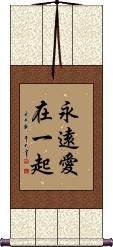
永遠愛在一起 is “together forever in love” in Chinese.
It's a nice phrase if you're a couple who plans to stay together and make your love last as long as you live.
Banzai
Modern Japanese Version
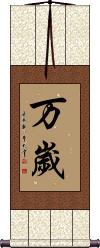
万歲 is the modern Japanese way to write banzai.
We've made two almost identical entries for this word, with just a variation on the first character. In the last century, 萬 was simplified to 万 in Japan and China. The new generation will expect it to be written as 万 but the old generation can still read the more traditional 萬 form. You must make your determination as to what version is best for you. If your audience is mostly Japanese, I suggest 万歲.
While it has become a popular, if not an odd, thing to scream as you jump out of an airplane (preferably with a parachute attached), banzai is actually a very old Asian way to say “hooray.” The Japanese word “banzai” comes from the Chinese word “wan sui” which means “The age of 10,000 years.” It is actually a wish that the Emperor or the Empire live that long.
Imagine long ago when the Emperor made a rare public appearance. This is what all of the people would yell to their leader in respect.
So if you like it as a hooray, or you want to wish someone that they live for 10,000 years, this is the calligraphy for you.
To other things with banzai in their names, I am still waiting for the promised sequel to Buckaroo Banzai.
Other translations: hurrah, long life, congratulations, cheers, live long.
Notes: Sometimes people confuse banzai with bonsai. A bonsai is a miniature tree. They have nothing to do with each other. Further, Bonzai is not a word at all - although it would make a great name for a calcium supplement for older people.
Dignity / Honor / Sanctity / Integrity
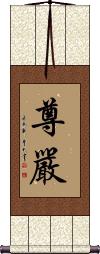
尊嚴 is a form of honor that means showing great respect for yourself, other people, and the rules you live by.
When you are honorable, you keep your word. You do the right thing regardless of what others are doing.
尊嚴 is the kind of personal honor or dignity that is of great value. If you lose this, you have lost yourself and perhaps the reputation of your family as well.
While this is not directly the same thing as “face” or “saving face” in Asian culture, it is associated with the same concept in China.
 In Japan, they currently use a more simplified second character for this word. The ancient Japanese form is the same as China but after WWII some Kanji were changed. If you want the modern Japanese version, just click on the Kanji image shown to the right, instead of the button above.
The Single Life
Dokushin-Kizoku
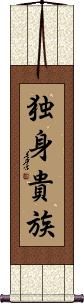
独身贵族 is a Japanese proverb that means “Single Aristocrat” or “Single Noble.”
The understood meaning is that single people can live freely without a spouse or kids to support them. To put it in an old cliché, they are footloose and fancy-free.
If you are a bachelor or bachelorette with few responsibilities and just a thirst for freedom and a worry-free life, this could be your title.
Thug Life
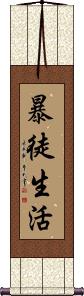
暴徒生活 is probably the best way to say “Thug Life” in Chinese, Japanese, and Korean.
It's a strange title, to be sure, so expect native Asian people to be confused when they see your Thug Life calligraphy.
The first two characters mean bandit, thug, ruffian, insurgent, rioter, or mob.
The last two characters mean life, live, or living.
Clarity
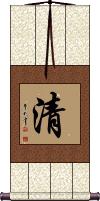
清 is a word that means clarity or clear in Chinese, Japanese Kanji, and old Korean Hanja.
Looking at the parts of this character, you have three splashes of water on the left, “life” on the top right, and the moon on the lower right.
Because of something Confucius said about 2500 years ago, you can imagine that this character means “live life with clarity like bright moonlight piercing pure water.” The Confucian idea is something like “Keep clear what is pure in yourself, and let your pure nature show through.” Kind of like saying, “Don't pollute your mind or body, so that they remain clear.”
This might be stretching the definition of this single Chinese character but the elements are there, and “clarity” is a powerful idea.
Korean note: Korean pronunciation is given above but this character is written with a slight difference in the "moon radical" in Korean. However, anyone who can read Korean Hanja, will understand this character with no problem (this is considered an alternate form in Korean). If you want the more standard Korean Hanja form (which is an alternate form in Chinese), just let me know.
Japanese note: When reading in Japanese, this Kanji has additional meanings of pure, purify, or cleanse (sometimes to remove demons or "exorcise"). Used more in compound words in Japanese than as a stand-alone Kanji.
Choose Life
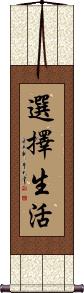
選擇生活 can mean to choose life instead of death (or suicide) or to choose to live life to the fullest.
I think of it as the key phrase used by Renton (Ewan McGregor) in the movie Trainspotting. While Chinese people will not think of Trainspotting when they see this phrase, for me, it will always be what comes near the end of this colorful rant:
Choose life. Choose a job. Choose a career. Choose a family. Choose a fucking big television. Choose washing machines, cars, compact disc players, and electrical tin can openers. Choose good health, low cholesterol, and dental insurance. Choose fixed-interest mortgage repayments. Choose a starter home. Choose your friends. Choose leisure wear and matching luggage. Choose a three-piece suite on-hire purchase in a range of fucking fabrics. Choose DIY and wondering who the fuck you are on a Sunday morning. Choose sitting on that couch watching mind-numbing, spirit-crushing game shows, stuffing fucking junk food into your mouth. Choose rotting away at the end of it all, pissing your last in a miserable home, nothing more than an embarrassment to the selfish, fucked-up brats you have spawned to replace yourself. Choose your future. Choose life.
Tiger Rumor
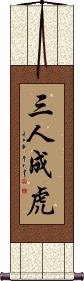
These four characters together relay the meaning that can be expressed in English as “When three people say there's a tiger running in the street, you believe it.”
Of course, there is an ancient story behind this idiom...
三人成虎 is actually a proverb that resulted from a conversation that occurred around 300 B.C.
The conversation was between the king of the Wei kingdom and one of the king's ministers named Pang Cong.
It was near the end of one of many wars, this time with the Zhao kingdom. Pang Cong was to be sent by the king to the Zhao kingdom with the king's son, who was to be held hostage. It was common at the time for a king to make his son a hostage to secure stable peace between warring kingdoms.
Before minister Pang Cong departed, he asked his king, “If one person told you a tiger was running in the street, would you believe it?.”
“No,” the king said.
The minister continued, “What if two people told you?”
The king replied, “Well, I would have my doubts but I might believe it.”
The minister continued, “So, what if three people told you that a tiger is running in the streets?”
The king replied, “Yes, I would believe it. It must be true if three people say it.”
The minister then reminded the king, “Your son and I are now traveling far away to live in the distant Zhao kingdom - much farther from your palace than the street. Rumors may fly about me in my absence, so I hope your majesty will weight such rumors appropriately.”
The king replied, “I have every trust in you, do not worry”
While the minister was gone, the king's enemies gossiped about minister Pang Cong on many occasions. At first, the king thought nothing of these comments and rumors. But slowly, as the rumors mounted, the king began to suspect ill of his minister.
Sometime later, when peace was well-established, the minister and prince were freed and returned to the kingdom of Wei. The king received his son BUT DID NOT EVEN SUMMON MINISTER PANG CONG TO THE PALACE!
Hopefully, this story will help you see how dangerous words can be when used to promote rumors or create ill will. And perhaps will inspire you not to believe everything you hear.
There is also a secondary suggestion in this idiom that gossip is as ferocious as a tiger. Some Chinese people who don't know the ancient story above may believe that this scroll means that rumors are as vicious as three tigers.
Note: This proverb appears in my Korean dictionary but is not well-known in Korea.
Body and Earth in Unity
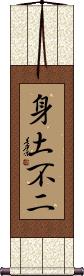
身土不二 (Shindofuni) is originally a Buddhist concept or proverb referring to the inseparability of body-mind and geographical circumstances.
This reads, “Body [and] earth [are] not two.”
Other translations or matching ideas include:
Body and land are one.
Body and earth can not be separated.
Body earth sensory curation.
You are what you eat.
Indivisibility of the body and the land (because the body is made from food and food is made from the land).
Going further, this speaks of our human bodies and the land from which we get our food being closely connected. This phrase is often used when talking about natural and organic vegetables coming directly from the farm to provide the healthiest foods in Japan.
Character notes: 身(shin) in this context does not just mean your physical body but a concept including both body and mind.
土 (do) refers to the soil, earth, clay, land, or in some cases, locality. It's not the proper name of Earth, the planet. However, it can refer to the land or realm we live in.
Japanese note: This has been used in Japan, on and off, since 1907 as a slogan for a governmental healthy eating campaign (usually pronounced as shindofuji instead of the original shindofuni in this context). It may have been hijacked from Buddhism for this propaganda purpose, but at least this is “healthy propaganda.”
Korean note: The phrase 身土不二 was in use by 1610 A.D. in Korea, where it can be found in an early medical journal.
In modern South Korea, it's written in Hangul as 신토불이. Korea used Chinese characters (same source as Japanese Kanji) as their only written standard form of the language until about a hundred years ago. Therefore, many Koreans will recognize this as a native phrase and concept.
See Also: Strength and Love in Unity
Better Late Than Never
It's Never Too Late Too Mend
Long ago in what is now China, there were many kingdoms throughout the land. This time period is known as “The Warring States Period” by historians because these kingdoms often did not get along with each other.
Sometime around 279 B.C. the Kingdom of Chu was a large but not particularly powerful kingdom. Part of the reason it lacked power was the fact that the King was surrounded by “yes men” who told him only what he wanted to hear. Many of the King's court officials were corrupt and incompetent which did not help the situation.
The King was not blameless himself, as he started spending much of his time being entertained by his many concubines.
One of the King's ministers, Zhuang Xin, saw problems on the horizon for the Kingdom, and warned the King, “Your Majesty, you are surrounded by people who tell you what you want to hear. They tell you things to make you happy and cause you to ignore important state affairs. If this is allowed to continue, the Kingdom of Chu will surely perish, and fall into ruins.”
This enraged the King who scolded Zhuang Xin for insulting the country and accused him of trying to create resentment among the people. Zhuang Xin explained, “I dare not curse the Kingdom of Chu but I feel that we face great danger in the future because of the current situation.” The King was simply not impressed with Zhuang Xin's words.
Seeing the King's displeasure with him and the King's fondness for his court of corrupt officials, Zhuang Xin asked permission from the King that he may take leave of the Kingdom of Chu, and travel to the State of Zhao to live. The King agreed, and Zhuang Xin left the Kingdom of Chu, perhaps forever.
Five months later, troops from the neighboring Kingdom of Qin invaded Chu, taking a huge tract of land. The King of Chu went into exile, and it appeared that soon, the Kingdom of Chu would no longer exist.
The King of Chu remembered the words of Zhuang Xin and sent some of his men to find him. Immediately, Zhuang Xin returned to meet the King. The first question asked by the King was “What can I do now?”
Zhuang Xin told the King this story:
A shepherd woke one morning to find a sheep missing. Looking at the pen saw a hole in the fence where a wolf had come through to steal one of his sheep. His friends told him that he had best fix the hole at once. But the Shepherd thought since the sheep is already gone, there is no use fixing the hole.
The next morning, another sheep was missing. And the Shepherd realized that he must mend the fence at once. Zhuang Xin then went on to make suggestions about what could be done to reclaim the land lost to the Kingdom of Qin, and reclaim the former glory and integrity of the Kingdom of Chu.
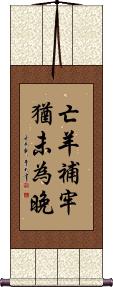
The Chinese idiom shown above came from this reply from Zhuang Xin to the King of Chu almost 2,300 years ago.
It translates roughly into English as...
“Even if you have lost some sheep, it's never too late to mend the fence.”
This proverb, 亡羊补牢犹未为晚, is often used in modern China when suggesting in a hopeful way that someone change their ways, or fix something in their life. It might be used to suggest fixing a marriage, quitting smoking, or getting back on track after taking an unfortunate path in life among other things one might fix in their life.
I suppose in the same way that we might say, “Today is the first day of the rest of your life” in our western cultures to suggest that you can always start anew.
Note: This does have Korean pronunciation but is not a well-known proverb in Korean (only Koreans familiar with ancient Chinese history would know it). Best if your audience is Chinese.
This in-stock artwork might be what you are looking for, and ships right away...

Gallery Price: $61.00
Your Price: $33.88
Gallery Price: $108.00
Your Price: $59.88

Gallery Price: $31.00
Your Price: $16.88
Gallery Price: $47.00
Your Price: $26.00

Gallery Price: $200.00
Your Price: $122.88

Gallery Price: $40.00
Your Price: $16.88
Gallery Price: $520.00
Your Price: $288.88
Gallery Price: $90.00
Your Price: $49.88

Gallery Price: $177.00
Your Price: $97.88

The following table may be helpful for those studying Chinese or Japanese...
| Title | Characters | Romaji (Romanized Japanese) | Various forms of Romanized Chinese | |
| Living Live Life | 生活 | sei katsu / seikatsu | shēng huó sheng1 huo2 sheng huo shenghuo | |
| Live For The Day | 活在今天 | huó zài jīn tiān huo2 zai4 jin1 tian1 huo zai jin tian huozaijintian | huo tsai chin t`ien huotsaichintien huo tsai chin tien |
|
| Optimism Happy With Your Fate | 樂天 / 楽天 乐天 | raku ten / rakuten | lè tiān / le4 tian1 / le tian / letian | le t`ien / letien / le tien |
| Live in Prosperity | 生活于繁榮中 生活于繁荣中 | shēng huó yú fán róng zhōng sheng1 huo2 yu2 fan2 rong2 zhong1 sheng huo yu fan rong zhong shenghuoyufanrongzhong | sheng huo yü fan jung chung shenghuoyüfanjungchung |
|
| Live for What You Love | 人生謳歌 | jin sei ou ka jinseiouka jin sei o ka | ||
| Live Free or Die | 不自由毋寧死 不自由毋宁死 | bú zì yóu wú nìng sǐ bu2 zi4 you2 wu2 ning4 si3 bu zi you wu ning si buziyouwuningsi | pu tzu yu wu ning ssu putzuyuwuningssu |
|
| Life is Short | 百歲光陰如過客 百岁光阴如过客 | bǎi suì guāng yīn rú guò kè bai3 sui4 guang1 yin1 ru2 guo4 ke4 bai sui guang yin ru guo ke baisuiguangyinruguoke | pai sui kuang yin ju kuo k`o paisuikuangyinjukuoko pai sui kuang yin ju kuo ko |
|
| Birth Life | 生 | shou / iku / sho / iku | shēng / sheng1 / sheng | |
| Life is a Journey | 人生是一段旅程 | rén shēng shì yí duàn lǚ chéng ren2 sheng1 shi4 yi2 duan4 lv3 cheng2 ren sheng shi yi duan lv cheng renshengshiyiduanlvcheng | jen sheng shih i tuan lü ch`eng jen sheng shih i tuan lü cheng |
|
| Realize Your Dreams | 實現你的夢想 实现你的梦想 | shí xiàn nǐ de mèng xiǎng shi2 xian4 ni3 de meng4 xiang3 shi xian ni de meng xiang shixiannidemengxiang | shih hsien ni te meng hsiang shihhsiennitemenghsiang |
|
| Learning is Eternal | 學無止境 学无止境 | xué wú zhǐ jìng xue2 wu2 zhi3 jing4 xue wu zhi jing xuewuzhijing | hsüeh wu chih ching hsüehwuchihching |
|
| Death Before Dishonor | 寧為玉碎不為瓦全 宁为玉碎不为瓦全 | níng wéi yù suì bù wéi wǎ quán ning2 wei2 yu4 sui4 bu4 wei2 wa3 quan2 ning wei yu sui bu wei wa quan ningweiyusuibuweiwaquan | ning wei yü sui pu wei wa ch`üan ning wei yü sui pu wei wa chüan |
|
| Freedom from Anger and Worry Yields Longevity | 不氣不愁活到白頭 不气不愁活到白头 | bù qì bù chóu huó dào bái tóu bu4 qi4 bu4 chou2 huo2 dao4 bai2 tou2 bu qi bu chou huo dao bai tou buqibuchouhuodaobaitou | pu ch`i pu ch`ou huo tao pai t`ou puchipuchouhuotaopaitou pu chi pu chou huo tao pai tou |
|
| Love Life | 熱愛生命 热爱生命 | rè ài shēng mìng re4 ai4 sheng1 ming4 re ai sheng ming reaishengming | je ai sheng ming jeaishengming |
|
| Madly in Love | 愛得死去活來 爱得死去活来 | ài de sǐ qù huó lái ai4 de5 si3 qu4 huo2 lai2 ai de si qu huo lai aidesiquhuolai | ai te ssu ch`ü huo lai aitessuchühuolai ai te ssu chü huo lai |
|
| Tanjun Simplicity | 単純 | tanjun | ||
| Death Before Dishonor | 寧為玉碎 宁为玉碎 | níng wéi yù suì ning2 wei2 yu4 sui4 ning wei yu sui ningweiyusui | ning wei yü sui ningweiyüsui |
|
| Death Before Surrender | 寧死不降 宁死不降 | nìng sǐ bù xiáng ning4 si3 bu4 xiang2 ning si bu xiang ningsibuxiang | ning ssu pu hsiang ningssupuhsiang |
|
| Together Forever in Love | 永遠愛在一起 永远爱在一起 | yǒng yuǎn ài zài yī qǐ yong3 yuan3 ai4 zai4 yi1 qi3 yong yuan ai zai yi qi yongyuanaizaiyiqi | yung yüan ai tsai i ch`i yungyüanaitsaiichi yung yüan ai tsai i chi |
|
| Banzai | 万歲 / 萬歲 万岁 | banzai | wàn suì / wan4 sui4 / wan sui / wansui | |
| Dignity Honor Sanctity Integrity | 尊嚴 尊严 / 尊厳 | son gen / songen | zūn yán / zun1 yan2 / zun yan / zunyan | tsun yen / tsunyen |
| The Single Life | 独身貴族 / 獨身貴族 独身贵族 | do kushin ki zoku dokushinkizoku | ||
| Thug Life | 暴徒生活 | bou to sei katsu boutoseikatsu bo to sei katsu | bào tú shēng huó bao4 tu2 sheng1 huo2 bao tu sheng huo baotushenghuo | pao t`u sheng huo paotushenghuo pao tu sheng huo |
| Clarity | 清 | sei | qīng / qing1 / qing | ch`ing / ching |
| Choose Life | 選擇生活 选择生活 | xuǎn zé shēng huó xuan3 ze2 sheng1 huo2 xuan ze sheng huo xuanzeshenghuo | hsüan tse sheng huo hsüantseshenghuo |
|
| Tiger Rumor | 三人成虎 | sān rén chéng hǔ san1 ren2 cheng2 hu3 san ren cheng hu sanrenchenghu | san jen ch`eng hu sanjenchenghu san jen cheng hu |
|
| Body and Earth in Unity | 身土不二 | shindofuni / shindofuji | ||
| Better Late Than Never | 亡羊補牢猶未為晚 亡羊补牢犹未为晚 | wáng yáng bǔ láo yóu wèi wéi wǎn wang2 yang2 bu3 lao2 you2 wei4 wei2 wan3 wang yang bu lao you wei wei wan | wang yang pu lao yu wei wei wan wangyangpulaoyuweiweiwan |
|
| In some entries above you will see that characters have different versions above and below a line. In these cases, the characters above the line are Traditional Chinese, while the ones below are Simplified Chinese. | ||||

Successful Chinese Character and Japanese Kanji calligraphy searches within the last few hours...



