Many custom options...


And formats...



Made in Chinese / Japanese...
Buy a Made calligraphy wall scroll here!
Personalize your custom “Made” project by clicking the button next to your favorite “Made” title below...
Switched to secondary search mode due to lack of results using primary.
These secondary results may not be very accurate. Try a different but similar meaning word or phrase for better results. Or...
Look up Made in my Japanese Kanji & Chinese Character Dictionary(My dictionary is a different system then the calligraphy search you just tried)
If you want a special phrase, word, title, name, or proverb, feel free to contact me, and I will translate your custom calligraphy idea for you.
2. Aces Dojo
3. Amadeo
4. Amadeus
5. 1000 good moves ruined by 1 bad
7. Banzai
8. Beer
9. Black or white cat matters not as long as it can catch mice
11. Mark the boat to find the lost sword / Ignoring the changing circumstances of the world
12. Open Your Heart
13. Confucius: Golden Rule / Ethic of Reciprocity
14. Crisis equals Danger plus Opportunity?
15. Daodejing / Tao Te Ching - Chapter 54
16. Brought Together from 1000 Miles Away by Fate
17. Determination
18. Diamond
20. Drinking the water of a well: One should never forget who dug it
21. Forest
22. Words Have Enormous Weight: One Word Worth Nine Caldrons
23. Glory and Honor
24. Hua Mulan
25. A Deliberate Inaction is Better than a Blind Action
26. Jinni
27. A Journey of 1000 Miles Begins with a Single Step
28. Khánh
30. Lioness
31. Live Laugh Love
33. Love and Respect
34. Madel
35. Madelaine
36. Madeleine
37. Madelin
38. Madeline
39. Madelyn
40. Madelynn
41. Mader
42. Madera
43. Metallica
44. Monkey / Ape
45. Monkey King
47. There’s No Place Like Home
48. Polo
49. Renni
51. Power of Oneself / Self-Sufficient
54. Shinken Shobu
55. Star
56. Zen Garden
57. Monkey
Abundance / Prosperous
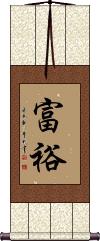
富裕 means prosperous, having an abundance, well-to-do, or well-off.
It's a simple word that suggests “you have made it” in Chinese, Japanese Kanji, and Korean Hanja.
See Also: Good Fortune
Aces Dojo

エースド道場 is the name Aces Dojo in Japanese.
Yes, I made this title just for your one dojo since you searched for it.
Note: Because this selection contains some special Japanese Katakana characters, it should be written by a Japanese calligrapher.
Amadeo
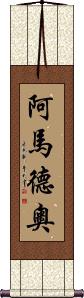
阿馬德奧 is the transliteration to Mandarin Chinese for the Latin / Spanish name Amadeo.
Amadeo
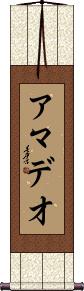
アマデオ is the name Amadeo in Japanese.
Note: Because this title is entirely Japanese Katakana, it should be written by a Japanese calligrapher.
Amadeus
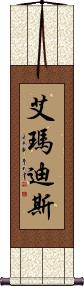
艾瑪迪斯 is the name Amadeus in Chinese (Mandarin).
Amadeus
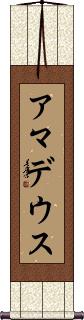
アマデウス is the name Amadeus in Japanese Katakana.
Note: Because this title is entirely Japanese Katakana, it should be written by a Japanese calligrapher.
1000 good moves ruined by 1 bad
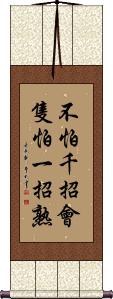
不怕千招会只怕一招熟 is a Chinese proverb that literally translates as: Do not worry about making a thousand clever moves; what [one has to] fear is one bad move.
Figuratively, this means: Even if you have made many clever moves before, one wrong move will ruin the whole game.
I compare this to the English saying, “It takes only one Aw-shit to wipe out a thousand Attaboys.”
Banzai / Wansui
Old Japanese / Traditional Chinese & Korean
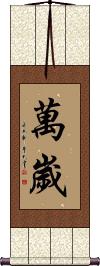
萬歲 is the traditional Chinese, Korean Hanja, and ancient Japanese way of writing banzai.
In modern times, the first character was simplified in Japan and China. So you might want to select the other entry for universal readability.
While it has become a popular, if not an odd, thing to scream as you jump out of an airplane (preferably with a parachute attached), banzai is actually a very old Asian way to say “hooray.” The Japanese word “banzai” comes from the Chinese word “wan sui,” which means “The age of 10,000 years.” It is actually a wish that the Emperor or the Empire live that long.
Imagine long ago when the Emperor made a rare public appearance. 萬歲 is what all people would yell to their leader in respect.
So if you like it as a hooray, or you want to wish someone that they live for 10,000 years, this is the calligraphy for you.
Other translations include Cheers! (not the drinking kind), hurrah!, long live [name]!, and congratulations!
To other things with banzai in their names, I am still waiting for the promised sequel to Buckaroo Banzai.
Notes: Sometimes people confuse banzai with bonsai. A bonsai is a miniature tree. They have nothing to do with each other.
Banzai
Modern Japanese Version
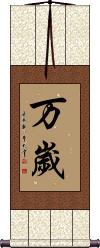
万歲 is the modern Japanese way to write banzai.
We've made two almost identical entries for this word, with just a variation on the first character. In the last century, 萬 was simplified to 万 in Japan and China. The new generation will expect it to be written as 万 but the old generation can still read the more traditional 萬 form. You must make your determination as to what version is best for you. If your audience is mostly Japanese, I suggest 万歲.
While it has become a popular, if not an odd, thing to scream as you jump out of an airplane (preferably with a parachute attached), banzai is actually a very old Asian way to say “hooray.” The Japanese word “banzai” comes from the Chinese word “wan sui” which means “The age of 10,000 years.” It is actually a wish that the Emperor or the Empire live that long.
Imagine long ago when the Emperor made a rare public appearance. This is what all of the people would yell to their leader in respect.
So if you like it as a hooray, or you want to wish someone that they live for 10,000 years, this is the calligraphy for you.
To other things with banzai in their names, I am still waiting for the promised sequel to Buckaroo Banzai.
Other translations: hurrah, long life, congratulations, cheers, live long.
Notes: Sometimes people confuse banzai with bonsai. A bonsai is a miniature tree. They have nothing to do with each other. Further, Bonzai is not a word at all - although it would make a great name for a calcium supplement for older people.
Beer
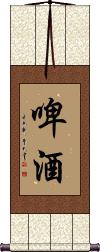
啤酒 means beer in Chinese.
This can refer to virtually any fermented grain-based alcoholic beverage that has bubbles. So this includes all kinds of ales and lagers.
In China, the grains used for beer sometimes include rice. But even in Chinese beer, the concept is the same - beer must be made with hops and yeast.
Beer was the third word I learned in Chinese, and I've toured 3 different breweries in China, Tsing Tao, Lao Shan, and Yanjing. I've done my research on this calligraphy entry!
Black or white cat matters not as long as it can catch mice
Ability is more important than looks
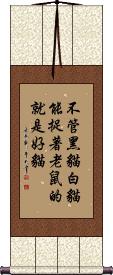
不管黑猫白猫能捉着老鼠的就是好猫 literally translates as: It doesn't matter [if a] cat [is] black [or] white, [as long as it] can catch mice, it's a good cat.
This proverb was either composed or made famous by Deng XiaoPing in 1961 when he exclaimed, “I don't care if it's a white cat or a black cat. It's a good cat so long as it catches mice” when his critics pointed out that his ideas were Capitalistic (free market). The response was meant to say, “It does not matter if it's Communist or Capitalist, as long as it works.”
This is a Chinese proverb that can be used to suggest one should disregard looks or a person's race, as long as they can do the job. It can also be used as a metaphor for many other situations.
Deng XiaoPing probably saved China from collapse (as the Soviet Union experienced). He changed China’s economy from pure Communism to a hybrid where the free market (Capitalism) is encouraged. More about Deng XiaoPing
Body and Earth in Unity
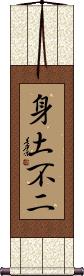
身土不二 (Shindofuni) is originally a Buddhist concept or proverb referring to the inseparability of body-mind and geographical circumstances.
This reads, “Body [and] earth [are] not two.”
Other translations or matching ideas include:
Body and land are one.
Body and earth can not be separated.
Body earth sensory curation.
You are what you eat.
Indivisibility of the body and the land (because the body is made from food and food is made from the land).
Going further, this speaks of our human bodies and the land from which we get our food being closely connected. This phrase is often used when talking about natural and organic vegetables coming directly from the farm to provide the healthiest foods in Japan.
Character notes: 身(shin) in this context does not just mean your physical body but a concept including both body and mind.
土 (do) refers to the soil, earth, clay, land, or in some cases, locality. It's not the proper name of Earth, the planet. However, it can refer to the land or realm we live in.
Japanese note: This has been used in Japan, on and off, since 1907 as a slogan for a governmental healthy eating campaign (usually pronounced as shindofuji instead of the original shindofuni in this context). It may have been hijacked from Buddhism for this propaganda purpose, but at least this is “healthy propaganda.”
Korean note: The phrase 身土不二 was in use by 1610 A.D. in Korea, where it can be found in an early medical journal.
In modern South Korea, it's written in Hangul as 신토불이. Korea used Chinese characters (same source as Japanese Kanji) as their only written standard form of the language until about a hundred years ago. Therefore, many Koreans will recognize this as a native phrase and concept.
See Also: Strength and Love in Unity
Mark the boat to find the lost sword / Ignoring the changing circumstances of the world
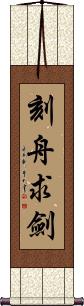
刻舟求劍 is an originally-Chinese proverb that serves as a warning to people that things are always in a state of change.
Thus, you must consider that and not depend on the old ways or a way that may have worked in the past but is no longer valid.
This idiom/proverb comes from the following story:
A man was traveling in a ferry boat across a river. With him, he carried a treasured sword. Along the way, the man became overwhelmed and intoxicated by the beautiful view and accidentally dropped his prized sword into the river. Thinking quickly, he pulled out a knife and marked on the rail of the boat where exactly he had lost his sword.
When the boat arrived on the other side of the river, the man jumped out of the boat and searched for his sword right under where he'd made the mark. Of course, the boat had moved a great distance since he made the mark, and thus, he could not find the sword.
While this man may seem foolhardy, we must take a great lesson from this parable: Circumstances change, so one should use methods to handle the change. In modern China, this is used in business to mean that one should not depend on old business models for a changing market.
This proverb dates back to the Spring and Autumn period (770–476 BC) of the territory now known as China. It has spread and is somewhat known in Japan and Korea.
Open Your Heart

敞開心扉 is the most common way to express the idea of “Opening your heart” in Chinese.
This phrase is made up or two words:
敞开 = To open wide, to be unrestricted.
心扉 = Inner heart or soul.
If you want it brokend down further into individual characters:
敞 = Open to the view of all people, spacious, to open wide, or to disclose.
开 = Open, to start, or the beginning.
心 = Heart/Mind
扉 = Door, gate, opening, or the title page.
So maybe you can say, “To open wide the door of your heart and mind to all.”
Other variations of “open your heart” also exist such as 打開心扉, 敞開你的心扉, 打開你的心, and Simplified Chinese 敞开心扉, 打开心扉, 敞开你的心扉, or 打开你的心. These are also correct, but not as commonly used as 敞開心扉.
Confucius: Golden Rule / Ethic of Reciprocity
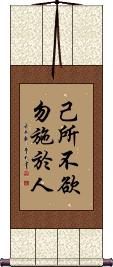
Do not do to others what you do not want done to yourself
Some may think of this as a “Christian trait,” but actually, it transcends many religions.
This Chinese teaching dates back to about 2,500 years ago in China. Confucius had always taught the belief in being benevolent (ren), but this idea was hard to grasp for some of his students, as benevolence could be kind-heartedness or an essence of humanity itself.
When answering Zhong Gong's question as to what "ren" actually meant, Confucius said:
己所不欲勿施于人 or "When you go out, you should behave as if you were in the presence of a distinguished guest; when people do favors for you, act as if a great sacrifice was made for you. Whatever you wouldn't like done to you, do not do that thing to others. Don't complain at work or home.”
Hearing this, Zhong Gong said humbly, “Although I am not clever, I will do what you say.”
From this encounter, the Chinese version of the “Golden Rule” or “Ethic of Reciprocity” came to be.
The characters you see above express, “Do not do to others whatever you do not want to be done to yourself.”
See Also: Confucius Teachings | Benevolence
Crisis equals Danger plus Opportunity?
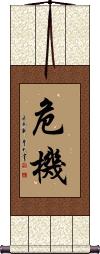
危機 means crisis in Chinese and Japanese.
Separately, the first character here does mean “danger” or “to endanger,” and the second character can mean “opportunity.”
However, I want to debunk a myth that was propagated by some westerners who did not have a clear understanding of Asian languages...
While often, Chinese/Japanese/Korean compound words (words of two or more characters) are the sum of their parts, this is not always the case. The compound is often understood with a completely different meaning than the two characters individually.
Many have said that the Chinese/Japanese/Korean word for Crisis is made up of the characters for “danger” and “opportunity.” 危機 is true when phrased this way.
However, it's not absolutely correct to say that “danger + opportunity = crisis” in Asian cultures.
English example:
If I tell you that...
Bovine creature + Guy behind the plate in baseball = Locomotive train protection
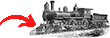
...you would think I was mad. But consider that “cow + catcher = cowcatcher,” which is the device that used to be found on steam engines to protect them if they hit an animal on the tracks. When we hear the word “cowcatcher,” we don't separate the words into their individual meanings (necessarily).
The same is true with the word for crisis in Chinese/Japanese/Korean. While you can separate the characters, few Asian people would automatically do so in their minds.
The final answer:
It is a half-truth to say, “danger plus opportunity equals crisis” in Chinese/Japanese/Korean. Use this statement and concept with caution.
Also, the second character can mean “secret” or “machine,” depending on context so I guess you have to say “a dangerous machine = crisis” or “danger + a secret = crisis.” Both of these are only slightly more ridiculous than the first premise.
PS: 危機 is probably not a great word for a scroll unless you have a special use for it.
Daodejing / Tao Te Ching - Chapter 54
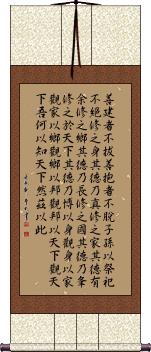
This is the Mawangdui version of Daodejing chapter 54.
By its virtue alone can one generation after another carry on the ancestral sacrifice.
Apply it to yourself, and by its power, you will be freed from dross.
Apply it to your household, and your household shall thereby have abundance.
Apply it to the village, and the village will be made secure.
Apply it to the kingdom, and the kingdom shall thereby be made to flourish.
Apply it to an empire, and the empire shall thereby be extended.
Therefore just as through oneself, one may contemplate Oneself;
So through the household one may contemplate the Household;
And through the village, one may contemplate the Village;
And through the kingdom, one may contemplate the Kingdom;
And through the empire, one may contemplate the Empire.
How do I know that the empire is so? By this.
What is firmly rooted cannot be pulled out;
What is tightly held in the arms will not slip loose;
Through this, the offering of sacrifice by descendants will never come to an end.
Cultivate it in your person, and its virtue will be genuine;
Cultivate it in the family, and its virtue will be more than sufficient;
Cultivate it in the hamlet, and its virtue will endure;
Cultivate it in the state, and its virtue will abound;
Cultivate it in the empire, and its virtue will be pervasive.
Hence look at the person through the person;
Look at the family through the family;
Look at the hamlet through the hamlet;
Look at the state through the state;
Look at the empire through the empire.
How do I know that the empire is like that?
By means of this.
Brought Together from 1000 Miles Away by Fate
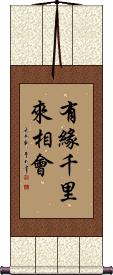
有緣千里來相會 means that fate or destiny has caused us to meet from a thousand miles away.
The 有緣 part suggests something that is connected as if by a thread due to fate, destiny, or karma.
This romantic phrase is seen in Chinese greeting cards. It relays the idea that your love was meant to be and that you were destined to meet (regardless of what distance or obstacles might have made such a meeting unlikely).
See Also: Red Thread
Determination
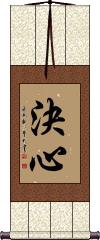
決心 is a Chinese, Japanese, and Korean word that holds the dictionary definition of determination but literally means determined heart.
The first character means to determine or determined.
The second character means heart, mind, or soul, so you can imagine that this form of determination partially means putting your heart into something. It can also be translated as resolve, resolution, or decision (as in a decision made and followed).
See Also: Devotion | Tenacious | Passion | Dedication | Will-Power
Diamond
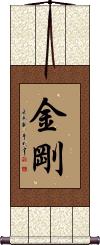
金剛 is a common way to call diamonds in Chinese and Japanese.
Traditionally, there were not that many diamonds that made their way to Asia, so this word does not have the deep cultural significance that it does in the west (thanks mostly to De Beers' marketing). Therefore, this word was kind of borrowed from other uses.
This title can also refer to vajra (a Sanskrit word meaning both thunderbolt and diamond that originally refers to an indestructible substance); hard metal; pupa of certain insects; Vajrapani, Buddha's warrior attendant; King Kong; adamantine; Buddhist symbol of the indestructible truth.
Diligent Study Proverb
Drill a hole in the wall to get light to read by.
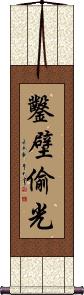
鑿壁偷光 is a Chinese proverb that means “Bore a hole in the wall to make use of the neighbor's light to study.”
This is a nice gift for a very studious person.
Kuang Heng was born during the Western Han period. He has been very fond of reading ever since he was young. However, he could not attend school since his family was poor, and he had to borrow books from people to learn.
To borrow these books, he normally did chores for people who had them. When he became older, he had to work in the field from sunrise to sunset since his family's financial situation did not improve. Thus, he tried to study at night, but he had no lamp.
One day, he noticed the light from the neighbor's house coming through a crack in the wall. This made him very happy, so he dug a larger hole from the crack and read in the light that shone through. This diligent study eventually made him an accomplished person.
Drinking the water of a well: One should never forget who dug it
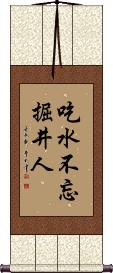
This proverb suggests that one should always be grateful to those who helped one succeed.
And remember your ancestors and those that came before you whose sacrifices made your present life better.
Some Chinese will separate the intended meaning from this proverb and translate this as “Don't forget the people who once helped you.” In Modern China, this idiom is virtually never used to refer to an actual well.
Note: This can be pronounced in Korean but it's not a commonly used phrase.
Forest
Wooded Area
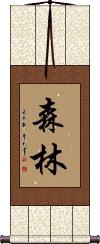
森林 is how to generically write “forest” or “woods” in Chinese, Japanese Kanji, and old Korean Hanja.
If you look at the first character, you will see that it is made up of three trees. The second is actually two trees. 森林 is one of those words that really visually expresses the meaning.
If your name is Forest, I suggest this title to represent your name.
Words Have Enormous Weight: One Word Worth Nine Caldrons
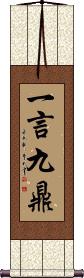
一言九鼎 is an ancient Chinese proverb used in modern times to talk of profound or powerful words.
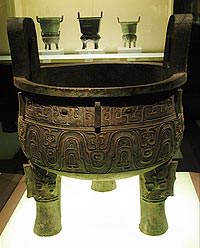 The literal meaning is “one word [worth] nine [sacred] tripods.” The tripod is a highly-prized three-legged (sometimes four-legged) metal pot or kettle of ancient China. They are often made of bronze, and the Emperor would have large ones gilded in gold. See the image to the right for an example.
Glory and Honor
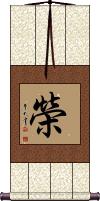
榮 relates to giving someone a tribute or praise.
It's a little odd as a gift, so this may not be the best selection for a wall scroll.
I've made this entry because this character is often misused as “honorable” or “keeping your honor.” It's not quite the same meaning, as this usually refers to a tribute or giving an honor to someone.
榮 is often found in tattoo books incorrectly listed as the western idea of personal honor or being honorable. Check with us before you get a tattoo that does not match the meaning you are really looking for. As a tattoo, this suggests that you either have a lot of pride in yourself or that you have a wish for prosperity for yourself and/or your family.
 In modern Japanese Kanji, glory and honor look like the image to the right.
There is a lot of confusion about this character, so here are some alternate translations for this character: prosperous, flourishing, blooming (like a flower), glorious beauty, proud, praise, rich, or it can be the family name “Rong.” The context in which the character is used can change the meaning between these various ideas.
In the old days, this could be an honor paid to someone by the Emperor (basically a designation by the Emperor that a person has high standing).
To sum it up: 榮 has a positive meaning; however, it's a different flavor than the idea of being honorable and having integrity.
Hua Mulan
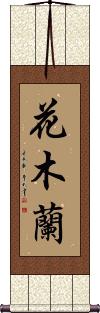
花木蘭 is the name of the famous Chinese woman warrior Hua Mulan.
She was made famous in the west by Disney's animated movie, “Mulan.”
Most of the historical information about her comes from an ancient poem. It starts with a concerned Mulan, as she is told a man from each family is to serve conscription in the army. Her father is too old, and her brother is too young. Mulan decides to take the place of her father. After twelve years of war, the army returns, and the best warriors are awarded great posts in the government and riches. Mulan turns down all offers and asks only for a good horse for the long trip home. When Mulan greets visiting comrades wearing her old clothes, they are shocked to find the warrior they rode into battle with for years is actually a woman.
A Deliberate Inaction is Better than a Blind Action
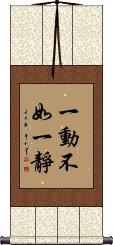
Sometimes 一動不如一靜 is translated by others as “Look before you leap” but the more accurate and direct translation is the one I used in the title.
While somewhat military in its origin, this proverb can apply to any situation where a decision needs to be made, but perhaps there are still some “unknowns.”
This phrase suggests that in our “action-based” world, sometimes the “smarter move” is “no move at all.”
See Also: Better to Choose Nothing Rather Than Make a Poor Choice
Jinni
Golden Girl
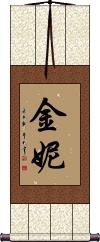
金妮 is a transliteration to Mandarin Chinese for the name Jinni.
This means “golden girl” or “girl of gold” in Chinese.
This is the special name I made up and chose for my third daughter. There is also another, more common way to transliterate this name which is 吉尼 instead of 金妮.
A Journey of 1000 Miles Begins with a Single Step
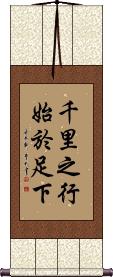
千里之行始於足下 is a Chinese proverb that means “a thousand-mile journey begins with the first step.”
This proverb figuratively means “big accomplishments come from an accumulation of little achievements made one by one.”
Khánh
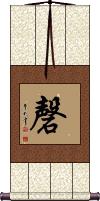
磬 means “chime stones,” but I'm including it here for those looking for the original Chinese character for the Vietnamese name Khánh.
Other definitions include ancient percussion instrument made of stone or jade pieces hung in a row and struck as a xylophone, sounding stone, ancient Chinese chime shaped like a chevron.
There is also a possibility that your original character is 慶 which means to celebrate or felicity. Contact me if you need that character.
Laughing Dragon Kung Fu
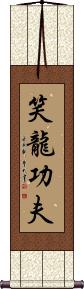
笑龍功夫 is the title for a Martial Arts studio (custom-made at by request of the owner of the studio).
Lioness
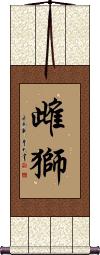
雌獅 is how to write “lioness” in Chinese.
Note: 雌獅 is not a very common title for a wall scroll in China. Perhaps because lions are not indigenous to China. Though oddly enough, the rarity of lions made them very prized - and lion dances are a popular festival attraction.
If you see the name of this animal species written on a wall scroll, it's more likely to be the masculine form of “lion.”
Live Laugh Love
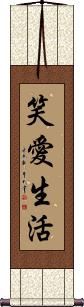
In English, the word order shown in the title is the most natural or popular. In Chinese, the natural order is a little different:
The first character means laugh (sometimes means smile).
The second character means love.
The last two characters mean “live” as in “to be alive” or “pursue life.”
Please note: 笑愛生活 is not a normal phrase in that it does not have a subject, verb, or object. It is a word list. Word lists are not common in Asian languages/grammar (at least not as normal as in English). We only added this entry because so many people requested it.
We put the characters in the order shown above, as it almost makes a single word with the meaning “A life of laughter and love.” It's a made-up word, but it sounds good in Chinese.
We removed the Japanese pronunciation guide from this entry, as the professional Japanese translator deemed it "near nonsense" from a Japanese perspective. Choose this only if your audience is Chinese and you want the fewest-possible characters to express this idea.
In Korean, this would be 소애생활 or "so ae saeng hwar" but I have not confirmed that this makes sense in Korean.
Live Long and Prosper
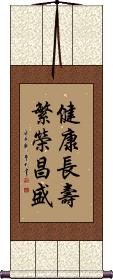
This means “Live Long And Prosper” in Chinese.
A phrase and greeting made famous by Leonard Nimoy in the role of Spock on the original Star Trek TV series.
Love and Respect
Love each other and show mutual respect
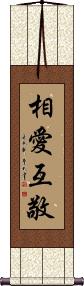
相愛互敬 is a nice way to say “Love and Respect” in Chinese.
This proverb is about the mutual exchange of love and respect within a good relationship.
The first two characters create a word that means “to love each other” or “mutual love.”
The third character means mutual, interlocking, or in some contexts, “to dovetail” (as in how joints are made in fine furniture).
The last character means “to respect,” “to venerate,” “to salute,” “reverence,” or simply “respect.”
Madel
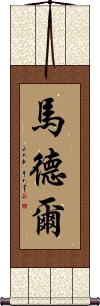
馬德爾 is the name Madel in Chinese (Mandarin).
Madel
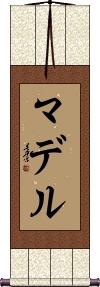
マデル is the name Madel in Japanese Katakana.
Note: Because this title is entirely Japanese Katakana, it should be written by a Japanese calligrapher.
Madelaine
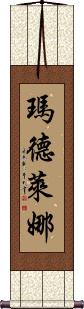
瑪德萊娜 is the name Madelaine in Chinese (Mandarin).
Madelaine
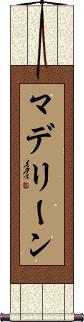
マデリーン is the name Madelaine in Japanese (Katakana).
Note: Because this title is entirely Japanese Katakana, it should be written by a Japanese calligrapher.
Madeleine
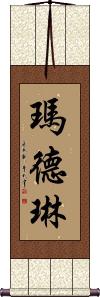
瑪德琳 is the name Madeleine in Chinese (Mandarin).
Madeleine
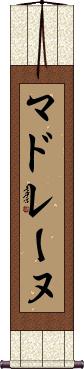
マドレーヌ is the name Madeleine in Japanese.
Note: Because this title is entirely Japanese Katakana, it should be written by a Japanese calligrapher.
Madelin

馬德林 is the name Madelin in Chinese (Mandarin).
Madelin
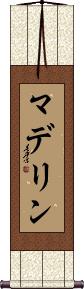
マデリン is the name Madelin in Japanese Katakana.
Note: Because this title is entirely Japanese Katakana, it should be written by a Japanese calligrapher.
Madeline
瑪德琳 is the name Madeline in Chinese (Mandarin).
Madeline
マデリン is the name Madeline in Japanese.
Note: Because this title is entirely Japanese Katakana, it should be written by a Japanese calligrapher.
Madelyn
瑪德琳 is the name Madelyn in Chinese (Mandarin).
Madelyn
マデリン is the name Madelyn in Japanese.
Note: Because this title is entirely Japanese Katakana, it should be written by a Japanese calligrapher.
Madelynn

馬德琳 is the name Madelynn in Chinese (Mandarin).
Madelynn
マデリン is the name Madelynn in Japanese Katakana.
Note: Because this title is entirely Japanese Katakana, it should be written by a Japanese calligrapher.
Mader
馬德爾 is the name Mader in Chinese (Mandarin).
Mader

マダー is the name Mader in Japanese Katakana.
Note: Because this title is entirely Japanese Katakana, it should be written by a Japanese calligrapher.
Madera

馬德拉 is the name Madera in Chinese (Mandarin).
Madera

マデラ is the name Madera in Japanese Katakana.
Note: Because this title is entirely Japanese Katakana, it should be written by a Japanese calligrapher.
Metallica
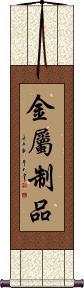
金屬制品 is the name Metallica in Chinese.
This literally means “Made from Metal” or “Metallic Product” in Chinese.

Monkey / Ape
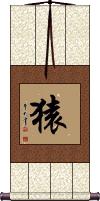
猿 is one of those cases when an error was made as Chinese characters were absorbed into the Japanese language during the 5th century.
In Japanese, this means monkey.
In Chinese, this means ape.
The Japanese word for ape means monkey in Chinese, so you can see how they were simply reversed.
Monkey King
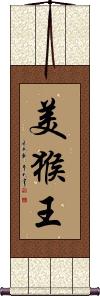
美猴王 is the specific title for “Monkey King.”
A character made famous by the ancient novel Journey to the West.
It literally means “Handsome/Beautiful Monkey King.”
See Also: Monkey Fist | Drunken Monkey
Monkey King
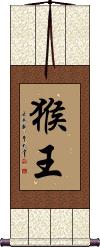
猴王 is the short title for “Monkey King.” This can refer to the character made famous by the ancient novel Journey to the West.
This literally reads “Monkey King.” However, this title is open to interpretation and could be used for someone who is the boss of the primate exhibit at the zoo or certain characters in Chinese opera.
See Also: Monkey Fist | Drunken Monkey
Monkey Stealing Peaches
Martial arts term
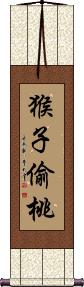
猴子偷桃 is a martial arts term that I find hilarious. I thought Stephen Chow had made this up for his Monkey King movie. After some research, it turns out to be real.
This can be translated as “monkey stealing peaches” or “monkey steals the peach.” It refers to distracting an opponent with one hand and seizing his testicles with the other.
In colloquial Chinese speech, this can refer to grabbing somebody by the balls (without any martial arts technique to the grabbing).
There’s No Place Like Home
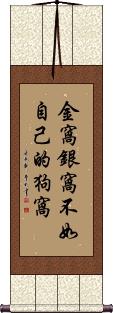
金窝银窝不如自己的狗窝 is a Chinese slang proverb that means “Golden house, [or a] silver house, not as good as my own dog house.”
It's basically saying that even a house made of gold or silver is not as good as my own home (which may only be suitable for a dog but at least it's mine).
Polo
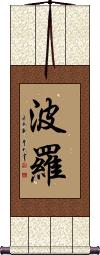
This is a common way to write Polo in Chinese.
This would also be the way to write Polo for the surname or the car made by Volkswagen (the Polo model is sold worldwide with the exception of the USA). It can also refer to Marco Polo in Chinese.
In Japanese, this is a name that romanizes as Hara.
Renni
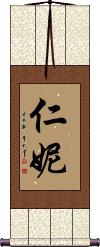
This is a name Renni in Mandarin Chinese. The name literally means “benevolent girl” in Chinese.
I kind of made up this name when my second daughter was born. The idea came for a feeling I got after performing a benevolent act for a poor family in Southern China. I want my daughter to follow that mode, and experience the same feeling one can only experience by doing benevolent acts.
Sanctified by God
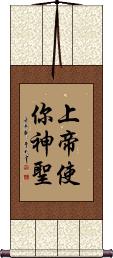
上帝使你神聖 means “Sanctified by God,” in Chinese.
This was added at the request of a customer. This may be more appropriate for a priest or reverend than a layman. But that depends on how your religion sees the order of things.
If you directly translate, you get something like, “God made you Holy.”
Here's the character breakdown:
上帝 = God
使 = Makes; Made; Let
你 = You
神聖 = Sacred; Holy; Sanctification; Divine; Hallow; Holiness
Power of Oneself / Self-Sufficient
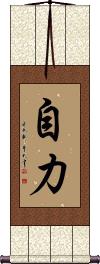
自力 is a word in Chinese, Japanese Kanji, old Korean, and Buddhist term meaning: the power within oneself; self-sufficient; by oneself; self-made; self-power; inner ability.
Shenzhou Spacecraft
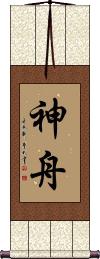
神舟 is the name of the Chinese spacecraft “Shenzhou.” The name means “divine craft” or “saintly vessel.”
The name is a play on words in Chinese, as there is an alternate name for China that is pronounced “Shenzhou” but means “Divine land” or “Land of the Gods” (just the second character is different).
The first flight of a Shenzhou spacecraft was in 1999, with more missions following. The next is planned for 2008, and will include China's first “spacewalk.” The tenth Shenzhou mission is planned for 2015, when China has promised its people that a Chinese astronaut will walk on the moon (or at least orbit the moon - there are two ways to interpret the announcement made in 2005).
For those of you concerned, this word is pronounced more like “Shen Joe” (with a slightly soft “J”) than the Romanization would suggest.
2016 Update: I wrote the above in 2006. Imagine that, 10 years later, none of the promises came true.
Shidai / Sida / Mahabhuta
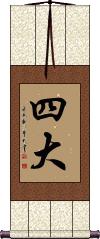
In Mahayana Buddhism, 四大 represents mahābhūta, the four elements of which all things are made: earth, water, fire, and wind.
This can also represent the four freedoms: speaking out freely, airing views fully, holding great debates, and writing big-character posters.
In some contexts, this can be a university or college offering four-year programs.
To others, this can represent the Tao, Heaven, Earth, and King.
Going back to the Buddhist context, these four elements “earth, water, fire, and wind,” represent 堅, 濕, 煖, 動, which are: solid, liquid, heat, and motion.
Shinken Shobu
Death Match
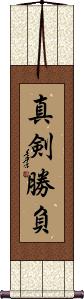
In modern Japanese, 真剣勝負 means to take something very seriously.
The literal and historical meaning is “real sword battle.” In old times, a Samurai apprentice would practice with a wooden practice sword. Once trained and qualified, they would wield a real steel sword made for battle and killing. They were ready for a “death match” or Shinken Shobu.
真剣 is an adjective that has come to mean serious/earnest. The literal translation is “real sword.”
勝負 in the simplest terms, means match, contest, game, or bout. Depending on the context, it could also mean victory or defeat, winning and losing, or the outcome of a battle.
There is a suggestion in Shinken Shobu that you train with serious and real intent, as we should train with the same fervor and dedication as if the battle was real. “Train as we fight.”
See Also: The More We Sweat in Training the Less We Bleed in Battle | Cry in the Dojo - Laugh on the Battlefield
Star
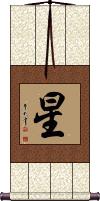
星 is how “star” is written in Chinese, Japanese, and old Korean.
Thousands of years ago, when this character was first developed, there was the belief that you could see remnants of stars in everything. In fact, some early Chinese men of science suggested that all living things came from “stardust” or cosmic debris. This could explain why the upper portion of this character means “sun” (a star itself) and the lower portion means “birth” or “life.”
Oddly enough, modern-day scientists suggest that we are all made up of cosmic dust. Seems they were getting it right in China at a time when the western world thought the Earth was flat and the Church was claiming that the sun and all cosmic bodies revolved around the Earth.
Zen Garden
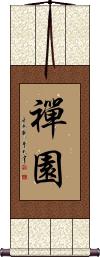
禪園 literally means “meditation garden.”
The first character happens to be known as Zen in the west (the pronunciation comes from Japanese) but this title is not often used in Japan (won't be recognized as a Japanese title).
The title “Zen Garden” was made up by westerners I'm afraid.
Monkey
Year of the Monkey / Zodiac Sign
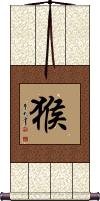
猴 is the monkey character in Chinese.
猴 means ape in Japanese due to an error made long ago as Japan absorbed Chinese characters.
If you were born in the year of the monkey, you . . .
Are smart, brave, active, and competitive.
Like new things.
Have a good memory.
Are quick to respond
Have an easy time winning people's trust.
Are, however, not very patient.
See also our Chinese Zodiac page.
Note: This character does have the meaning of monkey in Korean Hanja but is not used very often.
These search terms might be related to Made:
Always Be Prepared
Have a Walking Stick at the Ready Before You Stumble
My Life is Complete Because of You
Reach Peace and Calm Through Meditation
Skill Acquired Through Hard Training
The True and Complete Enlightenment
Through the Ups and Downs of Life
Truth Flashed Through the Mind
Uniform / Complete / Perfect / Order
The following table may be helpful for those studying Chinese or Japanese...
| Title | Characters | Romaji (Romanized Japanese) | Various forms of Romanized Chinese | |
| Abundance Prosperous | 富裕 | fu yuu / fuyuu / fu yu | fù yù / fu4 yu4 / fu yu / fuyu | fu yü / fuyü |
| Aces Dojo | エースド道場 | eesu doo joo eesudoojoo esu do jo | ||
| Amadeo | 阿馬德奧 阿马德奥 | ā mǎ dé ào a1 ma3 de2 ao4 a ma de ao amadeao | a ma te ao amateao |
|
| Amadeo | アマデオ | amadeo | ||
| Amadeus | 艾瑪迪斯 艾玛迪斯 | ài mǎ dí sī ai4 ma3 di2 si1 ai ma di si aimadisi | ai ma ti ssu aimatissu |
|
| Amadeus | アマデウス | amadeusu | ||
| 1000 good moves ruined by 1 bad | 不怕千招會隻怕一招熟 不怕千招会只怕一招熟 | bú pà qiān zhāo huì zhǐ pà yī zhāo shú bu2 pa4 qian1 zhao1 hui4 zhi3 pa4 yi1 zhao1 shu2 bu pa qian zhao hui zhi pa yi zhao shu | pu p`a ch`ien chao hui chih p`a i chao shu pu pa chien chao hui chih pa i chao shu |
|
| Banzai Wansui | 萬歲 万岁 | banzai / manzai | wàn suì / wan4 sui4 / wan sui / wansui | |
| Banzai | 万歲 / 萬歲 万岁 | banzai | wàn suì / wan4 sui4 / wan sui / wansui | |
| Beer | 啤酒 | pí jiǔ / pi2 jiu3 / pi jiu / pijiu | p`i chiu / pichiu / pi chiu | |
| Black or white cat matters not as long as it can catch mice | 不管黑貓白貓能捉著老鼠的就是好貓 不管黑猫白猫能捉着老鼠的就是好猫 | bù guǎn hēi māo bái māo néng zhuō zhe lǎo shǔ de jiù shì hǎo mǎo bu4 guan3 hei1 mao1 bai2 mao1 neng2 zhuo1 zhe lao3 shu3 de jiu4 shi4 hao3 mao3 bu guan hei mao bai mao neng zhuo zhe lao shu de jiu shi hao mao | pu kuan hei mao pai mao neng cho che lao shu te chiu shih hao mao | |
| Body and Earth in Unity | 身土不二 | shindofuni / shindofuji | ||
| Mark the boat to find the lost sword Ignoring the changing circumstances of the world | 刻舟求劍 刻舟求剑 | kokushuukyuuken kokushukyuken | kè zhōu qiú jiàn ke4 zhou1 qiu2 jian4 ke zhou qiu jian kezhouqiujian | k`o chou ch`iu chien kochouchiuchien ko chou chiu chien |
| Open Your Heart | 敞開心扉 敞开心扉 | chǎng kāi xīn fēi chang3 kai1 xin1 fei1 chang kai xin fei changkaixinfei | ch`ang k`ai hsin fei changkaihsinfei chang kai hsin fei |
|
| Confucius: Golden Rule Ethic of Reciprocity | 己所不欲勿施於人 己所不欲勿施于人 | jǐ suǒ bú yù wù shī yú rén ji3 suo3 bu2 yu4, wu4 shi1 yu2 ren2 ji suo bu yu, wu shi yu ren jisuobuyu,wushiyuren | chi so pu yü, wu shih yü jen chisopuyü,wushihyüjen |
|
| Crisis equals Danger plus Opportunity? | 危機 危机 | kiki | wēi jī / wei1 ji1 / wei ji / weiji | wei chi / weichi |
| Daodejing Tao Te Ching - Chapter 54 | 善建者不拔善抱者不脫子孫以祭祀不絕修之身其德乃真修之家其德有余修之鄉其德乃長修之國其德乃夆修之於天下其德乃博以身觀身以家觀家以鄉觀鄉以邦觀邦以天下觀天下吾何以知天下然茲以此 善建者不拔善抱者不脱子孙以祭祀不绝修之身其德乃真修之家其德有余修之乡其德乃长修之国其德乃夆修之于天下其德乃博以身观身以家观家以乡观乡以邦观邦以天下观天下吾何以知天下然兹以此 | shàn jiàn zhě bù bá shàn bào zhě bù tuō zǐ sūn yǐ jì sì bù jué xiū zhī shēn qí dé nǎi zhēn xiū zhī jiā qí dé yǒu yú xiū zhī xiāng qí dé nǎi zhǎng xiū zhī guó qí dé nǎi féng xiū zhī yú tiān xià qí dé nǎi bó yǐ shēn guān shēn yǐ jiā guān jiā yǐ xiāng guān xiāng yǐ bāng guān bāng yǐ tiān xià guān tiān xià wú hé yǐ zhī tiān xià rán zī yǐ cǐ shan4 jian4 zhe3 bu4 ba2 shan4 bao4 zhe3 bu4 tuo1 zi3 sun1 yi3 ji4 si4 bu4 jue2 xiu1 zhi1 shen1 qi2 de2 nai3 zhen1 xiu1 zhi1 jia1 qi2 de2 you3 yu2 xiu1 zhi1 xiang1 qi2 de2 nai3 zhang3 xiu1 zhi1 guo2 qi2 de2 nai3 feng2 xiu1 zhi1 yu2 tian1 xia4 qi2 de2 nai3 bo2 yi3 shen1 guan1 shen1 yi3 jia1 guan1 jia1 yi3 xiang1 guan1 xiang1 yi3 bang1 guan1 bang1 yi3 tian1 xia4 guan1 tian1 xia4 wu2 he2 yi3 zhi1 tian1 xia4 ran2 zi1 yi3 ci3 shan jian zhe bu ba shan bao zhe bu tuo zi sun yi ji si bu jue xiu zhi shen qi de nai zhen xiu zhi jia qi de you yu xiu zhi xiang qi de nai zhang xiu zhi guo qi de nai feng xiu zhi yu tian xia qi de nai bo yi shen guan shen yi jia guan jia yi xiang guan xiang yi bang guan bang yi tian xia guan tian xia wu he yi zhi tian xia ran zi yi ci | shan chien che pu pa shan pao che pu t`o tzu sun i chi ssu pu chüeh hsiu chih shen ch`i te nai chen hsiu chih chia ch`i te yu yü hsiu chih hsiang ch`i te nai chang hsiu chih kuo ch`i te nai feng hsiu chih yü t`ien hsia ch`i te nai po i shen kuan shen i chia kuan chia i hsiang kuan hsiang i pang kuan pang i t`ien hsia kuan t`ien hsia wu ho i chih t`ien hsia jan tzu i tz`u shan chien che pu pa shan pao che pu to tzu sun i chi ssu pu chüeh hsiu chih shen chi te nai chen hsiu chih chia chi te yu yü hsiu chih hsiang chi te nai chang hsiu chih kuo chi te nai feng hsiu chih yü tien hsia chi te nai po i shen kuan shen i chia kuan chia i hsiang kuan hsiang i pang kuan pang i tien hsia kuan tien hsia wu ho i chih tien hsia jan tzu i tzu |
|
| Brought Together from 1000 Miles Away by Fate | 有緣千里來相會 有缘千里来相会 | yǒu yuán qiān lǐ lái xiāng huì you3 yuan2 qian1 li3 lai2 xiang1 hui4 you yuan qian li lai xiang hui youyuanqianlilaixianghui | yu yüan ch`ien li lai hsiang hui yu yüan chien li lai hsiang hui |
|
| Determination | 決心 决心 | kesshin / keshin | jué xīn / jue2 xin1 / jue xin / juexin | chüeh hsin / chüehhsin |
| Diamond | 金剛 金刚 | kon gou / kongou / kon go | jīn gāng / jin1 gang1 / jin gang / jingang | chin kang / chinkang |
| Diligent Study Proverb | 鑿壁偷光 凿壁偷光 | záo bì tōu guāng zao2 bi4 tou1 guang1 zao bi tou guang zaobitouguang | tsao pi t`ou kuang tsaopitoukuang tsao pi tou kuang |
|
| Drinking the water of a well: One should never forget who dug it | 吃水不忘掘井人 | chī shuǐ bú wàng jué jǐng rén chi1 shui3 bu2 wang4 jue2 jing3 ren2 chi shui bu wang jue jing ren chishuibuwangjuejingren | ch`ih shui pu wang chüeh ching jen chih shui pu wang chüeh ching jen |
|
| Forest | 森林 | shinrin | sēn lín / sen1 lin2 / sen lin / senlin | |
| Words Have Enormous Weight: One Word Worth Nine Caldrons | 一言九鼎 | yī yán jiǔ dǐng yi1 yan2 jiu3 ding3 yi yan jiu ding yiyanjiuding | i yen chiu ting iyenchiuting |
|
| Glory and Honor | 榮 荣 / 栄 | ei | róng / rong2 / rong | jung |
| Hua Mulan | 花木蘭 花木兰 | huā mù lán hua1 mu4 lan2 hua mu lan huamulan | ||
| A Deliberate Inaction is Better than a Blind Action | 一動不如一靜 一动不如一静 | yí dòng bù rú yí jìng yi2 dong4 bu4 ru2 yi2 jing4 yi dong bu ru yi jing yidongburuyijing | i tung pu ju i ching itungpujuiching |
|
| Jinni | 金妮 | jīn nī / jin1 ni1 / jin ni / jinni | chin ni / chinni | |
| A Journey of 1000 Miles Begins with a Single Step | 千里之行始於足下 千里之行始于足下 | qiān lǐ zhī xíng shǐ yú zú xià qian1 li3 zhi1 xing2 shi3 yu2 zu2 xia4 qian li zhi xing shi yu zu xia qianlizhixingshiyuzuxia | ch`ien li chih hsing shih yü tsu hsia chien li chih hsing shih yü tsu hsia |
|
| Khánh | 磬 | kei / ke | qìng / qing4 / qing | ch`ing / ching |
| Laughing Dragon Kung Fu | 笑龍功夫 笑龙功夫 | xiào lóng gōng fu xiao4 long2 gong1 fu xiao long gong fu xiaolonggongfu | hsiao lung kung fu hsiaolungkungfu |
|
| Lioness | 雌獅 雌狮 | cí shī / ci2 shi1 / ci shi / cishi | tz`u shih / tzushih / tzu shih | |
| Live Laugh Love | 笑愛生活 笑爱生活 | xiào ài shēng huó xiao4 ai4 sheng1 huo2 xiao ai sheng huo xiaoaishenghuo | hsiao ai sheng huo hsiaoaishenghuo |
|
| Live Long and Prosper | 健康長壽繁榮昌盛 健康长寿繁荣昌盛 | Jiàn kāng cháng shòu fán róng chāng shèng Jian4 kang1 chang2 shou4 fan2 rong2 chang1 sheng4 Jian kang chang shou fan rong chang sheng | Chien k`ang ch`ang shou fan jung ch`ang sheng Chien kang chang shou fan jung chang sheng |
|
| Love and Respect | 相愛互敬 相爱互敬 | xiāng ài hù jìng xiang1 ai4 hu4 jing4 xiang ai hu jing xiangaihujing | hsiang ai hu ching hsiangaihuching |
|
| Madel | 馬德爾 马德尔 | mǎ dé ěr ma3 de2 er3 ma de er madeer | ma te erh mateerh |
|
| Madel | マデル | maderu | ||
| Madelaine | 瑪德萊娜 玛德莱娜 | mǎ dé lái nà ma3 de2 lai2 na4 ma de lai na madelaina | ma te lai na matelaina |
|
| Madelaine | マデリーン | maderiin / maderin | ||
| Madeleine | 瑪德琳 玛德琳 | mǎ dé lín ma3 de2 lin2 ma de lin madelin | ma te lin matelin |
|
| Madeleine | マドレーヌ | madoreenu / madorenu | ||
| Madelin | 馬德林 马德林 | mǎ dé lín ma3 de2 lin2 ma de lin madelin | ma te lin matelin |
|
| Madelin | マデリン | maderin | ||
| Madeline | 瑪德琳 玛德琳 | mǎ dé lín ma3 de2 lin2 ma de lin madelin | ma te lin matelin |
|
| Madeline | マデリン | maderin | ||
| Madelyn | 瑪德琳 玛德琳 | mǎ dé lín ma3 de2 lin2 ma de lin madelin | ma te lin matelin |
|
| Madelyn | マデリン | maderin | ||
| Madelynn | 馬德琳 马德琳 | mǎ dé lín ma3 de2 lin2 ma de lin madelin | ma te lin matelin |
|
| Madelynn | マデリン | maderin | ||
| Mader | 馬德爾 马德尔 | mǎ dé ěr ma3 de2 er3 ma de er madeer | ma te erh mateerh |
|
| Mader | マダー | madaa / mada | ||
| Madera | 馬德拉 马德拉 | mǎ dé lā ma3 de2 la1 ma de la madela | ma te la matela |
|
| Madera | マデラ | madera | ||
| Metallica | 金屬制品 金属制品 | jīn shǔ zhì pǐn jin1 shu3 zhi4 pin3 jin shu zhi pin jinshuzhipin | chin shu chih p`in chinshuchihpin chin shu chih pin |
|
| Monkey Ape | 猿 | saru | yuán / yuan2 / yuan | yüan |
| Monkey King | 美猴王 | měi hóu wáng mei3 hou2 wang2 mei hou wang meihouwang | ||
| Monkey King | 猴王 | hóu wáng / hou2 wang2 / hou wang / houwang | ||
| Monkey Stealing Peaches | 猴子偷桃 | hóu zi tōu táo hou2 zi5 tou1 tao2 hou zi tou tao houzitoutao | hou tzu t`ou t`ao houtzutoutao hou tzu tou tao |
|
| There’s No Place Like Home | 金窩銀窩不如自己的狗窩 金窝银窝不如自己的狗窝 | jīn wō yín wō bù rú zì jǐ de gǒu wō jin1 wo1 yin2 wo1 bu4 ru2 zi4 ji3 de5 gou3 wo1 jin wo yin wo bu ru zi ji de gou wo | chin wo yin wo pu ju tzu chi te kou wo | |
| Polo | 波羅 波罗 | hara | bō luó / bo1 luo2 / bo luo / boluo | po lo / polo |
| Renni | 仁妮 | rén nī / ren2 ni1 / ren ni / renni | jen ni / jenni | |
| Sanctified by God | 上帝使你神聖 上帝使你神圣 | shèng dì shǐ nǐ shén shèng sheng4 di4 shi3 ni3 shen2 sheng4 sheng di shi ni shen sheng shengdishinishensheng | sheng ti shih ni shen sheng shengtishihnishensheng |
|
| Power of Oneself Self-Sufficient | 自力 | jiriki | zì lì / zi4 li4 / zi li / zili | tzu li / tzuli |
| Shenzhou Spacecraft | 神舟 | shén zhōu shen2 zhou1 shen zhou shenzhou | shen chou shenchou |
|
| Shidai Sida Mahabhuta | 四大 | shi dai / shidai | sì dà / si4 da4 / si da / sida | ssu ta / ssuta |
| Shinken Shobu | 真剣勝負 | shinken shoubu shinkenshoubu shinken shobu | ||
| Star | 星 | hoshi | xīng / xing1 / xing | hsing |
| Zen Garden | 禪園 禅园 | zen sono / zensono | chán yuán chan2 yuan2 chan yuan chanyuan | ch`an yüan chanyüan chan yüan |
| Monkey | 猴 | hóu / hou2 / hou | ||
| In some entries above you will see that characters have different versions above and below a line. In these cases, the characters above the line are Traditional Chinese, while the ones below are Simplified Chinese. | ||||

Successful Chinese Character and Japanese Kanji calligraphy searches within the last few hours...



