Many custom options...


And formats...



Nails in Chinese / Japanese...
Buy a Nails calligraphy wall scroll here!
Personalize your custom “Nails” project by clicking the button next to your favorite “Nails” title below...
Fancy Nails
(Special Business Name)
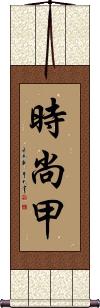
時尚甲 is a special entry for a customer's business name for a nail salon known as “Fancy Nails.”
Note: In Japanese Katakana, Fancy Nails would be ファンシー ネイルズ
Nail Shop / Manicure and Pedicure Salon
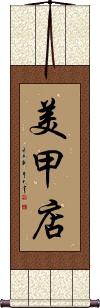
美甲店 is how to title a business that performs only healthful and beauty services to fingernails and toenails. 美甲店 is not the same as a “Beauty Salon,” which offers services beyond your nails.
If you own such a business, this is a nice way to decorate your nail salon.
Ding
Surname
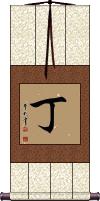
丁 is the Mandarin Chinese surname Ding.
In Japanese, 丁 can be surnames that romanize as Chō or Chou. It can also be more unusual Japanese surnames Rei, Yoroi, Yoboro, Youro, Momoki, Hinoto, Tei, Chiyon, Choudei, Chiyun, or Jiyon.
丁 can refer to nails or pieces of something. It is also a counter for long thin objects like scissors, spades, hoes, inksticks, palanquins, candles, etc.
Cho
Surname
In Japanese, 丁 can be surnames that romanize as Chō or Chou. It can also be more unusual Japanese surnames Rei, Yoroi, Yoboro, Youro, Momoki, Hinoto, Tei, Chiyon, Choudei, Chiyun, or Jiyon.
丁 is also the Mandarin Chinese surname Ding.
丁 can refer to nails or pieces of something. It is also a counter for long thin objects like scissors, spades, hoes, inksticks, palanquins, candles, etc.
Not the results for nails that you were looking for?
Below are some entries from our dictionary that may match your nails search...
| Characters If shown, 2nd row is Simp. Chinese |
Pronunciation Romanization |
Simple Dictionary Definition |
五逆 see styles |
wǔ nì wu3 ni4 wu ni gogyaku ごぎゃく |
(1) {Buddh} five cardinal sins (killing one's father, killing one's mother, killing an arhat, shedding the blood of a Buddha, causing a schism within the sangha); (2) (hist) crime of killing one's master, father, grandfather, mother, or grandmother pañcānantarya; 五無間業 The five rebellious acts or deadly sins, parricide, matricide, killing an arhat, shedding the blood of a Buddha, destroying the harmony of the sangha, or fraternity. The above definition is common both to Hīnayāna and Mahāyāna. The lightest of these sins is the first; the heaviest the last. II. Another group is: (1) sacrilege, such as destroying temples, burning sutras, stealing a Buddha's or a monk's things, inducing others to do so, or taking pleasure therein; (2) slander, or abuse of the teaching of śrāvaka s, pratyekabuddhas, or bodhisattvas; (3) ill-treatment or killing of a monk; (4) any one of the five deadly sins given above; (5) denial of the karma consequences of ill deeds, acting or teaching others accordingly, and unceasing evil life. III. There are also five deadly sins, each of which is equal to each of the first set of five: (1) violation of a mother, or a fully ordained nun; (2) killing a bodhisattva in a sangha; (5) destroying a Buddha's stūpa. IV. The five unpardonable sin of Devadatta who (1) destroyed the harmony of the community; (2) injured Śākyamuni with a stone, shedding his blood; (3) induced the king to let loose a rutting elephant to trample down Śākyamuni; (4) killed a nun; (5) put poison on his finger-nails and saluted Śākyamuni intending to destroy him thereby. |
四塔 see styles |
sì tǎ si4 ta3 ssu t`a ssu ta shitō |
The four stūpas at the places of Buddha's birth, Kapilavastu; enlightenment, Magadha: preaching, Benares; and parinirvāṇa, Kuśinagara. Four more are located in the heavens of the Travastriṃśas gods, one each tor his hair, nails, begging bowl, and teeth, E., S., W., N., respectively. |
外相 see styles |
wài xiàng wai4 xiang4 wai hsiang gaishou / gaisho がいしょう |
Foreign Minister Foreign Minister External appearance or conduct; what is manifested without; externally. The 十二外相 are the hair, teeth, nails, etc. |
夜爪 see styles |
yozume よづめ |
cutting one's nails at night (said to cause one to miss the deathbed of one's parents) |
彪悍 see styles |
biāo hàn biao1 han4 piao han |
tough as nails; formidable; kick-ass; plucky |
斗拱 see styles |
dǒu gǒng dou3 gong3 tou kung |
dougong – an interlocking wooden bracket system between the top of a column and a crossbeam, used in traditional Chinese architecture to support overhanging roofs, composed of blocks and arms fitted together without nails |
爪塔 see styles |
zhǎo tǎ zhao3 ta3 chao t`a chao ta sō tō |
A stūpa, or reliquary, for preserving and honouring the nails and hair of the Buddha, said to be the first Buddhist stūpa raised. |
爪淨 爪净 see styles |
zhǎo jìng zhao3 jing4 chao ching sō jō |
Nail 'cleaned', i. e. fruit, etc., that can be peeled with the nails, one of the five kinds of 'clean' food. |
爪犢 爪犊 see styles |
zhǎo dú zhao3 du2 chao tu Sōtoku |
The long-nailed ascetic Brahmacārī (of the) Vātsīputrīyaḥ; it is said that his nails were a treatise and his hair a discourse 爪章髮論. |
爪糞 see styles |
tsumekuso つめくそ |
dirt that gathers under nails |
聖釘 see styles |
seitei / sete せいてい |
{Christn} Holy Nail; relics claimed to be the nails used for Christ's crucifixion |
伸ばす see styles |
nobasu のばす |
(transitive verb) (1) to grow long (e.g. hair, nails); (2) to lengthen; to extend; to stretch; (3) to reach out; to hold out; (4) to straighten; to smooth out; (5) to spread evenly (dough, cream, etc.); (6) to dilute; to thin out; (7) to postpone; (8) to prolong; (9) to strengthen; to develop; to expand |
延ばす see styles |
nobasu のばす |
(transitive verb) (1) to grow long (e.g. hair, nails); (2) to lengthen; to extend; to stretch; (3) to reach out; to hold out; (4) to straighten; to smooth out; (5) to spread evenly (dough, cream, etc.); (6) to dilute; to thin out; (7) to postpone; (8) to prolong; (9) to strengthen; to develop; to expand |
角蛋白 see styles |
jiǎo dàn bái jiao3 dan4 bai2 chiao tan pai |
keratin (protein forming nails and feathers etc) |
針の筵 see styles |
harinomushiro はりのむしろ |
bed of nails; bed of thorns; bed of needles |
八位胎藏 see styles |
bā wèi tāi zàng ba1 wei4 tai1 zang4 pa wei t`ai tsang pa wei tai tsang hachi i taizō |
The eight stages of the human foetus: 羯羅藍 kalala, the appearance after the first week from conception; 額部曇 arbuda, at end of second week; 閉尸 peśī, third; 健南 ghana, fourth; 鉢羅奢法 praśākhā, limbs formed during fifth week; sixth, hair, nails, and teeth; seventh, the organs of sense, eyes, ears, nose, and tongue; and eighth, complete formation. |
斬釘截鐵 斩钉截铁 see styles |
zhǎn dīng jié tiě zhan3 ding1 jie2 tie3 chan ting chieh t`ieh chan ting chieh tieh zantei settetsu |
lit. to chop the nail and slice the iron (idiom); fig. resolute and decisive; unhesitating; categorical to cut through nails and steel |
痛ネイル see styles |
itaneiru / itaneru いたネイル |
nails adorned with images of anime characters |
釘バット see styles |
kugibatto くぎバット |
wooden bat studded with nails; nail bat; spiked bat |
丑の刻参り see styles |
ushinokokumairi うしのこくまいり |
(exp,n) cursing ritual where one visits a shrine at 2am and nails a doll representing a person to a tree, praying for said person's death |
丑の時参り see styles |
ushinotokimairi うしのときまいり |
(exp,n) (See 丑の刻参り) cursing ritual where one visits a shrine at 2am and nails a doll representing a person to a tree, praying for said person's death |
爪を噛む癖 see styles |
tsumeokamukuse つめをかむくせ |
(expression) habit of biting one's nails |
針のむしろ see styles |
harinomushiro はりのむしろ |
bed of nails; bed of thorns; bed of needles |
ネイルアート see styles |
neiruaato / neruato ネイルアート |
nail art; fashion nails |
ネイル・アート |
neiru aato / neru ato ネイル・アート |
nail art; fashion nails |
Variations: |
harinomushiro はりのむしろ |
bed of nails; bed of thorns; bed of needles |
Variations: |
firuin; firu in フィルイン; フィル・イン |
(1) {music} fill-in (usu. percussion); fill; (2) infill (on gel nails) |
Variations: |
nobasu のばす |
(transitive verb) (1) (esp. 伸ばす) to grow long (e.g. hair, nails); (transitive verb) (2) to lengthen; to extend; to stretch; (transitive verb) (3) (esp. 伸ばす) to reach out; to hold out; (transitive verb) (4) to straighten; to smooth out; (transitive verb) (5) to spread evenly (dough, cream, etc.); (transitive verb) (6) to dilute; to thin out; (transitive verb) (7) (esp. 延ばす) to postpone; (transitive verb) (8) to prolong; (transitive verb) (9) to strengthen; to develop; to expand |
Variations: |
neiruaato; neiru aato / neruato; neru ato ネイルアート; ネイル・アート |
nail art; fashion nails |
Variations: |
harinomushiro はりのむしろ |
(exp,n) bed of nails; bed of thorns; bed of needles |
Click here for more nails results from our dictionary
The following table may be helpful for those studying Chinese or Japanese...
| Title | Characters | Romaji (Romanized Japanese) | Various forms of Romanized Chinese | |
| Fancy Nails | 時尚甲 时尚甲 | shí shàng jiǎ shi2 shang4 jia3 shi shang jia shishangjia | shih shang chia shihshangchia |
|
| Nail Shop Manicure and Pedicure Salon | 美甲店 | měi jiǎ diàn mei3 jia3 dian4 mei jia dian meijiadian | mei chia tien meichiatien |
|
| Ding | 丁 | chou / tei / hinoto cho / tei / hinoto | dīng / ding1 / ding | ting |
| Cho | 丁 | chou / tei / hinoto cho / tei / hinoto | dīng / ding1 / ding | ting |
| In some entries above you will see that characters have different versions above and below a line. In these cases, the characters above the line are Traditional Chinese, while the ones below are Simplified Chinese. | ||||

Successful Chinese Character and Japanese Kanji calligraphy searches within the last few hours...



