Many custom options...


And formats...



Not what you want?
Try other similar-meaning words, fewer words, or just one word.
O Shu Wei in Chinese / Japanese...
Buy an O Shu Wei calligraphy wall scroll here!
Personalize your custom “O Shu Wei” project by clicking the button next to your favorite “O Shu Wei” title below...
Switched to secondary search mode due to lack of results using primary.
These secondary results may not be very accurate. Try a different but similar meaning word or phrase for better results. Or...
Look up O Shu Wei in my Japanese Kanji & Chinese Character Dictionary(My dictionary is a different system then the calligraphy search you just tried)
If you want a special phrase, word, title, name, or proverb, feel free to contact me, and I will translate your custom calligraphy idea for you.
2. Danger
3. The one who retreats 50 paces mocks the one to retreats 100
4. Guan Yu
5. Jehovah
7. Kenpo / Kempo / Quan Fa / Chuan Fa
8. Koh
10. Le
11. Listen to Both Sides and be Enlightened, Listen to One Side and be in the Dark
12. Liu Bei
14. Past experience is the teacher for the future
15. Pure Land Buddhism / Jodo Buddhism
16. Tiger Rumor
17. Warrior Essence / Warrior Spirit / Martial
18. Wei
19. The Game of Weiqi / Weichi / Go
20. Wei Zheng
23. Zhang Fei
24. Zhuge Liang
Bojutsu / Bojitsu
The art of using a stick as a weapon
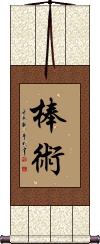
棒術 is the title Bōjutsu (though some use the romanization Bojitsu).
棒術 is a martial art centered around using a “bō” or staff as a weapon.
This title is a combination of the Japanese word “bō” (which means staff, stick, club, rod, pole, or cudgel) with the Japanese word “jutsu” (which means art or technique).
While this word can be pronounced in Chinese (bang shu), it's not a common term in China. Please consider this title to be “Japanese only.”
Danger
A dangerous character in every way
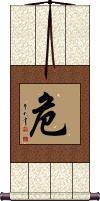
危 means danger, peril, or “to endanger” in Chinese, Japanese, and old Korean.
If you live a dangerous life or want to subtly warn others that you are a dangerous person, this may be the selection for you.
This also means “danger” and sometimes “fear” in Japanese and Korean but is seldom seen outside of compound words in those languages (as a single character, it's kind of like an abbreviation for danger in Japanese and Korean). 危 is also a rather odd selection for a wall scroll anyway. It's only here because people search for danger on our website.
The one who retreats 50 paces mocks the one to retreats 100
The pot calls the kettle black
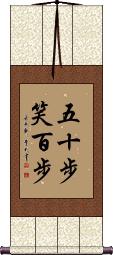
五十步笑百步 is a Chinese proverb that means the one who retreats 50 paces mocks the one who retreats 100 paces.
During the Warring States Period of what is now China (475 - 221 B.C.), the King of Wei was in love with war. He often fought with other kingdoms just for spite or fun.
One day, the King of Wei asked the philosopher Mencius, “I love my people, and all say I do the best for them. I move the people from famine-stricken areas to places of plenty and transport grains from rich areas to the poor. Nobody goes hungry in my kingdom, and I treat my people far better than other kings. But why does the population of my kingdom not increase, and why does the population of other kingdoms not decrease?”
Mencius answered, “Since you love war, I will make this example: When going to war, and the drums beat to start the attack, some soldiers flee for their lives in fear. Some run 100 paces in retreat, and others run 50 steps. Then the ones who retreated 50 paces laugh and taunt those who retreated 100 paces, calling them cowards mortally afraid of death. Do you think this is reasonable?
The King of Wei answered, “Of course not! Those who run 50 paces are just as timid as those who run 100 paces.”
Mencius then said, “You are a king who treats his subjects better than other kings treat their people, but you are so fond of war that your people suffer from great losses in battle. Therefore, your population does not grow. While other kings allow their people to starve to death, you send your people to die in war. Is there any difference?”
This famous conversation led to the six-character proverb shown here. It serves as a warning to avoid hypocrisy. It goes hand-in-hand with the western phrase, “The pot calls the kettle black,” or the Biblical phrase, “Before trying to remove a splinter from your neighbor's eye, first remove the plank from your own eye.”
Guan Yu
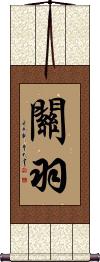
關羽 is the name Guan Yu, Army General for the Kingdom of Shu.
He is also known as Guan Gong (like saying Duke Guan or Sir Guan)
He was immortalized in the novel, “Romance of the Three Kingdoms.”
He was a fearsome fighter, also famous for his virtue and loyalty. He is worshiped by some modern-day soldiers and has the title “Warrior Saint” in China. Some believe he offers safety and protection for military servicemen.
Guan Yu lived until 219 A.D.
Jehovah
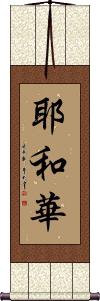
耶和華 is the Mandarin Chinese name for Jehovah.
This is the biblical name for God. Originally this was YHWH or Yahweh from Hebrew, although Yahweh is usually written 雅威 (Ya-wei) in Mandarin. Also, this is not the same as God which is 上帝 (Shang-di).
Jujitsu / Jujutsu
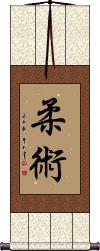
柔術 has been somewhat incorrectly spelled and pronounced “Jujitsu” for some time in the English-speaking world. The correct Japanese Romaji is Jujutsu or Juujutsu.
A little background on the word: By combining the Kanji pronounced “Ju” (which means flexible, pliable, gentle, yielding) with the Kanji pronounced “Jutsu” (which means art or technique), we get a meaning that can be translated as “flexible technique,” “gentle art” or “yielding technique.”
柔術 does make sense in Chinese as well, although pronounced “rou shu” in China.
The Jujutsu system has a history in Japan that started well before the 1600s. Some see this style as a variation of the “Empty Hand Method” (Karate-do). Even the samurai of old used some Jujutsu methods in defending themselves with their unarmed hands against weapons that could pierce their heavy armor.
There are convoluted relationships between various schools and systems of martial arts, but it's generally accepted that Jujutsu led to the development of Judo and a few other variations.
Kenpo / Kempo / Quan Fa / Chuan Fa
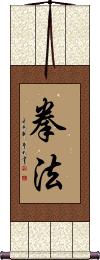
拳法 is a form of martial arts that can be translated in several ways.
Some will call it “fist principles,” “the way of the fist,” or even “law of the fist.” The first character literally means fist. The second can mean law, method, way, principle, or Buddhist teaching.
Kempo is really a potluck of martial arts. Often a combination of Chinese martial arts such as Shaolin Kung Fu with Japanese martial arts such as Karate, Jujutsu (Jujitsu), Aikido, and others. You may see the term “Kempo Karate,” which basically means Karate with other disciplines added. In this way, Kempo becomes an adjective rather than a title or school of martial arts.
These facts will long be argued by various masters and students of Kempo. Even the argument as to whether it should be spelled “kenpo” or “Kempo” ensues at dojos around the world (the correct Romaji should actually be “kenpou” if you precisely follow the rules).
The benefit of Kempo is that the techniques are easier to learn and master than pure Kung Fu (wu shu). Students are often taught basic Karate moves, kicks, and punches before augmenting the basic skills with complex Kung Fu techniques. This allows students of Kempo to achieve a level where they can defend themselves or fight in a relatively short amount of time (a few years rather than a decade or more).
Because the definition of this word is so fluid, I should make some notes here:
1. Purists in Okinawa will claim that “Okinawa Kenpo” or “Ryukyu Hon Kenpo” is the original and true version of this martial art from the old kingdom. It is actually little or no connection between Okinawa Kenpo and the way the word is used elsewhere.
2. In Chinese, where these characters are pronounced “quan fa” (sometimes Romanized as “chuan fa” because the Chinese-pinyin “q” actually sounds like an English “ch” sound), these characters do not hold the connotation of being a mixed martial art. It is simply defined as “the law of the fist.”
3. My Japanese dictionary oddly defines Kenpo as the “Chinese art of self-defense.” I personally don't feel this is the most common way that people perceive the word but just something you should know.

許 is the name Koh in Chinese.
It could also be 高, 寇, 柯, or 邱 depending on origin and dialect. This is Xu (like Shu) in Mandarin, but can be Koh from Cantonese, Teochew, or Hokkien dialects.
Kuoshu / Martial Arts
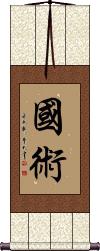
This is a way to write martial arts in Chinese.
This can be romanized as Kuoshu, Kuo Shu, Guoshu, or Guo Shu.
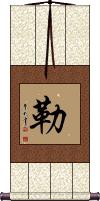
勒 is a Chinese surname that romanizes as Le or Lè and comes from ancient place names (Shu-Le) or ethnic groups like the Huns.
Use caution: There are other surnames in Asia that romanize as Le; here are a few:
Vietnamese (Lê): Most common usage, from Chinese 黎 (Lí), signifying a major royal family like the Lê Dynasty (1428–1788).
Chinese (樂 - Lè): Means "happiness" or "joy," from historical figures or noble lineages.
Korean: Can be a variant of Li or Lee, representing different Chinese characters (e.g., 黎, 呂).
Listen to Both Sides and be Enlightened, Listen to One Side and be in the Dark
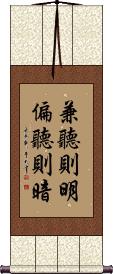
兼聽則明偏聽則暗 is an ancient Chinese proverb about getting all the information from all sides so that you truly understand a situation.
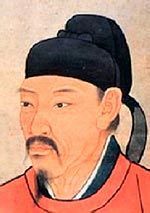
Wei Zheng
A man named Wei Zheng lived between 580-643 AD. He was a noble and wise historian and minister in the court of the early Tang Dynasty. The emperor once asked him, “What should an emperor do to understand the real-world situation, and what makes an emperor out-of-touch with reality?”
Wei Zheng replied, “Listen to both sides and you will be enlightened; listen to only one side and you will be left in the dark.”
Then Wei Zheng went on to cite examples of leaders in history that were victorious after heeding both sides of the story, and other leaders that met their doom because they believed one-sided stories which often came from flattering lips.
Please note that there is an unwritten rule when the same character appears twice in the same phrase, the calligrapher will alter the appearance so that no two characters are exactly alike in the same piece. This calligraphy has two repeating characters that will be written differently than they appear here.
Liu Bei
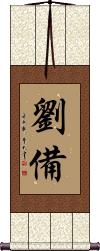
劉備 is the name Liu Bei (161-223AD), warlord at the end of the Han dynasty and founder of the Han kingdom of Shu.
In Japanese, this can be the name Ryuubi or Ryūbi. Most Japanese will be familiar with the Chinese historical figure, Liu Bei.
Martial Arts / Wushu
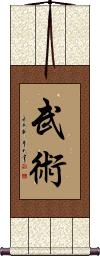
武術 is Wushu or Wu Shu, the very Chinese way to express “Martial Arts.”
Some even use this word to describe Kung Fu directly. But this is a label that fits all disciplines from Karate to Kung Fu to Taekwondo.
Note: This also means Martial Arts with the same appearance as old Korean Hanja characters and is pronounced “musul” or “musur” in Korean.
While this is best if your audience is Chinese or Korean, this also means “martial arts” in Japanese, where the popularity of this term is growing (romanized as Bujutsu or Bujitsu) in Japanese martial arts circles.
Past experience is the teacher for the future
Past events not forgotten serve as teachers for later events.
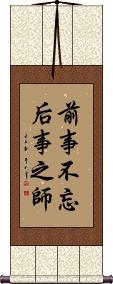
The most literal translation to English of this ancient 前事不忘后事之师 Chinese proverb is:
“Past events not forgotten serve as teachers for later events.”
However, it's been translated several ways:
Don't forget past events, they can guide you in the future.
Benefit from past experience.
Past experience, if not forgotten, is a guide for the future.
Past calamity is my teacher.
A good memory for the past is a teacher for the future.
The remembrance of the past is the teacher of the future.
If one remembers the lessons of the past; They will serve as a guide to avoid mistakes in the future.
The origin:
This proverb comes from the 5th century B.C., just before the Warring States Period in the territory now known as China.
The head of the State of Jin, Zhi Bo, seized power in a coup. He did this with help from the armies of the State of Han and Wei. Instead of being grateful for the help from Han and Wei, he treacherously took the land of Han and Wei. Never satisfied, Zhi Bo employed the armies of Han and Wei to attack and seize the State of Zhao.
The king of Zhao took advice from his minister Zhang Mengtan and secretly contacted the Han and Wei armies to reverse their plans and attack the army of Zhi Bo instead. The plan was successful, and the State of Zhao was not only saved but was set to become a powerful kingdom in the region.
Zhang Mengtan immediately submitted his resignation to a confused king of Zhao. When asked why, Zhang Mengtan said, “I've done my duty to save my kingdom, but looking back at past experience, I know sovereign kings are never satisfied with the power or land at hand. They will join others and fight for more power and more land. I must learn from past experiences, as those experiences are the teachers of future events.”
The king could not dispute the logic in that statement and accepted Zhang Mengtan's resignation.
For generations, the State of Zhao continued to fight for power and land until finally defeated and decimated by the State of Qin (which led to the birth of the Qin Dynasty in 221 B.C.).
Pure Land Buddhism / Jodo Buddhism
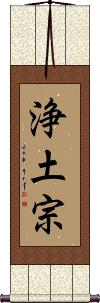
浄土宗 is the title of Japanese “Pure Land Buddhism.” This form is also romanized/known as “Jodo Shu” (jōdo shū).
Also known as Amidism for the fact that this is a branch of Mahayana (Mahāyāna) Buddhism which focuses on Amitabha (Amitābha) Buddha. This form of Buddhism, along with Chinese characters, came to Japan via China in the 5th century, according to most historians.
Notes:
Pure Land Buddhism is also known as 


 (jōdo bukkyō).
Some will just express it with just (Pure Land).
See Also: Shin Buddhism
Tiger Rumor
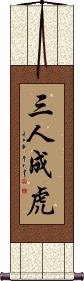
These four characters together relay the meaning that can be expressed in English as “When three people say there's a tiger running in the street, you believe it.”
Of course, there is an ancient story behind this idiom...
三人成虎 is actually a proverb that resulted from a conversation that occurred around 300 B.C.
The conversation was between the king of the Wei kingdom and one of the king's ministers named Pang Cong.
It was near the end of one of many wars, this time with the Zhao kingdom. Pang Cong was to be sent by the king to the Zhao kingdom with the king's son, who was to be held hostage. It was common at the time for a king to make his son a hostage to secure stable peace between warring kingdoms.
Before minister Pang Cong departed, he asked his king, “If one person told you a tiger was running in the street, would you believe it?.”
“No,” the king said.
The minister continued, “What if two people told you?”
The king replied, “Well, I would have my doubts but I might believe it.”
The minister continued, “So, what if three people told you that a tiger is running in the streets?”
The king replied, “Yes, I would believe it. It must be true if three people say it.”
The minister then reminded the king, “Your son and I are now traveling far away to live in the distant Zhao kingdom - much farther from your palace than the street. Rumors may fly about me in my absence, so I hope your majesty will weight such rumors appropriately.”
The king replied, “I have every trust in you, do not worry”
While the minister was gone, the king's enemies gossiped about minister Pang Cong on many occasions. At first, the king thought nothing of these comments and rumors. But slowly, as the rumors mounted, the king began to suspect ill of his minister.
Sometime later, when peace was well-established, the minister and prince were freed and returned to the kingdom of Wei. The king received his son BUT DID NOT EVEN SUMMON MINISTER PANG CONG TO THE PALACE!
Hopefully, this story will help you see how dangerous words can be when used to promote rumors or create ill will. And perhaps will inspire you not to believe everything you hear.
There is also a secondary suggestion in this idiom that gossip is as ferocious as a tiger. Some Chinese people who don't know the ancient story above may believe that this scroll means that rumors are as vicious as three tigers.
Note: This proverb appears in my Korean dictionary but is not well-known in Korea.
Warrior Essence / Warrior Spirit / Martial
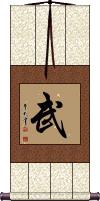
武 is the essence or spirit of a warrior. 武 is part of the word “wu shu” which is sometimes translated as “martial arts” or “kung fu.”
In more modern speech and another context, this can mean military, martial, warlike, fierce, and perhaps violent but usually as a prefix for a longer word or phrase.

魏 is a surname that romanizes as Wei in Chinese (Mandarin).
This is not the only Wei: The surname Wei (魏, 卫, 危, etc.) is a common Chinese surname with multiple origins, often meaning "defend/guard" (卫) or "leather" (韦) from ancient states or official titles, also used by various ethnic groups, and is a significant name in Chinese history, appearing in texts like the Hundred Family Surnames. Its Cantonese romanization is often "Wai".

ウェイ is the name Wei in Japanese Katakana.
Note: Because this title is entirely Japanese Katakana, it should be written by a Japanese calligrapher.
The Game of Weiqi / Weichi / Go
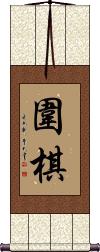
圍棋 is the Chinese title for the ancient game of strategy known as Weiqi or Wei Chi in Chinese and Go in Japanese.
 Note: In Japanese, this game is known by a different single Kanji as seen to the right. If you want this Japanese "Go" character, click the Kanji to the right instead of the button above.
Wei Zheng
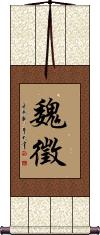
魏徵 is the name Wei Zheng, the Tang Dynasty politician and historian.
Known for rebelling against and later documenting the history of the Sui Dynasty which proceeded Tang.
Wine / Alcohol / Sake
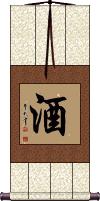
酒 is the Chinese character, Korean Hanja, and Japanese Kanji which means alcohol.
This can refer to wine (esp. rice wine), liquor, spirits, sake, or to alcoholic beverages in general.
In the west, we tend to say “sake” to mean Japanese rice wine, however, this character is a little ambiguous in Japanese. It literally just means alcohol and is often pronounced “shu” in Japanese. Specifically, in Japanese, you might want to ask for “seishu” or 清酒 to get the sake that you are used to in the west. Seishu literally means “clear alcohol.”
Wu Wei / Without Action
Daoist / Taoist Tenet
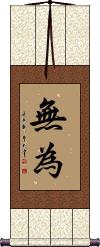
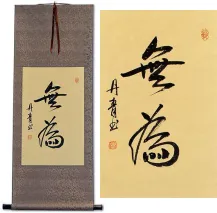
無為 or “Wu Wei” is a Daoist (Taoist) tenet that speaks to the idea of letting nature take its course.
Some will say it's about knowing when to take action and when not to. In reality, it's more about not going against the flow. What will happen is controlled by the Dao (Tao), for which one who follows the Dao will not resist or struggle against.
You can think of 無為 as the Chinese way to express “laissez-faire.”
There is a lot more to this concept, but if you are looking for this entry, you already know the expanded concept.
Warning: Outside of the Daoist context, this means idleness or inactivity (especially in Japanese, where not everyone knows this as a Daoist concept, though it does pair well with the Japanese concept of Wabi-Sabi).
Zhang Fei
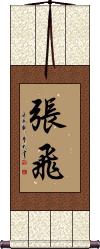
張飛 is the name of General Zhang Fei, of the Shu Kingdom. He was blood-brother of Liu Bei in the semi-historical novel “Romance of the Three Kingdoms.” Zhang Fei is famous for his heroic and fearsome fighting and his love of wine.
In Japanese, this can be the name Chouhi.
Zhuge Liang
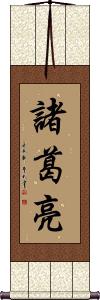
諸葛亮 is the name Zhuge Liang, written in Chinese.
Zhuge Liang lived from 181 to 234 A.D.
He was a military leader and prime minister of Shu Han (蜀漢) during the Three Kingdoms period.
He was the main hero of the fictional Romance of Three Kingdoms.
He is considered a famous sage, philosopher, and military genius.
This in-stock artwork might be what you are looking for, and ships right away...

Gallery Price: $168.00
Your Price: $92.88
Gallery Price: $79.00
Your Price: $43.88

Gallery Price: $108.00
Your Price: $59.88


Gallery Price: $72.00
Your Price: $39.88

Gallery Price: $63.00
Your Price: $34.88

Gallery Price: $101.00
Your Price: $55.88

Gallery Price: $101.00
Your Price: $55.88

Gallery Price: $72.00
Your Price: $39.88

Starting at: $28.88

Gallery Price: $108.00
Your Price: $59.88

Gallery Price: $108.00
Your Price: $59.88

Gallery Price: $72.00
Your Price: $39.88

Gallery Price: $63.00
Your Price: $34.88

Gallery Price: $72.00
Your Price: $39.88
The following table may be helpful for those studying Chinese or Japanese...
| Title | Characters | Romaji (Romanized Japanese) | Various forms of Romanized Chinese | |
| Bojutsu Bojitsu | 棒術 棒术 | bou jutsu / boujutsu / bo jutsu | bàng shù / bang4 shu4 / bang shu / bangshu | pang shu / pangshu |
| Danger | 危 | ki | wēi / wei1 / wei | |
| The one who retreats 50 paces mocks the one to retreats 100 | 五十步笑百步 | wù shí bù xiào bǎi bù wu4 shi2 bu4 xiao4 bai3 bu4 wu shi bu xiao bai bu wushibuxiaobaibu | wu shih pu hsiao pai pu wushihpuhsiaopaipu |
|
| Guan Yu | 關羽 关羽 | guān yǔ / guan1 yu3 / guan yu / guanyu | kuan yü / kuanyü | |
| Jehovah | 耶和華 耶和华 | yē hé huá ye1 he2 hua2 ye he hua yehehua | yeh ho hua yehhohua |
|
| Jujitsu Jujutsu | 柔術 柔术 | juu jutsu / juujutsu / ju jutsu | róu shù / rou2 shu4 / rou shu / roushu | jou shu / joushu |
| Kenpo Kempo Quan Fa Chuan Fa | 拳法 | kenpou / kenpo | quán fǎ / quan2 fa3 / quan fa / quanfa | ch`üan fa / chüanfa / chüan fa |
| Koh | 許 许 | xǔ / xu3 / xu | hsü | |
| Kuoshu Martial Arts | 國術 国术 | guó shù / guo2 shu4 / guo shu / guoshu | kuo shu / kuoshu | |
| Le | 勒 | lè / le4 / le | ||
| Listen to Both Sides and be Enlightened, Listen to One Side and be in the Dark | 兼聽則明偏聽則暗 兼听则明偏听则暗 | jiān tīng zé míng, piān tīng zé àn jian1 ting1 ze2 ming2, pian1 ting1 ze2 an4 jian ting ze ming, pian ting ze an | chien t`ing tse ming, p`ien t`ing tse an chien ting tse ming, pien ting tse an |
|
| Liu Bei | 劉備 刘备 | ryuubi / ryubi | liú bèi / liu2 bei4 / liu bei / liubei | liu pei / liupei |
| Martial Arts Wushu | 武術 武术 | bujutsu | wǔ shù / wu3 shu4 / wu shu / wushu | |
| Past experience is the teacher for the future | 前事不忘后事之師 前事不忘后事之师 | qián shì bú wàng hòu shí zhī shī qian2 shi4 bu2 wang4 hou4 shi2 zhi1 shi1 qian shi bu wang hou shi zhi shi | ch`ien shih pu wang hou shih chih shih chien shih pu wang hou shih chih shih |
|
| Pure Land Buddhism Jodo Buddhism | 淨土宗 浄土宗 | jou do shuu joudoshuu jo do shu | jìng tǔ zōng jing4 tu3 zong1 jing tu zong jingtuzong | ching t`u tsung chingtutsung ching tu tsung |
| Tiger Rumor | 三人成虎 | sān rén chéng hǔ san1 ren2 cheng2 hu3 san ren cheng hu sanrenchenghu | san jen ch`eng hu sanjenchenghu san jen cheng hu |
|
| Warrior Essence Warrior Spirit Martial | 武 | bu | wǔ / wu3 / wu | |
| Wei | 魏 | wèi / wei4 / wei | ||
| Wei | ウェイ | wei | ||
| The Game of Weiqi Weichi Go | 圍棋 围棋 | wéi qí / wei2 qi2 / wei qi / weiqi | wei ch`i / weichi / wei chi | |
| Wei Zheng | 魏徵 魏征 | wèi zhēng wei4 zheng1 wei zheng weizheng | wei cheng weicheng |
|
| Wine Alcohol Sake | 酒 | sake / shu | jiǔ / jiu3 / jiu | chiu |
| Wu Wei Without Action | 無為 无为 | mui | wú wéi / wu2 wei2 / wu wei / wuwei | |
| Zhang Fei | 張飛 张飞 | chou hi / chouhi / cho hi | zhāng fēi zhang1 fei1 zhang fei zhangfei | chang fei changfei |
| Zhuge Liang | 諸葛亮 诸葛亮 | zhū gě liàng zhu1 ge3 liang4 zhu ge liang zhugeliang | chu ko liang chukoliang |
|
| In some entries above you will see that characters have different versions above and below a line. In these cases, the characters above the line are Traditional Chinese, while the ones below are Simplified Chinese. | ||||

Successful Chinese Character and Japanese Kanji calligraphy searches within the last few hours...



