Many custom options...


And formats...



Open in Chinese / Japanese...
Buy an Open calligraphy wall scroll here!
Personalize your custom “Open” project by clicking the button next to your favorite “Open” title below...
1. Open Door
2. Open Hearted
3. Open Mind
9. An Open Book Benefits Your Mind
10. Open the Minds of the Next Generation To Stimulate Thinking
11. Hunt Foxes with Stealth, Hunt Wolves in the Open
12. Flower Open / Blooming Flower
13. Flowers Bloom and Flowers Fall
Open Door
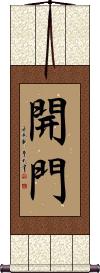
開門 means “to open a door,” “opening gate” or figuratively, “to open for business.”
Open Hearted
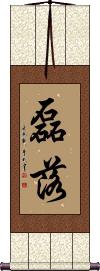
磊落 is a word that can mean big and stout, big-hearted, open and honest, or open-hearted in Chinese and Japanese.
Open Mind
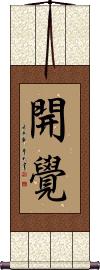
開覺 is a Buddhist term meaning “open mind.”
The more full definition as used in Buddhism is, “To arouse, awaken; to allow the original Buddha-nature to open and enlighten the mind.”
Open Your Heart

敞開心扉 is the most common way to express the idea of “Opening your heart” in Chinese.
This phrase is made up or two words:
敞开 = To open wide, to be unrestricted.
心扉 = Inner heart or soul.
If you want it brokend down further into individual characters:
敞 = Open to the view of all people, spacious, to open wide, or to disclose.
开 = Open, to start, or the beginning.
心 = Heart/Mind
扉 = Door, gate, opening, or the title page.
So maybe you can say, “To open wide the door of your heart and mind to all.”
Other variations of “open your heart” also exist such as 打開心扉, 敞開你的心扉, 打開你的心, and Simplified Chinese 敞开心扉, 打开心扉, 敞开你的心扉, or 打开你的心. These are also correct, but not as commonly used as 敞開心扉.
Happy / Open Heart

In mordern times, 開心 means to feel happy, to rejoice, or to have a great time, but directly translates as open heart.
In the Buddhist context, beyond opening the heart, it can mean to develop the mind, to initiate into truth, or awaken the mind.
開 = Open.
心 = Heart/Mind.
Not commonly used in Japanese where it might be read as open-mindeness.
Listen with Open Mind
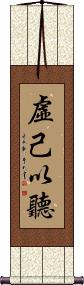
虛己以聽 is a Chinese proverb that means to listen to the ideas of others with an open mind.
Calm and Open Mind
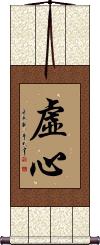
虛心 is a Buddhist term that speaks of being open-minded and/or having a calm and humble mind or heart.
Open and Calm Mind
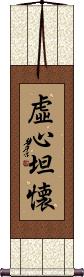
虛心坦懐 is a Japanese proverb that means “with an open and calm mind,” “with no preconceived notions,” or “without reservations.”
In some contexts, it can mean frank or candid.
If you want to remind yourself to approach each situation with no preconceptions, this is a good title for you. This can also refer to the ideas of being candid, frank, and straightforward.
An Open Book Benefits Your Mind
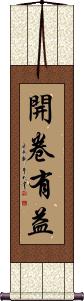
There are several ways to translate this ancient proverb. Translated literally and directly, it says, “Open roll has/yields benefit.”
To understand that, you must know a few things...
First, Chinese characters and language have deeper meanings that often are not spoken but are understood - especially with ancient texts like this. Example: It's understood that the “benefit” referred to in this proverb is to the reader's mind. Just the last character expresses that whole idea.
Second, Chinese proverbs are supposed to make you think and leave a bit of mystery to figure out.
Third, for this proverb, it should be noted that roll = book. When this proverb came about (about two thousand years ago), books were rolls of bamboo slips strung together. The first bound books like the ones we use today did not come about until about a thousand years after this proverb when they invented paper in China.
開卷有益 is a great gift for a bookworm who loves to read and increase their knowledge. Or for any friend that is or wants to be well-read.
Some other translations of this phrase:
Opening a book is profitable
The benefits of education.
Open the Minds of the Next Generation To Stimulate Thinking
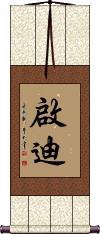
This word is often used to describe the idea of opening the minds of the young or the new generation.
See Also: Wisdom | Learning is Eternal | Learn From Wisdom
Hunt Foxes with Stealth, Hunt Wolves in the Open
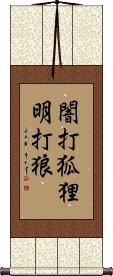
闇打狐狸明打狼 is a Chinese proverb that translates as: Hunt foxes stealthily, [and] hunt wolves openly [just as they do].
Figuratively, this means:
Different opponents require different appropriate strategies.
This is a suggestion that you should know your enemy and know that each enemy is different, therefore requires a specialized approach (attack).
See Also: Art of War Military
Flower Open / Blooming Flower
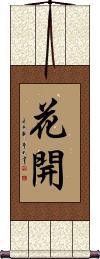
These two characters mean “flower open.”
花開 is also associated with Springtime, the beginning of something, or youth.
花開 is often followed by 花落 or “flower falls” (closes and loses its petals) which means “Things come and go” or “Youth comes and goes.”
If you like flowers and Springtime, this is a great selection for you. However, if you want the companion “flower falls” (flower withers), we offer that as a companion wall scroll or all together as a four-character phrase.
See Also: Flowers Fall
Flowers Bloom and Flowers Fall
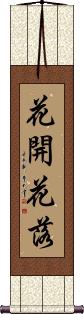
花開花落 is a complete proverb that lightly speaks of the cycle of life, or how things come and go in life.
This is used as a metaphor to suggest that youth is a temporary state that in time will pass.
This can also be used to suggest that fortunes can come and go (everything is temporary).
Note: There are two very similar versions of this proverb. The other uses a word that means wither instead of fall.
Flowers Bloom and Flowers Wither
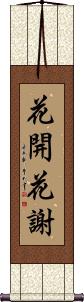
花開花謝 is a complete proverb that lightly speaks of the cycle of life, or how things come and go in life.
This is used as a metaphor to suggest that youth is a temporary state, which in time, will pass.
This proverb can be used to suggest that fortunes can come and go (everything is temporary).
Note: There are two very similar versions of this proverb. The other uses a word that means fall instead of wither.
Flowers Bloom and Flowers Fall
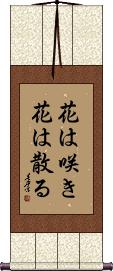
花は咲き花は散る is a Japanese proverb about the cycle of life, or how things come and go in life.
This can be used to suggest that youth, fortune, and life can come and go (everything is temporary).
Note: Because this selection contains some special Japanese Hiragana characters, it should be written by a Japanese calligrapher.
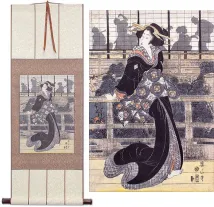
This in-stock artwork might be what you are looking for, and ships right away...
Gallery Price: $108.00
Your Price: $59.88

These search terms might be related to Open:
Best Love / Most Sincere Love
Forgive Yourself / Release Yourself
Frank
Fresh Start
Honest / Straightforward
Integrity: Sincere Honest and Faithful
Most Sincere Friend / Honest Friend / Real Friend / Best Friend
Perfectly Sincere Mind
Release / Let Go
Release of Desires
Sincere / True Sincerity
Sincere Heart
The following table may be helpful for those studying Chinese or Japanese...
| Title | Characters | Romaji (Romanized Japanese) | Various forms of Romanized Chinese | |
| Open Door | 開門 开门 | kai mon / kaimon | kāi mén / kai1 men2 / kai men / kaimen | k`ai men / kaimen / kai men |
| Open Hearted | 磊落 | rairaku | lěi luò / lei3 luo4 / lei luo / leiluo | lei lo / leilo |
| Open Mind | 開覺 开觉 | kaikaku / kaikaku | kāi jué / kai1 jue2 / kai jue / kaijue | k`ai chüeh / kaichüeh / kai chüeh |
| Open Your Heart | 敞開心扉 敞开心扉 | chǎng kāi xīn fēi chang3 kai1 xin1 fei1 chang kai xin fei changkaixinfei | ch`ang k`ai hsin fei changkaihsinfei chang kai hsin fei |
|
| Happy Open Heart | 開心 开心 | kai shin / kaishin | kāi xīn / kai1 xin1 / kai xin / kaixin | k`ai hsin / kaihsin / kai hsin |
| Listen with Open Mind | 虛己以聽 虚己以听 | xū jǐ yǐ tīng xu1 ji3 yi3 ting1 xu ji yi ting xujiyiting | hsü chi i t`ing hsüchiiting hsü chi i ting |
|
| Calm and Open Mind | 虛心 虚心 | ko shin / koshin | xū xīn / xu1 xin1 / xu xin / xuxin | hsü hsin / hsühsin |
| Open and Calm Mind | 虛心坦懐 虚心坦懐 | kyo shin tan kai kyoshintankai | ||
| An Open Book Benefits Your Mind | 開卷有益 开卷有益 | kāi juàn yǒu yì kai1 juan4 you3 yi4 kai juan you yi kaijuanyouyi | k`ai chüan yu i kaichüanyui kai chüan yu i |
|
| Open the Minds of the Next Generation To Stimulate Thinking | 啟迪 启迪 | qǐ dí / qi3 di2 / qi di / qidi | ch`i ti / chiti / chi ti | |
| Hunt Foxes with Stealth, Hunt Wolves in the Open | 闇打狐狸明打狼 暗打狐狸明打狼 | àn dǎ hú li míng dǎ láng an4 da3 hu2 li ming2 da3 lang2 an da hu li ming da lang andahulimingdalang | an ta hu li ming ta lang antahulimingtalang |
|
| Flower Open Blooming Flower | 花開 花开 | huā kāi / hua1 kai1 / hua kai / huakai | hua k`ai / huakai / hua kai | |
| Flowers Bloom and Flowers Fall | 花開花落 花开花落 | huā kāi huā luò hua1 kai1 hua1 luo4 hua kai hua luo huakaihualuo | hua k`ai hua lo huakaihualo hua kai hua lo |
|
| Flowers Bloom and Flowers Wither | 花開花謝 花开花谢 | huā kāi huā xiè hua1 kai1 hua1 xie4 hua kai hua xie huakaihuaxie | hua k`ai hua hsieh huakaihuahsieh hua kai hua hsieh |
|
| Flowers Bloom and Flowers Fall | 花は咲き花は散る | hana wa sa ki hana wa chi ru hanawasakihanawachiru | ||
| In some entries above you will see that characters have different versions above and below a line. In these cases, the characters above the line are Traditional Chinese, while the ones below are Simplified Chinese. | ||||

Successful Chinese Character and Japanese Kanji calligraphy searches within the last few hours...



