Many custom options...


And formats...



Raid in Chinese / Japanese...
Buy a Raid calligraphy wall scroll here!
Undaunted After Repeated Setbacks
Persistence to overcome all challenges
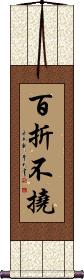
百折不撓 is a Chinese proverb that means “Be undaunted in the face of repeated setbacks.”
More directly translated, it reads, “[Overcome] a hundred setbacks, without flinching.” 百折不撓 is of Chinese origin but is commonly used in Japanese and somewhat in Korean (same characters, different pronunciation).
This proverb comes from a long, and occasionally tragic story of a man that lived sometime around 25-220 AD. His name was Qiao Xuan, and he never stooped to flattery but remained an upright person at all times. He fought to expose the corruption of higher-level government officials at great risk to himself.
Then when he was at a higher level in the Imperial Court, bandits were regularly capturing hostages and demanding ransoms. But when his own son was captured, he was so focused on his duty to the Emperor and the common good that he sent a platoon of soldiers to raid the bandits' hideout, and stop them once and for all even at the risk of his own son's life. While all of the bandits were arrested in the raid, they killed Qiao Xuan's son at first sight of the raiding soldiers.
Near the end of his career, a new Emperor came to power, and Qiao Xuan reported to him that one of his ministers was bullying the people and extorting money from them. The new Emperor refused to listen to Qiao Xuan and even promoted the corrupt Minister. Qiao Xuan was so disgusted that in protest, he resigned from his post as minister (something almost never done) and left for his home village.
His tombstone reads “Bai Zhe Bu Nao” which is now a proverb used in Chinese culture to describe a person of strong will who puts up stubborn resistance against great odds.
My Chinese-English dictionary defines these 4 characters as “keep on fighting despite all setbacks,” “be undaunted by repeated setbacks,” and “be indomitable.”
Our translator says it can mean “never give up” in modern Chinese.
Although the first two characters are translated correctly as “repeated setbacks,” the literal meaning is “100 setbacks” or “a rope that breaks 100 times.” The last two characters can mean “do not yield” or “do not give up.”
Most Chinese, Japanese, and Korean people will not take this absolutely literal meaning but will instead understand it as the title suggests above. If you want a single big word definition, it would be indefatigability, indomitableness, persistence, or unyielding.
See Also: Tenacity | Fortitude | Strength | Perseverance | Persistence
Not the results for raid that you were looking for?
Below are some entries from our dictionary that may match your raid search...
| Characters If shown, 2nd row is Simp. Chinese |
Pronunciation Romanization |
Simple Dictionary Definition |
壕 see styles |
háo hao2 hao hori ほり |
moat; (military) trench (1) moat; fosse; (2) canal; ditch; (1) moat; fosse; trench; ditch; (2) underground air-raid shelter; dugout; (surname) Hori |
抄 see styles |
chāo chao1 ch`ao chao shou / sho しょう |
to make a copy; to plagiarize; to search and seize; to raid; to grab; to go off with; to take a shortcut; to make a turning move; to fold one's arms (1) (obsolete) excerpt; extract; (2) annotation; (3) shou (unit of volume, approx. 1.8 ml); (female given name) Shou extract and annotate from a text |
襲 袭 see styles |
xí xi2 hsi souen / soen そうえん |
(bound form) to raid; to attack; (bound form) to continue the pattern; to perpetuate; (literary) classifier for suits of clothing or sets of bedding (1) pile; heap; layers (e.g. of clothing); set (e.g. of boxes); course (e.g. of stones); (counter) (2) counter for things that are stacked, piled up (or layered, etc.); (3) layers of clothing worn under one's overcoat; (4) (abbreviation) combination of colors created by layering of garments (colours); (personal name) Souen |
侵す see styles |
okasu おかす |
(transitive verb) (1) to invade; to raid; to violate (airspace, etc.); to intrude; to trespass; (transitive verb) (2) to infringe; to encroach; (transitive verb) (3) (See 冒す・おかす・2) to harm; to afflict; to affect |
侵入 see styles |
qīn rù qin1 ru4 ch`in ju chin ju shinnyuu / shinnyu しんにゅう |
to make (military) incursions; to invade; to intrude into; to trespass; to gain unauthorized access (computing) (n,vs,vi) invasion; incursion; raid; aggression; intrusion; trespass; penetration; hacking |
侵掠 see styles |
qīn lüè qin1 lve4 ch`in lve chin lve shinryaku しんりゃく |
(noun/participle) aggression; invasion; raid to attack |
侵略 see styles |
qīn lüè qin1 lu:e4 ch`in lu:e chin lu:e shinryaku しんりゃく |
to invade; invasion (noun/participle) aggression; invasion; raid |
偷襲 偷袭 see styles |
tōu xí tou1 xi2 t`ou hsi tou hsi |
to mount a sneak attack; to raid |
奇兵 see styles |
qí bīng qi2 bing1 ch`i ping chi ping kihei / kihe きへい |
troops appearing suddenly (in a raid or ambush) (ant: 正兵) irregular soldiers; commandos |
奇襲 奇袭 see styles |
qí xí qi2 xi2 ch`i hsi chi hsi kishuu / kishu きしゅう |
surprise attack; raid (n,vs,vt,adj-no) surprise attack |
奔襲 奔袭 see styles |
bēn xí ben1 xi2 pen hsi |
to carry out a long-range raid |
急襲 急袭 see styles |
jí xí ji2 xi2 chi hsi kyuushuu / kyushu きゅうしゅう |
sudden attack (noun, transitive verb) raid; assault; descent |
挖角 see styles |
wā jué wa1 jue2 wa chüeh |
to poach (talent, personnel from competitors); to raid (a competitor for its talent); Taiwan pr. [wa1 jiao3] |
攻伐 see styles |
gōng fá gong1 fa2 kung fa koubatsu / kobatsu こうばつ |
to attack; to raid; (of medicine) potent (n,vs,vi) subjugation; attacking; conquering |
攻撃 see styles |
kougeki / kogeki こうげき |
(noun, transitive verb) (1) (ant: 守備・1) attack; assault; raid; onslaught; offensive; (noun, transitive verb) (2) criticism; censure; denunciation; condemnation |
敵襲 see styles |
tekishuu / tekishu てきしゅう |
enemy attack; enemy raid |
来冦 see styles |
raikou / raiko らいこう |
invasion; raid |
来寇 see styles |
raikou / raiko らいこう |
(noun/participle) invasion; raid; inroad |
来襲 see styles |
raishuu / raishu らいしゅう |
(n,vs,vi) (incoming) attack; raid; invasion; assault |
查抄 see styles |
chá chāo cha2 chao1 ch`a ch`ao cha chao |
to take inventory of and confiscate a criminal's possessions; to search and confiscate (forbidden items); to raid |
殺進 杀进 see styles |
shā jìn sha1 jin4 sha chin |
to storm (a city etc); to raid |
游撃 see styles |
yuugeki / yugeki ゆうげき |
(noun/participle) (1) raid; military attack by a mobile unit; hit-and-run attack; search-and-kill mission; search-and-destroy mission; military action without a predetermined target; attacking the enemy or assisting allies as the opportunity arises; (2) (baseb) (abbreviation) shortstop; short |
爆撃 see styles |
bakugeki ばくげき |
(noun, transitive verb) bombing (raid) |
空襲 空袭 see styles |
kōng xí kong1 xi2 k`ung hsi kung hsi kuushuu / kushu くうしゅう |
to make an air raid (n,vs,vt,adj-no) air-raid |
突襲 突袭 see styles |
tū xí tu1 xi2 t`u hsi tu hsi |
to raid; to storm; surprise attack |
竄犯 窜犯 see styles |
cuàn fàn cuan4 fan4 ts`uan fan tsuan fan |
to raid; an intrusion (of the enemy, or bandit groups) |
緝查 缉查 see styles |
jī chá ji1 cha2 chi ch`a chi cha |
to raid; to search (for criminal) |
臨検 see styles |
rinken りんけん |
(noun, transitive verb) on-the-spot investigation or inspection; raid |
襲撃 see styles |
shuugeki / shugeki しゅうげき |
(noun, transitive verb) (surprise) attack; assault; raid; charge |
襲擊 袭击 see styles |
xí jī xi2 ji1 hsi chi |
attack (esp. surprise attack); raid; to attack |
Click here for more raid results from our dictionary
The following table may be helpful for those studying Chinese or Japanese...
| Title | Characters | Romaji (Romanized Japanese) | Various forms of Romanized Chinese | |
| Undaunted After Repeated Setbacks | 百折不撓 百折不挠 | hyaku setsu su tou hyakusetsusutou hyaku setsu su to | bǎi zhé bù náo bai3 zhe2 bu4 nao2 bai zhe bu nao baizhebunao | pai che pu nao paichepunao |
| In some entries above you will see that characters have different versions above and below a line. In these cases, the characters above the line are Traditional Chinese, while the ones below are Simplified Chinese. | ||||

Successful Chinese Character and Japanese Kanji calligraphy searches within the last few hours...



