Many custom options...


And formats...



Realistic in Chinese / Japanese...
Buy a Realistic calligraphy wall scroll here!
Personalize your custom “Realistic” project by clicking the button next to your favorite “Realistic” title below...
Reality / Realistic
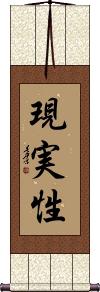
現実性 is a Japanese word that expresses the idea of reality or coming to understand what is true and real.
This can also be translated as realistic, practical, or feasible.
See Also: Illusion
Realistic / Practical
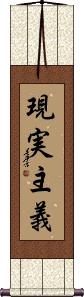
現実主義 means realistic or practical in Japanese.
If you need a reminder to remain grounded in your life, this is a great way to do that.
Realistic / Practical
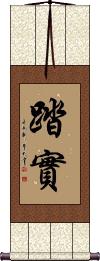
踏實 means realistic or practical.
If you need a reminder to remain grounded in your life, this is a great way to do that. 踏實 also can have the meanings of “at ease,” “down to earth,” “to have peace of mind,” “free from anxiety,” steady, or steadfast.
Keep Your Feet on the Ground
Be Down-to-Earth
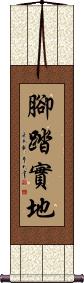
腳踏實地 is a four-character proverb that suggests that you should be practical, realistic, and grounded.
Some translate this as a suggestion to be down-to-earth.
The first character means “feet.”
The second means “step on” or “stand.”
The third means “solid,” “real,” or “true.”
The last character means “ground,” “earth,” or “terra.”
Literally, this means “[keep your] Feet Standing [on] Solid Ground.”
Mountain Travels Poem by Dumu

This poem was written almost 1200 years ago during the Tang dynasty.
It depicts traveling up a place known as Cold Mountain, where some hearty people have built their homes. The traveler is overwhelmed by the beauty of the turning leaves of the maple forest that surrounds him just as night overtakes the day, and darkness prevails. His heart implores him to stop, and take in all of the beauty around him.
First, before you get to the full translation, I must tell you that Chinese poetry is a lot different than what we have in the west. Chinese words simply don't rhyme in the same way that English or other western languages do. Chinese poetry depends on rhythm and a certain beat of repeated numbers of characters.
I have done my best to translate this poem keeping a certain feel of the original poet. But some of the original beauty of the poem in its original Chinese will be lost in translation.
Far away on Cold Mountain, a stone path leads upwards.
Among white clouds, people's homes reside.
Stopping my carriage I must, as to admire the maple forest at nights fall.
In awe of autumn leaves showing more red than even flowers of early spring.
Hopefully, this poem will remind you to stop, and “take it all in” as you travel through life.
The poet's name is “Du Mu” in Chinese that is: 
 .
.
The title of the poem, “Mountain Travels” is: 

You can have the title, poet's name, and even “Tang Dynasty” written as an inscription on your custom wall scroll if you like.
More about the poet:
Dumu lived from 803-852 AD and was a leading Chinese poet during the later part of the Tang dynasty.
He was born in Chang'an, a city in central China and the former capital of the ancient Chinese empire in 221-206 BC. In present-day China, his birthplace is currently known as Xi'an, the home of the Terracotta Soldiers.
He was awarded his Jinshi degree (an exam administered by the emperor's court which leads to becoming an official of the court) at the age of 25 and went on to hold many official positions over the years. However, he never achieved a high rank, apparently because of some disputes between various factions, and his family's criticism of the government. His last post in the court was his appointment to the office of Secretariat Drafter.
During his life, he wrote scores of narrative poems, as well as a commentary on the Art of War and many letters of advice to high officials.
His poems were often very realistic and often depicted everyday life. He wrote poems about everything, from drinking beer in a tavern to weepy poems about lost love.
The thing that strikes you most is the fact even after 1200 years, not much has changed about the beauty of nature, toils, and troubles of love and beer drinking.
Not the results for realistic that you were looking for?
Below are some entries from our dictionary that may match your realistic search...
| Characters If shown, 2nd row is Simp. Chinese |
Pronunciation Romanization |
Simple Dictionary Definition |
現実性 see styles |
genjitsusei / genjitsuse げんじつせい |
More info & calligraphy: Reality / Realistic |
腳踏實地 脚踏实地 see styles |
jiǎo tà shí dì jiao3 ta4 shi2 di4 chiao t`a shih ti chiao ta shih ti |
More info & calligraphy: Keep Your Feet on the Ground |
五教 see styles |
wǔ jiào wu3 jiao4 wu chiao gokyō |
The five division of Buddhism according to the Huayan School, of which there are two That of 杜順 Dushun down to 賢首 Xianshou is (1) 小乘教 Hīnayāna which interprets nirvana as annihilation; (2) 大乘始教 the primary stage of Mahāyāna, with two sections the 相始教 and 空 始教 or realistic and idealistic, (3) 大乘終教 Mahāyāna in its final stage, teaching the 眞如 and universal Buddhahood; (4) 頓教 the immediate, direct, or intuitive school, e. g. by right concentration of thought, or faith, apart from 'works'; (5) 圓教 the complete or perfect teaching of the Huayan, combining all the rest into one all-embracing vehicle. The five are now differentiated into 十宗 ten schools. The other division, by 圭峯 Guifeng of the same school, is (1) 人天教 rebirth as human beings for those who keep the five commandments and as devas those who keep the 十善 as 相始教 above; (4) 大乘破相教 as 空始教 above; and (5) 一乘顯性教 the one vehicle which reveals the universal Buddha-nature; it includes (3), (4), and (5) of the first group. See also 五時教. |
切實 切实 see styles |
qiè shí qie4 shi2 ch`ieh shih chieh shih |
feasible; realistic; practical; earnestly; conscientiously |
劇画 see styles |
gekiga げきが |
(1) gekiga; manga with a realistic, dramatic art style and mature themes; (2) (dated) (See 紙芝居) kamishibai; storytelling with pictures |
如實 如实 see styles |
rú shí ru2 shi2 ju shih nyo jitsu |
as things really are; realistic Real, reality, according to reality ( yathābhūtam); true; the 眞如 zhenru, or bhūtatathatā, for which it is also used; the universal undifferentiated, i. e. 平等不二, or the primary essence out of which the phenomenal arises; 如實空 is this essence in its purity; 如實不空 is this essence in its differentiation. |
実事 see styles |
jitsugoto; jitsuji じつごと; じつじ |
(1) fact; (a) truth; (2) (じつごと only) (in kabuki) realistic portrayal of an ordinary event (by a wise man) |
實際 实际 see styles |
shí jì shi2 ji4 shih chi jissai |
reality; practice; practical; realistic; real; actual The region of Reality. |
寫實 写实 see styles |
xiě shí xie3 shi2 hsieh shih |
realism; realistic portrayal; realistic; true to life |
有教 see styles |
yǒu jiào you3 jiao4 yu chiao yuukyou / yukyo ゆうきょう |
(given name) Yūkyō The realistic school as opposed to the 空教 teaching of unreality; especially (1) the Hīnayāna teaching of the 倶舍宗 Abhidharmakośa school of Vasubandhu, opposed to the 成實宗 Satya-siddhi school of Harivarman; (2) the Mahāyāna 法相宗 Dharma-lakṣana school, also called the 唯識宗, founded in China by Xuanzang, opposed to the 三論宗 Mādhyamika school of Nāgārjuna. |
法相 see styles |
fǎ xiàng fa3 xiang4 fa hsiang hossou / hosso ほっそう |
(1) {Buddh} (See 法性) dharmalaksana (dharma characteristics, the specific characteristics of all manifest phenomena); (2) (abbreviation) (See 法相宗) Hosso sect of Buddhism The aspects of characteristics of things-all things are of monad nature but differ in form. A name of the 法相宗 Faxiang or Dharmalakṣaṇa sect (Jap. Hossō), called also 慈恩宗 Cien sect from the Tang temple, in which lived 窺基 Kuiji, known also as 慈恩. It "aims at discovering the ultimate entity of cosmic existence n contemplation, through investigation into the specific characteristics (the marks or criteria) of all existence, and through the realization of the fundamental nature of the soul in mystic illumination". "An inexhaustible number" of "seeds" are "stored up in the Ālaya-soul; they manifest themselves in innumerable varieties of existence, both physical and mental". "Though there are infinite varieties. . . they all participate in the prime nature of the ālaya." Anesaki. The Faxiang School is one of the "eight schools", and was established in China on the return of Xuanzang, consequent on his translation of the Yogācārya works. Its aim is to understand the principle underlying the 萬法性相 or nature and characteristics of all things. Its foundation works are the 解深密經, the 唯識論, and the 瑜伽論. It is one of the Mahāyāna realistic schools, opposed by the idealistic schools, e.g. the 三論 school; yet it was a "combination of realism and idealism, and its religion a profoundly mystic one". Anesaki. |
現實 现实 see styles |
xiàn shí xian4 shi2 hsien shih genjitsu |
reality; actuality; real; actual; realistic; pragmatic; materialistic; self-interested actuality |
迫真 see styles |
hakushin はくしん |
(adj-no,n) realistic; true to life |
リアル see styles |
riaru リアル |
(adjectival noun) (1) real; realistic; true to life; (adjectival noun) (2) (colloquialism) serious; non-joking; earnest; (3) (abbreviation) {internet} realtime blog; (4) real world (cf. online games or social networking services); (personal name) Rial; Riehl; Ryall |
上座部 see styles |
shàng zuò bù shang4 zuo4 bu4 shang tso pu jouzabu / jozabu じょうざぶ |
Theravada school of Buddhism Sthaviravada (early Buddhist movement) 他毘梨典部; 他鞞羅部 Sthavirāḥ; Sthaviranikāya; or Āryasthāvirāḥ. The school of the presiding elder, or elders. The two earliest sections of Buddhism were this (which developed into the Mahāsthavirāḥ) and the Mahāsānghikāḥ or 大衆部. At first they were not considered to be different schools, the 上座部 merely representing the intimate and older disciples of Śākyamuni and the 大衆 being the rest. It is said that a century later under Mahādeva 大天 a difference of opinion arose on certain doctrines. Three divisions are named as resulting, viz. Mahāvihāravāsinaḥ, Jetavanīyāḥ, and Abhayagiri-vāsinaḥ. These were in Ceylon. In course of time the eighteen Hīnayāna sects were developed. From the time of Aśoka four principal schools are counted as prevailing: Mahāsāṅghika, Sthavira, Mūlasarvāstivda, and Saṁmitīya. The following is a list of the eleven sects reckoned as of the 上座部: 說一切有部; 雪山; 犢子; 法上; 賢冑; 正量; 密林山; 化地; 法藏; 飮光; and 經量部. The Sthaviravādin is reputed as nearest to early Buddhism in its tenets, though it is said to have changed the basis of Buddhism from an agnostic system to a realistic philosophy. |
写実的 see styles |
shajitsuteki しゃじつてき |
(adjectival noun) realistic; graphic; true to life |
即物的 see styles |
sokubutsuteki そくぶつてき |
(adjectival noun) practical; matter-of-fact; realistic; utilitarian; pragmatic |
吹冷風 吹冷风 see styles |
chuī lěng fēng chui1 leng3 feng1 ch`ui leng feng chui leng feng |
to blow cold; damping expectations by discouraging or realistic words |
実際的 see styles |
jissaiteki じっさいてき |
(adjectival noun) practical; realistic; pragmatic |
幻想劇 see styles |
gensougeki / gensogeki げんそうげき |
non-realistic drama |
毘婆沙 毗婆沙 see styles |
pí pó shā pi2 po2 sha1 p`i p`o sha pi po sha bibasha |
vibhāṣā, option, alternative, tr. 廣解 wider interpretation, or 異說 different explanation. (1) The Vibhāṣā-śāstra, a philosophical treatise by Kātyāyanīputra, tr. by Saṅghabhūti A. D. 383. The Vaibhāṣikas 毘婆沙論師 were the followers of this realistic school, 'in Chinese texts mostly quoted under the name of Sarvāstivādaḥ.' Eitel. (2) A figure stated at several tens of thousands of millions. (3) Vipaśyin, v. 毘婆尸. |
現実的 see styles |
genjitsuteki げんじつてき |
(adjectival noun) realistic; pragmatic |
等身大 see styles |
toushindai / toshindai とうしんだい |
(adj-no,n) (1) life-size; life-sized; (adj-no,n) (2) true-to-life; faithful (depiction); realistic |
一切有部 see styles |
yī qiè yǒu bù yi1 qie4 you3 bu4 i ch`ieh yu pu i chieh yu pu Issai u bu |
The realistic School, Sarvāstivādaḥ, a branch of the Vaibhāṣika, claiming Rāhula as founder, asserting the reality of all phenomena: 說一切有部; 薩婆多部; 薩婆阿私底婆拖部; 一切語言部. It divided, and the following seven schools are recorded, but the list is doubtful: — Mūlasarvāstivādaḥ 一切有根本部. Kāśyapīyaḥ 迦葉毘維, also known as Suvarṣakāḥ 蘇跋梨柯部; 遊梨沙部; 蘇梨沙部; and 善歲部. Dharmaguptāḥ 法密部; 法藏部; 法護部. Mahīśāsakāḥ or Mahīśāsikāḥ 摩醯奢婆迦部; 彌喜捨婆阿部; 彌沙塞部; 化地部; 正地部. Tāmraṣāṭīyāḥ. Vibhajyavādinaḥ 分別說部. Bahuśrutīyāḥ 婆收婁多柯 or 多聞部. |
実現可能 see styles |
jitsugenkanou / jitsugenkano じつげんかのう |
(adjectival noun) feasible; viable; realistic; achievable |
實事求是 实事求是 see styles |
shí shì qiú shì shi2 shi4 qiu2 shi4 shih shih ch`iu shih shih shih chiu shih |
lit. to seek truth from facts (idiom); fig. to be practical and realistic |
栩栩如生 see styles |
xǔ xǔ rú shēng xu3 xu3 ru2 sheng1 hsü hsü ju sheng |
vivid and lifelike (idiom); true to life; realistic |
活靈活現 活灵活现 see styles |
huó líng huó xiàn huo2 ling2 huo2 xian4 huo ling huo hsien |
living spirit, living image (idiom); true to life; vivid and realistic |
活龍活現 活龙活现 see styles |
huó lóng huó xiàn huo2 long2 huo2 xian4 huo lung huo hsien |
living spirit, living image (idiom); true to life; vivid and realistic |
浮世草子 see styles |
ukiyozoushi / ukiyozoshi うきよぞうし |
(Edo-period variety of) realistic literature; popular stories of everyday life in the Edo period |
Click here for more realistic results from our dictionary
The following table may be helpful for those studying Chinese or Japanese...
| Title | Characters | Romaji (Romanized Japanese) | Various forms of Romanized Chinese | |
| Reality Realistic | 現実性 | gen jitsu sei genjitsusei | ||
| Realistic Practical | 現実主義 | genjitsu shugi / genjisu syugi | ||
| Realistic Practical | 踏實 踏实 | tā shí / ta1 shi2 / ta shi / tashi | t`a shih / tashih / ta shih | |
| Keep Your Feet on the Ground | 腳踏實地 脚踏实地 | jiǎo tà shí dì jiao3 ta4 shi2 di4 jiao ta shi di jiaotashidi | chiao t`a shih ti chiaotashihti chiao ta shih ti |
|
| Mountain Travels Poem by Dumu | 遠上寒山石徑斜白雲生處有人家停車坐愛楓林晚霜葉紅於二月花 远上寒山石径斜白云生处有人家停车坐爱枫林晚霜叶红于二月花 | yuǎn shàng hán shān shí jìng xiá bái yún shēng chù yǒu rén jiā tíng chē zuò ài fēng lín wǎn shuàng yè hóng yú èr yuè huā yuan3 shang4 han2 shan1 shi2 jing4 xia2 bai2 yun2 sheng1 chu4 you3 ren2 jia1 ting2 che1 zuo4 ai4 feng1 lin2 wan3 shuang4 ye4 hong2 yu2 er4 yue4 hua1 yuan shang han shan shi jing xia bai yun sheng chu you ren jia ting che zuo ai feng lin wan shuang ye hong yu er yue hua | yüan shang han shan shih ching hsia pai yün sheng ch`u yu jen chia t`ing ch`e tso ai feng lin wan shuang yeh hung yü erh yüeh hua yüan shang han shan shih ching hsia pai yün sheng chu yu jen chia ting che tso ai feng lin wan shuang yeh hung yü erh yüeh hua |
|
| In some entries above you will see that characters have different versions above and below a line. In these cases, the characters above the line are Traditional Chinese, while the ones below are Simplified Chinese. | ||||

Successful Chinese Character and Japanese Kanji calligraphy searches within the last few hours...



