Many custom options...


And formats...



Rising in Chinese / Japanese...
Buy a Rising calligraphy wall scroll here!
Personalize your custom “Rising” project by clicking the button next to your favorite “Rising” title below...
1. A Rising Tide Lifts All Boats
2. Flying / Flight / Rising Upward
3. Fall Down Seven Times, Get Up Eight
4. Overcome / Surpass / Rise Above
5. Phoenix Rise from the Ashes
A Rising Tide Lifts All Boats
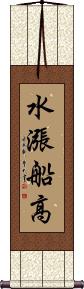
水漲船高 means “A rising tide lifts all boats/ships” in Chinese.
This idiom first appeared in the “Wudeng Huiyuan” (五燈會元) by the Song Dynasty monk Puji (普濟).
There is also a version that says “The longer the water flows, the higher the boat rises” or “水長船高”.
Acknowledgments: Thanks to Mac Lee for a factual correction to this entry.
Flying / Flight / Rising Upward
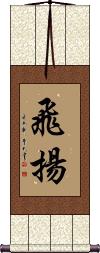
飛揚 means flight, flying, or to rise upwards in Chinese and Japanese Kanji.
飛揚 is not the most common title for a wall scroll but if you have a personal reason or this idea is important to you, then go for it.
This can also be the personal name “Hiyou” in Japanese.
Fall Down Seven Times, Get Up Eight
Always rising after a fall or repeated failures
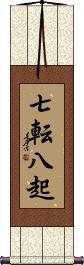
七転八起 is a Japanese proverb that relays the vicissitudes of life, with the meaning “seven times down eight times up.”
Some would more naturally translate it into English as “Always rising after a fall or repeated failures” or compare it to the English, “If at first, you don't succeed, try, try again.”
The first Kanji is literally “7.” The second means “fall down” (sometimes this Kanji means “turn around,” “revolve” or “turn over” but in this case, it holds the meaning of “fall”). The third is “8.” And the last is “get up,” “rouse,” or “rise.”
Basically, if you fail 7 times, you should recover from those events and be prepared to rise an 8th time. This also applies if it is the world or circumstances that knock you down seven times...
...just remember that you have the ability to bounce back from any kind of adversity.
Note: This can be pronounced in two ways. One is “shichi ten hakki” or “shichitenhakki.” The other is “nana korobi ya oki” also written, “nanakorobi-yaoki.”
Special Note: The second character is a Kanji that is not used in China. Therefore, please select a Japanese calligrapher for this title.
Overcome / Surpass / Rise Above
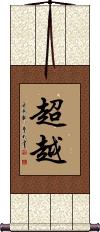
In Chinese, Japanese Kanji, and old Korean Hanja, 超越 means to overcome, surpass, transcendence, excel, exceed, go beyond, rise above, or transcend.
Phoenix Rise from the Ashes
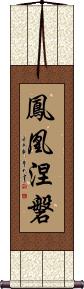
鳳凰涅磐 is a proverb that suggests “Legendary Phoenix rises from the ashes.” It means “Legendary Phoenix [reaches] Nirvana.”
There is a legend in China of a great bird reborn once every 500 years. This bird gathers all the ill will, suffering, desire, and other negative things of the world. The bird then plunges into the fire to burn away all negative things, sacrificing itself in the process (achieving Nirvana, or perhaps allowing others the opportunity to reach Nirvana).
500 years later, the phoenix is reborn from the ashes again, and the cycle repeats.
Rise Up with Thrift and Diligence
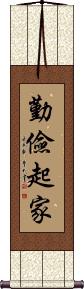
勤儉起家 is a Chinese proverb that suggests you begin to rise up by thrift and hard work.
Diligent work and spending money wisely will almost always pay off.
Rise and Fall / Ups and Downs
Eiko-Seisui
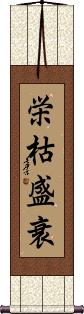
This Japanese proverb can be translated as “flourish and wither, prosper and perish,” “life is full of fortune and misfortune,” or simply “vicissitudes of life.”
栄枯盛衰 / 榮枯盛衰 is about the rise and fall of human affairs or the ups and downs of life. Prosperity comes and goes, everything is fleeting and temporary, but like waves, another swell of prosperity may come.
Here's how the Kanji break down in this proverb:
栄 = prosper; thrive; flourish; boom.
枯 = wither; die.
盛 = prosperous; flourishing; thriving; successful; energetic; vigorous; enthusiastic.
衰 = become weaker; decline; get weak; die down; subside; abate; fail.
 Notes: The original version of the first character looks like the image to the right. In modern Japan, they simplified that Kanji a bit into the version shown above. If you have a preference for which style is used for your calligraphy, please let me know when you place your order.
Apparently, with that original version of the first character, this is also used in Korean Hanja. However, I have not confirmed that
it’s
used in the same way or is widely-known in Korean.
This in-stock artwork might be what you are looking for, and ships right away...
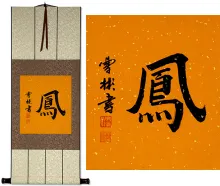
Gallery Price: $96.00
Your Price: $52.88
Gallery Price: $130.00
Your Price: $84.88

Gallery Price: $130.00
Your Price: $84.88

Gallery Price: $96.00
Your Price: $52.88
Not the results for rising that you were looking for?
Below are some entries from our dictionary that may match your rising search...
| Characters If shown, 2nd row is Simp. Chinese |
Pronunciation Romanization |
Simple Dictionary Definition |
旭 see styles |
xù xu4 hsü noboru のぼる |
More info & calligraphy: Morning SunMcIntosh (apple); McIntosh red; (given name) Noboru |
上昇 上升 see styles |
shàng shēng shang4 sheng1 shang sheng joushou / josho じょうしょう |
More info & calligraphy: Ascend(n,vs,vi,adj-no) rising; ascending; climbing to ascend [to the heavenly realm] |
新星 see styles |
xīn xīng xin1 xing1 hsin hsing shinhoshi しんほし |
More info & calligraphy: Nova(1) {astron} (See ノバ) nova; (2) new face; new star; (surname) Shinhoshi |
正精進 正精进 see styles |
zhèng jīng jìn zheng4 jing1 jin4 cheng ching chin shoushoujin / shoshojin しょうしょうじん |
More info & calligraphy: 6. Right Effort / Right Endeavor / Perfect Effortsamyagvyāyāma, right effort, zeal, or progress, unintermitting perseverance, the sixth of the 八正道; 'right effort, to suppress the rising of evil states, to eradicate those which have arisen, to stimulate good states, and to perfect those which have come into being. ' Keith. |
むくむく see styles |
mukumuku むくむく |
(adv,adv-to,vs) (1) (onomatopoeic or mimetic word) rising up (of smoke, clouds, etc.); towering; billowing; (adv,adv-to,vs) (2) (onomatopoeic or mimetic word) plump; chubby; (adv,adv-to) (3) (onomatopoeic or mimetic word) welling up (of an emotion); boiling up; (adv,adv-to) (4) (onomatopoeic or mimetic word) getting up; stirring; moving about; (adv,adv-to,vs) (5) (onomatopoeic or mimetic word) shaggy; hairy |
七転八起 see styles |
nanakorobiyaoki ななころびやおき shichitenhakki しちてんはっき |
More info & calligraphy: Fall Down Seven Times, Get Up Eight |
四無量心 四无量心 see styles |
sì wú liàng xīn si4 wu2 liang4 xin1 ssu wu liang hsin shi muryōshin |
More info & calligraphy: Brahmavihara - The Four Immeasurables |
の see styles |
no の |
(particle) (1) (occasionally ん, orig. written 乃 or 之) (See 乃) indicates possessive; (particle) (2) nominalizes verbs and adjectives; (particle) (3) (See が・1) substitutes for "ga" in subordinate phrases; (particle) (4) (often ん) (at sentence-end, falling tone) indicates a confident conclusion; (particle) (5) (feminine speech) (at sentence-end) indicates emotional emphasis; (particle) (6) (at sentence-end, rising tone) indicates question |
丘 see styles |
qiū qiu1 ch`iu chiu tsukasa つかさ |
mound; hillock; grave; classifier for fields (archaism) mound; hill; (1) hill; height; knoll; rising ground; (2) (mahj) (kana only) bonus points awarded to the winner at the end of a game; (female given name) Tsukasa A mound, a plot; personal name of Confucius. |
兀 see styles |
wù wu4 wu |
(literary) rising to a height; towering; (literary) bald; bare; (literary) still; yet |
出 see styles |
chū chu1 ch`u chu de で |
to go out; to come out; to arise; to occur; to produce; to yield; to go beyond; to exceed; (used after a verb to indicate an outward direction or a positive result); classifier for dramas, plays, operas etc (n,n-suf) (1) coming out; going out; outflow; efflux; rising (of the Sun or the Moon); (n,n-suf) (2) attending (work); appearing (on stage); one's turn to go on; (n,n-suf) (3) start; beginning; (n,n-suf) (4) origins; background; person (or item) originating from ...; graduate of ...; native of ...; member of ... (lineage); (n,n-suf) (5) architectural member that projects outward; (n,n-suf) (6) highest point of the stern of a ship; (n,n-suf) (7) (kana only) (usu. after the -masu stem of a verb as 〜出がある or 〜出がない, etc.) amount (comprising something); amount of time or effort required to do something; (surname) De To go out, come forth, put forth; exit; beyond. |
勃 see styles |
bó bo2 po botsu ぼつ |
flourishing; prosperous; suddenly; abruptly (1) (abbreviation) (See 勃牙利・ブルガリア) Bulgaria; (adjective) (2) (obsolete) (See 勃々・ぼつぼつ) spirited; rising; energetic; (adjective) (3) (obsolete) sudden; abrupt Shooting plants; a comet. |
壟 垄 see styles |
lǒng long3 lung oka おか |
ridge between fields; crop row; mounded soil forming a ridge in a field; grave mound hill; height; knoll; rising ground |
岡 冈 see styles |
gāng gang1 kang oka おか |
ridge; mound hill; height; knoll; rising ground; (place-name, surname) Oka |
暘 旸 see styles |
yáng yang2 yang hinode ひので |
rising sun; sunshine (surname) Hinode |
朣 see styles |
tóng tong2 t`ung tung |
light from the rising moon |
泩 see styles |
shēng sheng1 sheng |
rising of water |
渰 see styles |
yǎn yan3 yen |
(of cloud) forming or rising |
長 长 see styles |
zhǎng zhang3 chang michi みち |
chief; head; elder; to grow; to develop; to increase; to enhance (1) head; chief; leader; elder; (2) (See 短・1) merit; strong point; (3) superiority; (4) {music} (See 短・2) major; (surname) Michi chang, long; always; zhang, to grow, rising, senior. |
霨 see styles |
wèi wei4 wei |
rising of clouds |
一躍 see styles |
ichiyaku いちやく |
(adv,n,vs) (1) suddenly (rising to fame, etc.); instantly; immediately; overnight; (noun/participle) (2) (orig. meaning) one bound; one leap |
上下 see styles |
shàng xià shang4 xia4 shang hsia jouge / joge じょうげ |
the top and bottom of something; the full vertical extent of something; from top to bottom; to go up and down; before and after (as in 上下文[shang4 xia4 wen2] "context"); (used after a quantity) approximately; ... or so; (in a social hierarchy) the high and the low; seniors and juniors (as in 上下和睦[shang4 xia4 he2 mu4] "harmony between superiors and subordinates"); all members of a group (as in 舉國上下|举国上下[ju3 guo2 shang4 xia4] "the entire nation"); relative superiority (as in 不相上下[bu4 xiang1 shang4 xia4] "evenly matched") (1) top and bottom; high and low; above and below; upper and lower ends; up and down; (n,vs,vi) (2) going up and down; rising and falling; fluctuating; (n,vs,vi) (3) going and coming back; (4) upper and lower classes; ruler and ruled; the government and the people; (5) first and second volumes; (6) {cloth} top and bottom; two-piece (outfit); (place-name, surname) Jōge above and below |
上声 see styles |
joushou / josho じょうしょう |
(1) rising tone (in Chinese); (2) (of a Japanese accent) having a high, flat tone |
上數 上数 see styles |
shàng shǔ shang4 shu3 shang shu jōsu |
rising numbers |
上聲 上声 see styles |
shǎng shēng shang3 sheng1 shang sheng |
falling and rising tone; third tone in modern Mandarin See: 上声 |
上風 上风 see styles |
shàng fēng shang4 feng1 shang feng |
on the up; currently winning; rising (in popularity etc) |
中腰 see styles |
nakakoshi なかこし |
half-sitting posture; half-standing posture; half-rising posture; stooping position; (surname) Nakakoshi |
亢進 亢进 see styles |
kàng jìn kang4 jin4 k`ang chin kang chin koushin / koshin こうしん |
hyperfunction (medical) (noun/participle) rising; exacerbated; exasperated; accelerated; aggravated |
來潮 来潮 see styles |
lái cháo lai2 chao2 lai ch`ao lai chao |
(of water) to rise; rising tide; (of women) to get one's period |
初升 see styles |
chū shēng chu1 sheng1 ch`u sheng chu sheng |
rising (sun, moon etc) |
Click here for more rising results from our dictionary
The following table may be helpful for those studying Chinese or Japanese...
| Title | Characters | Romaji (Romanized Japanese) | Various forms of Romanized Chinese | |
| A Rising Tide Lifts All Boats | 水漲船高 水涨船高 | shuǐ zhǎng chuán gāo shui3 zhang3 chuan2 gao1 shui zhang chuan gao shuizhangchuangao | shui chang ch`uan kao shuichangchuankao shui chang chuan kao |
|
| Flying Flight Rising Upward | 飛揚 飞扬 | hi you / hiyou / hi yo | fēi yáng / fei1 yang2 / fei yang / feiyang | |
| Fall Down Seven Times, Get Up Eight | 七転八起 | shichi ten hakki / nana korobi ya oki shichi ten haki / nana korobi ya oki | ||
| Overcome Surpass Rise Above | 超越 | chou etsu / chouetsu / cho etsu | chāo yuè / chao1 yue4 / chao yue / chaoyue | ch`ao yüeh / chaoyüeh / chao yüeh |
| Phoenix Rise from the Ashes | 鳳凰涅磐 凤凰涅磐 | fèng huáng niè pán feng4 huang2 nie4 pan2 feng huang nie pan fenghuangniepan | feng huang nieh p`an fenghuangniehpan feng huang nieh pan |
|
| Rise Up with Thrift and Diligence | 勤儉起家 勤俭起家 | qín jiǎn qǐ jiā qin2 jian3 qi3 jia1 qin jian qi jia qinjianqijia | ch`in chien ch`i chia chinchienchichia chin chien chi chia |
|
| Rise and Fall Ups and Downs | 栄枯盛衰 / 榮枯盛衰 荣枯盛衰 | ei ko sei sui eikoseisui | ||
| In some entries above you will see that characters have different versions above and below a line. In these cases, the characters above the line are Traditional Chinese, while the ones below are Simplified Chinese. | ||||

Successful Chinese Character and Japanese Kanji calligraphy searches within the last few hours...



