Many custom options...


And formats...



Save in Chinese / Japanese...
Buy a Save calligraphy wall scroll here!
Personalize your custom “Save” project by clicking the button next to your favorite “Save” title below...
1. Salvation: To Save or Rescue
5. Super
6. Goat / Sheep
7. Brahmavihara - The Four Immeasurables
8. Dragon
9. Wolf
Salvation: To Save or Rescue
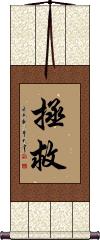
The first character, 拯, means to raise, aid, support, save or rescue.
The second character, 救, has a similar meaning of save, assist or rescue.
Together 拯救 reinforce each other to create a compound word that means salvation or rescue.
Salvation / Save / Rescue
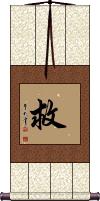
救 is a single character that can mean to save, to assist, to rescue, or imbue salvation.
This can also be a Japanese surname that romanizes as Sukui, Kyuu, or Kyu.
Namu Dai Bosa
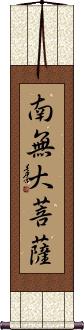
南無大菩薩 means to submit to or pay homage to the great Bodhisattva.
The last three characters, 大菩薩, can mean bodhisattva-mahāsattva, refer to one who has reached enlightenment but vows to save all beings before becoming a buddha or a high and noble monk.
Luohan / Lohan
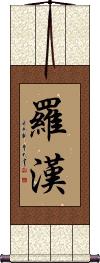
羅漢 is the title Lohan, achiever of Nirvana.
This can also be a place name and surname Rakan in Japanese.
In the Buddhist context, this can be arhan, arhat, saint, or perfect man of Hīnayāna. It can refer to the 16, 18, or 500 disciples appointed to witness Buddha's truth and save the world.
Super
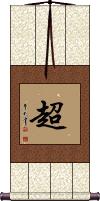
超 is “super” in Chinese and Japanese Kanji.
It can also mean: to exceed; to overtake; to surpass; to transcend; to pass; to cross; to jump over. It can also be a suffix like ultra- hyper- super-
From Sanskrit, this can be the Buddhist “vikrama,” meaning to leap over; surpass; exempt from; to save.
Goat / Sheep
Year of the Goat / Zodiac Sign
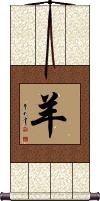
羊 is the character for goat or sheep in Chinese, old Korean, and Japanese.
If you were born in the year of the goat (sheep), you . . .
Are sophisticated and considerate
Can always find the best solution to problems.
Are tolerant.
Are not afraid of hardship.
Know how to save money (thrifty).
See also our Chinese Zodiac page.
Brahmavihara - The Four Immeasurables
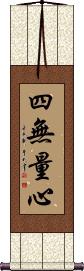
四無量心 is the cattāri brahmavihārā or catvāri apramāṇāni.
The four immeasurables, or infinite Buddha-states of mind. These four dhyānas include:
1. 慈無量心 boundless kindness, maitrī, or bestowing of joy or happiness.
2. 悲無量心 boundless pity, karuṇā, to save from suffering.
3. 喜無量心 boundless joy, muditā, on seeing others rescued from suffering.
4. 捨無量心 limitless indifference, upekṣā, i.e., rising above these emotions or giving up all things.
Dragon
Year of the Dragon / Zodiac Sign
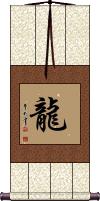
龍 is the character for dragon in Chinese, old Korean Hanja, and Japanese Kanji.
The dragon is a creature of myth and legend that dominates Chinese, Japanese, and even European folklore. In China, the dragon is the symbol of the Emperor, strength, and power, and the Chinese dragon is known as the god of water.
From the Chinese Zodiac, if you were born in the year of the Dragon, you . . .
Have a strong body and spirit.
Are full of energy.
Have vast goals.
Have a deep level of self-awareness.
Will do whatever you can to “save face.”
See also our Chinese Zodiac or Dragon Calligraphy pages.
Wolf
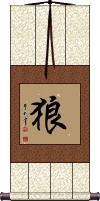
狼 is the character used to represent the elusive animal known as the wolf in both Chinese and Japanese.
If you are a fan of the wolf or the wolf means something special to you, this could make a great addition to your wall.
Do keep in mind, that much like our perception of wolves in the history of western culture, eastern cultures do not have a very positive view of wolves (save the scientific community and animal lovers). The wolf is clearly an animal that is misunderstood or feared the world over.
狼 is seldom used alone in Korean Hanja but is used in a compound word that means utter failure (as in a wolf getting into your chicken pen - or an otherwise ferocious failure). Not a good choice if your audience is Korean.
Dana: Almsgiving and Generosity
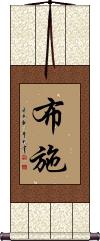
布施 is the Buddhist practice of giving known as Dāna or दान from Pali and Sanskrit.
Depending on the context, this can be alms-giving, acts of charity, or offerings (usually money) to a priest for reading sutras or teachings.
Some will put Dāna in these two categories:
1. The pure or unsullied charity, which looks for no reward here but only in the hereafter.
2. The sullied almsgiving whose object is personal benefit.
The first kind is, of course, the kind that a liberated or enlightened person will pursue.
Others will put Dāna in these categories:
1. Worldly or material gifts.
2. Unworldly or spiritual gifts.
You can also separate Dāna into these three kinds:
1. 財布施 Goods such as money, food, or material items.
2. 法布施 Dharma, as an act to teach or bestow the Buddhist doctrine onto others.
3. 無畏布施 Courage, as an act of facing fear to save someone or when standing up for someone or standing up for righteousness.
The philosophies and categorization of Dāna will vary among various monks, temples, and sects of Buddhism.
Breaking down the characters separately:
布 (sometimes written 佈) means to spread out or announce, but also means cloth. In ancient times, cloth or robs were given to the Buddhist monks annually as a gift of alms - I need to do more research, but I believe there is a relationship here.
施 means to grant, to give, to bestow, to act, to carry out, and by itself can mean Dāna as a single character.
Dāna can also be expressed as 檀那 (pronounced “tán nà” in Mandarin and dan-na or だんな in Japanese). 檀那 is a transliteration of Dāna. However, it has colloquially come to mean some unsavory or unrelated things in Japanese. So, I think 布施 is better for calligraphy on your wall to remind you to practice Dāna daily (or whenever possible).
Past experience is the teacher for the future
Past events not forgotten serve as teachers for later events.
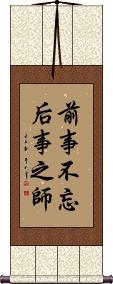
The most literal translation to English of this ancient 前事不忘后事之师 Chinese proverb is:
“Past events not forgotten serve as teachers for later events.”
However, it's been translated several ways:
Don't forget past events, they can guide you in the future.
Benefit from past experience.
Past experience, if not forgotten, is a guide for the future.
Past calamity is my teacher.
A good memory for the past is a teacher for the future.
The remembrance of the past is the teacher of the future.
If one remembers the lessons of the past; They will serve as a guide to avoid mistakes in the future.
The origin:
This proverb comes from the 5th century B.C., just before the Warring States Period in the territory now known as China.
The head of the State of Jin, Zhi Bo, seized power in a coup. He did this with help from the armies of the State of Han and Wei. Instead of being grateful for the help from Han and Wei, he treacherously took the land of Han and Wei. Never satisfied, Zhi Bo employed the armies of Han and Wei to attack and seize the State of Zhao.
The king of Zhao took advice from his minister Zhang Mengtan and secretly contacted the Han and Wei armies to reverse their plans and attack the army of Zhi Bo instead. The plan was successful, and the State of Zhao was not only saved but was set to become a powerful kingdom in the region.
Zhang Mengtan immediately submitted his resignation to a confused king of Zhao. When asked why, Zhang Mengtan said, “I've done my duty to save my kingdom, but looking back at past experience, I know sovereign kings are never satisfied with the power or land at hand. They will join others and fight for more power and more land. I must learn from past experiences, as those experiences are the teachers of future events.”
The king could not dispute the logic in that statement and accepted Zhang Mengtan's resignation.
For generations, the State of Zhao continued to fight for power and land until finally defeated and decimated by the State of Qin (which led to the birth of the Qin Dynasty in 221 B.C.).
These search terms might be related to Save:
Even an Iron Bar Can Be Ground to a Needle
Hoard
Keep Calm in Face of Adversity
Keep Calm, Be Not Impatient
Keep Your Feet on the Ground
Salvation / Save / Rescue
Salvation: To Save or Rescue
The following table may be helpful for those studying Chinese or Japanese...
| Title | Characters | Romaji (Romanized Japanese) | Various forms of Romanized Chinese | |
| Salvation: To Save or Rescue | 拯救 | zhěng jiù zheng3 jiu4 zheng jiu zhengjiu | cheng chiu chengchiu |
|
| Salvation Save Rescue | 救 | kyuu / kyu | jiù / jiu4 / jiu | chiu |
| Namu Dai Bosa | 南無大菩薩 南无大菩萨 | namu dai bosa namudaibosa | ||
| Luohan Lohan | 羅漢 罗汉 | rakan | luó hàn luo2 han4 luo han luohan | lo |
| Super | 超 | chou / cho | chāo / chao1 / chao | ch`ao / chao |
| Goat Sheep | 羊 | hitsuji | yáng / yang2 / yang | |
| Brahmavihara - The Four Immeasurables | 四無量心 四无量心 | shi mur you shin shimuryoushin shi mur yo shin | sì wú liàng xīn si4 wu2 liang4 xin1 si wu liang xin siwuliangxin | ssu wu liang hsin ssuwulianghsin |
| Dragon | 龍 龙 | ryuu / tatsu ryu / tatsu | lóng / long2 / long | lung |
| Wolf | 狼 | okami | láng / lang2 / lang | |
| Dana: Almsgiving and Generosity | 布施 | fuse | bù shī / bu4 shi1 / bu shi / bushi | pu shih / pushih |
| Past experience is the teacher for the future | 前事不忘后事之師 前事不忘后事之师 | qián shì bú wàng hòu shí zhī shī qian2 shi4 bu2 wang4 hou4 shi2 zhi1 shi1 qian shi bu wang hou shi zhi shi | ch`ien shih pu wang hou shih chih shih chien shih pu wang hou shih chih shih |
|
| In some entries above you will see that characters have different versions above and below a line. In these cases, the characters above the line are Traditional Chinese, while the ones below are Simplified Chinese. | ||||

Successful Chinese Character and Japanese Kanji calligraphy searches within the last few hours...



