Many custom options...


And formats...



Not what you want?
Try other similar-meaning words, fewer words, or just one word.
Self Pride in Chinese / Japanese...
Buy a Self Pride calligraphy wall scroll here!
Personalize your custom “Self Pride” project by clicking the button next to your favorite “Self Pride” title below...
Self-Respect / Self-Esteem
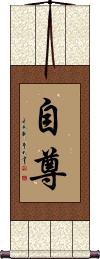
自尊 means self-respect or self-esteem in Chinese, Korean and Japanese. It can also mean “pride in oneself.”
Note: Japanese sometimes put the character for the heart after these two. However, this two-character word is universal between all three languages (which is often better since more than a third of the world's population can read this version as a native word).
Prideful Mind / Self-Respecting Heart
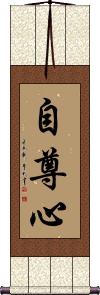
自尊心 is a Japanese and Korean word that means “pride” or “self-respect.”
The first Kanji/Hanja means oneself. The second can mean revered, valuable, precious, noble, or exalted. And the last Kanji/Hanja means heart, mind, and/or spirit.
While these characters make sense and hold the same general meaning in Chinese, this is not a normal Chinese word. This selection should only be used if your audience is Japanese or Korean.
See Also: Respect | Pride | Self-Reliance | Self-Control | Self-Discipline
Pride
自尊 can mean “pride,” “self-respect,” or “self-esteem.” The first character means “oneself,” and the second can mean revered, valuable, precious, noble, exalted, honorable, or simply “pride.”
I have also seen this two-character word translated as “amour propre,” self-regard, and self-pride.
自尊 is universal between Chinese, Japanese Kanji, and Korean Hanja written languages. It may also be understood in old Vietnamese (they once used Chinese characters as well).
Asian Pride / Oriental Pride / AZN Pryde
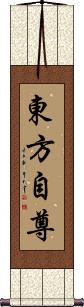
東方自尊 is the universal way to write “Asian Pride.”
We worked on this one for a long time. The effort involved both Chinese and Japanese translators and lengthy discussions. If you have been searching for this term, there is a reason that it's hard to find the way to write “Asian Pride” in Chinese and Japanese - it's because of the inherent difficulties in figuring out a universal combination of characters that can be read in all languages that use forms of Chinese characters.
This final solution that you see to the left creates a reasonable title in Chinese and an exotic (perhaps unusual) title in Japanese (This could be read as “Eastern Self-Respect” in Japanese”).
Although not as natural, it does have the same meaning as Korean Hanja, and the older generation of Vietnamese people will be able to read it.
The first two characters literally mean “Oriental” and the second two mean “pride,” “self-esteem,” or “self-respect” (we chose the most non-arrogant way to say “pride”). If you have “Asian Pride” (sometimes spelled Asian Pryde) these are the characters for you.
Note: For those who wonder, there is nothing technically wrong with the word “Oriental.” It is a correct word, and any bad meanings were created by so-called “Asian Americans” and Caucasians in the United States. To say “Asian” would not completely correct the intended meaning since that would include people from Saudi Arabia, Iraq, Iran, India, and portions of Russia.
For further proof, if you were of East Asian ancestry and born in England, you would be known as a “British Oriental” (The “Oriental stigma” is basically an American creation and, therefore, applies mainly to the American English language - where they get a bit overzealous with political correctness).
Further, since the Chinese and Japanese word for Oriental is not English, they can not be construed as having ill meaning. On one trip to China or Japan, you will find many things titled with these two characters, such as malls, buildings, and business names. These places also use “Oriental” as their English title (much as we do since our Chinese business name starts with these same two characters).
In short, the first two characters have the meaning that Americans attach to “Asian” but is more technically correct.
Gaman
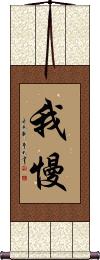
Gaman is a Zen Buddhist term from Japan that means “enduring the seemingly unbearable with patience and dignity.”
This title can also be translated as patience, perseverance, tolerance, or self-denial.
我慢 is also a Chinese Buddhist term with a different pronunciation. It comes from Sanskrit abhimāna or ātma-mada. Chinese Buddhism defines this very differently as “Egoism exalting self and depreciating others,” “self-intoxication,” or “pride.” Alone, the first character means “Me, I, or Self,” and the second character in a Buddhist context comes from Sanskrit māna and means pride, arrogance, self-conceit, looking down on others, superciliousness, etc.
I’m currently working with Japanese and Chinese translators to try and reconcile the true meaning or any commonality of this word between languages. For now, please only consider this if your audience is Japanese.
This in-stock artwork might be what you are looking for, and ships right away...

Gallery Price: $60.00
Your Price: $36.88

Gallery Price: $60.00
Your Price: $36.88

Gallery Price: $60.00
Your Price: $36.88
Not the results for self pride that you were looking for?
Below are some entries from our dictionary that may match your self pride search...
| Characters If shown, 2nd row is Simp. Chinese |
Pronunciation Romanization |
Simple Dictionary Definition |
我慢 see styles |
wǒ màn wo3 man4 wo man gaman がまん |
More info & calligraphy: Gamanabhimāna, ātma-mada. Egoism exalting self and depreciating others; self-intoxication, pride. |
自尊 see styles |
zì zūn zi4 zun1 tzu tsun jison じそん |
More info & calligraphy: Self-Respect / Self-Esteemself-respect; esteem; self-importance; pride |
自尊心 see styles |
zì zūn xīn zi4 zun1 xin1 tzu tsun hsin jisonshin じそんしん |
More info & calligraphy: Prideful Mind / Self-Respecting Heartself-esteem; self-respect; self-importance; conceit; pride |
慢 see styles |
màn man4 man man |
slow māna. Pride, arrogance, self-conceit, looking down on others, supercilious, etc.; there are categories of seven and nine kinds of pride. |
八慢 see styles |
bā màn ba1 man4 pa man hachiman |
The eight kinds of pride, māna, arrogance, or self-conceit, 如慢 though inferior, to think oneself equal to others (in religion); 慢慢 to think oneself superior among manifest superiors; 不如慢 to think oneself not so much inferior among manifest superiors; 增上慢 to think one has attained more than is the fact, or when it is not the fact; 我慢 self-superiority, or self-sufficiency; 邪慢 pride in false views, or doings; 憍慢 arrogance; 大慢 extreme arrogance. |
卑慢 see styles |
bēi màn bei1 man4 pei man himan |
(下慢) The pride of regarding self as little inferior to those who far surpass one; one of the 七慢. |
喬志 see styles |
takashi たかし |
pride; self-conceit; (given name) Takashi |
慢心 see styles |
màn xīn man4 xin1 man hsin manshin まんしん |
(n,vs,vi) self-conceit; pride pride |
矜恃 see styles |
kinji きんじ kyouji / kyoji きょうじ |
pride; dignity; self-respect |
矜持 see styles |
jīn chí jin1 chi2 chin ch`ih chin chih kinji きんじ kyouji / kyoji きょうじ |
reserved; aloof pride; dignity; self-respect |
自負 自负 see styles |
zì fù zi4 fu4 tzu fu jifu じふ |
conceited; to take responsibility (n,vs,vi) pride; self-confidence; thinking highly of oneself; being proud of one's abilities or achievements |
見慢 见慢 see styles |
jiàn màn jian4 man4 chien man kenman |
views (of self) and pride |
見識 见识 see styles |
jiàn shi jian4 shi5 chien shih kenshiki けんしき |
to gain first-hand knowledge of something; to experience for oneself; knowledge; experience; insight (1) views; opinion; discernment; (2) pride; self-respect |
識見 识见 see styles |
shí jiàn shi2 jian4 shih chien shikiken; shikken しきけん; しっけん |
knowledge and experience views; opinion; discernment; pride; self-respect; insight |
過慢 过慢 see styles |
guò màn guo4 man4 kuo man kaman |
The pride which among equals regards self as superior and among superiors as equal; one of the seven arrogances. |
邪慢 see styles |
xié màn xie2 man4 hsieh man jaman |
mithyāmāna ; perverse or evil pride, doing evil for self-advancement; to hold to heterodox views and not to reverence the triratna. |
四煩惱 四烦恼 see styles |
sì fán nǎo si4 fan2 nao3 ssu fan nao shi bonnō |
The four delusions in reference to the ego: 我痴 ignorance in regard to the ego; 我見 holding to the ego idea; 我慢 self-esteem, egotism, pride; 我愛 self-seeking, or desire, both the latter arising from belief in the ego. Also 四惑. |
意気地 see styles |
ikuji(p); ikiji いくじ(P); いきじ |
self-respect; self-confidence; guts; backbone; pride; drive; willpower |
自豪感 see styles |
zì háo gǎn zi4 hao2 gan3 tzu hao kan |
pride in something; self-esteem |
自負心 see styles |
jifushin じふしん |
pride; self-confidence; self-esteem; self-conceit |
見我慢 见我慢 see styles |
jiàn wǒ màn jian4 wo3 man4 chien wo man kengaman |
views of self and pride |
フライト see styles |
puraido プライド |
pride; dignity; self-worth; (personal name) Pride; Pryde |
Variations: |
kyouji; kinji / kyoji; kinji きょうじ; きんじ |
pride; dignity; self-respect |
Variations: |
ikuji(p); ikiji いくじ(P); いきじ |
self-respect; self-confidence; guts; backbone; pride; drive; willpower |
Variations: |
unubore(p); onobore(己惚re)(ok) うぬぼれ(P); おのぼれ(己惚れ)(ok) |
conceit; vanity; pride; self-importance; egotism |
Variations: |
ikuji(p); ikiji いくじ(P); いきじ |
self-respect; self-confidence; guts; backbone; pride; drive; willpower |
The following table may be helpful for those studying Chinese or Japanese...
| Title | Characters | Romaji (Romanized Japanese) | Various forms of Romanized Chinese | |
| Self-Respect Self-Esteem | 自尊 | jison | zì zūn / zi4 zun1 / zi zun / zizun | tzu tsun / tzutsun |
| Prideful Mind Self-Respecting Heart | 自尊心 | ji son shin jisonshin | zì zūn xīn zi4 zun1 xin1 zi zun xin zizunxin | tzu tsun hsin tzutsunhsin |
| Pride | 自尊 | jison | zì zūn / zi4 zun1 / zi zun / zizun | tzu tsun / tzutsun |
| Asian Pride Oriental Pride AZN Pryde | 東方自尊 东方自尊 | tou hou zi son touhouzison to ho zi son | dōng fāng zì zūn dong1 fang1 zi4 zun1 dong fang zi zun dongfangzizun | tung fang tzu tsun tungfangtzutsun |
| Gaman | 我慢 | ga man / gaman | wǒ màn / wo3 man4 / wo man / woman | |
| In some entries above you will see that characters have different versions above and below a line. In these cases, the characters above the line are Traditional Chinese, while the ones below are Simplified Chinese. | ||||

Successful Chinese Character and Japanese Kanji calligraphy searches within the last few hours...



