Many custom options...


And formats...



Not what you want?
Try other similar-meaning words, fewer words, or just one word.
Si Di Fen in Chinese / Japanese...
Buy a Si Di Fen calligraphy wall scroll here!
Personalize your custom “Si Di Fen” project by clicking the button next to your favorite “Si Di Fen” title below...
Switched to secondary search mode due to lack of results using primary.
These secondary results may not be very accurate. Try a different but similar meaning word or phrase for better results. Or...
Look up Si Di Fen in my Japanese Kanji & Chinese Character Dictionary(My dictionary is a different system then the calligraphy search you just tried)
If you want a special phrase, word, title, name, or proverb, feel free to contact me, and I will translate your custom calligraphy idea for you.
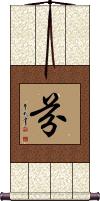
芬 is the name Fen in Chinese (Mandarin).
This is a valid surname in Chinese, but is also used for transliterations for the German/English name Fen.
Jehovah
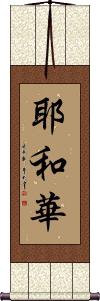
耶和華 is the Mandarin Chinese name for Jehovah.
This is the biblical name for God. Originally this was YHWH or Yahweh from Hebrew, although Yahweh is usually written 雅威 (Ya-wei) in Mandarin. Also, this is not the same as God which is 上帝 (Shang-di).
Kawa
Profound / Powerful Words
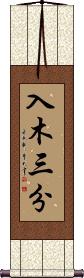
入木三分 is a four-character Chinese proverb that translates in English to a strong form of “profound” or “written with a forceful hand.”
But there is much more to the story...
The deep meaning behind this proverb comes from a man named Wan Xizhi, who lived in the third century.
He was a great writer and calligrapher whose writing style influenced generations of other writers and calligraphers.
He once wrote words on a piece of wood to be taken to an engraver.
When the engraver began to carve the characters into the wood, he found that Wang Xizhi's writing had penetrated the wood about 3/8 of an inch.
Thus people believed that his words were so powerful and profound that they caused the ink from his brush to penetrate the wood deeply.
The proverb literally means “penetrated wood three fen” (A fen is an ancient Chinese measurement of a little over 1/8 of an inch or almost 4mm).
Si Gung
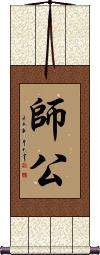
This is a term for “teacher” that is primarily used in Wing Chun martial arts schools.
In very old Buddhist context this can be “thaumaturge” meaning a worker of wonders and/or performer of miracles.
Unselfish: Perfectly Impartial
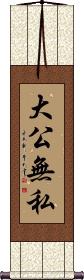
大公無私 is a Chinese proverb that comes from an old story from some time before 476 BC. About a man named Qi Huangyang, who was commissioned by the king to select the best person for a certain job in the Imperial Court.
Qi Huangyang selected his enemy for the job. The king was very confused by the selection, but Qi Huangyang explained that he was asked to find the best person for the job, not necessarily someone that he liked or had a friendship with.
Later, Confucius commented on how unselfish and impartial Qi Huangyang was by saying, “Da Gong Wu Si” which, if you look it up in a Chinese dictionary, is generally translated as “Unselfish” or “Just and Fair.”
If you translate each character, you'd have something like
“Big/Deep Justice Without Self.”
Direct translations like this leave out a lot of what the Chinese characters really say. Use your imagination, and suddenly you realize that “without self” means “without thinking about yourself in the decision” - together, these two words mean “unselfish.” The first two characters serve to drive the point home that we are talking about a concept that is similar to “blind justice.”
One of my Chinese-English dictionaries translates this simply as “just and fair.” So that is the short and simple version.
Note: This can be pronounced in Korean, but it's not a commonly used term.
See Also: Selflessness | Work Unselfishly for the Common Good | Altruism
Yuan Fen
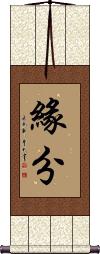
緣分 or Yuan Fen is the fate or chance that brings people together.
This can also mean a predestined affinity or relationship. Basically this is about destiny.
The following table may be helpful for those studying Chinese or Japanese...
| Title | Characters | Romaji (Romanized Japanese) | Various forms of Romanized Chinese | |
| Fen | 芬 | fēn / fen1 / fen | ||
| Jehovah | 耶和華 耶和华 | yē hé huá ye1 he2 hua2 ye he hua yehehua | yeh ho hua yehhohua |
|
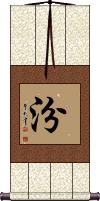
| Kawa | 汾 | kawa | fén / fen2 / fen | |
| Profound Powerful Words | 入木三分 | rù mù sān fēn ru4 mu4 san1 fen1 ru mu san fen rumusanfen | ju mu san fen jumusanfen |
|
| Si Gung | 師公 师公 | shi kou / shikou / shi ko | shī gōng / shi1 gong1 / shi gong / shigong | shih kung / shihkung |
| Unselfish: Perfectly Impartial | 大公無私 大公无私 | dà gōng wú sī da4 gong1 wu2 si1 da gong wu si dagongwusi | ta kung wu ssu takungwussu |
|
| Yuan Fen | 緣分 缘分 | yuán fèn / yuan2 fen4 / yuan fen / yuanfen | yüan fen / yüanfen | |
| In some entries above you will see that characters have different versions above and below a line. In these cases, the characters above the line are Traditional Chinese, while the ones below are Simplified Chinese. | ||||

Successful Chinese Character and Japanese Kanji calligraphy searches within the last few hours...



