Many custom options...


And formats...



Sleep in Chinese / Japanese...
Buy a Sleep calligraphy wall scroll here!
Personalize your custom “Sleep” project by clicking the button next to your favorite “Sleep” title below...
4. One Who Does Not Do Bad Things, Worries Not of Knocks at His Door
5. Realize Your Ambitions / Embrace Your Ambition
Sleep / Rest / Repose
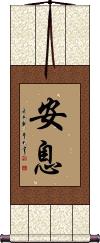
安息 means to rest, to go to sleep, to rest peacefully, or in repose, in Chinese characters, Japanese Kanji, and old Korean Hanja.
Dream / Vision
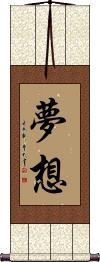
夢想 is the two-character version of dream or dreaming, which can mean “to dream of [something],” vision, imagine, or reverie.
Be careful, as, in some contexts, it can mean dreaming of something in vain.
Dream / Dreams
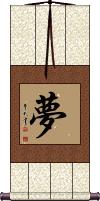
夢 is the very simple word for dreams in Chinese and Japanese.
It can also mean having a vision or simply an illusion.
One Who Does Not Do Bad Things, Worries Not of Knocks at His Door
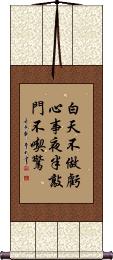
白天不做亏心事夜半敲门不吃惊 literally translates as: [If one does] not do bad things in the daytime, one need not be alarmed at knocks on the door in the middle of the night.
The meaning is something like, “A quiet conscience sleeps in thunder.” Basically, the message is, “don't commit crimes and you won't be jumpy every time the doorbell rings (so don't do anything wrong and your life will have fewer worries and you can sleep at night).”
Realize Your Ambitions / Embrace Your Ambition
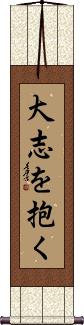
大志を抱く is a Japanese proverb that suggests you should embrace, pursue, and realize your ambitions.
The first part means ambitions or aspirations.
The last part means to embrace or to hold in your arms.
Here's the character breakdown:
大志 (taishi) ambition; aspiration.
を (o) particle
抱く (idaku) to embrace; to hold in the arms (e.g. a baby); to hug; to harbor/harbour; to bear (e.g., a grudge); to entertain (e.g., suspicion); to sleep with; to sit on eggs.
Note: Because this selection contains some special Japanese Hiragana characters, it should be written by a Japanese calligrapher.
Pursue Your Dreams
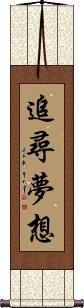
追尋夢想 means “pursue your dreams,” “follow your dreams,” or “chase your dreams” in Chinese.
The first two characters mean “to pursue,” “to track down,” or “to search for.”
The last two mean dreams. This version of dreams refers to those with an element of reality (not the dreams you have when you sleep but rather your aspirations or goals in life).
This title will tell everyone that you want to make your dreams come true.
See Also: Pursuit of Happiness
Only the sleepless know the length of night
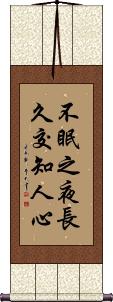
不眠之夜长久交知人心 literally translates as: [Only one who does] not sleep, learns how long the night is; [Only by] long acquaintance [does one] learn a person ['s true] character.
Basically, this proverb suggests that we really need to experience something intimately and for a long time to really know everything about it.
This can also be translated as “Spending years with someone is the only way to know them.”
Note: Sometimes this proverb is split into just the first or second idea alone (first 5 or last 5 characters only).
Ten Commandments
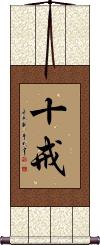
十戒 means Ten Commandments or Ten Precepts.
In the Buddhist context, these are prohibitions consisting of five commandments for the layman:
1. Not to destroy life 不殺生 Pāṇātipātāveramaṇi.
2. Not to steal 不倫盜 Adinnādānāver.
3. Not to commit adultery 不婬慾 Abrahmacaryaver.
4. Not to lie 不妄語 Musāvādāver.
5. Not to take intoxicating liquor 不飮酒 Suramereyya-Majjapamādaṭṭhānāver.
The ten commandments for the monk are the preceding five plus:
6. Not to eat food outside of regulated hours 不非時食 Vikāla-Bhojanāver.
7. Not to use garlands or perfumes 不著華鬘好香塗身 Mālā- Gandha-Vilepana-Dhāraṇa-Maṇḍana-Vibhūṣanaṭṭhānā.
8. Not to sleep on high or broad beds (chastity) 不坐高廣大牀 Uccāsayanā-Mahāsayanā.
9. Not to take part in singing, dancing, musical or theatrical performances 不歌舞倡伎不往觀聽 Nacca-Gīta-Vādita-Visūkadassanāver.
10. To refrain from acquiring uncoined or coined gold, or silver, or jewels 不得捉錢金銀寶物 Jātarūpa-Rajata-Paṭīggahaṇāver.
These original Buddhist commandments date back to about 2500 years ago. The English definitions above are followed by Chinese characters and original Pali pronunciation.
Under the Māhayāna Buddhism, these ten commands for the monk were changed, to accord with the new environment of the monk, to the following: not to kill, not to steal, to avoid all unchastity, not to lie, not to slander, not to insult, not to chatter, not to covet, not to give way to anger, to harbor no skepticism.
The following table may be helpful for those studying Chinese or Japanese...
| Title | Characters | Romaji (Romanized Japanese) | Various forms of Romanized Chinese | |
| Sleep Rest Repose | 安息 | an soku / ansoku | ān xī / an1 xi1 / an xi / anxi | an hsi / anhsi |
| Dream Vision | 夢想 梦想 | mu sou / musou / mu so | mèng xiǎng meng4 xiang3 meng xiang mengxiang | meng hsiang menghsiang |
| Dream Dreams | 夢 梦 | yume | mèng / meng4 / meng | |
| One Who Does Not Do Bad Things, Worries Not of Knocks at His Door | 白天不做虧心事夜半敲門不吃驚 白天不做亏心事夜半敲门不吃惊 | bái tiān bú zuò kuī xīn shì yè bàn qiāo mén bù chī jīng bai2 tian1 bu2 zuo4 kui1 xin1 shi4 ye4 ban4 qiao1 men2 bu4 chi1 jing1 bai tian bu zuo kui xin shi ye ban qiao men bu chi jing | pai t`ien pu tso k`uei hsin shih yeh pan ch`iao men pu ch`ih ching pai tien pu tso kuei hsin shih yeh pan chiao men pu chih ching |
|
| Realize Your Ambitions Embrace Your Ambition | 大志を抱く | taishi wo Idaku taishiwoIdaku | ||
| Pursue Your Dreams | 追尋夢想 追寻梦想 | zhuī xún mèng xiǎng zhui1 xun2 meng4 xiang3 zhui xun meng xiang zhuixunmengxiang | chui hsün meng hsiang chuihsünmenghsiang |
|
| Only the sleepless know the length of night | 不眠之夜長久交知人心 不眠之夜长久交知人心 | bù mián zhī yè cháng jiǔ jiāo zhī rén xīn bu4 mian2 zhi1 ye4 chang2 jiu3 jiao1 zhi1 ren2 xin1 bu mian zhi ye chang jiu jiao zhi ren xin | pu mien chih yeh ch`ang chiu chiao chih jen hsin pu mien chih yeh chang chiu chiao chih jen hsin |
|
| Ten Commandments | 十戒 | jukkai / jukai | shí jiè / shi2 jie4 / shi jie / shijie | shih chieh / shihchieh |
| In some entries above you will see that characters have different versions above and below a line. In these cases, the characters above the line are Traditional Chinese, while the ones below are Simplified Chinese. | ||||

Successful Chinese Character and Japanese Kanji calligraphy searches within the last few hours...



