Many custom options...


And formats...



Sons in Chinese / Japanese...
Buy a Sons calligraphy wall scroll here!
Personalize your custom “Sons” project by clicking the button next to your favorite “Sons” title below...
Love Between Child and Parents
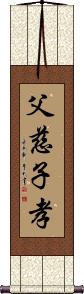
父慈子孝 is a Chinese proverb that means “benevolent father, filial son.”
Figuratively, this is the natural love between parents and children.
Sun Tzu: Regard Your Soldiers as Children
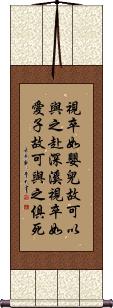
視卒如嬰兒故可以與之赴深溪視卒如愛子故可與之俱死 is an entry from the 10th section within the Earth/Terrain chapter of Sun Tzu's Art of War.
This is often translated as “Regard your soldiers as your children, and they will follow you into the deepest valleys. Look upon them as your own beloved sons, and they will stand by you even unto death.”
Spare the Rod, Spoil the Child
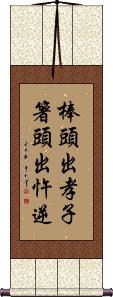
棒頭出孝子箸頭出忤逆 literally translates as:
A stick (or switch) produces filial sons; chopsticks produce disobedient [ones].
Figuratively, this means:
Strict discipline produces dutiful children, whereas indulgence produces disobedient ones.
This proverb is very similar to this English proverb:
“Spare the rod and spoil the child.”
No one knows a son better than the father
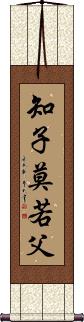
知子莫若父 can be translated as “No one knows a son better than his father.”
This idiom is based on the idea that after spending many years together, family members know everything about each other. Better than anyone else, a father knows the qualities and shortcomings of his son.
If you are looking for something about “father and son,” this is probably the best selection.
While this is the original proverb (very old), others have been composed about various combinations of mothers, sons, daughters, and fathers. Let me know if you need a custom version.
Not the results for sons that you were looking for?
Below are some entries from our dictionary that may match your sons search...
| Characters If shown, 2nd row is Simp. Chinese |
Pronunciation Romanization |
Simple Dictionary Definition |
七子 see styles |
qī zǐ qi1 zi3 ch`i tzu chi tzu fumiko ふみこ |
(female given name) Fumiko The parable in the Nirvana Sutra of the sick son whose parents, though they love all their sons equally, devote themselves to him. So does the Buddha specially care for sinners. The seven sons are likened to mankind, devas, sravakas, pratyeka-buddhas, and the three kinds of bodhisattvas of the 藏, 通 and 別教. |
三子 see styles |
sān zǐ san1 zi3 san tzu mine みね |
(female given name) Mine The three sons, one filial, wise, and competent; one unfilial but clever and competent; one unfilial stupid, and incompetent; types respectively of bodhisattvas, śrāvakas, and icchahtikas, 涅槃經 33. |
三族 see styles |
sān zú san1 zu2 san tsu sanzoku さんぞく |
(old) three generations (father, self and sons); three clans (your own, your mother's, your wife's) three types of relatives (e.g. father, children and grandchildren; parents, siblings, wife and children; etc.) |
三曹 see styles |
sān cáo san1 cao2 san ts`ao san tsao sansou / sanso さんそう |
the Three Caos (Cao Cao 曹操 and his sons Cao Pi 曹丕 and Cao Zhi 曹植), who established the Wei or Cao Wei dynasty 曹魏, and were all three noted poets and calligraphers sergeant (JSDF) |
三男 see styles |
mitsuo みつお |
(1) three sons; (2) third son; (given name) Mitsuo |
三蘇 三苏 see styles |
sān sū san1 su1 san su |
the Three Su's (famous Song dynasty writers Su Xun 蘇洵|苏洵[Su1 Xun2] and his sons Su Shi 蘇軾|苏轼[Su1 Shi4] and Su Zhe 蘇轍|苏辙[Su1 Zhe2]) |
佛子 see styles |
fó zǐ fo2 zi3 fo tzu busshi ぶっし |
(surname) Busshi Son of Buddha; a bodhisattva; a believer in Buddhism, for every believer is becoming Buddha; a term also applied to all beings, because all are of Buddha-nature. There is a division of three kinds: 外子 external sons, who have not yet believed; 度子 secondary sons, Hīnayānists; 眞子 true sons, Mahāyānists. |
兒女 儿女 see styles |
ér nǚ er2 nu:3 erh nü |
children; sons and daughters; a young man and a young woman (in love) |
外子 see styles |
wài zǐ wai4 zi3 wai tzu sotoko そとこ |
(polite) my husband (female given name) Sotoko external sons |
大通 see styles |
dà tōng da4 tong1 ta t`ung ta tung daitsuu / daitsu だいつう |
see 大通區|大通区[Da4 tong1 Qu1]; see 大通回族土族自治縣|大通回族土族自治县[Da4 tong1 Hui2 zu2 Tu3 zu2 Zi4 zhi4 xian4] (surname) Daitsuu 大通智勝 Mahābhijñā Jñānābhibhu. The great Buddha of supreme penetraton and wisdom. "A fabulous Buddha whose realm was Sambhava, his kalpa Mahārūpa. Having spent ten middling kalpas in ecstatic meditation he became a Buddha, and retired again in meditation for 84,000 kalpas, during which his sixteen sons continued (as Buddhas) his preaching. Incarnations of his sons are," Akṣobhya, Merukūṭa, Siṃhaghoṣa, Siṃhadhvaja, Ākāśapratiṣṭhita, Nityapaṛvrtta, Indradhvaja, Brahmadhvaja, Amitābha, Sarvalokadhātū- padravodvegapratyuttīrna, Tamāla-patra-candanagandha, Merukalpa, Meghasvara, Meghasvararāja, Sarvaloka-bhayastambhitatva- vidhvaṃsanakāra, and Śākyamuni; v. Eitel. He is said to have lived in a kalpa earlier than the present by kalpas as numerous as the atoms of a chiliocosm. Amitābha is his ninth son. Śākyamuni his sixteenth, and the present 大衆 or assembly of believers are said to be the reincarnation of those who were his disciples in that former aeon; v. Lotus Sutra, chapter 7. |
子女 see styles |
zǐ nǚ zi3 nu:3 tzu nü shijo しじょ |
children; sons and daughters (1) sons and daughters; children; (2) girl |
子弟 see styles |
zǐ dì zi3 di4 tzu ti shitei / shite してい |
child; the younger generation (1) children; sons; children and younger brothers; (2) young people |
孫息 孙息 see styles |
sūn xī sun1 xi1 sun hsi sonsoku |
sons and grandsons |
庶子 see styles |
shù zǐ shu4 zi3 shu tzu shoshi しょし |
son born of a concubine illegitimate child secondary sons |
慈子 see styles |
cí zǐ ci2 zi3 tz`u tzu tzu tzu yoshiko よしこ |
(female given name) Yoshiko Sons of compassion, i.e. the disciples of Maitreya. |
朮赤 术赤 see styles |
zhú chì zhu2 chi4 chu ch`ih chu chih |
Jöchi (c. 1182–1227) Mongol army commander, eldest of Genghis Khan's four sons |
梵相 see styles |
fàn xiàng fan4 xiang4 fan hsiang Bonsō |
Brahmadhvaja, one of the sons of Mahābhijña; his Buddha domain is south-west of our universe. |
毒藥 毒药 see styles |
dú yào du2 yao4 tu yao dokuyaku |
poison Poison, cf. the sons who drank their father's poisons in the 善門 chapter of The Lotus Sutra. |
父子 see styles |
fù zǐ fu4 zi3 fu tzu chichishi ちちし |
father and son father and child; father and son; father and daughter; (place-name) Chichishi fathers and sons |
轉輪 转轮 see styles |
zhuàn lún zhuan4 lun2 chuan lun tenrin |
rotating disk; wheel; rotor; cycle of reincarnation in Buddhism cakravartī, "a ruler the wheels of whose chariot roll everywhere without hindrance." M.W. Revolving wheels; to turn a wheel: also 轉輪王 (轉輪聖王); 輪王; 轉輪聖帝, cf. 斫. The symbol is the cakra or disc, which is of four kinds indicating the rank, i.e. gold, silver, copper, or iron, the iron cakravartī ruling over one continent, the south; the copper, over two, east and south: the silver, over three, east, west, and south; the golden being supreme over all the four continents. The term is also applied to the gods over a universe, and to a buddha as universal spiritual king, and as preacher of the supreme doctrine. Only a cakravartī possesses the 七寳 saptaratna and 1, 000 sons. The cakra, or discus, is also a missile used by a cakravartī for overthrowing his enemies. Its origin is probably the sun with its myriad rays. |
道子 see styles |
dào zǐ dao4 zi3 tao tzu mitsuko みつこ |
(female given name) Mitsuko true sons |
醫子 医子 see styles |
yī zǐ yi1 zi3 i tzu ishi |
The parable of the healing of his poisoned sons by the doctor in the Lotus Sutra. |
釋子 释子 see styles |
shì zǐ shi4 zi3 shih tzu shakushi しゃくし |
(literary) Buddhist monk; Buddhist monastic (surname) Shakushi śākyaputriya, sons of Śākyamuni, i.e. his disciples in general. |
釋迦 释迦 see styles |
shì jiā shi4 jia1 shih chia shaka しゃか |
sugar apple (Annona squamosa) (personal name) Shaka (釋迦婆) Śakra.; Śākya. the clan or family of the Buddha, said to be derived from śāka, vegetables, but intp. in Chinese as powerful, strong, and explained by 能 powerful, also erroneously by 仁charitable, which belongs rather to association with Śākyamuni. The clan, which is said to have wandered hither from the delta of the Indus, occupied a district of a few thousand square miles lying on the slopes of the Nepalese hills and on the plains to the south. Its capital was Kapilavastu. At the time of Buddha the clan was under the suzerainty of Kośala, an adjoining kingdom Later Buddhists, in order to surpass Brahmans, invented a fabulous line of five kings of the Vivartakalpa headed by Mahāsammata 大三末多; these were followed by five cakravartī, the first being Mūrdhaja 頂生王; after these came nineteen kings, the first being Cetiya 捨帝, the last Mahādeva 大天; these were succeeded by dynasties of 5,000, 7,000, 8,000, 9,000, 10,000, 15,000 kings; after which long Gautama opens a line of 1,100 kings, the last, Ikṣvāku, reigning at Potala. With Ikṣvāku the Śākyas are said to have begun. His four sons reigned at Kapilavastu. 'Śākyamuni was one of his descendants in the seventh generation.' Later, after the destruction of Kapilavastu by Virūḍhaka, four survivors of the family founded the kingdoms of Udyana, Bamyam, Himatala, and Sāmbī. Eitel. |
香嚴 香严 see styles |
xiāng yán xiang1 yan2 hsiang yen |
(香光莊嚴) The one whose mind meditates on Buddha becomes interpenetrated and glorified by Buddha-fragrance (and light). There are several deva-sons and others called Xiangyan. |
ソンス see styles |
sonsu ソンス |
(personal name) Sons |
三佛子 see styles |
sān fó zǐ san1 fo2 zi3 san fo tzu san busshi |
All the living are Buddha-sons, but they are of three kinds—the commonalty are 外子 external sons; the followers of the two inferior Buddhist vehicles, 小and 中 乘, are 庶子 secondary sons (i.e. of concubines); the bodhisattvas, i.e. mahāyānists) are 子 true sons, or sons in the truth. |
不動佛 不动佛 see styles |
bù dòng fó bu4 dong4 fo2 pu tung fo Fudō Butsu |
不動如來; 阿閦鞞 or 阿閦婆, Akṣobhya, one of the 五智如來 Five Wisdom, or Dhyāni-Buddhas, viz., Vairocana, Akṣobhya, Ratnasambhava, Amitābha, and Amoghasiddhi. He is especially worshipped by the Shingon sect, as a disciple of Vairocana. As Amitābha is Buddha in the western heavens, so Akṣobhya is Buddha in the eastern heaven of Abhirati, the realm of joy, hence he is styled 善快 or 妙喜, also 無瞋恚 free from anger. His cult has existed since the Han dynasty, see the Akṣobhya-Tathāgatasya-vyūha. He is first mentioned in the prajnapāramitā sutra, then in the Lotus, where he is the first of the sixteen sons of Mahābhijñā-jñānabhibhu. His dhyāni-bodhisattva is Vajrapāṇi. His appearance is variously described, but he generally sits on a lotus, feet crossed, soles upward, left hand closed holding robe, right hand fingers extended touching ground calling it as color is pale gold, some say blue a vajra is before him. His esoteric word is Hum; his element the air, his human form Kanakamuni, v. 拘. Jap. Ashuku, Fudo, and Mudo; Tib. mi-bskyod-pa, mi-'khrugs-pa (mintug-pa); Mong. Ülü küdelükci. v. 不動明王. |
八王子 see styles |
bā wáng zǐ ba1 wang2 zi3 pa wang tzu hachiouji / hachioji はちおうじ |
Hachiōji (city); (place-name, surname) Hachiouji; Hachioji The eight sons of the last of the 20,000 shining Buddhas 燈明佛 born before he left home to become a monk; their names are given in the first chapter of the Lotus sūtra. In Japan there are also eight sons of a Shinto deity, reincarnated as one of the six Guanyin. |
善天子 see styles |
shàn tiān zǐ shan4 tian1 zi3 shan t`ien tzu shan tien tzu zen tenshi |
good sons of gods |
Click here for more sons results from our dictionary
The following table may be helpful for those studying Chinese or Japanese...
| Title | Characters | Romaji (Romanized Japanese) | Various forms of Romanized Chinese | |
| Love Between Child and Parents | 父慈子孝 | fù cí zǐ xiào fu4 ci2 zi3 xiao4 fu ci zi xiao fucizixiao | fu tz`u tzu hsiao futzutzuhsiao fu tzu tzu hsiao |
|
| Sun Tzu: Regard Your Soldiers as Children | 視卒如嬰兒故可以與之赴深溪視卒如愛子故可與之俱死 视卒如婴儿故可以与之赴深溪视卒如爱子故可与之俱死 | shì cù rú yīng ér gù kě yǐ yú zhī fù shēn xī shì cù rú ài zǐ gù kě yú zhī jū sǐ shi4 cu4 ru2 ying1 er2 gu4 ke3 yi3 yu2 zhi1 fu4 shen1 xi1 shi4 cu4 ru2 ai4 zi3 gu4 ke3 yu2 zhi1 ju1 si3 shi cu ru ying er gu ke yi yu zhi fu shen xi shi cu ru ai zi gu ke yu zhi ju si | shih ts`u ju ying erh ku k`o i yü chih fu shen hsi shih ts`u ju ai tzu ku k`o yü chih chü ssu shih tsu ju ying erh ku ko i yü chih fu shen hsi shih tsu ju ai tzu ku ko yü chih chü ssu |
|
| Spare the Rod, Spoil the Child | 棒頭出孝子箸頭出忤逆 | bàng tóu chū xiào zǐ zhù tóu chū wǔ nì bang4 tou2 chu1 xiao4 zi3 zhu4 tou2 chu1 wu3 ni4 bang tou chu xiao zi zhu tou chu wu ni | pang t`ou ch`u hsiao tzu chu t`ou ch`u wu ni pang tou chu hsiao tzu chu tou chu wu ni |
|
| No one knows a son better than the father | 知子莫若父 | zhī zǐ mò ruò fù zhi1 zi3 mo4 ruo4 fu4 zhi zi mo ruo fu zhizimoruofu | chih tzu mo jo fu chihtzumojofu |
|
| In some entries above you will see that characters have different versions above and below a line. In these cases, the characters above the line are Traditional Chinese, while the ones below are Simplified Chinese. | ||||

Successful Chinese Character and Japanese Kanji calligraphy searches within the last few hours...



