Many custom options...


And formats...



Stud in Chinese / Japanese...
Buy a Stud calligraphy wall scroll here!
Personalize your custom “Stud” project by clicking the button next to your favorite “Stud” title below...
Switched to secondary search mode due to lack of results using primary.
These secondary results may not be very accurate. Try a different but similar meaning word or phrase for better results. Or...
Look up Stud in my Japanese Kanji & Chinese Character Dictionary(My dictionary is a different system then the calligraphy search you just tried)
If you want a special phrase, word, title, name, or proverb, feel free to contact me, and I will translate your custom calligraphy idea for you.
1. Learning leads to Knowledge, Study leads to Benevolence, Shame leads to Courage
4. Good Good Study, Day Day Up
5. Read / Study
7. Student
8. Studer
Learning leads to Knowledge, Study leads to Benevolence, Shame leads to Courage
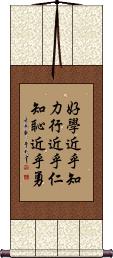
好學近乎知力行近乎仁知恥近乎勇 is a Saying from Confucius which relates certain actions to virtues.
A more verbose translation:
To love learning is akin to knowledge,
to study diligently is akin to benevolence,
to know shame is akin to courage.
Dojo / Martial Arts Studio
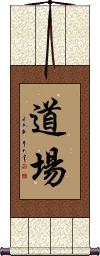
道場 is the Japanese term for a room or hall in which martial arts are taught.
道場 is often spelled “dojo” which has become a word in the English lexicon. However, the true Romaji is doujou or dōjō.
Please note: The Chinese definition of these characters is quite different. In Chinese, this is a place where Buddhist or Taoist mass is held. It could also be a place where spiritual or psychic events are performed.
Diligent Study Proverb
Drill a hole in the wall to get light to read by.
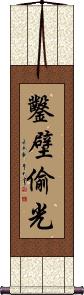
鑿壁偷光 is a Chinese proverb that means “Bore a hole in the wall to make use of the neighbor's light to study.”
This is a nice gift for a very studious person.
Kuang Heng was born during the Western Han period. He has been very fond of reading ever since he was young. However, he could not attend school since his family was poor, and he had to borrow books from people to learn.
To borrow these books, he normally did chores for people who had them. When he became older, he had to work in the field from sunrise to sunset since his family's financial situation did not improve. Thus, he tried to study at night, but he had no lamp.
One day, he noticed the light from the neighbor's house coming through a crack in the wall. This made him very happy, so he dug a larger hole from the crack and read in the light that shone through. This diligent study eventually made him an accomplished person.
Good Good Study, Day Day Up
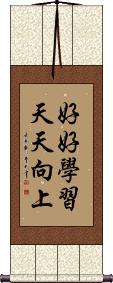
好好學習天天向上 is a famous proverb by Chairman Mao Zedong that sounds really strange when directly translated into English.
I include it in our database of phrases to illustrate how different the construction and grammar can be between Chinese and English. The direct translation is “Good Good Study, Day Day Up.” In Chinese, a repeated character/word can often serve to reinforce the idea (like saying “very” or suggesting “a lot of”). So “good good” really means “a lot of good.” While “day day” can be better translated as “day in day out.” The idea of “up” has a meaning in China of “rising above” or “improving.”
After understanding all of this, we come up with a slightly better translation of “With a lot of good study, day in and day out, we raise above.”
The more natural translation of this proverb would be something like, “study hard, and keep improving.”
Read / Study
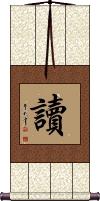
讀 is a Chinese character that means “to read out loud,” or “to study books.”
Very seldom used in Japanese anymore (except occasionally in Buddhism).
Study / Learn / School
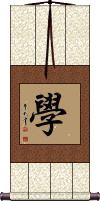
學 is “study” or “learn” in Chinese, Japanese Kanji, and old Korean Hanja.
學 is a very broad character that can mean a lot of things related to scholarship. It can refer to a school (in fact, if you put the character for “big” in front of this, you have “college” or “university,” if you put the word for “middle,” you have “middle school.” This can also mean science; the process of acquiring knowledge; learning; scholarship; erudition; knowledge. It can also add the Chinese or Japanese version of “-ology” (the study of) too many words.
 There is a very common simplified version of this character. You will see this form in modern Japan and mainland China, Singapore, and other places. If you want this simplified version, please click on the character shown to the right instead of the "select and customize" button above.
Student
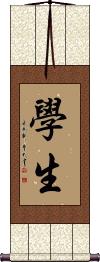
學生 is how to write “student” in Chinese, pre-WWII Japanese Kanji, and old Korean Hanja.
If you are a “student of life,” this might be an interesting wall scroll to hang in your reading room.
The first character means “study” or “learning.”
The second character means “life” or “birth.” Don't read too much into that second character unless you decide that this means “the birth of studies” or “the life of learning.” Everyone in China, Japan (and those who can read Hanja in Korea) will just read this word with the meaning of “student.”
If you put the character for “little” in front of this word, it becomes “elementary school student.” Prefixed with “middle,” it becomes “middle school student.” Prefixed with “big,” it becomes “university student” (though when these two characters for student are seen alone, it often suggests “university student”). The term “high school student” is written differently.
There is a very common simplified version of the first character for this word. You will see this form in modern Japan and mainland China, Singapore, and other places. If you want this simplified version, please click on the character shown to the right instead of the "select and customize" button above.
Studer

斯圖德 is the name Studer in Chinese (Mandarin).
Studer

ステューダー is the name Studer in Japanese Katakana.
Note: Because this title is entirely Japanese Katakana, it should be written by a Japanese calligrapher.
The following table may be helpful for those studying Chinese or Japanese...
| Title | Characters | Romaji (Romanized Japanese) | Various forms of Romanized Chinese | |
| Learning leads to Knowledge, Study leads to Benevolence, Shame leads to Courage | 好學近乎知力行近乎仁知恥近乎勇 好学近乎知力行近乎仁知耻近乎勇 | hào xué jìn hū zhī lì xíng jìn hū rén zhī chǐ jìn hū yǒng hao4 xue2 jin4 hu1 zhi1 li4 xing2 jin4 hu1 ren2 zhi1 chi3 jin4 hu1 yong3 hao xue jin hu zhi li xing jin hu ren zhi chi jin hu yong | hao hsüeh chin hu chih li hsing chin hu jen chih ch`ih chin hu yung hao hsüeh chin hu chih li hsing chin hu jen chih chih chin hu yung |
|
| Dojo Martial Arts Studio | 道場 道场 | dou jou / doujou / do jo | dào cháng dao4 chang2 dao chang daochang | tao ch`ang taochang tao chang |
| Diligent Study Proverb | 鑿壁偷光 凿壁偷光 | záo bì tōu guāng zao2 bi4 tou1 guang1 zao bi tou guang zaobitouguang | tsao pi t`ou kuang tsaopitoukuang tsao pi tou kuang |
|
| Good Good Study, Day Day Up | 好好學習天天向上 好好学习天天向上 | hǎo hǎo xué xí tiān tiān xiàng shàng hao3 hao3 xue2 xi2 tian1 tian1 xiang4 shang4 hao hao xue xi tian tian xiang shang | hao hao hsüeh hsi t`ien t`ien hsiang shang hao hao hsüeh hsi tien tien hsiang shang |
|
| Read Study | 讀 读 | doku | dú / du2 / du | tu |
| Study Learn School | 學 学 | gaku | xué / xue2 / xue | hsüeh |
| Student | 學生 学生 | gakusei | xué shēng xue2 sheng1 xue sheng xuesheng | hsüeh sheng hsüehsheng |
| Studer | 斯圖德 斯图德 | sī tú dé si1 tu2 de2 si tu de situde | ssu t`u te ssutute ssu tu te |
|
| Studer | ステューダー | suteuudaa / suteuda | ||
| In some entries above you will see that characters have different versions above and below a line. In these cases, the characters above the line are Traditional Chinese, while the ones below are Simplified Chinese. | ||||

Successful Chinese Character and Japanese Kanji calligraphy searches within the last few hours...



