Many custom options...


And formats...



Stumble in Chinese / Japanese...
Buy a Stumble calligraphy wall scroll here!
Personalize your custom “Stumble” project by clicking the button next to your favorite “Stumble” title below...
Have a Walking Stick at the Ready Before You Stumble
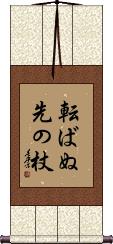
転ばぬ先の杖 is a Japanese proverb that literally translates as: Have a walking stick ready before stumbling.
This is similar to the English idiom, “A stitch in time saves nine.”
In simple terms, this means: Always being prepared in advance.
Note: Because this selection contains some special Japanese Hiragana characters, it should be written by a Japanese calligrapher.
See Also: Fix Roof Before the Rain; Dig the Well Before You Are Thirsty
Each Time You Stumble and Fall, You Gain Experience and Wisdom
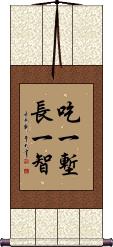
吃一塹長一智 is a Chinese proverb that means “Fall into a moat, and you will gain wisdom from the experience.”
It really suggests that the failures, troubles, frustrations, and setbacks that you encounter in your life are actually helping you to find wisdom. Some would also translate this proverb as “Learn from your mistakes” or “Learn from your experience.”
If you are studying Chinese, you will recognize the first character as “eat,” but in this case, it means to “experience” (as used in this proverb, it is suggesting that you have fallen into a moat and/or had a hard time crossing it).
Translated character by character, this whole proverb is, “Experience one moat, gain one wisdom/knowledge.”
Note: This can be pronounced in Korean, but it's not a commonly used phrase.
Fall Down Seven Times, Get Up Eight
Always rising after a fall or repeated failures
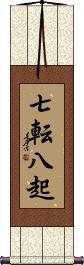
七転八起 is a Japanese proverb that relays the vicissitudes of life, with the meaning “seven times down eight times up.”
Some would more naturally translate it into English as “Always rising after a fall or repeated failures” or compare it to the English, “If at first, you don't succeed, try, try again.”
The first Kanji is literally “7.” The second means “fall down” (sometimes this Kanji means “turn around,” “revolve” or “turn over” but in this case, it holds the meaning of “fall”). The third is “8.” And the last is “get up,” “rouse,” or “rise.”
Basically, if you fail 7 times, you should recover from those events and be prepared to rise an 8th time. This also applies if it is the world or circumstances that knock you down seven times...
...just remember that you have the ability to bounce back from any kind of adversity.
Note: This can be pronounced in two ways. One is “shichi ten hakki” or “shichitenhakki.” The other is “nana korobi ya oki” also written, “nanakorobi-yaoki.”
Special Note: The second character is a Kanji that is not used in China. Therefore, please select a Japanese calligrapher for this title.
Fix the roof before the rain; Dig the well before you are thirsty
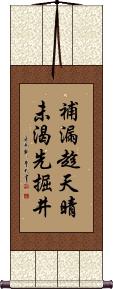
补漏趁天晴未渴先掘井 is a Chinese proverb that literally translates as: Mend the roof while the weather is fine, [and when you are] not yet thirsty, dig the well beforehand.
In simple terms, this means: Always being prepared in advance.
Not the results for stumble that you were looking for?
Below are some entries from our dictionary that may match your stumble search...
| Characters If shown, 2nd row is Simp. Chinese |
Pronunciation Romanization |
Simple Dictionary Definition |
絆 绊 see styles |
bàn ban4 pan rian りあん |
More info & calligraphy: Bond(1) bonds (between people); (emotional) ties; relationship; connection; link; (2) tether; fetters; (female given name) Rian |
栽 see styles |
zāi zai1 tsai sai さい |
to plant; to grow; to insert; to erect (e.g. a bus stop sign); to impose something on sb; to stumble; to fall down (surname) Sai |
跎 see styles |
tuó tuo2 t`o to |
to stumble; to waste time |
跲 see styles |
jiá jia2 chia |
to stumble |
踜 see styles |
lèng leng4 leng |
to stumble; to slip; to fall |
蹪 see styles |
tuí tui2 t`ui tui |
to stumble; to fall |
躂 跶 see styles |
dā da1 ta |
to stumble; to slip; variant of 達|达[da2] |
躓 踬 see styles |
zhì zhi4 chih |
to stumble |
淀む see styles |
yodomu よどむ |
(v5m,vi) to stagnate; to be stagnant; to settle; to deposit; to be sedimented; to be precipitated; to hesitate; to be sluggish; to stammer; to stumble; to falter |
澱む see styles |
yodomu よどむ |
(v5m,vi) to stagnate; to be stagnant; to settle; to deposit; to be sedimented; to be precipitated; to hesitate; to be sluggish; to stammer; to stumble; to falter |
絆倒 绊倒 see styles |
bàn dǎo ban4 dao3 pan tao |
to trip; to stumble |
絆腳 绊脚 see styles |
bàn jiǎo ban4 jiao3 pan chiao |
to stumble over something |
絆跤 绊跤 see styles |
bàn jiāo ban4 jiao1 pan chiao |
to trip; to stumble |
趔趄 see styles |
liè qie lie4 qie5 lieh ch`ieh lieh chieh |
to stagger; to stumble; to reel; Taiwan pr. [lie4ju1] |
跌撲 跌扑 see styles |
diē pū die1 pu1 tieh p`u tieh pu |
to tumble; to stumble and fall |
躓く see styles |
tsumazuku(p); tsumazuku つまずく(P); つまづく |
(v5k,vi) (1) (kana only) to trip (over); to stumble; (v5k,vi) (2) (kana only) to fail; to suffer a setback |
顛沛 颠沛 see styles |
diān pèi dian1 pei4 tien p`ei tien pei |
to fall over; to stumble; (fig.) to suffer hardship; to be in desperate straits |
吃螺絲 吃螺丝 see styles |
chī luó sī chi1 luo2 si1 ch`ih lo ssu chih lo ssu |
(of an actor, announcer etc) to stumble over words (Tw) |
泳がす see styles |
oyogasu およがす |
(transitive verb) (1) (See 泳がせる・1) to let (someone) swim; to make (someone) swim; to release (fish) into the water; to set (fish) swimming; (transitive verb) (2) to make (someone) stumble forward; to make stagger; to make lurch; (transitive verb) (3) to let (a suspect) roam freely (while monitoring them); to leave at large; (transitive verb) (4) to move about in the air (e.g. one's arms); to wave about |
蹴躓く see styles |
ketsumazuku; ketsumazuku けつまずく; けつまづく |
(v5k,vi) (1) (kana only) to trip over something; to stumble; (2) to fail |
閊える see styles |
tsukkaeru つっかえる tsukaeru つかえる |
(v1,vi) (1) (kana only) to stick; to get stuck; to get caught; to get jammed; to clog; (2) (kana only) to be unavailable; to be busy; to be occupied; to be full; (3) (kana only) to be piled up (e.g. of work); (4) (kana only) to halt (in one's speech); to stumble (over one's words); to stutter; to stammer; (5) (kana only) to feel blocked (of one's chest or throat, due to grief, anxiety, illness, etc.); to feel pressure; to feel pain |
一蹶不振 see styles |
yī jué bù zhèn yi1 jue2 bu4 zhen4 i chüeh pu chen |
one stumble, unable to rise (idiom); a setback leading to total collapse; ruined at a stroke; unable to recover after a minor hitch |
泳がせる see styles |
oyogaseru およがせる |
(transitive verb) (1) to let (someone) swim; to make (someone) swim; to release (fish) into the water; to set (fish) swimming; (transitive verb) (2) to make (someone) stumble forward; to make stagger; to make lurch; (transitive verb) (3) to let (a suspect) roam freely (while monitoring them); to leave at large; (transitive verb) (4) to move about in the air (e.g. one's arms); to wave about |
蹌踉ける see styles |
yorokeru よろける |
(v1,vi) (kana only) to stagger; to stumble |
蹌踉つく see styles |
yorotsuku よろつく |
(v5k,vi) (kana only) to stagger; to stumble; to totter |
蹌踉めく see styles |
yoromeku よろめく |
(v5k,vi) (1) (kana only) to stagger; to stumble; to totter; (v5k,vi) (2) (kana only) to misconduct oneself; to have a love affair; to waver; to feel some inclination |
蹣跚ける see styles |
yorokeru よろける |
(v1,vi) (kana only) to stagger; to stumble |
ひょろける see styles |
hyorokeru ひょろける |
(Ichidan verb) to stagger; to stumble; to be unsteady on one's feet |
踏鞴を踏む see styles |
tataraofumu たたらをふむ |
(exp,v5m) to stumble a step or two forward (when trying to stop); to pass one's destination and stumble a step or two forward; to totter |
蹈鞴を踏む see styles |
tataraofumu たたらをふむ |
(exp,v5m) to stumble a step or two forward (when trying to stop); to pass one's destination and stumble a step or two forward; to totter |
Click here for more stumble results from our dictionary
The following table may be helpful for those studying Chinese or Japanese...
| Title | Characters | Romaji (Romanized Japanese) | Various forms of Romanized Chinese | |
| Have a Walking Stick at the Ready Before You Stumble | 転ばぬ先の杖 | koro ba nu saki no tsue korobanusakinotsue | ||
| Each Time You Stumble and Fall, You Gain Experience and Wisdom | 吃一塹長一智 吃一堑长一智 | chī yí qiàn, zhǎng yí zhì chi1 yi2 qian4 zhang3 yi2 zhi4 chi yi qian zhang yi zhi chiyiqianzhangyizhi | ch`ih i ch`ien chang i chih chihichienchangichih chih i chien chang i chih |
|
| Fall Down Seven Times, Get Up Eight | 七転八起 | shichi ten hakki / nana korobi ya oki shichi ten haki / nana korobi ya oki | ||
| Fix the roof before the rain; Dig the well before you are thirsty | 補漏趁天晴未渴先掘井 补漏趁天晴未渴先掘井 | bǔ lòu chèn tiān qíng wèi kě xiān jué jǐng bu3 lou4 chen4 tian1 qing2 wei4 ke3 xian1 jue2 jing3 bu lou chen tian qing wei ke xian jue jing | pu lou ch`en t`ien ch`ing wei k`o hsien chüeh ching pu lou chen tien ching wei ko hsien chüeh ching |
|
| In some entries above you will see that characters have different versions above and below a line. In these cases, the characters above the line are Traditional Chinese, while the ones below are Simplified Chinese. | ||||

Successful Chinese Character and Japanese Kanji calligraphy searches within the last few hours...



