Many custom options...


And formats...



Surname in Chinese / Japanese...
Buy a Surname calligraphy wall scroll here!
Personalize your custom “Surname” project by clicking the button next to your favorite “Surname” title below...
If you would like your name in Chinese calligraphy and it does not appear below, please contact me, and I'll transliterate and add your name to our website database for you.
1. Ou
2. Tran
3. Zheng / Tei / Jeong / Trinh
4. Luo / Raku
5. Deng
6. Liu
8. Guo
9. Peng
10. Ma
12. Luo
13. Chan
14. Neng
15. Lei
16. Chen
17. Leung
18. Suzuki
19. Chu
20. Qin / Chin / Tan / Yasushi
21. Choi
22. Hirabarashi / Hiryabayashi
23. Azuka
24. Chan
25. Kakazu
26. Takeda
27. Xuan
29. Qin / Chin
30. Midoriya
31. Shang
32. Aung
33. Endo
34. Sato
35. Gu
36. Shimabukuro
37. Yeh
38. Shen / Shum
39. Cen / Shum
40. Chong
41. Chan
42. Tan
43. Lou
44. Ding
45. Cho
46. Yat
47. Chow
48. Zhou
49. Ocean
50. Harimaya
Ou
Surname

歐 is the Chinese surname, Ou.
Sometimes this is the short version of the surname 歐陽 or Ouyang. There is a related character, 區, which can also be a surname with the same romanization.
Tran
Surname
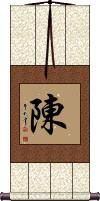
陳 is the Chinese character that was the Vietnamese surname Trần before Vietnam romanized their language.
This can also refer to the Trần Dynasty of Vietnam (1225 to 1400).
This is also the Chinese surname Chen, Chin or Chan, Korean surname Jin, and Japanese Surname Yo or Chin.
Zheng / Tei / Jeong / Trinh
Chinese Japanese Korean Vietnamese Surname
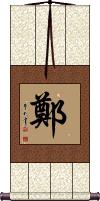
鄭 is the Chinese surname Zheng, Japanese surname Tei, Korean surname Jeong, and Vietnamese surname Trịnh.
This can also refer to the state of Zheng during the Warring States period of China.
In Korea, this can be the original way to write the surname Jeong in the old days (now it's 정 in modern Korea). Can also romanize from Korean as Chung or Jung.
In Japanese, this is the surname Tei. But can romanize as the following Japanese names/surnames: Ti; Te; Tsun; Dziyon; Chiyon; Chon; Chou; Chun; Chuu; Chien; Zen; Jiyon; Jon; Jou; Jun.
In Vietnamese, this is the name Trịnh from the time before Vietnam romanized the language.
Luo / Raku
Surname
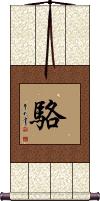
駱 is a character that can be a Chinese surname Luo or a Japanese surname Raku.
The original meaning of this character is a camel, but that is rather archaic. The surname is the first thing that comes to mind for any Chinese or Japanese person.
Deng
Surname
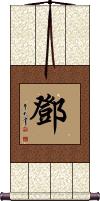
Liu
Chinese Surname
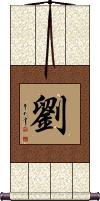
劉 is the name surname Liu in Chinese (Mandarin).
While typically only read as a surname, the meaning of 劉 is battle-ax or asa a verb, to kill or slaughter.
Nguyen / Ruan
Surname
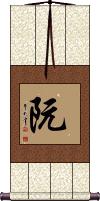
阮 is the original Chinese character that represented the Vietnamese surname Nguyễn before Vietnam stopped using Chinese characters and romanized their language. It is probably the most common surname in all of Vietnam. While romanized as Nguyen, it sounds more like the English word “Win” or “When.” 阮 can also represent the Nguyen Dynasty in Vietnam, which lasted from 1802 to 1945.
阮 is also the Chinese surname Ruan, most Chinese with this surname have ancestors from a small state named Ruan during the Shang Dynasty (1600-1046 BC) located in the southeast of modern-day Gansu Province.
In Japanese, this can be the rare surnames pronounced Min, Gen, Ken, Gan, or En.
Besides a surname, this character also represents an ancient musical instrument.
Guo
Surname
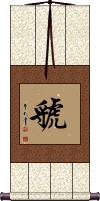
This is a Chinese surname that romanizes as Guo.
The origin was a tribe or group within the Zhou Dynasty. Descendants of this group still maintain this surname.
Peng
Surname
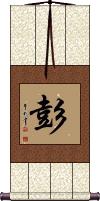
This is the Chinese surname Peng.
In Japanese, this can be the given name, Mitsuru.
In Korean, this is the surname usually romanized as Paeng.
Ma
Surname
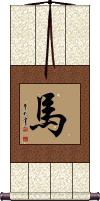
馬 is the surname Ma in Chinese (Mandarin).
The meaning of 馬 is horse. There is a less-common Chinese surname, 麻, meaing hemp.
Kung / Gong / Mitsugi
Surname
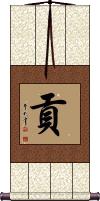
貢 is a Chinese surname that can romanize as Gong from Mandarin or Kung from Cantonese.
In Japan, this can be the surname or given name Mitsugi.
The meaning of this is tribute or gifts.
Luo
Surname
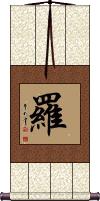
羅 is a character that can be the Chinese surname Luo.
This can also be the Japanese surname Ra, Ami, Ai, Rou, or Ro (and a few others).
The meaning is to collect, gather, catch, or sift. It may also refer to gauze, a lightweight fabric, or thin silk.
Luo
Surname
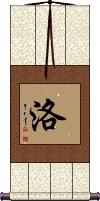
This is a common Chinese surname that romanizes as Luo.
This is not the only character that can be a Luo surname.
Chan
Hokkien Surname
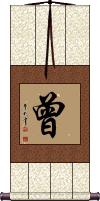
This is a Hokkien surname that is often romanized as Chan.
The meaning is great- (as in great-grandfather, grandmother, grandchild, etc.).
In some context, can mean already. In Japanese, this can be a surname that romanizes as Son.
Neng
Surname
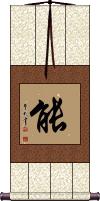
This is the Mandarin Chinese surname, Neng.
The meaning of this word in Chinese and Japanese is “can,” “capability,” or “to be able to.”
This can also be a surname in Japanese that romanize as Nozaki, Nouzaki, Nou, or Takumi.
Lei
Surname
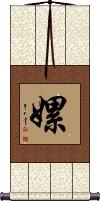
This is one Chinese surname that romanizes as Lei.
There are other characters that romanize as Lei, and are surnames. Make sure you get the right one.
I believe this is also a surname in Korean, where it's written as 루 and pronounced like “Ru” or “Lu” in modern Korean.
Chen
Surname
This is the most common character for a Chinese surname that romanizes as “Chen.”
This is also a surname, You or Yo in Japanese, though it can also be pronounced as Chin in Japanese.
In Korean, it is a surname romanized as Jin.
As a word, this character means: to lay out; to exhibit; to display; to narrate; to state; to explain; to tell.
The Chen clan, or family, ruled a small kingdom from 1046 BC to 479 BC. It was one of 12 small but powerful vassal states during the Spring and Autumn Period, 770-475 BC. This name reappeared as the Chen Dynasty (陳朝) of the Southern dynasties from 557 AD to 589 AD.
Leung
Surname

梁 is the most common character that can represent a surname romanized as Leung (from Cantonese) or Liang (from Mandarin).
The actual meaning is roof beam, structural beam, pillar and sometimes bridge.
This can refer to the Liang dynasty of China (502-557 AD).
This can also be the rare surname Reon in Japanese.
Suzuki
Surname
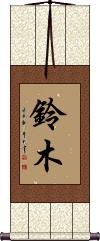
This is the Japanese surname, Suzuki.
This is the family name of the founder of Suzuki Loom Company, which later became Suzuki Motor Corporation.
This name can also be romanized as Sudzuki; Suzushi; Suzuko; Susuheki; Susugi; Susuki.
Chinese pronunciation is shown above but this is recognized as a Japanese surname when read in Chinese.
Chu
Surname
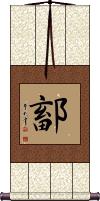
This is a Chinese surname that romanizes as Chu.
Please note, there are several surnames that romanize as Chu. In fact, in the mainland, names that romanize as Zhu would be Chu in Taiwan. It's easy to get confused to please email me if you are not sure about which surname you need (send me an image of the character if you can).
Qin / Chin / Tan / Yasushi
Surname
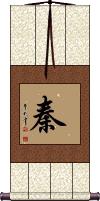
秦 is a common character that can be the surname romanized as Qin or Chin in Chinese.
秦 is the same Qin as the Qin dynasty (221-207 BC). The Qin dynasty established the first emperor and the first unification of China (previously a multitude of kingdoms).
秦 is also a surname in Vietnamese where it is romanized as Tần and in Japanese where it is romanized as Yasushi.
Choi
Surname
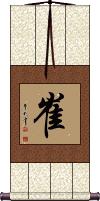
崔 is both a word and surname in Chinese and Korean.
In Korean, this romanizes as Choi. Occasionally, some have romanized it as Choe.
In Chinese, this is romanized as Cui in the mainland and Tsui in Taiwan.
The meaning of this characters is high mountain or precipitous.
崔 is also a rarely used Japanese surname or given name. From Japanese, this has the following possible romanizations: Chiyoi; Chioe; Chiejiyon; Chiei; Chie; Che; Takashi; Sun; Sa.
Hirabarashi / Hiryabayashi
Surname
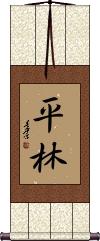
平林 is the Japanese surname Hirabarashi or Hiryabayashi.
Azuka
Japanese surname
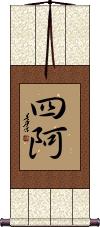
四阿 is the Japanese surname Azuka, Adzuma, Azuma, or Aoka.
This also means arbor/arbour, bower, summer house, or square gazebo.
Chan
Taiwanese Surname
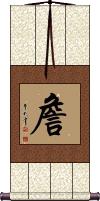
This is a surname that romanizes as Chan from the Taiwanese (Wade-Giles) method or romanizing Mandarin Chinese.
The actual meaning is excellent or verbose.
Kakazu
Surname
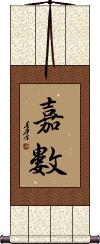
This is the most common version of the Japanese surname Kakazu in Kanji.
A more rare version is 加数.
Takeda
Surname
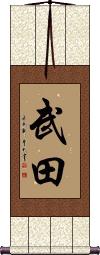
This is a Japanese surname that romanizes as Takeda.
This can also be the Japanese surnames Muta, Tageta, Takedo, or Taketa.
Xuan
Surname
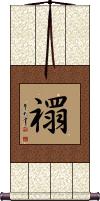
禤 is the most common character for a Chinese surname that romanizes as Xuan.
禤 is also a name in Korean that romanizes as Hwon or Hweon.
Guan / Kwan / Seki
Surname
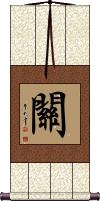
關 is a surname in three languages.
In Chinese, it romanizes as Guan.
In Korean, it's Kwan (or Gwan).
In Japanese it's Seki.
The meaning of the character is mountain pass; to close; to shut; to turn off; barrier; frontier.
Qin / Chin
Surname
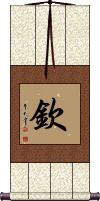
欽 is one of a few Chinese characters that can be a surname romanized as Qin or Chin.
The actual meaning of this character is reverence; respect; admire; venerate; by the emperor himself; imperial.
In Japanese, this can be the name Makoto.
Midoriya
Surname
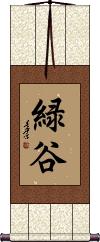
緑谷 is a Japanese surname that romanizes as Midoriya.
There may be other surnames that romanize as Midoriya, but with different Kanji, so double check before you order.
Shang
Surname
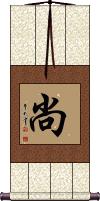
This is the most common character for the Chinese surname that romanizes as Shang. This is also a name, “Makato” in Japanese and “Sang” in Korean.
尚 is also a word meaning: still; yet; to value; to esteem; furthermore; in addition; greater; further.
Aung
Burmese Surname
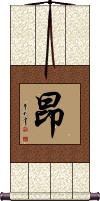
昂 is often used to represent the Burmese surname Aung.
The actual meaning is to lift, raise, high, high spirits, soar, or soaring.
In Japanese, this can be the given name Hisashi.
Endo
Japanese Surname
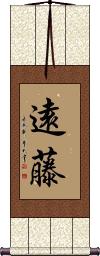
遠藤 is the Japanese surname Endō, Endo, or Endou.
This can also be pronounced Toodou or Tōdō.
This is a known Japanese surname in Chinese, so that Chinese pronunciation is listed above - this is not a Chinese surname.
Sato
Japanese Surname
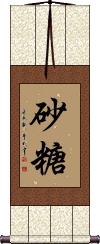
砂糖 is a Japanese surname, “Sato.”
This also means sugar or granulated sugar in both Chinese and Japanese.
There are several given names and surnames that romanize as Sato from Japanese. To see more, check out this link: Sato.
Be sure to pick the right Sato before you order a wall scroll etc.
Gu
Surname

顧 is the Chinese surname Gu.
顧 means, “to look after” or “consider.”
Other characters can be surnames and romanize as Gu, so make sure you are not looking for 谷 (valley/grain), 古 (ancient), or 辜 (guilt).
Shimabukuro
Surname
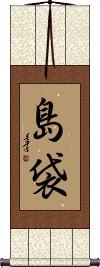
This is the Japanese surname Shimabukuro.
There are alternate romanizations such as Jimabukuro, Shimabuku, Shimafukuro, Shimatai, and Shikubukuro.
Occasionally, you will see 嶋袋 as Shimabukuro, but that is a rare variant of this name.
Yeh
Surname
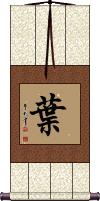
葉 is the surname Yeh which is common in Taiwan.
The meaning of this character is harmony, leaf, page, lobe, or (historical) period. The context in which this character is used determines the meaning.
Shen / Shum
Surname
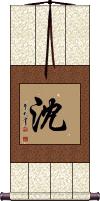
This is a Chinese surname that romanizes as Shen from Mandarin or Shum from Cantonese.
In Japanese, it can be the surnames Chin, Chimu, Sen, Sun, Shin, or Shimu.
The meaning is to sink or heavy.
This 沈 character is a variant of 沉.
Cen / Shum
Surname
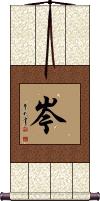
This is the Chinese surname Cen in mainland Mandarin, Tsen from Taiwan Mandarin, or Shum in Cantonese.
The meaning is “small hill.”
Also a female given name Rei or given name “Takeshi” or “Takashi” in Japanese.
Chong
Surname
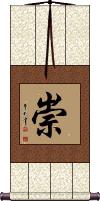
This is the surname “Chong” or “Zhong” in Mandarin Chinese, “Sung” in Cantonese and Korean, and Su in Japanese.
崇 is used in other Chinese words and other Asian languages with the following meanings:
high; sublime; lofty; to esteem; to worship; eminent; honorable; honourable; reverence; adore/adoration.
Chan
Cantonese Surname
This is the most common Cantonese surname that is often romanized as Chan.
The actual meaning of this character is to lay out, to exhibit, to display, to narrate, to state, to explain, or to tell.
This also can refer to the ancient state of Chan/Chen 1045-479 BC, or the Chen dynasty of China 557-589 BC.
Tan
Surname
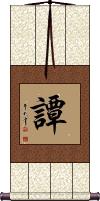
譚 is the surname Tan in Chinese.
The original form is 譚 but generations ago some changed the character to 覃 and some write it 檀 or 談. All of these romanize as tán in Mandarin Chinese and Tam in Cantonese. 覃, 檀, and 談 are rarely used for surnames now, you probably want 譚.
If you are looking for the origin of the Vietnamese name Tan, that came from 秦.
If you need one of these other characters, just copy and paste it into the search bar above, and an "Order Scroll" button will appear for you.

陸 is the most common Chinese surname character that romanizes as Lou.
The meaning of 陸 is land or shore.
This may not be the character you want as Lou can represent various characters/surnames like 盧 (a type of rice vessel), 樓 (tower), 婁 (astrological mansion), or 路 (road).
Other variations of romanization include: Lau, Lo, Lu, Liu, Loo, and Low.
Ding
Surname
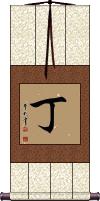
丁 is the Mandarin Chinese surname Ding.
In Japanese, 丁 can be surnames that romanize as Chō or Chou. It can also be more unusual Japanese surnames Rei, Yoroi, Yoboro, Youro, Momoki, Hinoto, Tei, Chiyon, Choudei, Chiyun, or Jiyon.
丁 can refer to nails or pieces of something. It is also a counter for long thin objects like scissors, spades, hoes, inksticks, palanquins, candles, etc.
Cho
Surname
In Japanese, 丁 can be surnames that romanize as Chō or Chou. It can also be more unusual Japanese surnames Rei, Yoroi, Yoboro, Youro, Momoki, Hinoto, Tei, Chiyon, Choudei, Chiyun, or Jiyon.
丁 is also the Mandarin Chinese surname Ding.
丁 can refer to nails or pieces of something. It is also a counter for long thin objects like scissors, spades, hoes, inksticks, palanquins, candles, etc.
Yat
Vietnamese Surname

畢 is the Chinese origin character for the Vietnamese surname, Yat.
The meaning is the whole of, to finish, to complete, full, or finished.
This is also the “Net” constellation (one of the 28 mansions) in ancient Chinese astronomy.
I have not been able to confirm this, but some sources suggest that this character can be romanized as “Yat” for Cantonese and perhaps other southern Chinese dialects.
Chow
Surname
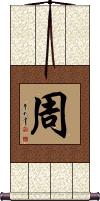
周 originally represents the Zhou Dynasty (1046-256 BC) of ancient China.
It has become a surname in China that romanizes as Zhou from Mandarin, Chou in Taiwan, and often written as Chow from Cantonese.
The actual meaning is circle, circumference, lap, cycle, all, thorough, or perimeter. It is used in Japanese Kanji and old Korean Hanja with that meaning - though it can also be used as a name in those languages as well.
Zhou
Surname
周 originally represents the Zhou Dynasty (1046-256 BC) of ancient China.
It has become a surname in China that romanizes as Zhou from Mandarin, Chou in Taiwan, and often written as Chow from Cantonese.
The actual meaning is circle, circumference, lap, cycle, all, thorough, or perimeter. It is used in Japanese Kanji and old Korean Hanja with that meaning - though it can also be used as a name in those languages as well.
Ocean
Surname

奧申 is the name Ocean in Chinese (Mandarin).
This sounds like Ocean, but does not mean ocean. It's a transliteration, not a translation.
Harimaya
Japanese Surname

播磨屋 is one of several Japanese surnames that romanize as Harimaya.
Make sure this is the correct version before ordering. Others include 播广谷, 播摩屋, 播摩谷, 播磨谷, and 針間矢.
You may want to check our...
Your name on a Chinese calligraphy scroll page
Your name on a Japanese calligraphy scroll page
...for a list of almost 5000 names.
The following table may be helpful for those studying Chinese or Japanese...
| Title | Characters | Romaji (Romanized Japanese) | Various forms of Romanized Chinese | |
| Ou | 歐 欧 | ōu / ou1 / ou | ||
| Tran | 陳 | chin | chén / chen2 / chen | ch`en / chen |
| Zheng Tei Jeong Trinh | 鄭 郑 | tei | zhèng / zheng4 / zheng | cheng |
| Luo Raku | 駱 骆 | raku | luò / luo4 / luo | lo |
| Deng | 鄧 邓 | dèng / deng4 / deng | teng | |
| Liu | 劉 刘 | liú / liu2 / liu | ||
| Nguyen Ruan | 阮 / 阮 阮 | Min / Gen | ruǎn / ruan3 / ruan | juan |
| Guo | 虢 | guó / guo2 / guo | kuo | |
| Peng | 彭 | mitsuru | péng / peng2 / peng | p`eng / peng |
| Ma | 馬 马 | mǎ / ma3 / ma | ||
| Kung Gong Mitsugi | 貢 贡 | mitsugi | gòng / gong4 / gong | kung |
| Luo | 羅 罗 | ra | luō / luo1 / luo | lo |
| Luo | 洛 | luò / luo4 / luo | lo | |
| Chan | 曾 | son | zēng / zeng1 / zeng | tseng |
| Neng | 能 | nou / no | néng / neng2 / neng | |
| Lei | 嫘 | léi / lei2 / lei | ||
| Chen | 陳 陈 | chin | chén / chen2 / chen | ch`en / chen |
| Leung | 梁 | reon / ryou reon / ryo | liáng / liang2 / liang | |
| Suzuki | 鈴木 | suzu ki / suzuki | líng mù / ling2 mu4 / ling mu / lingmu | |
| Chu | 鄐 | chù / chu4 / chu | ch`u / chu | |
| Qin Chin Tan Yasushi | 秦 | shin | qín / qin2 / qin | ch`in / chin |
| Choi | 崔 | cuī / cui1 / cui | ts`ui / tsui | |
| Hirabarashi Hiryabayashi | 平林 | hirabarashi | ||
| Azuka | 四阿 | Azuka | ||
| Chan | 詹 | zhān / zhan1 / zhan | chan | |
| Kakazu | 嘉數 嘉数 | kakazu | ||
| Takeda | 武田 | takeda | wǔ tián / wu3 tian2 / wu tian / wutian | wu t`ien / wutien / wu tien |
| Xuan | 禤 | xuān / xuan1 / xuan | hsüan | |
| Guan Kwan Seki | 關 关 | seki | guān / guan1 / guan | kuan |
| Qin Chin | 欽 钦 | kin | qīn / qin1 / qin | ch`in / chin |
| Midoriya | 緑谷 | midoriya | ||
| Shang | 尚 | nao | shàng / shang4 / shang | |
| Aung | 昂 | hisashi | áng / ang2 / ang | |
| Endo | 遠藤 远藤 | endou / endo | yuǎn téng yuan3 teng2 yuan teng yuanteng | yüan t`eng yüanteng yüan teng |
| Sato | 砂糖 | satou / sato sato / sato | shā táng / sha1 tang2 / sha tang / shatang | sha t`ang / shatang / sha tang |
| Gu | 顧 顾 | gù / gu4 / gu | ku | |
| Shimabukuro | 島袋 | shimabukuro | ||
| Yeh | 葉 叶 | you / yo | yè / ye4 / ye | yeh |
| Shen Shum | 沈 | jin | shěn / shen3 / shen | |
| Cen Shum | 岑 | rei / takeshi | cén / cen2 / cen | ts`en / tsen |
| Chong | 崇 | sū | chóng / chong2 / chong | ch`ung / chung |
| Chan | 陳 陈 | you / yo | chén / chen2 / chen | ch`en / chen |
| Tan | 譚 谭 | tán / tan2 / tan | t`an / tan | |
| Lou | 陸 陆 | lù / lu4 / lu | ||
| Ding | 丁 | chou / tei / hinoto cho / tei / hinoto | dīng / ding1 / ding | ting |
| Cho | 丁 | chou / tei / hinoto cho / tei / hinoto | dīng / ding1 / ding | ting |
| Yat | 畢 毕 | pi | bì / bi4 / bi | pi |
| Chow | 周 | shuu / shu | zhōu / zhou1 / zhou | chou |
| Zhou | 周 | shuu / shu | zhōu / zhou1 / zhou | chou |
| Ocean | 奧申 奥申 | ào shēn / ao4 shen1 / ao shen / aoshen | ||
| Harimaya | 播磨屋 | harimaya | ||
| In some entries above you will see that characters have different versions above and below a line. In these cases, the characters above the line are Traditional Chinese, while the ones below are Simplified Chinese. | ||||

Successful Chinese Character and Japanese Kanji calligraphy searches within the last few hours...



