Many custom options...


And formats...



Sutra in Chinese / Japanese...
Buy a Sutra calligraphy wall scroll here!
Personalize your custom “Sutra” project by clicking the button next to your favorite “Sutra” title below...
1. Heart Sutra
4. Namu Myoho Renge Kyo / Homage to Lotus Sutra
5. Wisdom and Insight of the Buddha
6. Immortal
7. When the sun rises it first shines on the highest mountain
8. Nichiren
Heart Sutra
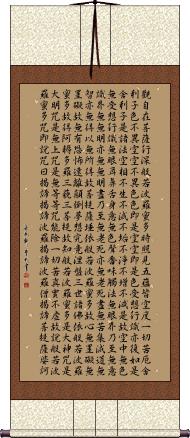
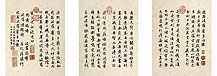
This is the Heart Sutra in Chinese as translated by Xuanzang.
The Heart Sutra is often cited as the best-known and most popular of all Buddhist scriptures.
Notes: There are too many characters for this to be done by the economy calligrapher. You must choose a Master Calligrapher.
With this many characters, and the fact that one tiny mistake wipes out hours of work, keep in mind that writing the Heart Sutra is usually a full day of work for a calligrapher. This work and personal energy should be cherished and respected. In other words, the calligrapher is not charging enough money for the value that you are getting here.
Also, you will find that as my server processes 260 characters, the customization process is a bit slow for this title.
Heart Sutra Title
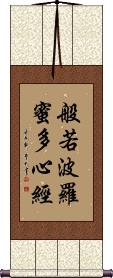
般若波羅蜜多心經 is the title of the Heart Sutra.
The Heart Sutra is a popular Buddhist writing that includes a famous mantra.
Heart Sutra Mantra
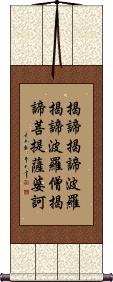
揭諦揭諦波羅揭諦波羅僧揭諦菩提薩婆訶 is the Mantra included within the Heart Sutra.
Namu Myoho Renge Kyo / Homage to Lotus Sutra
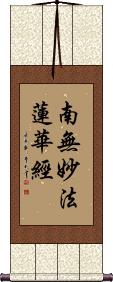
南無妙法蓮華經 is sometimes translated as the “Devotion to the Law of the Lotus Flower Scripture.”
This is a meditation chant and homage to the Lotus Sutra, used by Nichiren Buddhists in Japan.
This is also a chant used in China by certain sects of Buddhism that celebrate the deity Guanyin.
Also romanized as “Nam Myōhō Renge Kyō” or without accents as “Nam Myoho Renge Kyo.”


Original
Traditional
Version
The last character was originally written as seen on the left. Sometimes, you will see it written in the Japanese variant form as shown on the right. If you want this Japanese variant, click on the "Modern Japanese Variant" text instead of the button up by the main title of this entry.
Wisdom and Insight of the Buddha
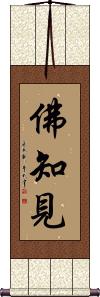
This title represents the wisdom and insight of the Buddha, or the penetrative power of Buddha's wisdom, or vision.
佛知見 is a term derived from the Lotus Sutra, perhaps up to 1900 years ago.
Immortal
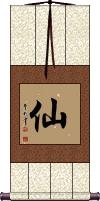
仙 means immortal (as in a being or person).
In some contexts, it can mean hermit, ascetic, man of the hills, or wizard. The Buddha is often put in this category.
In Chinese mythology and folklore, there is a famous group of eight immortals (八仙).
The 楞嚴經 (Śūraṅgama Sūtra) speaks of many kinds of immortals including walkers on the earth, fliers, wanderers at will (into space or into the deva heavens), beings with the ability to transform themselves into any form, etc.
When the sun rises it first shines on the highest mountain
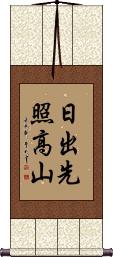
This old Buddhist phrase means, “When the sun rises it always shines first on the highest mountain,” or “When the sun appears, it first casts its light upon the highest mountain.”
This comes from the Avatamsaka Sutra and has been used as the name or portion of the name for temples in Japan and sites in China.
The Buddha's first round of teaching (Avatamsaka period) is likened to the time when the sun rises from the east horizon. When the sun first rises it illuminates the high mountains. In this analogy, the high mountains represent the great Bodhisattvas and/or those most ready to receive enlightenment and liberation.
This can be romanized from Japanese as “Nichi shutsu sen shō kō san,” “Nisshutsu saki teru takayama,” or “Hide temazu kōzan wo terasu yama.” The last one is probably the most common. Ask three Japanese people what they think the pronunciation is, and you will get three different opinions.
Nichiren
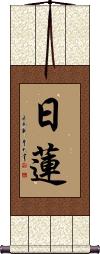
日蓮 is the title Nichiren.
This title refers to a Buddhist priest who lived from 1222 to 1282. He is the founder of the Nichiren sect of Buddhism.
According to historical documents, the Nichiren sect was established in 1252. Adding the character 宗 for sect, this would be 日蓮宗 (Nichiren sect), which is also known as the 法華宗 or Lotus sect.
According to Soothill-Hodous...
Nichiren's chief tenets are the three great mysteries 三大祕法, representing the trikāya:
1. 本尊 or chief object of worship, being the great maṇḍala of the worlds of the ten directions, or universe, i.e., the body or nirmāṇakāya of Buddha.
2. 題目 the title of the Lotus Sutra 妙法蓮華經 Myo-ho-ren-ge-kyo, preceded by Namo, or “Adoration to the scripture of the lotus of the wonderful law,” for it is Buddha's spiritual body.
3. 戒壇 the altar of the law, which is also the title of the Lotus as above; the believer, wherever he is, dwells in the Pure-land of calm light 寂光淨土, the saṃbhogakāya.
This in-stock artwork might be what you are looking for, and ships right away...
The following table may be helpful for those studying Chinese or Japanese...
| Title | Characters | Romaji (Romanized Japanese) | Various forms of Romanized Chinese | |
| Heart Sutra | 觀自在菩薩行深般若波羅蜜多時照見五蘊皆空度一切苦厄舍利子色不異空空不異色色即是空空即是色受想行識亦復如是舍利子是諸法空相不生不滅不垢不淨不增不減是故空中無色無受想行識無眼耳鼻舌身意無色聲香味觸法無眼界乃至無意識界無無明亦無無明盡乃至無老死亦無老死盡無苦集滅道無智亦無得以無所得故菩提薩埵依般若波羅蜜多故心無罣礙無罣礙故無有恐怖遠離顛倒夢想究竟涅盤三世諸佛依般若波羅蜜多故得阿耨多羅三藐三菩提故知般若波羅蜜多是大神咒是大明咒是無上咒是無等等咒能除一切苦真實不虛故說般若波羅蜜多咒即說咒曰揭諦揭諦波羅揭諦波羅僧揭諦菩提薩婆訶 观自在菩萨行深般若波罗蜜多时照见五蕴皆空度一切苦厄舍利子色不异空空不异色色即是空空即是色受想行识亦复如是舍利子是诸法空相不生不灭不垢不净不增不减是故空中无色无受想行识无眼耳鼻舌身意无色声香味触法无眼界乃至无意识界无无明亦无无明尽乃至无老死亦无老死尽无苦集滅道无智亦无得以无所得故菩提萨埵依般若波罗蜜多故心无罣碍无罣碍故无有恐怖远离颠倒梦想究竟涅盘三世诸佛依般若波罗蜜多故得阿耨多罗三藐三菩提故知般若波罗蜜多是大神咒是大明咒是无上咒是无等等咒能除一切苦真实不虚故说般若波罗蜜多咒即说咒曰揭谛揭谛波罗揭谛波罗僧揭谛菩提萨婆诃 | |||
| Heart Sutra Title | 般若波羅蜜多心經 般若波罗蜜多心经 | bō rě bō luó mì duō xīn jīng bo1 re3 bo1 luo2 mi4 duo1 xin1 jing1 bo re bo luo mi duo xin jing boreboluomiduoxinjing | po je po lo mi to hsin ching pojepolomitohsinching |
|
| Heart Sutra Mantra | 揭諦揭諦波羅揭諦波羅僧揭諦菩提薩婆訶 揭谛揭谛波罗揭谛波罗僧揭谛菩提萨婆诃 | jiē dì jiē dì bō luō jiē dì bō luō sēng jiē dì pú tí sà pó hē jie1 di4 jie1 di4 bo1 luo1 jie1 di4 bo1 luo1 seng1 jie1 di4 pu2 ti2 sa4 po2 he1 jie di jie di bo luo jie di bo luo seng jie di pu ti sa po he | chieh ti chieh ti po lo chieh ti po lo seng chieh ti p`u t`i sa p`o ho chieh ti chieh ti po lo chieh ti po lo seng chieh ti pu ti sa po ho |
|
| Namu Myoho Renge Kyo Homage to Lotus Sutra | 南無妙法蓮華經 / 南無妙法蓮華経 南无妙法莲华经 | na mu myou hou ren ge kyou namumyouhourengekyou na mu myo ho ren ge kyo | nán wú miào fǎ lián huá jīng nan2 wu2 miao4 fa3 lian2 hua2 jing1 nan wu miao fa lian hua jing nanwumiaofalianhuajing | nan wu miao fa lien hua ching nanwumiaofalienhuaching |
| Wisdom and Insight of the Buddha | 佛知見 佛知见 | bucchiken / buchiken | fó zhī jiàn fo2 zhi1 jian4 fo zhi jian fozhijian | fo chih chien fochihchien |
| Immortal | 仙 | sento / sen | xiān / xian1 / xian | hsien |
| When the sun rises it first shines on the highest mountain | 日出先照高山 | hiide temazu kousan wo terasu yama hide temazu kosan wo terasu yama | rì chū xiān zhào gāo shān ri4 chu1 xian1 zhao4 gao1 shan1 ri chu xian zhao gao shan richuxianzhaogaoshan | jih ch`u hsien chao kao shan jihchuhsienchaokaoshan jih chu hsien chao kao shan |
| Nichiren | 日蓮 日莲 | nichi ren / nichiren | rì lián / ri4 lian2 / ri lian / rilian | jih lien / jihlien |
| In some entries above you will see that characters have different versions above and below a line. In these cases, the characters above the line are Traditional Chinese, while the ones below are Simplified Chinese. | ||||

Successful Chinese Character and Japanese Kanji calligraphy searches within the last few hours...



