Many custom options...


And formats...



Not what you want?
Try other similar-meaning words, fewer words, or just one word.
The Geisha in Chinese / Japanese...
Buy a The Geisha calligraphy wall scroll here!
Personalize your custom “The Geisha” project by clicking the button next to your favorite “The Geisha” title below...
The Geisha’s World
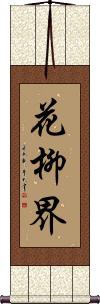
花柳界 literally means “Flower Willow World/Kingdom.”
In Japanese, this means “The Realm of the Geisha” or “World of the Geisha.” I suppose there is a presumption that the Geisha is surrounded by flowers in their residence. In Chinese and Korean, this pretty much has colloquially come to mean “The Red Light District” or to refer to pimps, prostitutes, and johns as a group.
Geisha
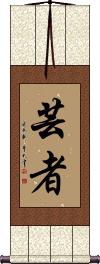
芸者 is the real basis for the way we spell geisha.
However, there are many more ways to refer to a woman that fills the role that westerners think of when they hear the word geisha.
In Japanese, these characters literally mean “artful person.” But in English, it might be better translated as “a person (woman) highly trained/accomplished in the arts.”
However, my Japanese dictionary says “a singing and dancing girl.”
Many will argue as to whether “geisha” = “prostitute” or not. My Japanese friends seem to have the opinion that a geisha is so highly trained in the art of playing musical instruments and dancing that the fact she might also be a prostitute is secondary to her performance on stage.
芸者 is a “Japanese only” term, they use a slightly different first character to express “geisha” in Chinese. Since this is a Japanese term, I have not included the Chinese version.
Geisha / Geigi
(Danger: Means prostitute in Japanese and Chinese!)
NOT APPROPRIATE FOR
CUSTOM CALLIGRAPHY
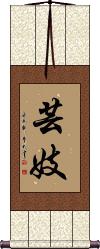
芸妓 is how to refer to a geisha that offers “special services.”
Please don't order this, it's only here for reference. 芸妓 is not appropriate for custom calligraphy!
Geisha of Unequaled Talent
(Danger: Can mean prostitute!)
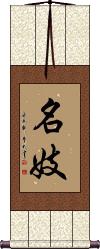
In Japanese, 名妓 means “distinguished/talented/beautiful geisha.”
The meaning in Chinese (and the deeper meaning in Japanese) would be “distinguished/talented/beautiful prostitute.”
I am not sure that our master calligrapher will even write this, so please note that fact if you decide to place the order. Of course, we'll refund your money if he refuses.
Whore / Mysterious Woman
Danger: Means prostitute in Japanese!
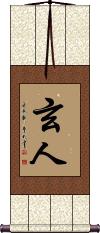
玄人 literally means “Mysterious Person/Woman.”
In Japanese, this is associated with a “geisha,” which matches this definition of a “mysterious woman.” However, this is the colloquial way to say “professional geisha” or “expert prostitute” in Japanese. It, therefore, might not be what you want on your wall.
Notes: This is a "Japanese only" term, though a Chinese person who sees these characters will think of a geisha or an alluring Japanese female musician.
While not often seen in Korean Hanja, this would mean a "dark woman," as in a woman that you cannot easily see through.
Jikata

This word has a few possible meanings.
It can refer to a room, hall, or place (a dojo or small theater). The dictionary suggests that in some context, this can refer to a special geisha who is talented in certain musical arts.
Martial Arts Master
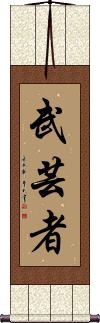
武芸者 is the Japanese Kanji title for “Martial Arts Master.” It suggests that you have reached at least the level of black belt and are probably to the level where you are ready to become an instructor.
Please consider carefully where you stand before ordering this phrase on a wall scroll. If you are not a master, this will make you look a bit foolish.
If you want to get this as a gift for your master at the dojo. Try to discreetly make sure this term is used in your school. Different schools and styles of Japanese martial arts use different terms. You may notice in the Romaji that the last two characters romanize as “geisha” which means “person skilled in arts” (what a geisha girl really is). The title here has the character for “martial,” “warrior,” and/or “military” in front of it. Therefore the literal translation is “martial art person.”
These Kanji are valid Chinese characters and Korean Hanja, but this title does not really make sense in Chinese and is not often used in Korean, though a Chinese or Korean would be able to guess the meaning by looking at the first and last characters.
This in-stock artwork might be what you are looking for, and ships right away...
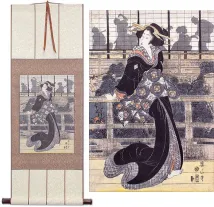
Gallery Price: $108.00
Your Price: $59.88
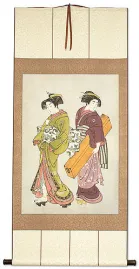
Gallery Price: $178.00
Your Price: $98.88
Gallery Price: $144.00
Your Price: $79.88
Gallery Price: $108.00
Your Price: $59.88
Gallery Price: $108.00
Your Price: $59.88
Gallery Price: $108.00
Your Price: $59.88
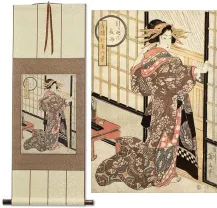
Gallery Price: $108.00
Your Price: $59.88
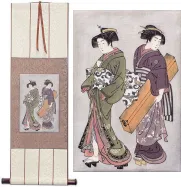
Gallery Price: $72.00
Your Price: $39.88
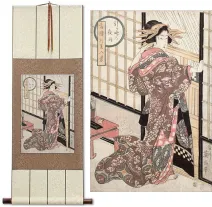
Gallery Price: $108.00
Your Price: $59.88
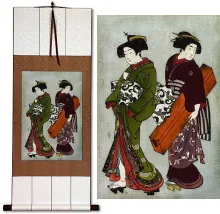
Gallery Price: $108.00
Your Price: $59.88
Gallery Price: $44.00
Your Price: $24.00
Gallery Price: $58.00
Your Price: $32.00
Gallery Price: $45.00
Your Price: $25.00
Gallery Price: $144.00
Your Price: $79.88
Gallery Price: $117.00
Your Price: $64.88
Not the results for the geisha that you were looking for?
Below are some entries from our dictionary that may match your the geisha search...
| Characters If shown, 2nd row is Simp. Chinese |
Pronunciation Romanization |
Simple Dictionary Definition |
玉 see styles |
yù yu4 yü hikaru ひかる |
More info & calligraphy: Jade(1) (also formerly read as ごく) precious stone (esp. jade); (2) {food} (occ. ギョク) egg (esp. as a sushi topping); (3) stock or security being traded; product being bought or sold; (4) (See 建玉) position (in finance, the amount of a security either owned or owed by an investor or dealer); (5) geisha; (6) (abbreviation) (See 玉代) time charge for a geisha; (7) (abbreviation) {shogi} (See 玉将) king (of the junior player); (female given name) Hikaru Jade, a gem; jade-like, precious; you, your. |
名妓 see styles |
míng jì ming2 ji4 ming chi meigi / megi めいぎ |
More info & calligraphy: Geisha of Unequaled Talentfamous geisha; talented geisha; beautiful geisha |
玄人 see styles |
haruto はると |
More info & calligraphy: Whore / Mysterious Woman |
芸妓 see styles |
geiko / geko げいこ geigi / gegi げいぎ |
More info & calligraphy: Geisha / Geigi |
芸者 see styles |
geisha / gesha げいしゃ |
More info & calligraphy: Geisha |
花柳界 see styles |
karyuukai / karyukai かりゅうかい |
More info & calligraphy: The Geisha’s World |
ハドロン see styles |
patoron パトロン |
(1) patron (of the arts, an artist, etc.); patroness; financial supporter; (2) (See 芸者,旦那・4) sugar daddy; man who provides for a woman (e.g. a geisha); (3) patron; master; manager; boss |
函 see styles |
hán han2 han hako はこ |
envelope; case; letter (1) box; case; chest; package; pack; crate; (2) car (of a train, etc.); (3) shamisen case; shamisen; (4) (colloquialism) public building; community building; (5) (archaism) man who carries a geisha's shamisen; (6) (archaism) receptacle for human waste; feces (faeces); (suf,ctr) (7) counter for boxes (or boxed objects) |
凾 see styles |
hán han2 han kan はこ |
(1) box; case; chest; package; pack; crate; (2) car (of a train, etc.); (3) shamisen case; shamisen; (4) (colloquialism) public building; community building; (5) (archaism) man who carries a geisha's shamisen; (6) (archaism) receptacle for human waste; feces (faeces); (suf,ctr) (7) counter for boxes (or boxed objects) A box, receptacle; to enfold: a letter. |
匣 see styles |
xiá xia2 hsia hako はこ kushige くしげ |
box (1) box; case; chest; package; pack; crate; (2) car (of a train, etc.); (3) shamisen case; shamisen; (4) (colloquialism) public building; community building; (5) (archaism) man who carries a geisha's shamisen; (6) (archaism) receptacle for human waste; feces (faeces); (suf,ctr) (7) counter for boxes (or boxed objects); (archaism) toiletries case |
妓 see styles |
jì ji4 chi gi ぎ |
prostitute geisha A singing-girl, courtesan. |
珠 see styles |
zhū zhu1 chu megumi めぐみ |
bead; pearl; CL:粒[li4],顆|颗[ke1] (1) ball; sphere; globe; orb; (2) bead (of sweat, dew, etc.); drop; droplet; (3) ball (in sports); (4) pile (of noodles, etc.); (5) bullet; (6) bulb (i.e. a light bulb); (7) lens (of glasses, etc.); (8) bead (of an abacus); (9) (slang) (abbreviation) ball (i.e. a testicle); (10) gem; jewel (esp. spherical; sometimes used figuratively); pearl; (11) female entertainer (e.g. a geisha); (12) (derogatory term) person (when commenting on their nature); character; (13) item, funds or person used as part of a plot; (n,n-suf) (14) egg; (suffix noun) (15) coin; (16) precious; beautiful; excellent; (female given name) Megumi mani. A pearl; a bead; synonym for buddha-truth. |
筐 see styles |
kuāng kuang1 k`uang kuang shou / sho しょう |
basket; CL:隻|只[zhi1] (1) box; case; chest; package; pack; crate; (2) car (of a train, etc.); (3) shamisen case; shamisen; (4) (colloquialism) public building; community building; (5) (archaism) man who carries a geisha's shamisen; (6) (archaism) receptacle for human waste; feces (faeces); (suf,ctr) (7) counter for boxes (or boxed objects); (archaism) fine-meshed bamboo basket; (personal name) Shou |
筥 see styles |
jǔ ju3 chü hakozaki はこざき |
round bamboo basket (1) box; case; chest; package; pack; crate; (2) car (of a train, etc.); (3) shamisen case; shamisen; (4) (colloquialism) public building; community building; (5) (archaism) man who carries a geisha's shamisen; (6) (archaism) receptacle for human waste; feces (faeces); (suf,ctr) (7) counter for boxes (or boxed objects); (surname) Hakozaki |
箱 see styles |
xiāng xiang1 hsiang hakozaki はこざき |
box; trunk; chest (1) box; case; chest; package; pack; crate; (2) car (of a train, etc.); (3) shamisen case; shamisen; (4) (colloquialism) public building; community building; (5) (archaism) man who carries a geisha's shamisen; (6) (archaism) receptacle for human waste; feces (faeces); (suf,ctr) (7) counter for boxes (or boxed objects); (surname) Hakozaki |
粋 see styles |
cuì cui4 ts`ui tsui sui すい |
Japanese variant of 粹 (1) essence; the best; cream; (noun or adjectival noun) (2) (See 粋・いき・1) chic; smart; stylish; tasteful; refined; sophisticated; (noun or adjectival noun) (3) considerate; understanding; thoughtful; tactful; (noun or adjectival noun) (4) familiar with worldly pleasures (esp. sexual relations, geisha districts and red-light districts); (female given name) Sui |
お酌 see styles |
oshaku おしゃく |
(noun/participle) (1) pouring alcohol; (2) person pouring alcohol for guests or customers (typically a woman); (3) (apprentice) geisha; dancing girl |
一本 see styles |
hitomoto ひともと |
(1) one long cylindrical thing; one film, TV show, etc.; one goal, home run, etc.; one telephone call; (2) one version; (3) one book; a certain book; (4) (martial arts term) ippon; one point; a blow; (5) experienced geisha; (suffix noun) (6) single-minded focus on ...; (surname) Hitomoto |
二業 二业 see styles |
èr yè er4 ye4 erh yeh nigyou / nigyo にぎょう |
(archaism) restaurants and geisha establishments Two classes of karma. (1) (a) 引業 leads to the 總報, i.e. the award as to the species into which one is to be born, e.g. men, gods, etc.; (6) 滿業 is the 別報 or fulfillment in detail, i.e. the kind or quality of being e.g. clever or stupid, happy or unhappy, etc. (2) (a) 善業 and (b) 惡業 Good and evil karma, resulting in happiness or misery. (3) (a) 助業 Aids to the karma of being reborn in Amitābha's Pure—land e. g. offerings, chantings, etc.; (b) 正業 thought and invocation of Amitābha with undivided mind, as the direct method. |
仕込 see styles |
shikomi しこみ |
(irregular okurigana usage) (n,n-suf) (1) training; education; upbringing; (2) stocking up; laying in; (3) preparation (e.g. ingredients); (4) girl studying to become a geisha; (place-name) Shikomi |
其者 see styles |
soresha それしゃ |
(irregular okurigana usage) (1) expert; (2) geisha; prostitute |
坐敷 see styles |
zashiki ざしき |
(irregular kanji usage) (1) tatami room; tatami mat room; formal Japanese room; (2) dinner party in a tatami room (esp. when a geisha or maiko attends) |
娘分 see styles |
musumebun むすめぶん |
(1) treating someone as one's own daughter; someone who is treated as a daughter; (2) (archaism) woman who manages geisha (Edo period) |
小童 see styles |
hichi ひち |
(archaism) small child (esp. a servant child in the Heian-period imperial palace); (archaism) young person; young servant; (out-dated or obsolete kana usage) (kana only) (derogatory term) boy; child; youth; brat; (kana only) (derogatory term) boy; child; youth; brat; (1) (archaism) girl-in-training (e.g. a geisha-in-training or a girl who performs miscellaneous tasks in a brothel); (2) (archaism) (derogatory term) brat; scamp; rascal; jackanapes; (3) (archaism) disciple; apprentice; (place-name) Hichi |
左褄 see styles |
hidarizuma ひだりづま |
(1) left skirt of a kimono; (2) (See 芸妓) geisha (because they often walked holding the left hem of their kimono) |
座敷 see styles |
zashiki ざしき |
(1) tatami room; tatami mat room; formal Japanese room; (2) dinner party in a tatami room (esp. when a geisha or maiko attends) |
弦妓 see styles |
gengi げんぎ |
(obscure) geisha; woman who entertains (e.g. by playing the shamisen) for her living |
御酌 see styles |
oshaku おしゃく |
(noun/participle) (1) pouring alcohol; (2) person pouring alcohol for guests or customers (typically a woman); (3) (apprentice) geisha; dancing girl |
愛妓 see styles |
aigi あいぎ |
favored geisha; beloved geisha; geisha someone is showing favor to |
抱主 see styles |
kakaenushi かかえぬし |
(irregular okurigana usage) employer (esp. of a geisha, prostitute, etc.); master; mistress |
Click here for more the geisha results from our dictionary
The following table may be helpful for those studying Chinese or Japanese...
| Title | Characters | Romaji (Romanized Japanese) | Various forms of Romanized Chinese | |
| The Geisha’s World | 花柳界 | karyuukai / karyukai | huā liǔ jiè hua1 liu3 jie4 hua liu jie hualiujie | hua liu chieh hualiuchieh |
| Geisha | 芸者 | geisha | yún zhě / yun2 zhe3 / yun zhe / yunzhe | yün che / yünche |
| Geisha Geigi | 芸妓 | geigi | yún jì / yun2 ji4 / yun ji / yunji | yün chi / yünchi |
| Geisha of Unequaled Talent | 名妓 | mei gi / meigi | míng jì / ming2 ji4 / ming ji / mingji | ming chi / mingchi |
| Whore Mysterious Woman | 玄人 | kurouto / kuroto | xuán rén / xuan2 ren2 / xuan ren / xuanren | hsüan jen / hsüanjen |
| Jikata | 地方 | jikata | dì fāng / di4 fang1 / di fang / difang | ti fang / tifang |
| Martial Arts Master | 武芸者 | bugeisha | wǔ yún zhě wu3 yun2 zhe3 wu yun zhe wuyunzhe | wu yün che wuyünche |

Successful Chinese Character and Japanese Kanji calligraphy searches within the last few hours...



