Many custom options...


And formats...



Worn in Chinese / Japanese...
Buy a Worn calligraphy wall scroll here!
Personalize your custom “Worn” project by clicking the button next to your favorite “Worn” title below...
Woman
The ancient way to say Woman
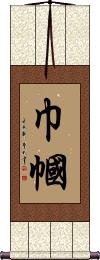
巾幗 is the very old way to say woman in Chinese.
A common title in ancient China, this actually refers to the scarf or head wrapping worn by virtually all women at that time.
巾幗 is kind of a cool way to say Woman now. The actual gender character alone on a wall scroll would actually look like a fancy sign for the woman's restroom (WC).
 If you are curious, the character to the right means female or woman. Knowing 女 is useful information if you are a woman searching for a toilet in China or Japan.
Ultimate Loyalty to Your Country
The most famous tattoo in Chinese history
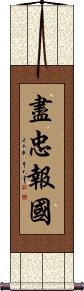
盡忠報國 is a proverb that is the tattoo worn on the back of Yue Fei, a famous Chinese warrior who lived until 1142 A.D.
The tattoo can be translated as “Serve the country with the utmost loyalty.” More literally, it means “[The] Ultimate Loyalty [is too] Duty [of] Country.”
Legend has it that this tattoo once saved his life when he was accused of treason.
The first two characters have come to create a word that means “serve the country faithfully” or “die for the country.” Note: It's more a willingness to die for one's country than the actual act of dying.
The last two characters have come to mean “Dedicate oneself to the service of one's country.”
Both of these words are probably only in the Chinese lexicon because of this famous tattoo.
If you break it down, character-by-character, here is what you get:
1. To the utmost, to the limit of something, the ultimate.
2. Loyalty or duty (a sense of duty to one's master, lord, country, or job).
3. Report, recompense, give back to (in this case, you are giving yourself to your country as payback).
4. Country, state, nation, kingdom.
These search terms might be related to Worn:
Akita Dog / Akitainu / Akita Inu
Devil Dog
Dog
Earth Dog
Fire Dog
Fu Dog / Foo Dog
Golden/Metal Dog
Inugami / Dog Spirit
Water Dog
Wood Dog
Not the results for worn that you were looking for?
Below are some entries from our dictionary that may match your worn search...
| Characters If shown, 2nd row is Simp. Chinese |
Pronunciation Romanization |
Simple Dictionary Definition |
冠 see styles |
guàn guan4 kuan masaru まさる |
to put on a hat; to be first; to dub (1) (See 衣冠,束帯) traditional cap worn by Shinto clergy and courtiers; (2) crown; diadem; coronet; (3) (かんむり only) top kanji radical; (4) (かむり only) (See 俳諧・1) first verse of a haikai, etc.; (adj-t,adv-to) (5) (かん only) best; peerless; first; (6) (かんむり only) name; title; named sponsorship of a program, event, team, etc.; (counter) (7) (かん only) {shogi} counter for titles; (given name) Masaru crown |
強い see styles |
kowai こわい |
More info & calligraphy: Tsuyoi |
ヘルド see styles |
peruto ペルト |
More info & calligraphy: Held |
ランニング see styles |
ranningu ランニング |
More info & calligraphy: Running |
儽 see styles |
lěi lei3 lei |
lazy; tired out, worn fatigued |
勩 勚 see styles |
yì yi4 i |
(literary) toilsome; laborious; (of an edge etc) worn out; blunt |
壞 坏 see styles |
huài huai4 huai kai |
bad; spoiled; broken; to break down; (suffix) to the utmost To go to ruin, decay, perish, destroy, spoil, worn out, rotten, bad. |
幗 帼 see styles |
guó guo2 kuo |
cap worn by women; feminine |
弊 see styles |
bì bi4 pi minegawa みねがわ |
detriment; fraud; harm; defeat (1) (rare) bad habit; harm; (prefix) (2) (humble language) (See 弊社) my; our; (personal name) Minegawa Worn out, reduced to extremities, corrupt, deceptive; my, mine. |
攺 see styles |
yǐ yi3 i |
a kind of metal or jade ornament worn in ancient times to ward off evil spirits |
敝 see styles |
bì bi4 pi teruo てるお |
my (polite); poor; ruined; shabby; worn out; defeated (personal name) Teruo |
楝 see styles |
liàn lian4 lien sendan せんだん ouchi / ochi おうち |
Melia japonica (1) (kana only) chinaberry; Japanese bead tree (Melia azedarach); (2) Indian sandalwood (Santalum album); (1) (archaism) chinaberry; Japanese bead tree (Melia azedarach); (2) light purple outside, green inside; purple outside, light purple inside; type of garment layering color scheme, worn in April and May |
樗 see styles |
chū chu1 ch`u chu buna ぶな |
simaroubaceae (1) (archaism) chinaberry; Japanese bead tree (Melia azedarach); (2) light purple outside, green inside; purple outside, light purple inside; type of garment layering color scheme, worn in April and May; (surname) Buna |
爛 烂 see styles |
làn lan4 lan ran らん |
soft; mushy; well-cooked and soft; to rot; to decompose; rotten; worn out; chaotic; messy; utterly; thoroughly; crappy; bad (adj-t,adv-to) (rare) brilliant; bright; (female given name) Ran Glittering, as iridescent fish. |
珶 see styles |
dì di4 ti |
white jade worn on belt |
瘁 see styles |
cuì cui4 ts`ui tsui |
care-worn; distressed; tired; overworked; sick; weary |
癯 see styles |
qú qu2 ch`ü chü |
thin; emaciated; worn; tired |
皁 see styles |
zào zao4 tsao |
black; police runners, from the black clothes formerly worn by them |
破 see styles |
pò po4 p`o po hazaki はざき |
broken; damaged; worn out; lousy; rotten; to break, split or cleave; to get rid of; to destroy; to break with; to defeat; to capture (a city etc); to expose the truth of (See 序破急) middle section of a song (in gagaku or noh); (surname) Hazaki To break, disrupt, destroy, cause schism; solve, disprove, refute, negate. |
絰 绖 see styles |
dié die2 tieh |
hempen band worn on the head or waist by a mourner |
繦 襁 see styles |
qiǎng qiang3 ch`iang chiang tasuki たすき |
string of copper coins; variant of 襁[qiang3] (1) cord used to tuck up the sleeves of a kimono; (2) sash (worn across chest, e.g. by election candidate or relay runners); (3) wrapper band on books, CDs, etc. |
舊 旧 see styles |
jiù jiu4 chiu ku |
old; opposite: new 新; former; worn (with age) Old, ancient. |
萩 see styles |
qiū qiu1 ch`iu chiu hagizaki はぎざき |
Lespedeza bicolor (1) (kana only) bush clover; Japanese clover (any flowering plant of genus Lespedeza); (2) dark red exterior with blue interior (color combination worn in autumn); (surname) Hagizaki |
衵 see styles |
nì ni4 ni akome あこめ |
women's undergarments (archaism) layer of clothing worn by nobles (worn beneath the robe but over the undergarments) |
袍 see styles |
páo pao2 p`ao pao hou / ho ほう |
gown (lined) round-necked robe worn by members of nobility and the imperial court a robe. |
袙 see styles |
akome あこめ |
(archaism) layer of clothing worn by nobles (worn beneath the robe but over the undergarments); (place-name) Akome |
袴 裤 see styles |
kù ku4 k`u ku hakama はかま |
variant of 褲|裤[ku4] (1) hakama; pleated skirt or loose-legged trousers worn over a kimono mainly on ceremonial occasions; (2) (leaf) sheath; (3) (sake bottle) stand; (surname) Hakama |
裳 see styles |
shang shang5 shang chima チマ |
used in 衣裳[yi1 shang5] (kana only) chima (kor:); long skirt traditionally worn by Korean women |
襦 see styles |
rú ru2 ju chogori チョゴリ |
jacket; short coat (kana only) chogori (kor:); jeogori; short jacket traditionally worn by Koreans |
襲 袭 see styles |
xí xi2 hsi souen / soen そうえん |
(bound form) to raid; to attack; (bound form) to continue the pattern; to perpetuate; (literary) classifier for suits of clothing or sets of bedding (1) pile; heap; layers (e.g. of clothing); set (e.g. of boxes); course (e.g. of stones); (counter) (2) counter for things that are stacked, piled up (or layered, etc.); (3) layers of clothing worn under one's overcoat; (4) (abbreviation) combination of colors created by layering of garments (colours); (personal name) Souen |
Click here for more worn results from our dictionary
The following table may be helpful for those studying Chinese or Japanese...
| Title | Characters | Romaji (Romanized Japanese) | Various forms of Romanized Chinese | |
| Woman | 巾幗 巾帼 | jīn guó / jin1 guo2 / jin guo / jinguo | chin kuo / chinkuo | |
| Ultimate Loyalty to Your Country | 盡忠報國 尽忠报国 | jìn zhōng bào guó jin4 zhong1 bao4 guo2 jin zhong bao guo jinzhongbaoguo | chin chung pao kuo chinchungpaokuo |
|
| In some entries above you will see that characters have different versions above and below a line. In these cases, the characters above the line are Traditional Chinese, while the ones below are Simplified Chinese. | ||||

Successful Chinese Character and Japanese Kanji calligraphy searches within the last few hours...



