Many custom options...


And formats...



Not what you want?
Try other similar-meaning words, fewer words, or just one word.
Zen Way in Chinese / Japanese...
Buy a Zen Way calligraphy wall scroll here!
Personalize your custom “Zen Way” project by clicking the button next to your favorite “Zen Way” title below...
2. Appreciation of Truth by Meditation
5. Zen Buddhism
6. Dogen
8. Self Awareness Becomes a Buddha
10. Bodhidharma
11. Zheng / Tei / Jeong / Trinh
12. No Mind / Mushin
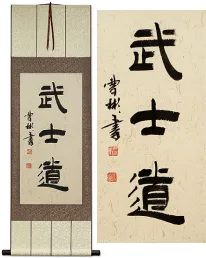
Zendo / The Zen Way
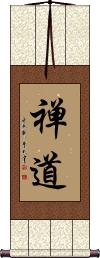
禪道 is a title used in certain contexts but is not widely known by the general population of China or Japan.
In Japanese, you will see this title romanized as “zendo,” which is the brand name of a board game, and also a title used by some martial arts studios and karate dojos. Oddly, many translate this as “zen fist,” although there is no “fist” in the title. If you literally translated this title, it would be “meditation way” or “meditation method.”
In Chinese, this would be “chan dao” with the same literal meaning as the Japanese title. It's used in China by just a handful of martial arts styles/studios.
You should only order this title if you really understand the meaning, and it has some personal connection to you (such as practicing a martial art style that uses this title, or if you love the board game Zendo). Many who see your wall scroll will not be familiar with this title, and you'll have some explaining to do.
 The first character can also be written in a more complex traditional way as shown to the right. Let us know in the special instructions for your calligraphy project if you want this style.
 If you order this from the Japanese master calligrapher, the first character will automatically be written with an extra dot on top. This is the variant form of the original Chinese character which is commonly used in modern Japan Kanji. See sample to the right.
Appreciation of Truth by Meditation
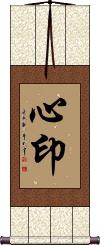
心印 is a Buddhist concept that simply stated is “appreciation of truth by meditation.”
It's a deep subject, but my understanding is that you can find truth through meditation, and once you've found the truth, you can learn to appreciate it more through further meditation. This title is not commonly used outside of the Buddhist community (your Asian friends may or may not understand it). The literal translation would be something like “the mind seal,” I've seen this term translated this way from Japanese Buddhist poetry. But apparently, the seal that is stamped deep in your mind is the truth. You just have to meditate to find it.
Soothill defines it this way: Mental impression, intuitive certainty; the mind is the Buddha-mind in all, which can seal or assure the truth; the term indicates the intuitive method of the Chan (Zen) school, which was independent of the spoken or written word.
Reference: Soothill-Hodous Dictionary of Chinese Buddhism
See Also: Zen
Zen Do Kai / Zendokai
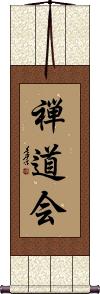
This is the martial arts title Zendokai.
The first two characters refer to Zen ascetic practices or Zen teachings. Noting that Zen or 禅 means meditation and Dou/Do or 道 means way.
Kai or 会 (originally written 會) in this context means society, association, or club.
Zendokai Karate beyond the normal fighting skills invites the practitioner to notice and observe their own body with mindfulness and self-awareness and can re-acquire and hone their genuine self.
Zen Understanding
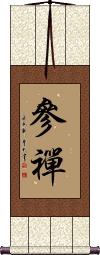
參禪 is a title that speaks of reaching an understanding (of Zen or the world). It also means “to practice meditation.” The two concepts lead you to the idea that meditation leads to understanding. 參禪 is pretty deep, so you can do your research or decide what this means for you.
This can also be defined in a more complex way as “thoroughly penetrating with meditative insight.”
Zen Buddhism
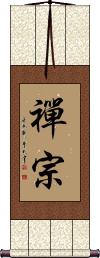
禪宗 is one way to title “Zen Buddhism.” Because the original pronunciation of Zen in Chinese is Chan, you'll also see this expressed as Chan Buddhism.
From the Buddhist Dictionary:
The Chan, meditative or intuitional, sect is usually said to have been established in China by Bodhidharma, the twenty-eighth patriarch, who brought the tradition of the Buddha-mind from India. This sect, believing in direct enlightenment, disregarded ritual and sūtras and depended upon the inner light and personal influence for the propagation of its tenets, founding itself on the esoteric tradition supposed to have been imparted to Kāśyapa by the Buddha, who indicated his meaning by plucking a flower without further explanation. Kāśyapa smiled in apprehension and is supposed to have passed on this mystic method to the patriarchs. The successor of Bodhidharma was 慧可 Huike, and he was succeeded by 僧璨 Sengcan, 道信 Daoxin, 弘忍 Hongren, 慧能 Huineng, and 神秀 Shenxiu, the sect dividing under the two latter into the southern and northern schools: the southern school became prominent, producing 南嶽 Nanyue and 靑原 Qingyuan, the former succeeded by 馬祖 Mazu, the latter by 石頭 Shitou. From Mazu's school arose the five later schools.
Dogen
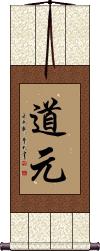
Usually, when people are looking for 道元 or “Dogen,” they are referring to the Japanese Zen monk by this name.
He lived from 1200-1253. This Dogen name or title literally means “The Way Origin” or “Beginning of the Path.” It is understood to mean “beginning of right doctrine or faith” in the context of his name and work to establish the Sōtō school of Zen in Japan.
To accomplish that task, this humble monk traveled from Japan and across China to find the more original or pure forms of Buddhism.
The Great Path has No Gate
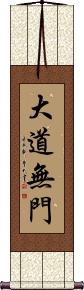
大道無門 is a Buddhist proverb that means “The Great Way has no entrance,” “The Great Way is gateless,” or “The Great Path lacks a gate.”
This can be translated in many other ways.
This concept was authored within a long sacred text by 無門慧開 (known as Wúmén Huìkāi in Chinese or Mumon Ekai in Japanese). He was a Chinese Chan Master (in Japanese, a Zen Master) who lived between 1183 and 1260 AD. His most famous work was a 48-koan collection titled “The Gateless Barrier” or “The Gateless Gate” (無門關 Wú Mén Guān in Chinese, or 無門関 Mu Mon Kan in Japanese). This calligraphy title is a notable line from this collection.
I like this reference to the source of this proverb: The Gateless Gate 無門關
Self Awareness Becomes a Buddha
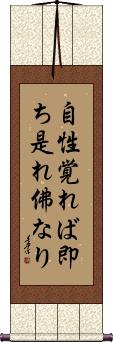
自性覚れば即ち是れ佛なり is a Zen quote that means “If one realizes one's own nature, one becomes a Buddha.”
The inference here is that if you understand who you really are, and become truly aware of yourself and your original nature, you are well on your way to becoming a liberated person (a Buddha).
Note: Because this selection contains some special Japanese Hiragana characters, it should be written by a Japanese calligrapher.
Light / Bright / Shine
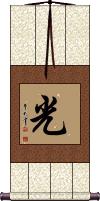
光 is the simplest way to express “light” in Chinese, Japanese Kanji, and old Korean Hanja.
It can also mean ray or bright. Chinese tend to use a two-character word for light/bright, so this character is probably best if your audience is Japanese. Also, when pronounced Rei, this can be a Japanese female given name.
In the Zen Buddhist context, this is the pure light that everyone possesses at their origin.
Bodhidharma
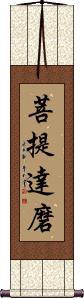
菩提達磨 is the title Bodhidharma in Chinese and Japanese.
Bodhidharma, commonly known as Damo, is reputed as the founder of the Chan (Zen) or Intuitional or Mystic School.
He likely came from south India and spread Mahayana Buddhism throughout China (even meeting the Emperor) and his disciples likely spread this all the way to Korea, Japan, and beyond in the 5th and 6th centuries.
Sometimes the last character varies in Chinese to 摩 instead of 磨 - let me know if you need a certain variation when you order.
Zheng / Tei / Jeong / Trinh
Chinese Japanese Korean Vietnamese Surname
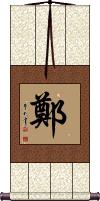
鄭 is the Chinese surname Zheng, Japanese surname Tei, Korean surname Jeong, and Vietnamese surname Trịnh.
This can also refer to the state of Zheng during the Warring States period of China.
In Korea, this can be the original way to write the surname Jeong in the old days (now it's 정 in modern Korea). Can also romanize from Korean as Chung or Jung.
In Japanese, this is the surname Tei. But can romanize as the following Japanese names/surnames: Ti; Te; Tsun; Dziyon; Chiyon; Chon; Chou; Chun; Chuu; Chien; Zen; Jiyon; Jon; Jou; Jun.
In Vietnamese, this is the name Trịnh from the time before Vietnam romanized the language.
No Mind / Mushin
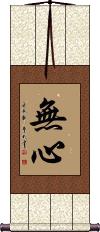
In Japanese, 無心 means innocent or without knowledge of good and evil. It literally means “without mind.”
無心 is one of the five spirits of the warrior (budo) and is often used as a Japanese martial arts tenet. Under that context, places such as the Budo Dojo define it this way: “No mind, a mind without ego. A mind like a mirror which reflects and dos not judge.” The original term was “mushin no shin,” meaning “mind of no mind.” It is a state of mind without fear, anger, or anxiety. Mushin is often described by the phrase “Mizu no Kokoro,” which means “mind like water.” The phrase is a metaphor describing the pond that clearly reflects its surroundings when calm but whose images are obscured once a pebble is dropped into its waters.
This has a good meaning in conjunction with Chan / Zen Buddhism in Japan. However, out of that context, it means mindlessness or absent-mindedness. To non-Buddhists in China, this is associated with doing something without thinking.
In Korean, this usually means indifference.
Use caution and know your audience before ordering this selection.
More info: Wikipedia: Mushin
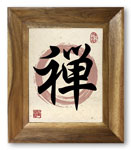
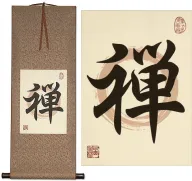
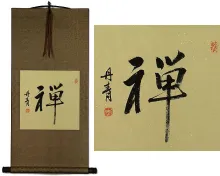
This in-stock artwork might be what you are looking for, and ships right away...

Gallery Price: $200.00
Your Price: $98.88

Gallery Price: $31.00
Your Price: $16.88
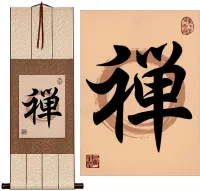
Gallery Price: $90.00
Your Price: $49.88
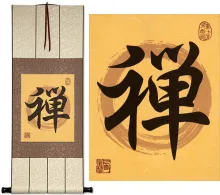
Gallery Price: $106.00
Your Price: $58.88
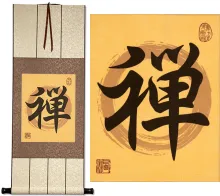
Gallery Price: $106.00
Your Price: $58.88

Gallery Price: $200.00
Your Price: $98.88

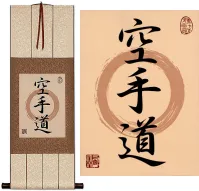
Gallery Price: $90.00
Your Price: $49.88

Gallery Price: $150.00
Your Price: $88.88


Gallery Price: $106.00
Your Price: $58.88
The following table may be helpful for those studying Chinese or Japanese...
| Title | Characters | Romaji (Romanized Japanese) | Various forms of Romanized Chinese | |
| Zendo The Zen Way | 禅道 / 禪道 禅道 | zen dou / zendou / zen do | chán dào / chan2 dao4 / chan dao / chandao | ch`an tao / chantao / chan tao |
| Appreciation of Truth by Meditation | 心印 | shin nin / shinnin | xīn yìn / xin1 yin4 / xin yin / xinyin | hsin yin / hsinyin |
| Zen Do Kai Zendokai | 禅道会 | zen dou kai zendoukai zen do kai | ||
| Zen Understanding | 參禪 参禅 | cān chán / can1 chan2 / can chan / canchan | ts`an ch`an / tsanchan / tsan chan | |
| Zen Buddhism | 禪宗 禅宗 | zen shuu / zenshuu / zen shu | chán zōng chan2 zong1 chan zong chanzong | ch`an tsung chantsung chan tsung |
| Dogen | 道元 | dou gen / dougen / do gen | dào yuán / dao4 yuan2 / dao yuan / daoyuan | tao yüan / taoyüan |
| The Great Path has No Gate | 大道無門 大道无门 | dai dou mu mon daidoumumon dai do mu mon | dà dào wú mén da4 dao4 wu2 men2 da dao wu men dadaowumen | ta tao wu men tataowumen |
| Self Awareness Becomes a Buddha | 自性覚れば即ち是れ佛なり | Jishou satore ba sunawachi kore butsu nari Jisho satore ba sunawachi kore butsu nari | ||
| Light Bright Shine | 光 | hikari | guāng / guang1 / guang | kuang |
| Bodhidharma | 菩提達磨 菩提达磨 | bodai daruma bodaidaruma | pú tí dá mó pu2 ti2 da2 mo2 pu ti da mo putidamo | p`u t`i ta mo putitamo pu ti ta mo |
| Zheng Tei Jeong Trinh | 鄭 郑 | tei | zhèng / zheng4 / zheng | cheng |
| No Mind Mushin | 無心 无心 | mu shin / mushin | wú xīn / wu2 xin1 / wu xin / wuxin | wu hsin / wuhsin |
| In some entries above you will see that characters have different versions above and below a line. In these cases, the characters above the line are Traditional Chinese, while the ones below are Simplified Chinese. | ||||

Successful Chinese Character and Japanese Kanji calligraphy searches within the last few hours...



