There are thousands of
Buddhist terms and titles.
If what you want is not
here, please contact me,
and I'll help you get what
you need.
Chinese & Japanese Buddhism Calligraphy Wall Scrolls
You can choose from many custom options to create artwork with Buddhism characters on a wall scroll or portrait/
Start by clicking on a "Customize & Buy" button below...
Switched to secondary search mode due to lack of results using primary.
These secondary results may not be very accurate. Try a different but similar meaning word or phrase for better results. Or:
Look up in my Japanese Kanji & Chinese Character Dictionary(My dictionary is a different system then the calligraphy search you just tried)
If you want a special phrase, word, title, name, or proverb, feel free to contact me, and I will translate your custom calligraphy idea for you.
4. Kenpo / Kempo / Quan Fa / Chuan Fa
5. 7. Right Mindfulness / Right Memory / Perfect Mindfulness
6. Uechi-Ryu
9. Heart Sutra
10. All Tenets of the Noble Eightfold Path
12. Bodhi - Awakening Enlightenment
14. Impermanence
16. Mindfulness
17. Appreciation of Truth by Meditation
18. Mind Like Water
19. Triple Truth of Japanese Buddhism
20. Mercy / Compassion / Buddhist Loving Kindness
22. 4. Right Action / Perfect Conduct
23. Kensho - Initial Enlightenment
24. Ken Zen Ichi Nyo
27. Purified Spirit / Enlightened Attitude
28. Shaolin Temple
30. 2. Right Resolve / Right Thought / Right Intention / Perfect Resolve
31. Diligence
34. Peaceful Heart / Peace of Mind / Calm Mind
36. True Emptiness Yields Transcendent Existence
37. Shugyo
38. Bodhisattva
39. Dharma / The Law
40. Dojo / Martial Arts Studio
41. Sky / Ether / Void / Emptiness / Unreality
42. Inner Bliss and Peace from Meditation
43. Karma
44. Live In The Moment / Live In The Now
45. Namu Amida Butsu
46. One Heart / One Mind / Heart and Soul
47. Truth Flashed Through The Mind
49. 6. Right Effort / Right Endeavor / Perfect Effort
50. Buddha Heart / Mind of Buddha
51. Confidence / Faithful Heart
52. Fate / Opportunity / Chance
53. Four Noble Truths: Suffering
54. Free Will
55. Goddess of Mercy and Compassion
56. Doing good is the greatest source of happiness
57. Guan Shi Yin: Protector Of Life
58. Intuitive Wisdom / Inner Light
60. Meditation
61. The Middle Way
62. Musashi
63. Nothingness
64. Reach Peace and Calm Through Meditation
66. Selflessness
68. Shaolin Chuan / Shao Lin Quan
71. 1. Right Understanding / Right Perspective / Right View / Perfect View
72. 3. Right Speech / Right Talk / Perfect Speech
73. 5. Right Living / Right Livelihood / Perfect Livelihood
74. 8. Right Concentration / Perfect Concentration
75. Akemi
76. Avatar
77. Awareness
79. Bodhidharma
82. Happy Buddha
83. Seeing one’s Nature and becoming a Buddha
84. Buddhism
85. The Buddha is in Each Sentient Being
87. Dana: Almsgiving and Generosity
89. Dragon Spirit
90. Amitabha Buddha
92. Four Elements
93. Four Noble Truths: Desire and Attachment
94. Four Noble Truths: Elimination of Desire or Attachment
95. Gaman
97. Lucky / Auspicious / Good Omen
99. Kensho Jobutsu - Enlightenment - Path to Buddha
100. Kodokan
No Mind / Mushin
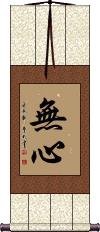
In Japanese, 無心 means innocent or without knowledge of good and evil. It literally means “without mind.”
無心 is one of the five spirits of the warrior (budo) and is often used as a Japanese martial arts tenet. Under that context, places such as the Budo Dojo define it this way: “No mind, a mind without ego. A mind like a mirror which reflects and dos not judge.” The original term was “mushin no shin,” meaning “mind of no mind.” It is a state of mind without fear, anger, or anxiety. Mushin is often described by the phrase “Mizu no Kokoro,” which means “mind like water.” The phrase is a metaphor describing the pond that clearly reflects its surroundings when calm but whose images are obscured once a pebble is dropped into its waters.
This has a good meaning in conjunction with Chan / Zen Buddhism in Japan. However, out of that context, it means mindlessness or absent-mindedness. To non-Buddhists in China, this is associated with doing something without thinking.
In Korean, this usually means indifference.
Use caution and know your audience before ordering this selection.
More info: Wikipedia: Mushin
Believe / Faith / Trust
śraddhā
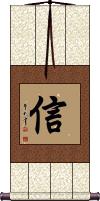
信 can mean to believe, truth, faith, fidelity, sincerity, trust, and confidence in Chinese, old Korean Hanja, and Japanese Kanji.
This single character is often part of other words with similar meanings.
It is one of the five basic tenets of Confucius.
In Chinese, it sometimes has the secondary meaning of a letter (as in the mail) depending on context but it will not be read that way when seen on a wall scroll.
In the Buddhist context, this is śraddhā (faith through hearing or being taught).
See Also: Faith | Trust Your Heart | Confucius
Zen / Chan / Meditation
...as in Zen Buddhism
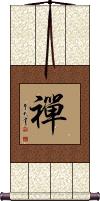
First, let's correct something: The Japanese romanization for this character, “Zen” has penetrated the English language. In English, it's almost always incorrectly used for phrases like “That's so zen.” Nobody says, “That's so meditation” - right? As the title of a sect, this would be like saying, “That's so Baptist!”
禪 by itself just means “meditation.” In that context, it should not be confined to use by any one religion or sect.
Regardless of the dictionary definition, more often than not, this character is associated with Buddhism. And here is one of the main reasons:
Zen is used as the title of a branch of Mahayana Buddhism, which strongly emphasizes meditation practice.
However, it should be noted that Buddhism came from India, and “Chan Buddhism” evolved and developed in medieval China. The Chinese character “Chan” was eventually pronounced as “Zen” in Japanese. Chan Buddhists in China have much in common with Zen Buddhists in Japan.
More about the history of Zen Buddhism here.
Please also note that the Japanese Kanji character for Zen has evolved a little in Japan, and the two boxes (kou) that you see at the top of the right side of the character have been replaced by three dots with tails.
 The original character would still be generally understood and recognized in Japanese (it's considered an ancient version in Japan) but if you want the specifically modern Japanese version, please click on the zen Kanji to the right. Technically, there is no difference between the Tensho and Reisho versions of Zen since they are ancient character styles that existed long before Japan had a written language.
 There is also an alternate/shorthand/simplified Chinese version, which has two dots or tails above the right-side radical. This version is also popular for calligraphy in China. If you want this version, just click the character to the right.
Further notes: Zen is just one of seven sects of Buddhism practiced in Japan. The others are 律 Ritsu (or Risshū), 法相 Hossō, 論 Sanron 華嚴 Kegon, 天台 Tendai, and 眞言 Shingon.
Kenpo / Kempo / Quan Fa / Chuan Fa
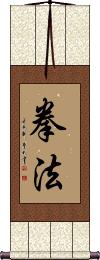
拳法 is a form of martial arts that can be translated in several ways.
Some will call it “fist principles,” “the way of the fist,” or even “law of the fist.” The first character literally means fist. The second can mean law, method, way, principle, or Buddhist teaching.
Kempo is really a potluck of martial arts. Often a combination of Chinese martial arts such as Shaolin Kung Fu with Japanese martial arts such as Karate, Jujutsu (Jujitsu), Aikido, and others. You may see the term “Kempo Karate,” which essentially means Karate with other disciplines added. In this way, Kempo becomes an adjective rather than a title or school of martial arts.
These facts will long be argued by various masters and students of Kempo. Even the argument as to whether it should be spelled “kenpo” or “Kempo” ensues at dojos around the world (the correct Romaji should actually be “kenpou” if you precisely follow the rules).
The benefit of Kempo is that the techniques are easier to learn and master than pure Kung Fu (wu shu). Students are often taught basic Karate moves, kicks, and punches before augmenting the basic skills with complex Kung Fu techniques. This allows students of Kempo to achieve a level where they can defend themselves or fight in a relatively short amount of time (a few years rather than a decade or more).
Because the definition of this word is so fluid, I should make some notes here:
1. Purists in Okinawa will claim that “Okinawa Kenpo” or “Ryukyu Hon Kenpo” is the original and true version of this martial art from the old kingdom. It is actually little or no connection between Okinawa Kenpo and the way the word is used elsewhere.
2. In Chinese, where these characters are pronounced “quan fa” (sometimes Romanized as “chuan fa” because the Chinese-pinyin “q” actually sounds like an English “ch” sound), these characters do not hold the connotation of being a mixed martial art. It is simply defined as “the law of the fist.”
3. My Japanese dictionary oddly defines Kenpo as the “Chinese art of self-defense.” I personally don't feel this is the most common way that people perceive the word but just something you should know.
7. Right Mindfulness / Right Memory / Perfect Mindfulness
Samyak Smriti / Samyak Smrti / Samma Sati
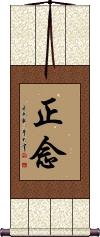
正念 is one of the Noble Eightfold Paths of Buddhism. Right Mindfulness, along with Right Effort and Right Concentration, constitute the path to Concentration or Perfect Thought.
Right Mindfulness is about remaining focused on one's body, feelings, mind, and mental qualities. It's also about being ardent, aware, and mindful, and supposes that you've already put aside worldly desire and aversion.
Monk Bhikkhu Bodhi described this as “The mind is deliberately kept at the level of bare attention, a detached observation of what is happening within us and around us in the present moment.” When practicing right mindfulness, the mind is trained to remain in the present, open, quiet, and alert, contemplating the present event.
Another definition: Ongoing mindfulness of body, feelings, thinking, and objects of thought.
This term is exclusively used by devout Buddhists. It is not a common term, and remains an unknown concept to most Japanese and Chinese people.
See Also: Enlightenment | Noble Eightfold Path
Uechi-Ryu
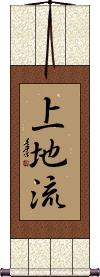
上地流 or Uechi-Ryū is the short name for a traditional style of Okinawan karate.
Uechi-Ryū is named after its creator, Kanbun Uechi. Uechi was an Okinawan man who left at the age of 19 for China to study Chinese martial arts and medicine.
The meaning of this title is “Uechi Flow,” “Uechi Style,” or “Uechi School.” Although, the name 上地 or Uechi can mean “higher stages of practice” in the Buddhist context. Therefore, you can stretch the meaning to be “Higher-Stages-of-Practice Style.”
Mercy / Compassion / Love
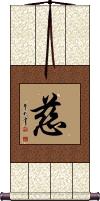
慈 is the simplest way to express the idea of compassion.
This can also mean love for your fellow humans, humanity, or living creatures. Sometimes this is extended to mean charity.
This term is often used in a Buddhist or Christian context. The concept was also spoken of by Laozi (Lao Tzu) in the Dao De Jing (Tao Te Ching).
慈 is considered the direct translation of the Sanskrit word मैत्री (maitrī) Pali word मेत्ता (mettā). In this context, it means benevolence, loving kindness, and goodwill.
This Chinese character is understood in Japanese but is usually used in compound words (not seen alone). Also used in old Korean Hanja, so it's very universal.
See Also: No Mercy | Benevolence | Forgiveness | Kindness
Namo Amitabha Buddha
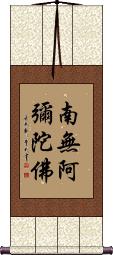
南無阿彌陀佛 is how to express “The Compassionate Amitabha Buddha” (especially for the Pure Land Buddhist Sect).
Some will translate as “Homage to Amitâbha Buddha” or “I seek refuge in the Amitâbha Buddha.”
This is valid in Chinese characters, Japanese Kanji, and old Korean Hanja.
Sometimes modern Japanese use a different version of the 4th and last Kanji, but the version shown here is the most universal.
This is used to pay homage to Amitabha Buddha.
See Also: Bodhisattva | Nirvana
Heart Sutra
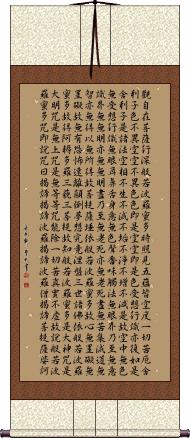
This is the Heart Sutra in Chinese as translated by Xuanzang.
The Heart Sutra is often cited as the best-known and most popular of all Buddhist scriptures.
Notes: There are too many characters for this to be done by the economy calligrapher. You must choose a Master Calligrapher.
With this many characters, and the fact that one tiny mistake wipes out hours of work, keep in mind that writing the Heart Sutra is usually a full day of work for a calligrapher. This work and personal energy should be cherished and respected. In other words, the calligrapher is not charging enough money for the value that you are getting here.
Also, you will find that as my server processes 260 characters, the customization process is a bit slow for this title.
All Tenets of the Noble Eightfold Path
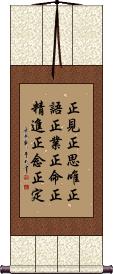
These are the eight tenets of the Buddhist Noble Eightfold Path written altogether.
Here's this list of tenets in English:
1. Right View / Right Understanding / Right Perspective / Perfect View
2. Right Resolve / Right Thought / Right Intention / Perfect Resolve
3. Right Speech / Right Talk / Perfect Speech
4. Right Action / Perfect Conduct
5. Right Living / Right Livelihood / Perfect Livelihood
6. Right Effort / Right Endeavor / Perfect Effort
7. Right Mindfulness / Right Memory / Perfect Mindfulness
8. Right Concentration / Perfect Concentration
Five Ancestors Fist
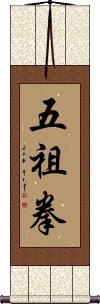
五祖拳 is a martial arts concept (or school) known as Five Ancestors' Fist.
The first character means five.
The second means ancestor, forefather, or grandparents.
The third means fist.
The ancestors referred to by this title and whose attributes contribute to this style are as follows:
1. Grace of the White Crane.
2. Agility of the Monkey.
3. Precision and skill of Emperor Taizu (great mythical ancestor).
4. Power of Luohan (Buddhist arhat).
5. Breath of Damo (founder of Buddhism, or the first Buddha).
Bodhi - Awakening Enlightenment
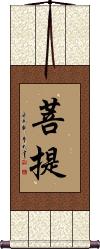
The Bodhi or 菩提 is the moment of completion in Buddhism.
It is when all things become known and you have completed your journey to enlightenment.
The reference is to the Bodhi tree where Siddhartha Gautama (the legendary man who established the Buddhist religion) achieved enlightenment. Sometimes this is referred to as “the tree of enlightenment,” but if you want the full version with the character for a tree at the end, please see the Bodhi Tree entry.
See Also: True Religion / Buddha Truth | Nirvana | Enlightenment
Buddha / Buddhism
Hotoke
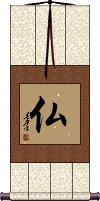
仏 is the single Japanese Kanji that can mean Buddha or Buddhism.
This Kanji was a shorthand way to write 佛 (Buddha) in Chinese (popular around the 13th century). Somehow, this became the version of this Chinese character that was absorbed into Japanese and thus became part of standard Kanji. Centuries later, this character is not recognized in China (except for those from China with a background in Chinese literature or language).
仏 is also a rare or derivative Korean Hanja form - but I doubt you will find any Korean that knows that.
Impermanence
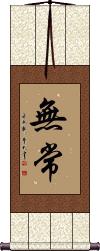
無常 is the state of being “not permanent,” “not enduring,” transitory, or evolving.
It can also mean variable or changeable. In some contexts, it can refer to a ghost that is supposed to take a soul upon death. Following that, this term can also mean to pass away or die.
In the Buddhist context, this is a reminder that everything in this world is ever-changing, and all circumstances of your life are temporary.
If you take the Buddhist philosophy further, none of these circumstances are real, and your existence is an illusion. Thus, the idea of the eternal soul is perhaps just your attachment to your ego. Once you release your attachment to all impermanent things, you will be on your way to enlightenment and Buddhahood.
Language notes for this word when used outside the context of Buddhism:
In Korean Hanja, this means uncertainty, transiency, mutability, or evanescent.
In Japanese, the definition orbits closer to the state of being uncertain.
Buddhism / Buddha
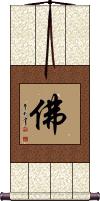
佛 is the essence of the Buddha or Buddhism.
Depending on the context, this word and character can be used to refer to the religion and lifestyle of Buddhism, or in some cases, the Buddha himself.
It is interesting to note that this word is separate from all others in the Chinese language. The sound of “fo” has only this meaning. 佛 is in contrast to many sounds in the Chinese language, which can have one of four tones, and more than 20 possible characters and meanings. This language anomaly shows how significantly Buddhism has affected China since ancient times.
More about Buddhism
佛 is also used with the same meaning in Korean Hanja.
It's used in the very religious context of Buddhism in Japan. It should be noted that there are two forms of this Kanji in use in Japan - this is the more formal/ancient version, but it's rarely seen outside of religious artwork and may not be recognized by all Japanese people.
It also acts as a suffix or first syllable for many Buddhist-related words in Chinese, Japanese, and Korean.
See our Buddhism & Zen page
See Also: Bodhisattva | Enlightenment
Mindfulness
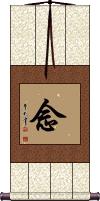
念 is the simplest way to write “mindfulness” in Chinese, Japanese Kanji, and old Korean Hanja.
念 can be defined these ways: To read; to study (a degree course); to read aloud; to miss somebody (keeping them in your mind); idea; remembrance; sense; thought; feeling; desire; concern; attention; recollection; memory; to think on/about; reflect; repeat, intone; a moment.
Obviously, the context in which the character is used determines which definition or meaning is perceived. As a single character, it's open and perhaps ambiguous. Thus, it can be read with any or all of these meanings.
念 is used in a Buddhist context (often written as 正念 or “right mindfulness”) with similar meanings of thought and contemplation.
In Japanese, this character is sometimes used as the name “Nen.”
See Also: Enlightenment
Appreciation of Truth by Meditation
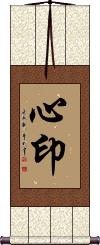
心印 is a Buddhist concept that simply stated is “appreciation of truth by meditation.”
It's a deep subject, but my understanding is that you can find truth through meditation, and once you've found the truth, you can learn to appreciate it more through further meditation. This title is not commonly used outside of the Buddhist community (your Asian friends may or may not understand it). The literal translation would be something like “the mind seal,” I've seen this term translated this way from Japanese Buddhist poetry. But apparently, the seal that is stamped deep in your mind is the truth. You just have to meditate to find it.
Soothill defines it this way: Mental impression, intuitive certainty; the mind is the Buddha-mind in all, which can seal or assure the truth; the term indicates the intuitive method of the Chan (Zen) school, which was independent of the spoken or written word.
Reference: Soothill-Hodous Dictionary of Chinese Buddhism
See Also: Zenmai / Royal Fern
Mind Like Water
Mizu No Kokoro
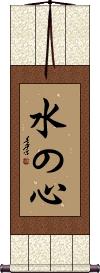
水の心 is the Japanese Buddhist and martial arts phrase, “Mizu no Kokoro,” which means “mind like water” or “heart of water.”
The phrase is a metaphor describing the pond that clearly reflects its surroundings when calm but whose images are obscured once a pebble is dropped into its waters.
Triple Truth of Japanese Buddhism

人間性を再生するのは寛容な心親切な言葉奉仕と思いやりの精神 is known as the Triple Truth of Buddhism in Japanese.
The Buddha ordered that all should know this triple truth...
A generous heart, kind speech, and a life of service and compassion are the things that renew humanity.
That is the English translation most commonly used for this Japanese Buddhist phrase. You might have seen this on a coffee cup or tee shirt.
Note: Because this selection contains some special Japanese Hiragana characters, it should be written by a Japanese calligrapher.
Mercy / Compassion / Buddhist Loving Kindness
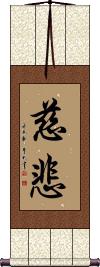
Besides the title above, 慈悲 can also be defined as clemency or lenience and sometimes the act of giving charity.
In the Buddhist context, it can mean “benevolence,” “loving-kindness and compassion,” or “mercy and compassion.”
This Buddhist virtue is perhaps the most important to employ in your life. All sentient beings that you encounter should be given your loving kindness. And trust me, however much you can give, it comes back. Make your life and the world a better place!
This Chinese/Japanese Buddhist term is the equivalent of Metta Karuna from Pali or Maitri Karuna from Sanskrit.
慈 can mean loving-kindness by itself.
悲 adds a component of sorrow, empathy, compassion, and sympathy for others.
See Also: Benevolence
Sit in Meditation
Zazen
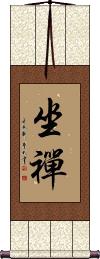
坐禪 describes the act of sitting in a state of deep meditation.
You'll notice that the second character is Chan/Zen (often used to title the meditative form of Buddhism).
In Korean Hanja, this means “religious meditation” (roughly the same as the Chinese definition).
Buddhists may define this as sitting in dhyāna, abstract meditation, fixed abstraction, or contemplation.
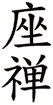 Japanese note: This will make sense in Japanese but the Kanji shown to the left are partially in ancient/traditional Japanese form. Japanese Buddhists may use 坐禪, 坐禅, 座禪, or 座禅. The most standard/modern Japanese form of this word is shown to the right. Click on the Kanji to the right (instead of the button above) if you want this specifically Japanese version.
4. Right Action / Perfect Conduct
Samyak Karmanta / Samma Kammanta
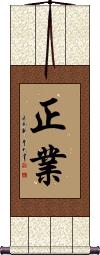
正業 is one of the Noble Eightfold Paths of Buddhism. Right Action, along with Right Speech and Right Living, constitute the path to Virtue.
The five precepts of Right Action are...
1. Refrain from destroying living beings (no murder or any form of taking a life).
2. Refrain from stealing.
3. Refrain from sexual misconduct (adultery, rape, etc.).
4. Refrain from false speech (lying or trickery).
5. Refrain from intoxicants that lead to heedlessness (no drugs or alcohol).
This concept can be summarized as “Avoidance of actions that conflict with moral discipline.”
Note: In Japanese, when read by a non-Buddhist, this will mean “the right job/vocation.”
This term is exclusively used by devout Buddhists. It is not a common term, and remains an unknown concept to most Japanese and Chinese people.
See Also: Enlightenment | Noble Eightfold Path
Kensho - Initial Enlightenment
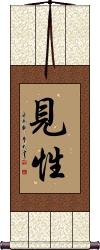
見性 has the same meaning as Satori but refers to the initial state or initial experience of enlightenment.
This can also mean “self-discovery,” “self-awareness,” or “consciousness of one's character.”
In a very religious context, this means to behold the Buddha nature within oneself.
This term is exclusively used by devout Buddhists. It is not a common term, and remains an unknown concept to most Japanese and Chinese people. Some Japanese people will dispute whether this title is valid in the Japanese language. Only order this if you are sure this title is right for you.
See Also: Enlightenment
Ken Zen Ichi Nyo
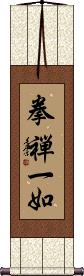
拳禪一如 is a Japanese phrase that is often translated as “train both body and spirit.”
Here's the breakdown of the words in this phrase:
拳 means fist.
禅 is zen, which means meditation.
一如 is a word that means “to be just like,” “oneness,” “true nature,” or “true character.”
So to get to the translation of “train both body and spirit,” you must understand that “fist” is representing “body” and the idea of meditation is representing “mind.”
I have to say, this is not how I would translate this. To me, it's really about training with your mind and remembering that meditation is a huge part of training, not just your fist. As the Shaolin Buddhist monks show us, meditation is just as important as physical training in martial arts.
Every day is a good day
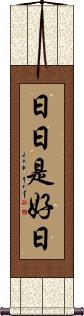
日日是好日 is an old Chinese and Japanese Buddhist proverb.
日日是好日 means “every day is a good day.”
In Japanese, it can be pronounced or romanized as “nichinichi kore koujitsu” or “hibi kore kōjitsu.”
The Noble Eightfold Path
Ashtangika Marga / Astangika-Marga / Atthangika Magga
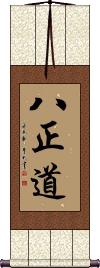
八正道 is a complex set of steps that Buddhists much take to cleanse karma, achieve enlightenment, eventually cease the cycle of rebirth and live in a state of Nirvana.
Note: This term is exclusively used by devout Buddhists. It is not a common term and remains an unknown concept to most Japanese and Chinese people. Sometimes written as 八聖道.
See Also: Enlightenment
Purified Spirit / Enlightened Attitude
A Japanese martial arts title/concept
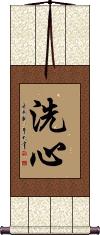
The first Kanji alone means to wash, bathe, primness, cleanse or purify.
The second Kanji means heart, mind, soul, or essence.
Together, these two Kanji create a word defined as “purified spirit” or “enlightened attitude” within Japanese martial arts.
洗心 is one of the five spirits of the warrior (budo) and is often used as a Japanese martial arts tenet. Under that context, it's often defined as a spirit that protects and harmonizes the universe. Senshin is a spirit of compassion that embraces and serves all humanity and whose function is to reconcile discord in the world. It holds all life to be sacred. It is the Buddha mind.
This title will only be familiar to Japanese who practice certain martial arts. Others may not recognize this word at all.
洗心 does not show up as a word in too many Chinese dictionaries, but it can be read and has the same meaning in Chinese.
 There is an issue with the first character. The original, and probably most correct version is shown above. However, many dojo documents and other sources have used a more simple first character. Arguments ensue about which version is correct. If you want to be correct in the Japanese language, use the “Select and Customize” button above. If you want to match the Kanji used by your dojo, click the Kanji shown to the right. There is a slightly different meaning with this first character which means before, ahead, previous, future, precedence.
Shaolin Temple
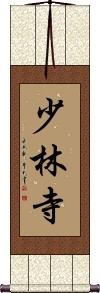
少林寺 is the full title of the Shaolin Temple.
This refers to the Buddhist monastery famous for its kung fu monks.
少林寺 is also known in Japanese, where they use the same characters but romanize them as Shourinji or Shōrinji.
Some believe this monastery and temple represent where Bodhidharma sat with his face to a wall for nine years, leading to his discovery of enlightenment and the establishment of Buddhism in China.
True / Real / Genuine
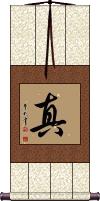
真 is a simple way to express the idea that something is real, true, truth, or genuine.
Occasionally, this character refers to a Buddhist sect that originated in the 13th century.
真 is commonly used as a compound with other characters to create ideas like “true love.” It's also used similarly to the English words “really” or “truly” to say “really good” or “He is really knowledgeable.” Those phrases start with “他真的是... (note the second character is 真).
There are two ways to write this character, shown here is the most common way in China; however, a slight stroke variation is used in Korean Hanja. If you want that version, just let us know when you place your order.
See Also: Honesty
2. Right Resolve / Right Thought / Right Intention / Perfect Resolve
Samyak Samkalpa / Samma Sankappa
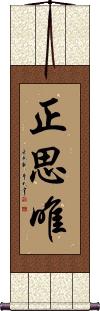
正思唯 is one of the Noble Eightfold Paths of Buddhism. Right Thought, along with the Right View, constitute the path to Wisdom.
In Buddhism, Right Thought, in simple terms, means to free yourself from having ill will towards anyone or anything. It also suggests that you remain harmless to other living creatures.
This can also be defined as “Resolve in favor of renunciation, goodwill, and non-harming of sentient beings.”
 There is an ancient/alternate version of the third character for this selection. You can see that alternation third character to the right. If you want your selection to use that older character, just click on the character to the right, instead of the button above.
Note: This term is exclusively used by devout Buddhists. It is not a common term, and remains an unknown concept to most Japanese and Chinese people.
See Also: Enlightenment | Noble Eightfold Path
Diligence
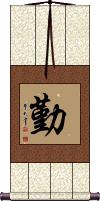
勤 is a single character that means diligence or “sense of duty” in Chinese and Korean (also understood in Japanese but not commonly seen as a stand-alone Kanji).
As a single character on a wall scroll, this will only be seen with this meaning. However, it can also mean industrious, hardworking, frequent, regular, constant, energy, zeal, fortitude, or virility.
In Buddhism, this can represent vīrya (viriya), the idea of energy, diligence, enthusiasm, or effort. It can mean an attitude of gladly engaging in wholesome activities, and it functions to cause one to accomplish wholesome or virtuous actions. Some Buddhists may even define this as “manliness” (a definition from a hundred years ago, before equality).
If you or someone you know is a hard worker (or needs a reminder to be diligent), then this is the wall scroll to have in your/their office.
See Also: Tenacious / Tenacity | Carry On | Undaunted
Four Noble Truths (Buddhism)
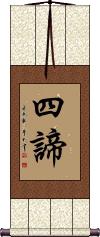
四諦 is the title of the Four Noble Truths as taught in virtually all sects of Buddhism.
These truths are suffering (dukkha), desire/attachment (samudaya), release from desire/attachment (nirodha), and the path leading away from suffering (magga).
The suggestion behind these truths is that all things in nature suffer. All things in nature have desire and attachment for things in the physical world. The enlightened can release themselves from the bonds of desire and attachment. And finally, once they release all desire and attachment, the enlightened will find a path that leads away from suffering.
This term is exclusively used by devout Buddhists. It is not a common term, and remains an unknown concept to most Japanese, Chinese, and Korean people.
See Also: Enlightenment
Four Noble Truths (Full List)
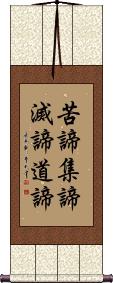
苦諦集諦滅諦道諦 is the list of tenets of the Four Noble Truths as taught in virtually all sects of Buddhism.
They are suffering (dukkha), desire/attachment (samudaya), release from desire/attachment (nirodha), and the path leading away from suffering (magga).
Karma - Cause and Effect
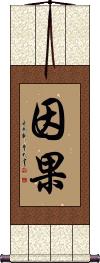
因果 is a label that is used inside and outside of the Buddhist faith to speak of Karma.
Along with the meaning of Karma, this word can mean “retribution” or “chain of cause and effect.”
Peaceful Heart / Peace of Mind / Calm Mind
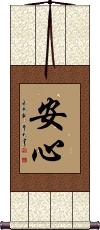
安心 can mean relief, peace of mind, feeling at ease, to be relieved, to set one's mind at rest, and easiness.
安心 is a nice word that encompasses great meanings within just two characters. Some of the other meanings include pacifying, settling the mind, and peace of mind. It's also the idea of feeling a sense of security, safety, and confidence in your state of well-being.
This can be used by everyone, but some consider it to be a Buddhist concept (You'll find it in your Zen dictionary).
Note: Can be romanized as Anshin or Anjin in Japanese.
Shiken Haramitsu Daikomyo
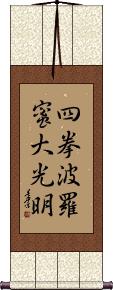
四拳波羅蜜大光明 is “shiken haramitsu daikōmyō,” a famous Japanese Buddhist mantra.
四拳 = shi-ken = four fists (many translate this as “four hearts”).
波羅蜜 = ha-ra-mitsu = A loanword representing pāramitā, or entrance into Nirvana. Awkwardly, it also means jackfruit.
大光明 = dai-kou-myo = big/great light bright (great bright light).
Shiken represents four hearts:
1. The Merciful Heart - Love and caring for all living things.
2. The Sincere Heart - Pursues righteousness, or the right path - sincerely trying to do what is right.
3. The Attuned Heart - Knows that nature and fate have their ways, and thus stay in tune with the universe.
4. The Dedicated Heart - Steadfast on the chosen path to the end.
True Emptiness Yields Transcendent Existence
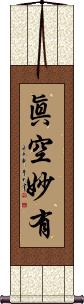
According to Soothill 眞空妙有 means:
The true void is the mysteriously existing, truly void, or immaterial, yet transcendentally existing.
眞空妙有 is the state of being nonexistent after removing all errant worldly influences. 眞空妙有 is achieved when all forms of existence are seen for their real nature.
Shugyo
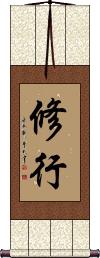
修行 is shugyō or shugyou in Japanese. It refers to ascetic practices, training, practice, discipline, and study.
修行 is also a word in the original Chinese, referring more to religious studies and practices.
In the Buddhist context, this represents caryā. In Buddhism, this relates to one's conduct, observing and doing, cultivating oneself in the right practice, and/or being pious.
Bodhisattva
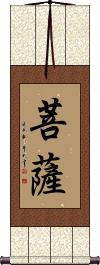
菩薩 is the title of a Buddhist deity that exists to help you reach enlightenment.
In Buddhist beliefs, a bodhisattva (bodhisatta) is dedicated to helping us achieve enlightenment. Bodhisattva means enlightenment truth which is bodhi sattva in Sanskrit.
This term is sometimes used to refer to a kindhearted person, one who will sacrifice himself/herself for others and lacks ego or desire but is instead devoted to the good and well-being of others.
See Also: True Religion / Buddha Truth | Namo Amitabha Buddha
Dharma / The Law
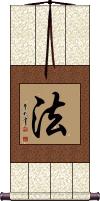
法 is the simple way to write “law” or in a Buddhist context “Dharma.”
This can also mean method, way, or Buddhist teaching. It's also an abbreviation for the country of France.
The Buddhist context exists in Chinese and Korean Hanja but I have not yet confirmed that this means more than “law” when used alone in Japanese.
Dojo / Martial Arts Studio
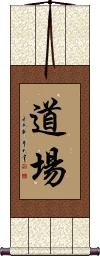
道場 is the Japanese term for a room or hall in which martial arts are taught.
道場 is often spelled “dojo” which has become a word in the English lexicon. However, the true Romaji is doujou or dōjō.
Please note: The Chinese definition of these characters is quite different. In Chinese, this is a place where Buddhist or Taoist mass is held. It could also be a place where spiritual or psychic events are performed.
Sky / Ether / Void / Emptiness / Unreality
(Used in Japanese version of five elements)
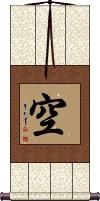
空 is a single character that means empty, void, hollow, vacant, vacuum, blank, nonexistent, vacuity, voidness, emptiness, non-existence, immateriality, unreality, the false or illusory nature of all existence, and being unreal.
In the Buddhist context, this relates to the doctrine that all phenomena and the ego have no reality but are composed of a certain number of skandhas or elements, which disintegrate. The void, the sky, space. The universal, the absolute, complete abstraction without relativity. The doctrine further explains that all things are compounds, or unstable organisms, possessing no self-essence, i.e. are dependent, or caused, come into existence only to perish. The underlying reality, the principle of eternal relativity, or non-infinity, i.e. śūnya, permeates all phenomena making possible their evolution.
From Sanskrit and/or Pali, this is the translation to Chinese and Japanese of the title śūnya or śūnyatā.
In Japanese, when pronounced as “ron” (sounds like “roan”) this can be a given name. It should be noted that this Kanji has about 5 different possible pronunciations in Japanese: kuu, kara, sora, ron, and uro. 空 is also an element in the Japanese version of the five elements.
Inner Bliss and Peace from Meditation
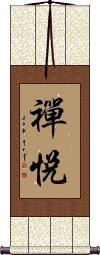
禪悅 is a title that refers to the inner bliss and peace you can achieve from meditation.
This term transcends a few religions, including Taoism and Buddhism. It can also be translated as “joy of the mystic trance” or simply “meditative bliss.”
Amazing that such a complex idea can be expressed in just two Chinese characters. Note that the first character is Chan/Zen (Chinese/Japanese), which means “meditation” in both languages.
Karma
Single character for Buddhist Karma
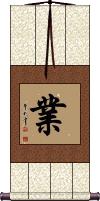
This is the simplest way to express the idea of Karma. This is the Buddhist concept of actions committed in a former life affecting the present and future.
Out of the context of Buddhism, this Karma character means one's profession in life, trade, occupation, business, study, or career.
The Karma definition applies to both Chinese and Japanese for this character. This also works as Korean Hanja as Karma; although the meaning can vary depending on context (my Korean dictionary gives the definition of profession/occupation).
Live In The Moment / Live In The Now
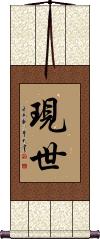
現世 is a very short way to write “live in the moment” or “live in the now” in Japanese.
This short word is open to interpretation. It's used in Japanese Buddhism to mean “the current epoch” or “the current age” (the current age is but a brief moment in the greater scope of existence). In that context, this is pronounced “utsushiyo” or “ustusiyo” in Japanese. Otherwise, it's pronounced “gensei” in Japanese.
Other translation possibilities include:
Earthly world
This world
This life
Present life
Present generation
Present incarnation
This existence
This (momentary) reality
Note: This is also a word in Chinese and old Korean Hanja. While the meaning is more or less the same, this is not recommended for a wall scroll if your audience is Chinese or Korean. This selection is best if your audience is Japanese.
Namu Amida Butsu
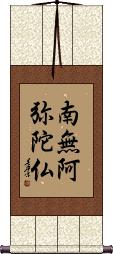
南無阿弥陀仏 is the modern Japanese version of “Namu Amida Butsu” or “The Compassionate Amitabha Buddha.”
Some will translate this as “I sincerely believe in Amitabha; Lord have mercy on me.”
This phrase especially applies to Japanese Pure Land Buddhists.
There is a universal version using ancient characters (with more strokes) for the 4th and last characters. That version is also used in Chinese, Korean, and occasionally Vietnamese.
This is used to pay homage to Amitabha Buddha.
See Also: Bodhisattva | Nirvana
One Heart / One Mind / Heart and Soul
Isshin
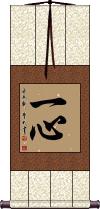
一心 can mean “one mind,” “single-minded focus,” or “wholehearted devotion,” from Chinese, Japanese Kanji, and old Korean Hanja.
Colloquially or figuratively, it means: wholeheartedly; heart and soul; of one mind; single-mindedness, wholeheartedness; one's whole heart; with the whole mind or heart; one mind in heart.
I'm not kidding, all of those came right from the dictionary for this one title.
In martial arts usage, this term emphasizes total commitment, where intent, attention, and action are unified without distraction.
In Japanese budō, it often conveys wholehearted dedication to practice or principle, whereas in Chinese usage it tends toward inner mental cultivation.
In Buddhism, this can refer to the bhūtatathatā, or the whole of things; the universe as one mind, or a spiritual unity.
In Japanese, this can be the female given name, Hitomi.
Truth Flashed Through The Mind
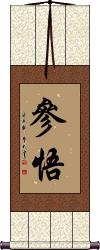
參悟 is a Chan / Zen Buddhism concept that means “to understand (mystery) from meditation” or “to see truth flash through the mind.”
參悟 is a pretty deep idea; therefore, your study and contemplation may be required before fully appreciating it.
Zen Understanding
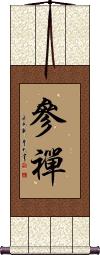
參禪 is a title that speaks of reaching an understanding (of Zen or the world). It also means “to practice meditation.” The two concepts lead you to the idea that meditation leads to understanding. 參禪 is pretty deep, so you can do your research or decide what this means for you.
This can also be defined in a more complex way as “thoroughly penetrating with meditative insight.”
6. Right Effort / Right Endeavor / Perfect Effort
Samyag Vyayama / Samma Vayama
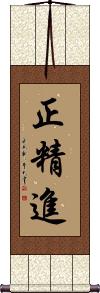
正精進 is one of the Noble Eightfold Paths of Buddhism. Right Effort, along with Right Mindfulness and Right Concentration, constitute the path to Concentration or Perfect Thought.
The proper effort is not the effort to make something particular happen. It is the effort to be aware and awake in each moment, the effort to overcome laziness and defilement, and the effort to make each activity of our daily meditation. This concept is about pursuing wholesome things that promote good karma.
Another definition: Cultivation of what is karmically wholesome and avoidance of what is karmically unwholesome.
This term is exclusively used by devout Buddhists. It is not a common term, and remains an unknown concept to most Japanese and Chinese people.
See Also: Enlightenment | Noble Eightfold Path
Buddha Heart / Mind of Buddha
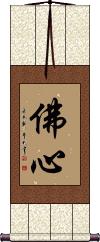
佛心 means the Buddha's mind, Buddha-heart, or the spiritually enlightened heart/mind.
The Buddha Heart is detached from good and evil and other such constructs. The Buddha Heart has mercy, compassion, and loving-kindness for all sentient life, the good, the wicked, and all in between.
The heart and mind (心) are the same concepts in the ancient Orient, so you can use heart and mind interchangeably in this context.
Confidence / Faithful Heart
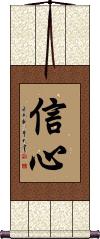
信心 is a Chinese, Japanese, and Korean word that means confidence, faith, or belief in somebody or something.
The first character means faith, and the second can mean heart or soul. Therefore, you could say this means “faithful heart” or “faithful soul.”
In Korean especially, this word has a religious connotation.
In the old Japanese Buddhist context, this was a word for citta-prasāda (clear or pure heart-mind).
In modern Japan (when read by non-Buddhists), this word is usually understood as “faith,” “belief,” or “devotion.”
See Also: Self-Confidence
Fate / Opportunity / Chance
The Buddhist idea of Fate
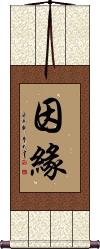
因緣 is the Buddhist concept of a chance meeting or an opportunity that presents itself by fate.
Sometimes this is used to describe a cosmic chain of events or cause and effect.
It also is used to describe predestined relationships between people - and sometimes married couples (although if you want one about marriage, try this: Fate / Destiny of Lovers.
因緣 can also be translated as origin, karma, destiny, affinity, connection, and relation. This all depends on context - seen alone on a wall scroll, this will be read with a “fate/chance” meaning by a Chinese person or a Korean person who can read Hanja.
The more complex definition of this word would be, “Direct causes and indirect conditions, which underlie the actions of all things.”
This concept is known as nidana in the original Sanskrit. Also sometimes presented as hetupratyaya (or “hetu and prataya”), which I believe is Pali.
Note: Japanese will tend to use this version of the second Kanji: 
If you order this from the Japanese master calligrapher, expect that you’ll get this version. However, this word often carries a negative connotation in Japanese (bad things happen), as it is used that way in a certain Japanese idiom. Therefore, this may not be the best choice if Japanese is your target language.
See Also: Opportunity
Four Noble Truths: Suffering
Dukkha
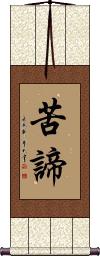
苦諦 relays that part of life in this universe is suffering.
All living things experience some form of suffering, according to Buddhist teaching.
This title is about accepting and understanding that the world is full of suffering.
This term is exclusively used by devout Buddhists. It is not a common term, and is remains an unknown concept to most Chinese, Japanese, and Korean people.
See Also: Enlightenment
Free Will
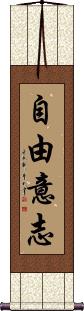
自由意志 is a concept that has existed for thousands of years that humans can understand right and wrong, then make a decision one way or the other (thus affecting their fate).
Sources such as Confucius, Buddhist scriptures, the Qur'an, and the Bible all address this idea.
As for the characters shown here, the first two mean free, freedom, or liberty. The last two mean “will.”
Can be romanized from Japanese as jiyū-ishi, jiyuu-ishi, and sometimes jiyuu-ishii.
It's 자유의지 or jayuu-yiji in Korean and zìyóu yìzhì in Chinese.
See Also: Sexual Freedom | Strong Willed | Tea Fate
Goddess of Mercy and Compassion
This is the long or more formal version of this title
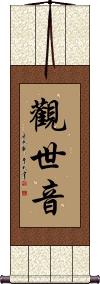
觀世音 is the longer and perhaps more formal title for the Buddhist deity known as the Goddess of Mercy or Bodhisattva of Compassion.
The longer title of this bodhisattva is Romanized in the following ways:
Mandarin Chinese: Guanshi Yin, Kuan-shih Yin.
Japanese: Kanzeon.
Sanskrit: Bodhisattva Avalokitesvara.
Korean: Gwan-se-eum.
Vietnamese: Quan Thế Âm.
Thai: Prah Mae Kuan Eim.
English: Bodhisattva of Mercy and Salvation, Goddess of Compassion, Buddha of Mercy, et al.
Please view our more common and shorter version, “Guan Yin” before you make a decision. Also, note that the first character has a slight variation in Japanese. If your audience is specifically Japanese, you may want to select that version.
See Also: Goddess
Doing good is the greatest source of happiness
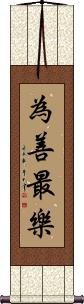
為善最樂 can mean “Doing good is the greatest source of happiness” or “doing good deeds brings the greatest joy.”
The origin is not known but is sometimes used in the context of Buddhism. However, this Chinese proverb or philosophy is a relatively mainstream idea of benevolence.
Guan Shi Yin: Protector Of Life
觀世音 is an alternate title for Guanyin, the Bodhisattva of Compassion or Goddess of Mercy.
觀世音 is the Buddhist bestower of children, the protector of life and all in distress (especially of those at sea).
Intuitive Wisdom / Inner Light
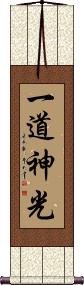
一道神光 is a Buddhist term that means “inner light,” or “intuitive wisdom.”
This actually reads, “[the] one path/way [of] spiritual light.” It implies that your spirit knows the way, and will light the path for you.
Light / Bright / Shine
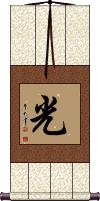
光 is the simplest way to express “light” in Chinese, Japanese Kanji, and old Korean Hanja.
It can also mean ray or bright. Chinese tend to use a two-character word for light/bright, so this character is probably best if your audience is Japanese. Also, when pronounced Rei, this can be a Japanese female given name.
In the Zen Buddhist context, this is the pure light that everyone possesses at their origin.
Meditation
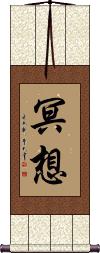
This encompasses the idea of meditation.
It's also a term used to describe a deep form of daydreaming, exploring one's imagination, the act of contemplating, or the idea of contemplation. 冥想 is often associated with Buddhism; however, the word “Zen” in Japanese (or “Chan” in Chinese) is probably more commonly used (or better known in the west).
See Also: Zenmai / Royal Fern
The Middle Way
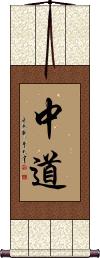
In the most basic translation, 中道 means road through the middle or middle road.
The expanded meaning can be moderation or the golden mean.
But if you are looking for this title, you are probably seeking the Buddhist definition, which is more complex.
中道 is the middle way or middle path of Buddhism. This has various interpretations. In general, it denotes the mean between two extremes and has special reference to the mean between realism and nihilism, or eternal substantial existence and annihilation.
The Buddha teaches that one should not take things to extremes. Don't be extremely evil and engage in debauchery and murder. But do not spend every waking out trying to be a perfect saint. Instead, take the middle path, try to help others, show loving kindness wherever you can, and try not to do harm. If you inadvertently harm another being, make amends if you can, and move on. Realize you are not perfect, but in time, a path of moderation lead toward proper living and enlightenment.
Musashi
The most famous Samurai
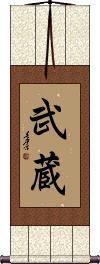
Miyamoto Musashi is probably the most famous Samurai in all of Japanese history.
武蔵 is the short title for a man long in legend. While coming from a lower class, his new sword and fighting techniques put him on par with the best that feudal Japan had to offer. His long career started with his first duel at age 13!
He is credited with using two swords at once and never losing a single battle in his career. After becoming a Buddhist, and getting older, like many old warriors, he took up a peaceful and solitary life until his death around 1645 A.D.
Note: Technically, Musashi is his given name, and Miyamoto is his surname. However, it's suggested that he assumed both of these names and had a few other names in childhood, as well as being given a Buddhist name. It's hard to know what to call him, as with most Kanji, there are multiple pronunciations. The characters for Musashi can also be pronounced Takezō. But everyone in modern times seems to know him by the name Musashi.
Nothingness
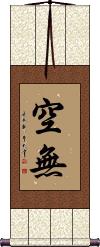
空無 is “nothingness” in a Buddhist context.
The first character means empty but can also mean air or sky (air and sky have no form).
The second character means have not, no, none, not, or to lack.
Together these characters reinforce each other into a word that means “absolute nothingness.”
I know this is a term used in Buddhism, but I have not yet figured out the context in which it is used. I suppose it can be the fact that Buddhists believe that the world is a non-real illusion, or perhaps it's about visualizing yourself as “nothing” and therefore leaving behind your desire and worldliness.
Buddhist concepts and titles often have this element of ambiguity or, rather, “mystery.” Therefore, such ideas can have different meanings to different people, and that's okay. If you don't get it right in this lifetime, there will be plenty more lifetimes to master it (whatever “it” is, and if “it” really exists at all).
Soothill defines this as “Unreality, or immateriality, of things, which is defined as nothing existing of independent or self-contained nature.”
Reach Peace and Calm Through Meditation
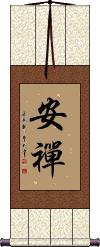
安禪 creates a title that means to reach peace and calm through meditation.
安禪 is an excellent wall scroll for your relaxation or meditation room.
This is also a Buddhist-related term that encompasses the idea of entering into dhyana meditation.
This is also used in Japanese, but in modern times, the second character has changed, so it's 安禅 now. If you want the modern Japanese version, just choose a Japanese calligrapher, and let me know when you place your order.
Realization and Knowledge
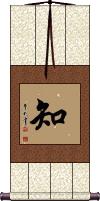
知 means realization or true knowing.
This can also translate as to know, to be aware, wisdom, or higher knowledge.
From older Buddhist ideas, this can represent विद्या (Vidyā or Vidya) or ज्ञान (Jñāna or Jnana) and even the combination Sanskrit word विज्ञान (Vijñāna or Vijnana) which can translate as wisdom arising from perception or knowing.
However, 知 should be distinguished as true knowing versus having a relative understanding or 會.
Selflessness
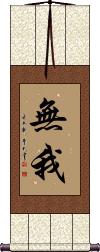
無我 is a more common way to say selflessness in Japanese. This literally means “no self,” or a better translation might be “not thinking of oneself.” 無我 is also understood in Chinese and Korean. 無我 is a very old word in CJK languages.
無我 is the word a Buddhist would use to express the idea of selflessness or unselfishness. For Korean Buddhists, it can mean self-renunciation.
See Also: Lotus
Shakyamuni / The Buddha
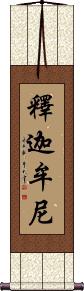
釋迦牟尼 is a transliteration of “Shakyamuni” or “Sakyamuni” in Chinese, Japanese, and old Korean.
The perceived meaning of the name is roughly translated as “Sage of the Sakyas.”
This same Buddha is also known as “Siddhartha Gautama,” “Gotama Buddha,” “Tathagata,” or simply, “The Supreme Buddha.”
Shakyamuni is the legendary man and prince who eventually established the Buddhist religion.
Note: Occasionally Romanized as “Siddhattha Gotama.”
This combination of characters is sometimes seen and used in South Korea and Japan as well (with the same meaning).
Note: 釋迦牟尼 came from the Sanskrit शाक्यमुनि and can also be romanized with diuretics as Śākyamuni.
Shaolin Chuan / Shao Lin Quan
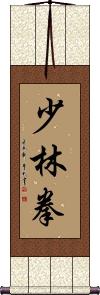
少林拳 is the title of the martial art (style of Kung Fu) that is taught to the monks and students in the Shaolin Buddhist Monastery.
The addition of Chuan or Quan, which means fist is what signifies that you are talking about this school or form of martial arts.
Stillness / Quiet / Calm
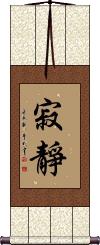
寂靜 is the Chinese and old Japanese word for calmness, stillness, and tranquility.
In the Buddhist context, this can refer to the calmness of the heart, enlightenment, or the state of being calm and quiet - free from temptation and distress. This can be thought of as being in a state of earthly nirvāṇa.
Note: The second character is written just slightly differently in modern Japanese (静 instead of 靜). Expect a slight variation if you order this from the Japanese master calligrapher. The version shown here is considered the ancient Japanese and original Chinese form.
Wake Up to Reality
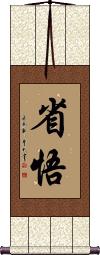
省悟 is a Chinese word that means “to wake up to reality,” “to come to oneself,” “to realize,” “to see the truth,” or “to reflect and become aware.”
省悟 is often used in the context of Buddhism.
In Japanese, this has the same meaning but is more often used as a given name, Seigo.
1. Right Understanding / Right Perspective / Right View / Perfect View
Samyag Dristhi / Samyag Drsti / Samma Ditthi
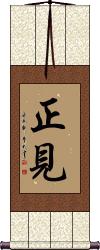
正見 is one of the Noble Eightfold Paths of Buddhism. Right View, along with the Right Thought, constitutes the path to Wisdom.
To get to the correct view of the world, you must first understand and follow Four Noble Truths.
Note: This term is exclusively used by devout Buddhists. It is not a common term, and remains an unknown concept to most Japanese and Chinese people.
See Also: Enlightenment | Noble Eightfold Path
3. Right Speech / Right Talk / Perfect Speech
Samyag Vaca / Samma Vaca / Samma Vacha
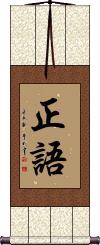
正語 is one of the Noble Eightfold Paths of Buddhism. Right Speech, along with Right Action and Right Living, constitute the path to Virtue.
Right Speech is abstaining from lying, abstaining from divisive speech, abstaining from abusive speech, abstaining from idle chatter, abstaining from slander, abstaining from gossip, or any form of harmful or wrong speech.
This term is exclusively used by devout Buddhists. It is not a common term, and remains an unknown concept to most Japanese and Chinese people.
See Also: Enlightenment | Noble Eightfold Path
5. Right Living / Right Livelihood / Perfect Livelihood
Samyag Ajiva / Samma Ajiva
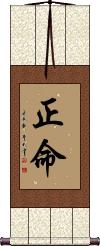
正命 (right living) is one of the Noble Eightfold Paths of Buddhism.
Right Living, along with Right Speech and Right Action, constitute the path to Virtue.
Right Living means that a Buddhist should only take a job or pursue a career in a field that does no harm. Buddhists should not work in the arms trade, as pimps or in the field of prostitution, as a butcher or in a shop that kills or sells meat, in a laboratory that does animal research, or in any other business that involves scheming or unethical behavior.
Another definition: Avoidance of professions that are harmful to sentient beings, such as slaughterer, hunter, dealer in weaponry or narcotics, etc.
This term is exclusively used by devout Buddhists. It is not a common term, and remains an unknown concept to most Japanese and Chinese people.
See Also: Enlightenment | Noble Eightfold Path
8. Right Concentration / Perfect Concentration
Samyak Samadhi / Samma Samadhi
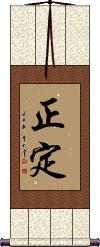
正定 is one of the Noble Eightfold Paths of Buddhism. Right Concentration, along with Right Effort and Right Mindfulness, constitute the path to Concentration or Perfect Thought.
Right Concentration has to do with leaving behind sensuality, unwholesome states, as well as pleasure and pain. 正定 is a complex idea, but once you have achieved the shedding of worldly sensation, you can truly concentrate and find a higher level of awareness.
Another definition: Concentration of mind that finds its high point in the four absorptions.
This term is exclusively used by devout Buddhists. It is not a common term, and remains an unknown concept to most Japanese and Chinese people.
See Also: Enlightenment | Noble Eightfold Path
Akemi
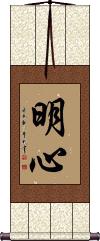
In Japanese, this is a female given name, Akemi (sometimes Meimi or Harumi).
In the Buddhist context, this title means enlightened heart.
Avatar
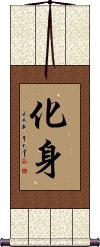
化身 is a way to say avatar in Chinese characters, Korean Hanja, and Japanese Kanji.
This is the original Buddhist idea of an avatar (not the movie). This can also mean: incarnation; reincarnation; embodiment; personification; impersonation.
化身 is the Chinese word used for the original Sanskrit, nirmāṇakāya. Alternates for nirmāṇakāya include 應身, 應化身, or 變化身. In the context of Buddhism, this is a Buddha's metamorphosic body, which has the power to assume any shape to propagate the Truth. This title, 化身, is used for the appearance of a Buddha's many forms.
Awareness
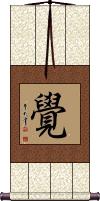
覺 can mean to feel; to figure out; thinking; awake; aware; bodhi; knowing; understanding; enlightenment; illumination; apprehend; perceive; realize.
覺 is a character that is impossible to define in a single word.
This term is often associated with Buddhism where it's understood to be: Illumination, enlightenment, or awakening in regard to the real in contrast to the seeming. However, it can also refer to enlightenment in regard to morality and evil.
Notes:
In Japanese, this can be the personal name Satoru.
In certain context, and only when pronounced as “jiao” in Chinese, it can refer to a nap, sleep or the state of sleeping. However, as a single character on a wall scroll, everyone will read this with the awareness or enlightenment context.
By no means is this the only way to write enlightenment. In fact, you should only choose this character if you are looking more for a word meaning awareness.
See Also: Enlightenment | Wisdom | Realization and Knowledge
Kindness / Benevolence
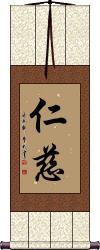
仁慈 word is used in Chinese, Korean, Japanese, and Asian Buddhism to relay the important idea of loving kindness.
仁慈 can also be defined as: benevolent; charitable; kind; merciful; kind-hearted; benevolence; kindness; humanity; mercy.
In Japanese, this can also be the given name Hitoji. This would also be a good Mandarin Chinese given name romanized as Jentzu (in Taiwan) or Renci (which sounds like ren-tsuh).
Bodhidharma
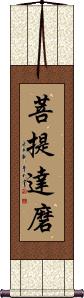
菩提達磨 is the title Bodhidharma in Chinese and Japanese.
Bodhidharma, commonly known as Damo, is reputed as the founder of the Chan (Zen) or Intuitional or Mystic School.
He likely came from south India and spread Mahayana Buddhism throughout China (even meeting the Emperor) and his disciples likely spread this all the way to Korea, Japan, and beyond in the 5th and 6th centuries.
Sometimes the last character varies in Chinese to 摩 instead of 磨 - let me know if you need a certain variation when you order.
Body and Earth in Unity
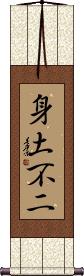
身土不二 (Shindofuni) is originally a Buddhist concept or proverb referring to the inseparability of body-mind and geographical circumstances.
This reads, “Body [and] earth [are] not two.”
Other translations or matching ideas include:
Body and land are one.
Body and earth cannot be separated.
Body earth sensory curation.
You are what you eat.
Indivisibility of the body and the land (because the body is made from food and food is made from the land).
Going further, this speaks of our human bodies and the land from which we get our food being closely connected. This phrase is often used when talking about natural and organic vegetables coming directly from the farm to provide the healthiest foods in Japan.
Character notes: 身(shin) in this context does not just mean your physical body but a concept including both body and mind.
土 (do) refers to the soil, earth, clay, land, or in some cases, locality. It's not the proper name of Earth, the planet. However, it can refer to the land or realm we live in.
Japanese note: This has been used in Japan, on and off, since 1907 as a slogan for a governmental healthy eating campaign (usually pronounced as shindofuji instead of the original shindofuni in this context). It may have been hijacked from Buddhism for this propaganda purpose, but at least this is “healthy propaganda.”
Korean note: The phrase 身土不二 was in use by 1610 A.D. in Korea, where it can be found in an early medical journal.
In modern South Korea, it's written in Hangul as 신토불이. Korea used Chinese characters (same source as Japanese Kanji) as their only written standard form of the language until about a hundred years ago. Therefore, many Koreans will recognize this as a native phrase and concept.
See Also: Strength and Love in Unity
The Aura of Buddha
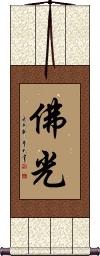
佛光 means Buddha's teachings, or Buddha's Light.
This often refers to the aura around the head of Buddha.
Alternate meanings include Spiritual Enlightenment (from Buddha), Buddha's Halo, Light of the Buddha, or Buddha's Glory.
Happy Buddha
Buddha of Joyful Light
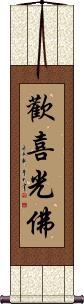
This title is Buddha of Joyful Light.
歡喜光佛 is Amitābha from Sanskrit but pronounced very differently in Chinese and Japanese.
Seeing one’s Nature and becoming a Buddha
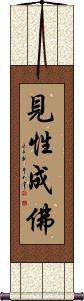
見性成佛 is a universal phrase that suggests that one may see one's nature and accomplish Buddhahood.
見性 suggests penetrating deep inside oneself to see one's “Original finally
Mind.”
成佛 refers to a sentient being who dispenses with illusions and delusions
through ascetic practice, is enlightened to the truth, and becomes a Buddha.
This is used by Mahayana, Chan, and Zen Buddhists in China, Korea, and Japan.
You will also see this with the last character written as 仏 in Japanese. In the religious context, 佛 is commonly used to mean Buddha. If you want the other version, see Kenshō Jōbutsu 見性成仏
Buddhism
(2 characters)
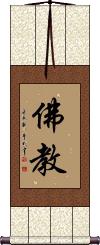
佛教 is the more exact way to express the religion or lifestyle of Buddhism.
It can also be read as “Buddha's Teachings.” 佛教 is Chinese only, as a different character is more commonly used in Japanese to express Buddhism. The same first character is used in Korea, but a slight variation exists in the second character in Korean Hanja. However, it would be fully recognized by any Korean person who can read Hanja.
The Buddha is in Each Sentient Being
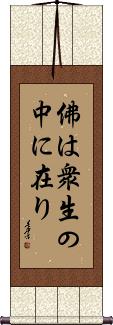
佛は衆生の中に在り is “Butsu wa shujo no naka ni ari” and means that the Buddha (potential for Buddhahood) exists in all beings in the universe.
So yes, your dog has the potential to be a Buddha (but only in a future reincarnation as a human). But all things, from the tiny cricket to the humpback whale have Buddha nature within them. If one takes the time to look and contemplate, one will see the Buddha in all things.
In Japan, sometimes the Buddha character is written 仏 instead of 佛, so you might see the whole phrase written as 仏は衆生の中に在り.
Note: Because this selection contains some special Japanese Hiragana characters, it should be written by a Japanese calligrapher.
Calm and Open Mind
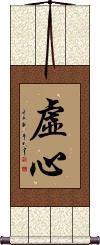
虛心 is a Buddhist term that speaks of being open-minded and/or having a calm and humble mind or heart.
Dana: Almsgiving and Generosity
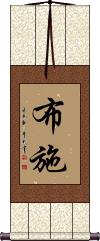
布施 is the Buddhist practice of giving known as Dāna or दान from Pali and Sanskrit.
Depending on the context, this can be alms-giving, acts of charity, or offerings (usually money) to a priest for reading sutras or teachings.
Some will put Dāna in these two categories:
1. The pure or unsullied charity, which looks for no reward here but only in the hereafter.
2. The sullied almsgiving whose object is personal benefit.
The first kind is, of course, the kind that a liberated or enlightened person will pursue.
Others will put Dāna in these categories:
1. Worldly or material gifts.
2. Unworldly or spiritual gifts.
You can also separate Dāna into these three kinds:
1. 財布施 Goods such as money, food, or material items.
2. 法布施 Dharma, as an act to teach or bestow the Buddhist doctrine onto others.
3. 無畏布施 Courage, as an act of facing fear to save someone or when standing up for someone or standing up for righteousness.
The philosophies and categorization of Dāna will vary among various monks, temples, and sects of Buddhism.
Breaking down the characters separately:
布 (sometimes written 佈) means to spread out or announce, but also means cloth. In ancient times, cloth or robs were given to the Buddhist monks annually as a gift of alms - I need to do more research, but I believe there is a relationship here.
施 means to grant, to give, to bestow, to act, to carry out, and by itself can mean Dāna as a single character.
Dāna can also be expressed as 檀那 (pronounced “tán nà” in Mandarin and dan-na or だんな in Japanese). 檀那 is a transliteration of Dāna. However, it has colloquially come to mean some unsavory or unrelated things in Japanese. So, I think 布施 is better for calligraphy on your wall to remind you to practice Dāna daily (or whenever possible).
Door of Great Wisdom
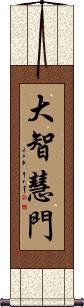
大智慧門 is the title for “The Great Wisdom Door,” or “The Gate to Great Wisdom.”
This refers to a portal to all wisdom and knowledge in Buddhism.
Dragon Spirit
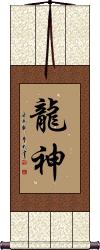
龍神 is a Chinese, Japanese Kanji, and old Korean Hanja title that can mean “dragon god,” “dragon king,” or “dragon spirit.”
In the context of Buddhism, this is one of eight kinds of spiritual beings found in Mahāyāna texts.
Amitabha Buddha
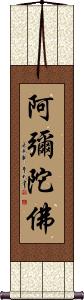
This title can mean the Buddha of the Western paradise.
But it's more a chant that means “May the lord Buddha preserve us!” or “Merciful Buddha!.”
阿彌陀佛 is also a translation to Chinese, Japanese, and Korean for “Amitâbha Buddha.”
Asian Buddhists will often greet and say goodbye to each other with this phrase/chant/title.
Evil Cause, Evil Result
Meaning: You reap what you sow
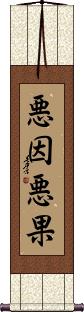
悪因悪果 is a Japanese proverb that means “Evil cause, evil effect” or “Bad causes bring bad results.”
The English equivalent is probably, “Sow evil and reap evil” or more commonly, “You reap what you sow.”
Note: 悪因悪果 is also considered to be a Buddhist phrase encompassing the idea of karmic retribution.
Four Elements
Buddhist Term
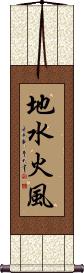
地水火風 is a Buddhist term that means “earth, water, fire, wind.”
This is often just referred to as “the four elements.” There is a more common title (the five elements) that adds wood to the mix. These four elements are used in some sects of Japanese Buddhism (not so much in Chinese).
Four Noble Truths: Desire and Attachment
Samudaya
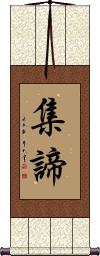
集諦 represents the idea that the core of suffering is often the concept of desire or attachment.
This can be carnal desire, monetary desire, or the attachment you have to something that you are unwilling to part with (such as a fancy car). 集諦 is a simplification of the second noble truth which is an exploration into the root causes of suffering - it's deeper than I can go in a few sentences.
This term is exclusively used by devout Buddhists. It is not a common term, and is remains an unknown concept to most Chinese, Japanese, and Korean people.
See Also: Enlightenment
Four Noble Truths: Elimination of Desire or Attachment
Nirodha
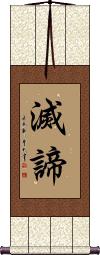
滅諦 suggests that once you eliminate desire or attachment to worldly things, only then can you achieve enlightenment.
Realize that things are impermanent. That fancy car, beautiful spouse, big house, and impressive career are things you can't take with you. These things are a flash in the pan compared to the infinite span of history, generations to come, time, and space.
This term is exclusively used by devout Buddhists. It is not a common term, and is remains an unknown concept to most Japanese, Korean, and Chinese people.
See Also: Enlightenment
Gaman
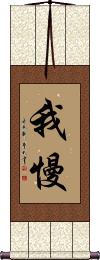
Gaman is a Zen Buddhist term from Japan that means “enduring the seemingly unbearable with patience and dignity.”
This title can also be translated as patience, perseverance, tolerance, or self-denial.
我慢 is also a Chinese Buddhist term with a different pronunciation. It comes from Sanskrit abhimāna or ātma-mada. Chinese Buddhism defines this very differently as “Egoism exalting self and depreciating others,” “self-intoxication,” or “pride.” Alone, the first character means “Me, I, or Self,” and the second character in a Buddhist context comes from Sanskrit māna and means pride, arrogance, self-conceit, looking down on others, superciliousness, etc.
I’m currently working with Japanese and Chinese translators to try and reconcile the true meaning or any commonality of this word between languages. For now, please only consider this if your audience is Japanese.
Ghost / Soul / Spirit
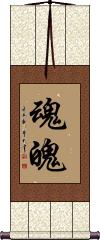
魂魄 is a Chinese, Japanese Kanji, and old Korean Hanja term for ghost, soul, or spirit.
It's used in the context of Buddhism as:
Animus and anima; the spiritual nature or mind, and the animal soul; the two are defined as mind and body or mental and physical, the invisible soul inhabiting the visible body, the former being celestial, the latter terrestrial.
Lucky / Auspicious / Good Omen
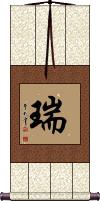
瑞 is a Chinese, Japanese, and old Korean word that means: lucky; auspicious; propitious; freshness; purity; luster; a good omen.
In Japanese, this can be the following female given names: Yutaka; Midzuho; Mizuho; Mizuki; Mizue; Mizu; Mio; Tamami. It can also be a Japanese surname, Zui or Shirushi.
In the Buddhist context, this can represent an auspicious jade token or good omen.
Happy / Open Heart

In mordern times, 開心 means to feel happy, to rejoice, or to have a great time, but directly translates as open heart.
In the Buddhist context, beyond opening the heart, it can mean to develop the mind, to initiate into truth, or awaken the mind.
開 = Open.
心 = Heart/Mind.
Not commonly used in Japanese where it might be read as open-mindeness.
Kensho Jobutsu - Enlightenment - Path to Buddha
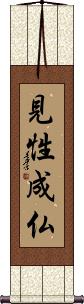
見性成仏 or Kenshō Jōbutsu is the initial enlightenment that leads to self-awareness, becoming Buddha, and the path to enter Nirvana.
Kenshō Jōbutsu is a complex concept in Japanese Buddhism. 見性成仏 is probably better translated as “Seeing one’s nature and becoming a Buddha.”
See Also: Enlightenment | Ten
Kodokan
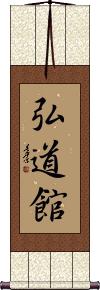
弘道館 is a Japanese title that romanizes as Kodokan.
There are a few martial arts titles that are romanized as Kodokan, so be careful to choose the correct one. This one roughly means “Great Way Hall.”
In the old Buddhist context, the 弘 Kanji can mean vast, great, to enlarge, spread abroad, or widely to proclaim.
The 道 part is the “Way,” as seen in many martial arts titles. It is the root character of Taoism/Daoism (romanized as Tao or Dao from Chinese, but Do in Japanese).
The 館 or hall part is implied to be a dojo or place of learning.
This in-stock artwork might be what you are looking for, and ships right away...