Many custom options...


And formats...



Cover in Chinese / Japanese...
Buy a Cover calligraphy wall scroll here!
Personalize your custom “Cover” project by clicking the button next to your favorite “Cover” title below...
Cover

封面 is the name Cover in Chinese (Mandarin).
Cover

カバー is the name Cover in Japanese Katakana.
Note: Because this title is entirely Japanese Katakana, it should be written by a Japanese calligrapher.
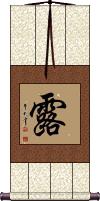
露 is the Chinese, Japanese Kanji, and old Korean Hanja for dew.
Depending on the context in which this character is used, it can also mean: tears; syrup; nectar; outdoors (not under cover); to show; to reveal; to betray; to expose; scanty; bare; unconcealed; naked; public.
露 can be a Chinese surname Lu. 露 can also be the Japanese surname Tsuyuzaki or Tsuyusaki, and the given names Tsuyu or Akira.
Oddly, 露 is sometimes used as an abbreviation for Russia.
In the Buddhist context, 露 also means dew, but can be a symbol of transience. Sometimes used as a metaphor to expose or disclose knowledge and truth.
Turtle
...also means tortoise
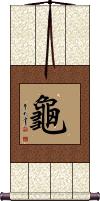
龜 is the generic term for turtle in Chinese and old Korean Hanja. It's like saying “turtle” (or “tortoise”) without being specific about the species of turtle.
Please note that there are many special characters in Chinese and a few in Japanese that denote specific species of turtle and do not include this character. We can't possibly cover all of these species, but if you want a certain one, such as “loggerhead” or a “leatherback,” just contact me, and I'll do my best to research your special species.
If you noticed, I said species names that do not include this character. This is because, in much the same way we can do it in English by just saying, “loggerhead” instead of “loggerhead turtle,” the same can be done in Chinese and Japanese.
 This may be hard to believe, but the image shown to the right is an alternate version of this character, which is currently used in Japan. This was originally an alternate form in ancient China for turtle - but it's so obscure now that most Chinese people would just think this is the Japanese version of turtle (I did a lot of research on this). The version shown in the upper left is traditional Chinese (also used in Korea 100+ years ago). It will generally not be recognized by the new generation of Japanese people. If your audience is Japanese, please click on the Kanji image shown to the right to have the calligrapher write that version (instead of clicking the button above).
Note: In Japanese, this Kanji is also a representation of long life. This is related to the fact that a tortoise can live for hundreds of years.
Qi Gong / Chi Kung
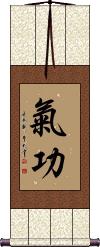
氣功 or Qigong is the title of a technique that is somewhere between medical practice, meditation, and in some cases, religion.
The definition is blurred depending on which school of Qigong you are following. In some cases, it is even incorporated with martial arts.
Some people (even Chinese people) mix this title with Tai Chi (Tai Qi) exercises.
Lately, in China, people will claim to practice Tai Chi rather than Qigong because the Qigong title was recently used as a cover for an illegal pseudo-religious movement in China with the initials F.G. or F.D. (I can not write those names here for fear of our website being banned in China).
You can learn those names and more here: Further info about Qigong
If you are wondering why I wrote “Qi Gong” and “Chi Kung” as the title of this calligraphy entry, I should teach you a little about the various ways in which Chinese can be Romanized. One form writes this as “Chi Kung” or “Chikung” (Taiwan). In the mainland and elsewhere, it is Romanized as “Qi Gong” or “Qigong.” The pronunciation is the same in Taiwan, mainland, and Singapore Mandarin. Neither Romanization is exactly like English. If you want to know how to say this with English rules, it would be something like “Chee Gong” (but the “gong” has a vowel sound like the “O” in “go”).
Romanization is a really confusing topic and has caused many Chinese words to be mispronounced in the west. One example is “Kung Pao Chicken,” which should actually be more like “Gong Bao” with the “O” sounding like “oh” for both characters. Neither the Romanization system in Taiwan nor the Mainland is perfect, in my opinion, and leads to many misunderstandings.
In modern Japan, you may see this written as 気功, but the original 氣功 is still recognized. If you need the Japanese version, please contact me.
These search terms might be related to Cover:
Alert / on Guard / Lingering Mind
Blessings and Protection
Case
Defense / Defend
Divine Protection
Duty to Defend and Protect Country
Embrace Life
Embrace Life / Embrace Living
Forgiveness (From the Top Down)
God Bless You / May God Protect You
Guard
Hide / Shelter / Shield
Highest Quality / Top Notch
Japanese Snapping Turtle / Chinese Soft Shell Turtle
Just as Liquor Turns a Face Red, Gold Turns a Heart Black
Keep Calm in Face of Adversity
Love and Protect
Protect Guard Treasure Cherish
Protection
Realize Your Ambitions / Embrace Your Ambition
Resilient in the Face of Adversity
Shell
Shield
Top Quality / First Class
Under the Protection of the Dragon Saint
Not the results for Cover that you were looking for?
Below are some entries from our dictionary that may match your Cover search...
| Characters If shown, 2nd row is Simp. Chinese |
Pronunciation Romanization |
Simple Dictionary Definition |
悶 闷 see styles |
mèn men4 men mon もん |
More info & calligraphy: Melancholy / Sorrow(rare) (See 悶え・もだえ) agony; anguish; (given name) Mon Depressed, oppressed, sad, melancholy; to cover, shut down, or in. |
蓋 盖 see styles |
gài gai4 kai kinugasa きぬがさ |
More info & calligraphy: Guycover; lid; cap; (surname) Kinugasa A cover, anything that screens, hides, or hinders; to build; then, for. The passions which delude the real mind so that it does not develop. A hat, or umbrella, or any cover. The canopy over a Buddha. |
露 see styles |
lù lu4 lu roshia ろしあ |
More info & calligraphy: Dew(1) dew; (2) tears; (adverb) (3) (See 露聊かも) (not) a bit; (not) at all; (place-name) Russia Dew; symbol of transience; to expose, disclose. |
封面 see styles |
fēng miàn feng1 mian4 feng mien |
More info & calligraphy: Cover |
カバー see styles |
kabaa / kaba カバー |
More info & calligraphy: Cover |
侜 see styles |
zhōu zhou1 chou |
to conceal; to cover |
冒 see styles |
mào mao4 mao hounen / honen ほうねん |
to emit; to give off; to send out (or up, forth); to brave; to face; (bound form) reckless; to falsely adopt (sb's identity etc); to feign; (literary) to cover (personal name) Hounen To risk; rash; counterfeit; introduce. |
冖 see styles |
mì mi4 mi |
"cover" radical in Chinese characters (Kangxi radical 14), occurring in 軍|军[jun1], 冠[guan1] etc, known as 禿寶蓋|秃宝盖[tu1 bao3 gai4] or 平寶蓋|平宝盖[ping2 bao3 gai4] |
冪 幂 see styles |
mì mi4 mi beki べき |
(math.) power; exponent; to cover with a cloth; cloth cover; veil (mathematics term) exponent; power |
包 see styles |
bāo bao1 pao hou / ho ほう |
to cover; to wrap; to hold; to include; to take charge of; to contract (to or for); package; wrapper; container; bag; to hold or embrace; bundle; packet; CL:個|个[ge4],隻|只[zhi1] (See ゲル) yurt (chi: bāo); (surname) Hou to wrap |
匸 see styles |
xì xi4 hsi |
"cover" or "conceal" radical in Chinese characters (Kangxi radical 23) (distinguished from 匚[fang1]) |
大 see styles |
dài dai4 tai yutaka ゆたか |
see 大夫[dai4 fu5] (pref,adj-na,n) (1) large; big; great; huge; vast; major; important; serious; severe; (prefix) (2) great; prominent; eminent; distinguished; (suffix) (3) -sized; as big as; the size of; (suffix noun) (4) (abbreviation) (See 大学・1) university; (5) large (e.g. serving size); large option; (6) (abbreviation) (See 大の月) long month (i.e. having 31 days); (given name) Yutaka Maha. 摩訶; 麼賀. Great, large, big; all pervading, all-embracing; numerous 多; surpassing ; mysterious 妙; beyond comprehension 不可思議; omnipresent 體無不在. The elements, or essential things, i.e. (a) 三大 The three all-pervasive qualities of the 眞如 q.v. : its 體, 相 , 用 substance, form, and functions, v. 起信論 . (b) 四大 The four tanmātra or elements, earth, water, fire, air (or wind) of the 倶舍論. (c)五大 The five, i.e. the last four and space 空, v. 大日經. (d) 六大 The six elements, earth, water, fire, wind, space (or ether), mind 識. Hīnayāna, emphasizing impersonality 人空, considers these six as the elements of all sentient beings; Mahāyāna, emphasizing the unreality of all things 法空, counts them as elements, but fluid in a flowing stream of life, with mind 識 dominant; the esoteric sect emphasizing nonproduction, or non-creation, regards them as universal and as the Absolute in differentiation. (e) 七大 The 楞嚴經 adds 見 perception, to the six above named to cover the perceptions of the six organs 根. |
奄 see styles |
yǎn yan3 yen |
suddenly; abruptly; hastily; to cover; to surround |
套 see styles |
tào tao4 t`ao tao |
to cover; to encase; cover; sheath; to overlap; to interleave; to model after; to copy; formula; harness; loop of rope; (fig.) to fish for; to obtain slyly; classifier for sets, collections; bend (of a river or mountain range, in place names); tau (Greek letter Ττ) |
寄 see styles |
jì ji4 chi yorizaki よりざき |
to entrust; to place in sb's care; (bound form) to depend on; to attach oneself to; to reside temporarily; (bound form) foster (as in 寄女[ji4 nu : 3] foster daughter); to send by post; to mail (surname) Yorizaki To go or put under cover, lodge, confide to, deliver, convey, transfer; to enter, put in a list. |
屏 see styles |
píng ping2 p`ing ping hei / he へい |
(standing) screen (1) wall; (2) fence; (surname) Hei to cover |
屛 see styles |
píng ping2 p`ing ping byō |
variant of 屏[ping2] Screen: to exclude, expel, turn away. |
帙 see styles |
zhì zhi4 chih chitsu ちつ |
book cover (1) protective covering for a book (often in the form of a folding case with clasps); (counter) (2) counter for book covers book |
幠 see styles |
hū hu1 hu |
arrogant; rude; to cover |
幭 see styles |
miè mie4 mieh |
carriage cover |
庇 see styles |
bì bi4 pi hisashi ひさし |
to protect; cover; shelter; hide or harbor (1) (archit) (kana only) eaves (of roof); (2) (archit) narrow aisle surrounding the core of a temple building; (3) visor (of cap); brim; peak; (4) (abbreviation) classic Japanese women's low pompadour hairstyle; (surname) Hisashi to hide |
弇 see styles |
yǎn yan3 yen |
to cover; trap |
弢 see styles |
tāo tao1 t`ao tao |
bow case; to cover |
扣 see styles |
kòu kou4 k`ou kou |
to fasten; to button; button; buckle; knot; to arrest; to confiscate; to deduct (money); discount; to knock; to smash, spike or dunk (a ball); to cover (with a bowl etc); (fig.) to tag a label on sb; (Tw) (loanword) code |
捂 see styles |
wǔ wu3 wu |
to enclose; to cover with the hand (one's eyes, nose or ears); to cover up (an affair); contrary; to contradict |
捫 扪 see styles |
mén men2 men |
lay hands on; to cover |
掩 see styles |
yǎn yan3 yen en |
to cover up; to conceal; to close (a door, book etc); (coll.) to get (one's fingers etc) caught when closing a door or lid; (literary) to launch a surprise attack To cover (with the hand), screen, shut up. |
揜 see styles |
yǎn yan3 yen |
cover up; to surprise |
揞 see styles |
ǎn an3 an |
to apply (medicinal powder to a wound); to cover up; to conceal |
摀 see styles |
wǔ wu3 wu |
variant of 捂[wu3]; to cover |
Click here for more Cover results from our dictionary
The following table may be helpful for those studying Chinese or Japanese...
| Title | Characters | Romaji (Romanized Japanese) | Various forms of Romanized Chinese | |
| Cover | 封面 | fēng miàn feng1 mian4 feng mian fengmian | feng mien fengmien |
|
| Cover | カバー | kabaa / kaba | ||
| Dew | 露 | ro | lòu / lou4 / lou | |
| Turtle | 龜 龟 / 亀 | kame | guī / gui1 / gui | kuei |
| Qi Gong Chi Kung | 氣功 气功 | ki kou / kikou / ki ko | qì gōng / qi4 gong1 / qi gong / qigong | ch`i kung / chikung / chi kung |
| In some entries above you will see that characters have different versions above and below a line. In these cases, the characters above the line are Traditional Chinese, while the ones below are Simplified Chinese. | ||||

Successful Chinese Character and Japanese Kanji calligraphy searches within the last few hours...



