Many custom options


And formats



South Korea in Chinese / Japanese
Buy a South Korea calligraphy wall scroll here!
Personalize your custom “South Korea” project by clicking the button next to your favorite “South Korea” title below.
1. South Korea
2. North Korea
3. Hwacheon
4. Mahjong
5. Easter
7. Bodhidharma
8. Three Treasures of Buddhism
10. Hapkido
South Korea
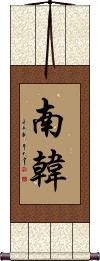
南韓 is the common Chinese name for the country of South Korea.
The official English name being Republic of Korea.
See Also: North Korea | Asia
South Korea
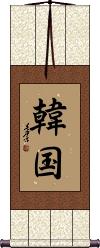
This is South Korea written in Japanese.
North Korea
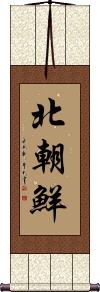
北朝鮮 is the Chinese and Japanese name for the country of North Korea.
The official English name being Democratic People's Republic of Korea.
See Also: Asia
North Korea
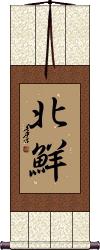
This short Japanese name for the country of North Korea (Democratic People's Republic of Korea).
There is a 3-character name, 北朝鮮 that is a lot more common.
See Also: Asia
Hwacheon
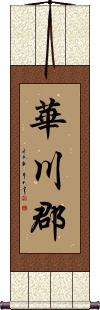
華川郡 is the name Hwacheon or Hwach'ŏn in Korean Hanja.
華川郡 usually refers to the Hwacheon County (Hwacheon-gun) county in Gangwon Province, South Korea.
Mahjong
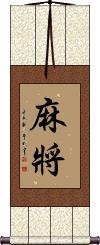
麻將 is the Chinese title for the game of mahjong.
Mahjong can also be spelled majiang, mah-jongg, and numerous other variants when played by people of other dialects. While the game originated in China, you will also find it played in Vietnam, South Korea, and Japan.
Easter
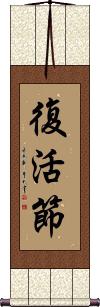
復活節 is the Chinese and old Korean way to write Easter.
Easter is not a well-known holiday in China, but Chinese Christians tend to follow the American tradition of the Easter egg ritual, etc. Non-Christians may think it's a celebration of rabbits that can lay eggs.
South Korea has a higher percentage of Christians than any other Asian country, so they celebrate Easter with plenty of enthusiasm.
Shakyamuni / The Buddha
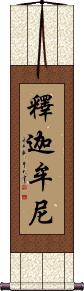
釋迦牟尼 is a transliteration of “Shakyamuni” or “Sakyamuni” in Chinese, Japanese, and old Korean.
The perceived meaning of the name is roughly translated as “Sage of the Sakyas.”
This same Buddha is also known as “Siddhartha Gautama,” “Gotama Buddha,” “Tathagata,” or simply, “The Supreme Buddha.”
Shakyamuni is the legendary man and prince who eventually established the Buddhist religion.
Note: Occasionally Romanized as “Siddhattha Gotama.”
This combination of characters is sometimes seen and used in South Korea and Japan as well (with the same meaning).
Note: 釋迦牟尼 came from the Sanskrit शाक्यमुनि and can also be romanized with diuretics as Śākyamuni.
Bodhidharma
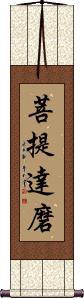
菩提達磨 is the title Bodhidharma in Chinese and Japanese.
Bodhidharma, commonly known as Damo, is reputed as the founder of the Chan (Zen) or Intuitional or Mystic School.
He likely came from south India and spread Mahayana Buddhism throughout China (even meeting the Emperor) and his disciples likely spread this all the way to Korea, Japan, and beyond in the 5th and 6th centuries.
Sometimes the last character varies in Chinese to 摩 instead of 磨 - let me know if you need a certain variation when you order.
Three Treasures of Buddhism
The Triple Gem
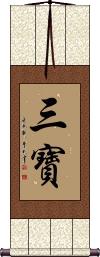
三寶 is the title for “Three Precious Treasures of Buddhism” or “The Triple Gem.”
These three treasures are the Buddha 佛, the Dharma 法 (teachings or the law of the Buddha), and the Sangha 僧 (the community of monks or followers).
This term is used by most (perhaps not all) Buddhists in China, Japan, and South Korea (written the same in the original form but pronounced differently in each language). Non-Buddhists may just read this as “Three Treasures” without the religious context. For instance, there is also a “Three Treasures of Chinese Medicine” that is sometimes titled the same way.
In modern Japanese and Simplified Chinese, this is written 三宝 instead of 三寶.
Body and Earth in Unity
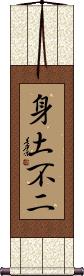
身土不二 (Shindofuni) is originally a Buddhist concept or proverb referring to the inseparability of body-mind and geographical circumstances.
This reads, “Body [and] earth [are] not two.”
Other translations or matching ideas include:
Body and land are one.
Body and earth cannot be separated.
Body earth sensory curation.
You are what you eat.
Indivisibility of the body and the land (because the body is made from food and food is made from the land).
Going further, this speaks of our human bodies and the land from which we get our food being closely connected. This phrase is often used when talking about natural and organic vegetables coming directly from the farm to provide the healthiest foods in Japan.
Character notes: 身(shin) in this context does not just mean your physical body but a concept including both body and mind.
土 (do) refers to the soil, earth, clay, land, or in some cases, locality. It's not the proper name of Earth, the planet. However, it can refer to the land or realm we live in.
Japanese note: This has been used in Japan, on and off, since 1907 as a slogan for a governmental healthy eating campaign (usually pronounced as shindofuji instead of the original shindofuni in this context). It may have been hijacked from Buddhism for this propaganda purpose, but at least this is “healthy propaganda.”
Korean note: The phrase 身土不二 was in use by 1610 A.D. in Korea, where it can be found in an early medical journal.
In modern South Korea, it's written in Hangul as 신토불이. Korea used Chinese characters (same source as Japanese Kanji) as their only written standard form of the language until about a hundred years ago. Therefore, many Koreans will recognize this as a native phrase and concept.
See Also: Strength and Love in Unity
Hapkido
Korean Martial Art of re-directing force
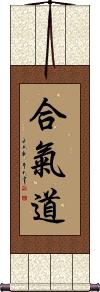
Hapkido or 合氣道 is a mostly-defensive martial art in Korea.
Hapkido has some connection to the Aikido of Japan. They are written with the same characters in both languages. However, it should be noted that the Korean Hanja characters shown here are the traditional Chinese form - but in modern Japan, the middle character was slightly simplified.
Note: You can consider this to be the older Japanese written form of Aikido. Titles on older books and signs about Aikido use this form.
The connection between Japanese Aikido and Korean Hapkido is muddled in history. The issue is probably due to the difficult relationship between the two countries around WWII. Many Koreans became virtual slaves to the Japanese during that period. After WWII, many things in Korea were disassociated from having any Japanese origin. The relationship has greatly mellowed out now.
Looking at the characters, the first means “union” or “harmony.”
The second character means “universal energy” or “spirit.”
The third means “way” or “method.”
One way to translate this into English is the “Harmonizing Energy Method.” This makes sense, as Hapkido has more to do with redirecting energy than fighting strength against strength.
More Hapkido info
More notes:
1. Sometimes Hapkido is Romanized as “hap ki do,” “hapki-do” “hab gi do” or “hapgido.”
2. Korean Hanja characters are actually Chinese characters that usually hold the same meaning in both languages. There was a time when these characters were the standard and only written form of Korean. The development of modern Korean Hangul characters is a somewhat recent event in the greater scope of history. There was a time when Chinese characters were the written form of many languages in places known in modern times as North Korea, South Korea, Japan, Vietnam, Singapore, Hong Kong, Taiwan, Mainland China, and a significant portion of Malaysia. Even today, more people in the world can read Chinese characters than English.
3. While these Korean Hanja characters can be pronounced in Chinese, this word is not well-known in China and is not considered part of the Chinese lexicon.
Taekwondo Tenets / Spirit of Taekwon-do
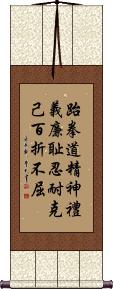
跆拳道精神禮義廉耻忍耐克己百折不屈 is General Choi's writing that is often called “The Tenets of Taekwon-do.”
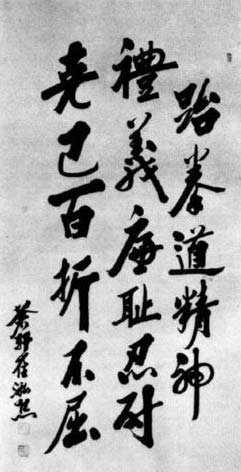
The actual title would be translated as “Taekwondo Spirit” or “The Spirit of Taekwondo.” It was originally written in Korean Hanja (Chinese characters used in Korea for about 1600 years).
General Choi's original calligraphy is shown to the right. Your custom calligraphy will be unique, and not an exact match, as each calligrapher has their own style.In modern times, the common form of written Korean is Hangul (a phonetic character set). The table below shows the text in Hangul and Hanja along with a pronunciation guide and a brief English translation:
| Traditional Korean Hanja | Modern Korean Hangul | Pronunciation | English |
| 跆拳道精神 | 태권도정신 | tae gweon do jeong sin | Taekwondo Spirit |
| 禮儀 | 예의 | ye yi | Courtesy / Etiquette / Propriety / Decorum / Formality |
| 廉耻 | 염치 | yeom ci | Integrity / Sense of Honor |
| 忍耐 | 인내 | in nae | Patience / Perseverance / Endurance |
| 克己 | 극기 | geug gi | Self-Control / Self-Denial / Self-Abnegation |
| 百折不屈 | 백절불굴 | baeg jeor bur gur | Indomitable Spirit (Undaunted even after repeated attacks from the opponent) |
| Note that the pronunciation is the official version now used in South Korea. However, it is different than what you may be used to. For instance, “Taekwon-do” is “tae gweon do.” This new romanization is supposed to be closer to actual Korean pronunciation. | |||
This in-stock artwork might be what you are looking for, and ships right away...


The following table may be helpful for those studying Chinese or Japanese:
| Title | Characters | Romaji (Romanized Japanese) | Various forms of Romanized Chinese | |
| South Korea | 南韓 南韩 | nán hán / nan2 han2 / nan han / nanhan | ||
| South Korea | 韓國 韓国 | kan koku / kankoku | ||
| North Korea | 北朝鮮 北朝鲜 | kita chousen kitachousen kita chosen | běi cháo xiǎn bei3 chao2 xian3 bei chao xian beichaoxian | pei ch`ao hsien peichaohsien pei chao hsien |
| North Korea | 北鮮 | hokusen / hokusen | ||
| Hwacheon | 華川郡 华川郡 | huá chuān hua2 chuan1 jun4 hua chuan jun huachuanjun | hua ch`uan chün huachuanchün hua chuan chün |
|
| Mahjong | 麻將 麻将 | má jiàng / ma2 jiang4 / ma jiang / majiang | ma chiang / machiang | |
| Easter | 復活節 复活节 | fù huó jié fu4 huo2 jie2 fu huo jie fuhuojie | fu huo chieh fuhuochieh |
|
| Shakyamuni The Buddha | 釋迦牟尼 释迦牟尼 | sha ka mu ni shakamuni | shì jiā móu ní shi4 jia1 mou2 ni2 shi jia mou ni shijiamouni | shih chia mou ni shihchiamouni |
| Bodhidharma | 菩提達磨 菩提达磨 | bodai daruma bodaidaruma | pú tí dá mó pu2 ti2 da2 mo2 pu ti da mo putidamo | p`u t`i ta mo putitamo pu ti ta mo |
| Three Treasures of Buddhism | 三寶 三宝 | san bou / sanbou / san bo | sān bǎo / san1 bao3 / san bao / sanbao | san pao / sanpao |
| Body and Earth in Unity | 身土不二 | shindofuni / shindofuji | ||
| Hapkido | 合氣道 合气道 | ai ki do / aikido | hé qì dào he2 qi4 dao4 he qi dao heqidao | ho ch`i tao hochitao ho chi tao |
| Taekwondo Tenets Spirit of Taekwon-do | 跆拳道精神禮義廉耻忍耐克己百折不屈 跆拳道精神礼义廉耻忍耐克己百折不屈 | tái quán dào jīng shén lǐ yì lián chǐ rěn nài kè jǐ bǎi zhé bù qū tai2 quan2 dao4 jing1 shen2 li3 yi4 lian2 chi3 ren3 nai4 ke4 ji3 bai3 zhe2 bu4 qu1 tai quan dao jing shen li yi lian chi ren nai ke ji bai zhe bu qu | t`ai ch`üan tao ching shen li i lien ch`ih jen nai k`o chi pai che pu ch`ü tai chüan tao ching shen li i lien chih jen nai ko chi pai che pu chü |
|
| In some entries above you will see that characters have different versions above and below a line. In these cases, the characters above the line are Traditional Chinese, while the ones below are Simplified Chinese. | ||||

Successful Chinese Character and Japanese Kanji calligraphy searches within the last few hours...



