Not what you want?
Try other similar-meaning words, fewer words, or just one word.
Buy a New Start calligraphy wall scroll here!
Personalize your custom “New Start” project by clicking the button next to your favorite “New Start” title below...
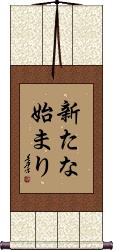
新たな始まり is a Japanese word that means “new beginning” or “new start.”
Here's the character breakdown:
新た (arata) = new; fresh; novel; newly; freshly; or this can be like the prefix “re-” like “re-start” or “reset.”
な (na) is kind of a connecting article. This glues “new” to “beginning.”
始まり (hajimari) = origin; beginning.
Note: Because this selection contains some special Japanese Hiragana characters, it should be written by a Japanese calligrapher.
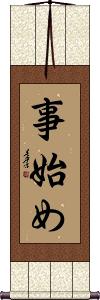
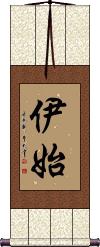
伊始 is a short version of “new beginning” or simply “beginning” in Chinese characters.
You can also translate this as “from this moment on,” “starting now,” or “henceforth.”
In the day-to-day speech, this word can apply to starting a new job, beginning a new career, entering a new chapter of your life, or taking a new position (in politics, scholarship, etc.).
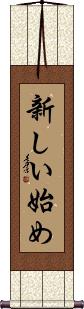
新しい始め is a verbose Japanese phrase that means “new beginning.”
The first three characters mean new, novel, fresh, recent, latest, up-to-date, or modern.
The last two characters mean beginning, start outset, opening, or origin.
Note: Because this selection contains some special Japanese Hiragana characters, it should be written by a Japanese calligrapher.
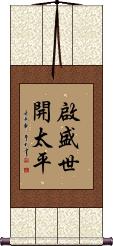
啟盛世開太平 means “To bring flourishing peace and security to the world (our current era).”
It's a wish that a new door leading to peace and prosperity could be opened to mankind.
Character and word breakdown:
啟 to open; to start; to initiate; to enlighten or awaken.
盛世 a flourishing period; period of prosperity; a golden age.
開 to open; to start; to turn on.
太平 peace and security; peace and tranquility; peace; tranquility.
I don't like to do breakdowns like this, as the words altogether create their unique meaning (encompassed in the main title above).
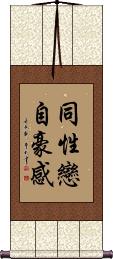
同性戀自豪感 or “Gay Pride” is a new idea in China. It's so new, that we may have just started the movement by translating this phrase.
If they ever do start having gay pride parades in China, my best guess is that these 6 characters will constitute the term they use to title the parade/movement.
Who knows, maybe in 10 years they will have a pride parade march straight past Tian'anmen Square on Chang An Street (the main drag in Beijing).
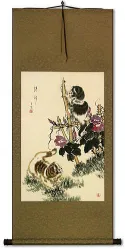
This in-stock artwork might be what you are looking for, and ships right away...
$148.88 ≈ €129.64
Below are some entries from our dictionary that may match your new start search...
| Characters If shown, 2nd row is Simp. Chinese |
Pronunciation Romanization |
Simple Dictionary Definition |
新生活 see styles |
shinseikatsu / shinsekatsu しんせいかつ |
More info & calligraphy: New Life |
リセット see styles |
risetto リセット |
More info & calligraphy: Lissette |
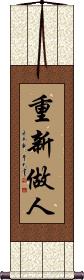
重新做人 see styles |
chóng xīn zuò rén chong2 xin1 zuo4 ren2 ch`ung hsin tso jen chung hsin tso jen |
More info & calligraphy: Fresh Start |
出任 see styles |
chū rèn chu1 ren4 ch`u jen chu jen |
to take up a post; to start in a new job |
初め see styles |
hajime はじめ zome ぞめ |
(n-t,n-adv) (1) beginning; start; outset; opening; (2) first (in line, etc.); (3) origin; (4) (kana only) such as ...; not to mention ...; (suffix) first doing of ... (ever, in one's life, in the new year, etc.) |
另開 另开 see styles |
lìng kāi ling4 kai1 ling k`ai ling kai |
to break up; to divide property and live apart; to start on a new (path) |
挖坑 see styles |
wā kēng wa1 keng1 wa k`eng wa keng |
to dig a hole; (fig.) to make things difficult for sb; (neologism) (slang) (of a writer) to start work on a new project |
更始 see styles |
gēng shǐ geng1 shi3 keng shih koushi / koshi こうし |
to make a new start; to regenerate (noun/participle) renewal; reform |
発刊 see styles |
hakkan はっかん |
(noun, transitive verb) publish; start (new) publication |
赴任 see styles |
fù rèn fu4 ren4 fu jen funin ふにん |
to travel to take up a new post (n,vs,vi) moving to a different location to start a new job; (proceeding to) new appointment |
開く see styles |
hiraku(p); hiraku ひらく(P); ヒラく |
(v5k,vi,vt) (1) to open; to undo; to unseal; to unpack; (v5k,vi,vt) (2) to bloom; to unfold; to spread out; (v5k,vi,vt) (3) to open (for business, e.g. in the morning); (v5k,vi,vt) (4) to be wide (gap, etc.); to widen; (transitive verb) (5) to hold (meeting, party, etc.); to give; to open; (transitive verb) (6) to found (nation, dynasty, sect, etc.); to open (a new business); to set up; to establish; to start; (transitive verb) (7) to open (ports, borders, etc.); (transitive verb) (8) to open (an account); (transitive verb) (9) (See 拓く) to open up (new land, path, etc.); to clear; to develop; (transitive verb) (10) {comp} to open (a file, etc.); (transitive verb) (11) {math} to extract (root); to reduce (equation); (transitive verb) (12) {food} (as 魚を開く) to cut open (fish); (transitive verb) (13) to change (kanji into hiragana); (v5k,vi) (14) to flare (e.g. skirt); (v5k,vi) (15) {sports} (as 体が開く, 肩が開く, etc.) to slacken (into a poor posture); (v5k,vi) (16) (kana only) {go} (usu. ヒラく) (See ヒラキ・3) to extend |
開場 开场 see styles |
kāi chǎng kai1 chang3 k`ai ch`ang kai chang kaiba かいば |
to begin; to open; to start; beginning of an event (n,vs,vi) (1) (ant: 閉場・1) opening (the doors of a venue); (n,vs,vi) (2) inauguration (of a new building, facility, etc.); (surname) Kaiba |
開學 开学 see styles |
kāi xué kai1 xue2 k`ai hsüeh kai hsüeh |
(of a student) to start school; (of a semester) to begin; (old) to found a school; the start of a new term |
開講 开讲 see styles |
kāi jiǎng kai1 jiang3 k`ai chiang kai chiang kaikou / kaiko かいこう |
to begin a lecture; to start on a story (n,vs,vt,vi) (1) (See 閉講) start of a course; start of lectures; (n,vs,vt,vi) (2) opening of a new course; offering a course (for the first time) |
別開生面 别开生面 see styles |
bié kāi shēng miàn bie2 kai1 sheng1 mian4 pieh k`ai sheng mien pieh kai sheng mien |
to start something new or original (idiom); to break a new path; to break fresh ground |
另起爐灶 另起炉灶 see styles |
lìng qǐ lú zào ling4 qi3 lu2 zao4 ling ch`i lu tsao ling chi lu tsao |
lit. to set up a separate kitchen (idiom); to start from scratch; back to square one; to start of on a new path |
咸與維新 咸与维新 see styles |
xián yù wéi xīn xian2 yu4 wei2 xin1 hsien yü wei hsin |
everyone participates in reforms (idiom); to replace the old with new; to reform and start afresh |
心機一転 see styles |
shinkiitten / shinkitten しんきいってん |
(noun/participle) (yoji) changing one's attitude; turning over a new leaf; getting a fresh start |
心気一転 see styles |
shinkiitten / shinkitten しんきいってん |
(irregular kanji usage) (noun/participle) (yoji) changing one's attitude; turning over a new leaf; getting a fresh start |
悔過自新 悔过自新 see styles |
huǐ guò zì xīn hui3 guo4 zi4 xin1 hui kuo tzu hsin |
to repent and start afresh (idiom); to turn over a new leaf |
手が付く see styles |
tegatsuku てがつく |
(exp,v5k) (1) to start making use of; to get to use something new; (exp,v5k) (2) to get sexually involved with a female subordinate |
改過自新 改过自新 see styles |
gǎi guò zì xīn gai3 guo4 zi4 xin1 kai kuo tzu hsin kaikajishin かいかじしん |
to reform and start afresh (idiom); to turn over a new leaf (yoji) changing one's attitude or conduct and making a new start; turning over a new leaf |
標新取異 标新取异 see styles |
biāo xīn qǔ yì biao1 xin1 qu3 yi4 piao hsin ch`ü i piao hsin chü i |
to start on something new and different (idiom); to display originality |
標新競異 标新竞异 see styles |
biāo xīn jìng yì biao1 xin1 jing4 yi4 piao hsin ching i |
to start on something new and different (idiom); to display originality |
旗を揚げる see styles |
hataoageru はたをあげる |
(exp,v1) (1) to raise (hoist) a flag; (exp,v1) (2) to raise an army; (exp,v1) (3) to start a new business |
行を改める see styles |
gyouoaratameru / gyooaratameru ぎょうをあらためる |
(exp,v1) to start a new paragraph |
友誼地久天長 友谊地久天长 see styles |
yǒu yì dì jiǔ tiān cháng you3 yi4 di4 jiu3 tian1 chang2 yu i ti chiu t`ien ch`ang yu i ti chiu tien chang |
Auld Lang Syne, Scottish song with lyrics by Robert Burns 羅伯特·伯恩斯|罗伯特·伯恩斯[Luo2 bo2 te4 · Bo2 en1 si1], sung to mark the start of a new year or as a farewell; also rendered 友誼萬歲|友谊万岁[You3 yi4 wan4 sui4] or 友誼天長地久|友谊天长地久[You3 yi4 tian1 chang2 di4 jiu3] |
Variations: |
denaosu でなおす |
(v5s,vi) (1) to make a fresh start; to turn over a new leaf; (v5s,vi) (2) to call again; to visit again; to come again |
Variations: |
mawasu まわす |
(transitive verb) (1) to turn; to rotate; to spin; to twist; to gyrate; (transitive verb) (2) to pass around; to send around; to hand around; to circulate; (transitive verb) (3) to move (someone or something to where its needed); to send; to bring; to transfer; to forward; to direct; to submit; (transitive verb) (4) to turn (to a new use); to use (for something else); (transitive verb) (5) to turn on (something that turns or has a rotating part, e.g. a washing machine); to start up (e.g. an engine); to give (something) a spin; (transitive verb) (6) to put (someone in a position); to make (e.g. an enemy of); (aux-v,v5s) (7) (after the -masu stem of a verb) to ... around (e.g. chase, fool, play); to do all over; to do everywhere; to do completely; (transitive verb) (8) to surround (something) with; to enclose with; (transitive verb) (9) to put (an arm) around (e.g. someone's waist); to reach around; (transitive verb) (10) to invest (money); to lend; (transitive verb) (11) to dial (a telephone number); (transitive verb) (12) (See 輪姦す) to gang-rape; (transitive verb) (13) to operate (e.g. business, shop) |
Variations: |
arukidasu あるきだす |
(v5s,vi) (1) to start walking; to begin to walk; (v5s,vi) (2) to begin (something new) |
The following table may be helpful for those studying Chinese or Japanese...
| Title | Characters | Romaji (Romanized Japanese) | Various forms of Romanized Chinese | |
| New Beginning | 新たな始まり | arata na hajimari aratanahajimari | ||
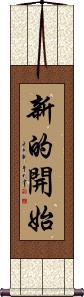
| New Beginning | 新的開始 新的开始 | xīn de kāi shǐ xin1 de kai1 shi3 xin de kai shi xindekaishi | hsin te k`ai shih hsintekaishih hsin te kai shih |
|
| New Beginning | 伊始 | yī shǐ / yi1 shi3 / yi shi / yishi | i shih / ishih | |
| Fresh Start | 重新做人 | chóng xīn zuò rén chong2 xin1 zuo4 ren2 chong xin zuo ren chongxinzuoren | ch`ung hsin tso jen chunghsintsojen chung hsin tso jen |
|
| New Beginning | 新しい始め | atarashii hajime atarashiihajime atarashi hajime | ||
| Worldwide Wish for Peace and Prosperity | 啟盛世開太平 启盛世开太平 | qǐ shèng shì kāi tài píng qi3 sheng4 shi4 kai1 tai4 ping2 qi sheng shi kai tai ping qishengshikaitaiping | ch`i sheng shih k`ai t`ai p`ing chishengshihkaitaiping chi sheng shih kai tai ping |
|
| Gay Pride | 同性戀自豪感 同性恋自豪感 | tóng xìng liàn zì háo gǎn tong2 xing4 lian4 zi4 hao2 gan3 tong xing lian zi hao gan tongxinglianzihaogan | t`ung hsing lien tzu hao kan tunghsinglientzuhaokan tung hsing lien tzu hao kan |
|
| In some entries above you will see that characters have different versions above and below a line. In these cases, the characters above the line are Traditional Chinese, while the ones below are Simplified Chinese. | ||||
Successful Chinese Character and Japanese Kanji calligraphy searches within the last few hours...

All of our calligraphy wall scrolls are handmade.
When the calligrapher finishes creating your artwork, it is taken to my art mounting workshop in Beijing where a wall scroll is made by hand from a combination of silk, rice paper, and wood.
After we create your wall scroll, it takes at least two weeks for air mail delivery from Beijing to you.
Allow a few weeks for delivery. Rush service speeds it up by a week or two for $10!
When you select your calligraphy, you'll be taken to another page where you can choose various custom options.
The wall scroll that Sandy is holding in this picture is a "large size"
single-character wall scroll.
We also offer custom wall scrolls in small, medium, and an even-larger jumbo size.
Professional calligraphers are getting to be hard to find these days.
Instead of drawing characters by hand, the new generation in China merely type roman letters into their computer keyboards and pick the character that they want from a list that pops up.
There is some fear that true Chinese calligraphy may become a lost art in the coming years. Many art institutes in China are now promoting calligraphy programs in hopes of keeping this unique form
of art alive.
Even with the teachings of a top-ranked calligrapher in China, my calligraphy will never be good enough to sell. I will leave that to the experts.
The same calligrapher who gave me those lessons also attracted a crowd of thousands and a TV crew as he created characters over 6-feet high. He happens to be ranked as one of the top 100 calligraphers in all of China. He is also one of very few that would actually attempt such a feat.
Check out my lists of Japanese Kanji Calligraphy Wall Scrolls and Old Korean Hanja Calligraphy Wall Scrolls.
Some people may refer to this entry as New Start Kanji, New Start Characters, New Start in Mandarin Chinese, New Start Characters, New Start in Chinese Writing, New Start in Japanese Writing, New Start in Asian Writing, New Start Ideograms, Chinese New Start symbols, New Start Hieroglyphics, New Start Glyphs, New Start in Chinese Letters, New Start Hanzi, New Start in Japanese Kanji, New Start Pictograms, New Start in the Chinese Written-Language, or New Start in the Japanese Written-Language.