Many custom options


And formats

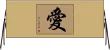

Fang in Chinese & Japanese Calligraphy
Compare the meanings and pronunciations of the entries related to Fang below. Choose “Customize & Buy” next to your preferred entry to personalize your calligraphy wall scroll.
1. Fang
3. Fong
5. No Worries
7. Return to Dwell in Gardens and Fields Poem
9. Phoung
10. Phuong
11. Ark
12. Fanchon
13. Fanfan
14. Fantine
15. Fontaine
16. Jikata
17. Relax
18. Alfonso
19. Alfonzo
20. Alphonso
22. Fontenot
23. Lafond
24. Lafontaine
25. Lafountain
26. Wilfong
27. Alphonse
28. Asian Pride / Oriental Pride / AZN Pryde
Fang
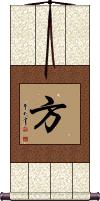
方 is the most common version of a Chinese surname that romanizes as Fong from Taiwan or Fang from mainland China.
The meaning of this character is square, upright, honest, fair and square, direction, place, or side. Sometimes 方 can refer to a method, prescription, or way of doing things.
In Japanese, this can be the given names Michi, Masani, Masashi,Tamotsu, Tadashi. It can also be Japanese surnames Hon, Hou, Ho, Fuon, Pan, Ban, Tokukata, or Kata.
Ivory / Tooth

牙 is the character for ivory or tooth in Chinese, Japanese Kanji, and old Korean Hanja.
牙 can also mean tooth, tusk, fang, or molar.
Fong
方 is the most common version of a Chinese surname that romanizes as Fong from Taiwan or Fang from mainland China.
The meaning of this character is square, upright, honest, fair and square, direction, place, or side. Sometimes 方 can refer to a method, prescription, or way of doing things.
In Japanese, this can be the given names Michi, Masani, Masashi,Tamotsu, Tadashi. It can also be Japanese surnames Hon, Hou, Ho, Fuon, Pan, Ban, Tokukata, or Kata.
Never Give Up
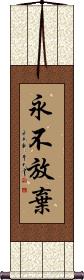
The first character means “eternal” or “forever,” and the second means “not” (together, they mean “never”). The last two characters mean “give up” or “abandon.” Altogether, you can translate this proverb as “never give up” or “never abandon.”
Depending on how you want to read this, 永不放棄 is also a statement that you will never abandon your hopes, dreams, family, or friends.
No Worries
My Australian friends always say, “No worries, mate.” It's caught on with me, though I drop the “mate” part since it confuses my fellow Americans.
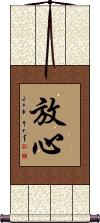
If you would like to express the idea of “no worries,” 放心 is the best and most natural way to say it in Chinese.
The characters you see to the left can mean “put your mind at rest” or “to be at ease.” You could literally translate “no worries,” but it doesn't “flow” like this simple Chinese version.
For your info, the first character means to release, to free, to let go, to relax, or to rest. The second character means your heart or your mind.
Note that in Japanese and Korean, this holds the similar meaning of “peace of mind” but can also mean absentmindedness or carelessness, depending on context.
Release / Let Go
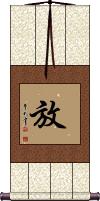
放 means to release, to free, to let go, to let out, to set off (fireworks).
In Japanese, this can also be a place called Hanashi
放 is also used in the context of Buddhism.
In Buddhism, this can represent the release of desire, materialism, suffering, or mortality.
Return to Dwell in Gardens and Fields Poem

This is Tao Yuanming's poem, “Returning to Dwell in Gardens and Fields.”
少無適俗韻 性本愛丘山。
誤落塵網中 一去三十年。
羈鳥戀舊林 池魚思故淵。
開荒南野際 抱拙歸園田。
方宅十餘畝 草屋八九間。
榆柳蔭後簷 桃李羅堂前。
暖暖遠人村 依依墟裡煙。
狗吠深巷中 雞鳴桑樹顛。
戶庭無塵雜 虛室有餘閒。
久在樊籠裡 復得返自然。
Defense / Defend
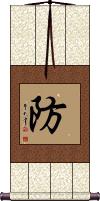
防 is a single Chinese character and Korean Hanja that means to protect, defend, guard against, prevent, ward off, or counter.
防 means the same thing in Japanese, though seldom seen alone as a single Kanji. When written alone, it could be the Japanese surname Fusegi.
Phoung
方 is the name Phoung in Chinese (Mandarin).
Phuong
方 is the original Chinese character for the Vietnamese surname Phuong or Phương.
方 means square, upright, or side. In Vietnamese specifically, it can mean "direction" or "phoenix" (rebirth).
In Cambodian there is an unrelated surname, ភួង, meaning "garland necklace (of flowers)" which also romanizes as Phuong. This is probably not the character you want if your name is Cambodian (unless your ancestry is Chinese or you know what you are doing).
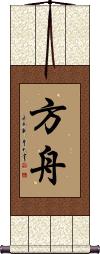
方舟 is the Chinese, Japanese, and old Korean name for an ark (as in Noah's Ark).
The literal translation is the square boat.
Fanchon

This is a common Mandarin Chinese transliteration for the female French name Fanchon.
Fanfan

This is a common Mandarin Chinese transliteration for the female French name Fanfan.
Fantine

This is a common Mandarin Chinese transliteration for the female French name Fantine.
Fontaine

方丹 is the name Fontaine in Chinese (Mandarin).
Jikata

This word has a few possible meanings.
It can refer to a room, hall, or place (a dojo or small theater). The dictionary suggests that in some context, this can refer to a special geisha who is talented in certain musical arts.
Relax
Chill Out
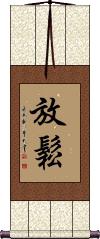
This means to relax in Chinese.
In most cases it's used to suggest that a person “relax,” “hang loose” or “chill out.”
In context where this word is not applied to a human, it can mean to loosen, as in to loosen a knot in a rope.
Alfonso

阿方索 is the transliteration to Mandarin Chinese for the Latin / Spanish name Alfonso.
Alfonzo
阿方索 is the name Alfonzo in Chinese (Mandarin).
Alphonso
阿方索 is the name Alphonso in Chinese (Mandarin).
Firefighter / Fireman

消防員 is a firefighter or fireman in Chinese.
Fontenot

方特諾 is the name Fontenot in Chinese (Mandarin).
Lafond

拉方德 is the name Lafond in Chinese (Mandarin).
Lafontaine

拉方丹 is the name Lafontaine in Chinese (Mandarin).
Lafountain
拉方丹 is the name Lafountain in Chinese (Mandarin).
Wilfong

威爾方 is the name Wilfong in Chinese (Mandarin).
Alphonse

阿爾方斯 is the name Alphonse in Chinese (Mandarin).
Asian Pride / Oriental Pride / AZN Pryde
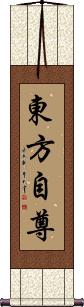
東方自尊 is the universal way to write “Asian Pride.”
We worked on this one for a long time. The effort involved both Chinese and Japanese translators and lengthy discussions. If you have been searching for this term, there is a reason that it's hard to find the way to write “Asian Pride” in Chinese and Japanese - it's because of the inherent difficulties in figuring out a universal combination of characters that can be read in all languages that use forms of Chinese characters.
This final solution that you see to the left creates a reasonable title in Chinese and an exotic (perhaps unusual) title in Japanese (This could be read as “Eastern Self-Respect” in Japanese”).
Although not as natural, it does have the same meaning as Korean Hanja, and the older generation of Vietnamese people will be able to read it.
The first two characters literally mean “Oriental” and the second two mean “pride,” “self-esteem,” or “self-respect” (we chose the most non-arrogant way to say “pride”). If you have “Asian Pride” (sometimes spelled Asian Pryde) these are the characters for you.
Note: For those who wonder, there is nothing technically wrong with the word “Oriental.” It is a correct word, and any bad meanings were created by so-called “Asian Americans” and Caucasians in the United States. To say “Asian” would not completely correct the intended meaning since that would include people from Saudi Arabia, Iraq, Iran, India, and portions of Russia.
For further proof, if you were of East Asian ancestry and born in England, you would be known as a “British Oriental” (The “Oriental stigma” is essentially an American creation and, therefore, applies mainly to the American English language - where they get a bit overzealous with political correctness).
Further, since the Chinese and Japanese word for Oriental is not English, they cannot be construed as having ill meaning. On one trip to China or Japan, you will find many things titled with these two characters, such as malls, buildings, and business names. These places also use “Oriental” as their English title (much as we do since our Chinese business name starts with these same two characters).
In short, the first two characters have the meaning that Americans attach to “Asian” but is more technically correct.
Tom Clan Generational Poem

爾昌友延嗣捷開文裔光宗傳世澤遠晉本立道隆積善家國重學業廣成芳 is the Tom Clan Generational Poem.
If you are interested in this poem, you probably already know the meaning, so for now we'll forgo including a translation.
1 Corinthians 13:8

This is 1 Corinthians 13:8 in Chinese, from the Chinese Union Version (和合本).
In English, the King James Version reads, “Charity never faileth: but whether there be prophecies, they shall fail; whether there be tongues, they shall cease; whether there be knowledge, it shall vanish away.”
1 Corinthians 14:22
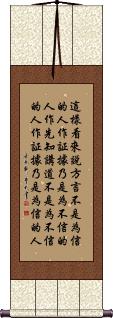
Here is 1 Corinthians 14:22 in Chinese.
The text with punctuation:
这样看来,说方言,不是为信的人作证据,乃是为不信的人。作先知讲道,不是为不信的人作证据,乃是为信的人。
Hand-painted calligraphy does not retain punctuation.
This translation is from the Chinese Union Bible.
You may know it from the KJV as:
Wherefore tongues are for a sign, not to them that believe, but to them that believe not: but prophesying serveth not for them that believe not, but for them which believe.
1 Corinthians 13:4-8

愛是恆久忍耐又有恩慈愛是不嫉妒愛是不自誇不張狂不做害羞的事不求自己的益處不輕易發怒不計算人的惡不喜歡不義只喜歡真理凡事包容凡事相信凡事盼望凡事忍耐愛是永不止息先知講道之能終必歸於無有說方言之能終必停止知識也終必歸於無有 is 1 Corinthians 13:4-8 in Chinese, from the Chinese Union Version (和合本).
In English, the King James Version reads, “Charity suffereth long, and is kind; charity envieth not; charity vaunteth not itself, is not puffed up, Doth not behave itself unseemly, seeketh not her own, is not easily provoked, thinketh no evil; Rejoiceth not in iniquity, but rejoiceth in the truth; Beareth all things, believeth all things, hopeth all things, endureth all things. Charity never faileth: but whether there be prophecies, they shall fail; whether there be tongues, they shall cease; whether there be knowledge, it shall vanish away.”
These search terms might be related to Fang:
Eye for an Eye, Tooth for a Tooth
Ivory / Tooth
Tooth for a Tooth
Not the results for Fang that you were looking for?
Below are some entries from our dictionary that may match your Fang search:
| Characters If shown, 2nd row is Simp. Chinese |
Pronunciation Romanization |
Simple Dictionary Definition |
放 see styles |
fàng fang4 fang hanashi はなし |
More info & calligraphy: Release / Let Go(place-name) Hanashi To let go, release, send out; put, place. |
方 see styles |
fāng fang1 fang michi みち |
More info & calligraphy: Fang(1) direction; way; side; area (in a particular direction); (2) (often 私の方, あなたの方, etc.) side (of an argument, etc.); one's part; (3) type; category; (4) field (of study, etc.); (5) indicates one side of a comparison; (6) way; method; manner; means; (7) length (of each side of a square); (given name) Michi Square; place; correct; a means, plan, prescription; then, now, just. |
防 see styles |
fáng fang2 fang fusegi ふせぎ |
More info & calligraphy: Defense / Defend(surname) Fusegi Ward of, protect, beware; to counter. |
地方 see styles |
dì fang di4 fang5 ti fang chikata ちかた |
More info & calligraphy: Jikata(1) district; region; area; locality; (2) (See 中央・2) the country; countryside; the provinces; rural area; (3) (obsolete) (Imperial Japanese Army jargon) civilian society; (surname) Chikata |
放心 see styles |
fàng xīn fang4 xin1 fang hsin houshin / hoshin ほうしん |
More info & calligraphy: No Worries(n,vs,vi) (1) absentmindedness; preoccupation; being in a daze; (n,vs,vi) (2) (dated) setting one's mind at ease; ceasing to worry; relief; (n,vs,vi) (3) (archaism) (Mencian philosophical term; contrast with 良心) loss of one's moral sense; straying from virtue absentmindedness |
放鬆 放松 see styles |
fàng sōng fang4 song1 fang sung |
More info & calligraphy: Relax |
方舟 see styles |
fāng zhōu fang1 zhou1 fang chou houshuu / hoshu ほうしゅう |
More info & calligraphy: Arkark (i.e. Noah's); (given name) Houshuu |
日方 see styles |
rì fāng ri4 fang1 jih fang hinata ひなた |
the Japanese side or party (in negotiations etc) (personal name) Hinata |
消防員 消防员 see styles |
xiāo fáng yuán xiao1 fang2 yuan2 hsiao fang yüan |
More info & calligraphy: Firefighter / Fireman |
仿 see styles |
fǎng fang3 fang |
to imitate; to copy |
倣 仿 see styles |
fǎng fang3 fang |
variant of 仿[fang3] |
匚 see styles |
fāng fang1 fang |
"right open box" radical (Kangxi radical 22), occurring in 区, 医, 匹 etc |
坊 see styles |
fáng fang2 fang machi まち |
workshop; mill; Taiwan pr. [fang1] (1) bonze; monk; (2) (ぼう only) monk's dwelling; (3) boy; son; sonny; (4) (ぼう only) (used by male children) I; me; (suffix) (5) (ぼう only) (familiar language) (after name; familiar form of address) little; (suffix) (6) (ぼう only) (often preceded by ん) person who is ...; (surname) Machi A place, locality; a temple, place of assembly, etc. |
妨 see styles |
fáng fang2 fang hokken ほっけん |
to hinder; (in the negative or interrogative) (no) harm; (what) harm (personal name) Hokken to hinder |
房 see styles |
fáng fang2 fang bou / bo ぼう |
house; room; CL:間|间[jian1]; branch of an extended family; classifier for family members (or concubines) (1) chamber; room; cell (prison); atrium; (2) (See 坊・2) home of a monk; monk; (3) {astron} (See 二十八宿,蒼竜・そうりょう・3) Chinese "room" constellation (one of the 28 mansions); (surname) Bou House, room. The rooms for monks and nuns in a monastery or nunnery. |
旊 see styles |
fǎng fang3 fang |
variant of 瓬[fang3] |
昉 see styles |
fǎng fang3 fang |
dawn; to begin |
枋 see styles |
fāng fang1 fang mayumi まゆみ |
Santalum album; square wooden pillar (female given name) Mayumi |
淓 see styles |
fāng fang1 fang |
name of a river |
瓬 see styles |
fǎng fang3 fang |
potter; ceramicist |
紡 纺 see styles |
fǎng fang3 fang matsuyo まつよ |
to spin (cotton or hemp etc); fine woven silk fabric (personal name) Matsuyo |
肪 see styles |
fáng fang2 fang suenaka すえなか |
animal fat (personal name) Suenaka |
舫 see styles |
fǎng fang3 fang moyai もやい |
2 boats lashed together; large boat (irregular okurigana usage) painter; mooring rope |
芳 see styles |
fāng fang1 fang yoshiharu よしはる |
fragrant (personal name) Yoshiharu fragrant |
蚄 see styles |
fāng fang1 fang |
used in 虸蚄[zi3 fang1] |
訪 访 see styles |
fǎng fang3 fang hou / ho ほう |
(bound form) to seek by inquiry; (bound form) to visit; to call on (surname) Hou to question |
邡 see styles |
fāng fang1 fang |
name of a district in Sichuan |
鈁 钫 see styles |
fāng fang1 fang |
francium (chemistry) |
髣 see styles |
fǎng fang3 fang |
seemingly |
魴 鲂 see styles |
fáng fang2 fang |
bream; Zeus japanicus |
Click here for more Fang results from our dictionary
The following table may be helpful for those studying Chinese or Japanese:
| Title | Characters | Romaji (Romanized Japanese) | Various forms of Romanized Chinese | |
| Fang | 方 | hou / ho | fāng / fang1 / fang | |
| Ivory Tooth | 牙 | kiba | yá / ya2 / ya | |
| Fong | 方 | hou / ho | fāng / fang1 / fang | |
| Never Give Up | 永不放棄 永不放弃 | yǒng bù fàng qì yong3 bu4 fang4 qi4 yong bu fang qi yongbufangqi | yung pu fang ch`i yungpufangchi yung pu fang chi |
|
| No Worries | 放心 | houshin / hoshin | fàng xīn / fang4 xin1 / fang xin / fangxin | fang hsin / fanghsin |
| Release Let Go | 放 | hana / pang | fàng / fang4 / fang | |
| Return to Dwell in Gardens and Fields Poem | 少無適俗韻性本愛丘山誤落塵網中一去三十年羈鳥戀舊林池魚思故淵開荒南野際抱拙歸園田方宅十余畝草屋八九間榆柳蔭后檐桃李羅堂前暖暖遠人村依依墟里煙狗吠深巷中雞鳴桑樹顛戶庭無塵雜虛室有余閑久在樊籠里復得返自然 少无适俗韵性本爱丘山误落尘网中一去三十年羁鸟恋旧林池鱼思故渊开荒南野际抱拙归园田方宅十余亩草屋八九间榆柳荫后檐桃李罗堂前暖暖远人村依依墟里烟狗吠深巷中鸡鸣桑树颠户庭无尘杂虚室有余闲久在樊笼里复得返自然 | shào wú shì sú yùn xìng běn ài qiū shān wù luò chén wǎng zhōng yī qù sān shí nián jī niǎo liàn jiù lín chí yú sī gù yuān kāi huāng nán yě jì bào zhuō guī yuán tián fāng zhái shí yú mǔ cǎo wū bā jiǔ jiān yú liǔ yīn hòu yán táo lǐ luó táng qián nuǎn nuǎn yuǎn rén cūn yī yī xū lǐ yān gǒu fèi shēn xiàng zhōng jī míng sāng shù diān hù tíng wú chén zá xū shì yǒu yú xián jiǔ zài fán lóng lǐ fù dé fǎn zì rán shao4 wu2 shi4 su2 yun4 xing4 ben3 ai4 qiu1 shan1 wu4 luo4 chen2 wang3 zhong1 yi1 qu4 san1 shi2 nian2 ji1 niao3 lian4 jiu4 lin2 chi2 yu2 si1 gu4 yuan1 kai1 huang1 nan2 ye3 ji4 bao4 zhuo1 gui1 yuan2 tian2 fang1 zhai2 shi2 yu2 mu3 cao3 wu1 ba1 jiu3 jian1 yu2 liu3 yin1 hou4 yan2 tao2 li3 luo2 tang2 qian2 nuan3 nuan3 yuan3 ren2 cun1 yi1 yi1 xu1 li3 yan1 gou3 fei4 shen1 xiang4 zhong1 ji1 ming2 sang1 shu4 dian1 hu4 ting2 wu2 chen2 za2 xu1 shi4 you3 yu2 xian2 jiu3 zai4 fan2 long2 li3 fu4 de2 fan3 zi4 ran2 shao wu shi su yun xing ben ai qiu shan wu luo chen wang zhong yi qu san shi nian ji niao lian jiu lin chi yu si gu yuan kai huang nan ye ji bao zhuo gui yuan tian fang zhai shi yu mu cao wu ba jiu jian yu liu yin hou yan tao li luo tang qian nuan nuan yuan ren cun yi yi xu li yan gou fei shen xiang zhong ji ming sang shu dian hu ting wu chen za xu shi you yu xian jiu zai fan long li fu de fan zi ran | shao wu shih su yün hsing pen ai ch`iu shan wu lo ch`en wang chung i ch`ü san shih nien chi niao lien chiu lin ch`ih yü ssu ku yüan k`ai huang nan yeh chi pao cho kuei yüan t`ien fang chai shih yü mu ts`ao wu pa chiu chien yü liu yin hou yen t`ao li lo t`ang ch`ien nuan nuan yüan jen ts`un i i hsü li yen kou fei shen hsiang chung chi ming sang shu tien hu t`ing wu ch`en tsa hsü shih yu yü hsien chiu tsai fan lung li fu te fan tzu jan shao wu shih su yün hsing pen ai chiu shan wu lo chen wang chung i chü san shih nien chi niao lien chiu lin chih yü ssu ku yüan kai huang nan yeh chi pao cho kuei yüan tien fang chai shih yü mu tsao wu pa chiu chien yü liu yin hou yen tao li lo tang chien nuan nuan yüan jen tsun i i hsü li yen kou fei shen hsiang chung chi ming sang shu tien hu ting wu chen tsa hsü shih yu yü hsien chiu tsai fan lung li fu te fan tzu jan |
|
| Defense Defend | 防 | bou / bo | fáng / fang2 / fang | |
| Phoung | 方 | fāng / fang1 / fang | ||
| Phuong | 方 | fāng / fang1 / fang | ||
| Ark | 方舟 | hakobune | fāng zhōu fang1 zhou1 fang zhou fangzhou | fang chou fangchou |
| Fanchon | 芳淑 | fāng shū / fang1 shu1 / fang shu / fangshu | ||
| Fanfan | 芳芳 | fāng fāng fang1 fang1 fang fang fangfang | ||
| Fantine | 芳汀 | fāng tīng fang1 ting1 fang ting fangting | fang t`ing fangting fang ting |
|
| Fontaine | 方丹 | fāng dān / fang1 dan1 / fang dan / fangdan | fang tan / fangtan | |
| Jikata | 地方 | jikata | dì fāng / di4 fang1 / di fang / difang | ti fang / tifang |
| Relax | 放鬆 放松 | fàng sōng fang4 song1 fang song fangsong | fang sung fangsung |
|
| Alfonso | 阿方索 | ā fāng suǒ a1 fang1 suo3 a fang suo afangsuo | a fang so afangso |
|
| Alfonzo | 阿方索 | ā fāng suǒ a1 fang1 suo3 a fang suo afangsuo | a fang so afangso |
|
| Alphonso | 阿方索 | ā fāng suǒ a1 fang1 suo3 a fang suo afangsuo | a fang so afangso |
|
| Firefighter Fireman | 消防員 消防员 | xiāo fáng yuán xiao1 fang2 yuan2 xiao fang yuan xiaofangyuan | hsiao fang yüan hsiaofangyüan |
|
| Fontenot | 方特諾 方特诺 | fāng tè nuò fang1 te4 nuo4 fang te nuo fangtenuo | fang t`e no fangteno fang te no |
|
| Lafond | 拉方德 | lā fāng dé la1 fang1 de2 la fang de lafangde | la fang te lafangte |
|
| Lafontaine | 拉方丹 | lā fāng dān la1 fang1 dan1 la fang dan lafangdan | la fang tan lafangtan |
|
| Lafountain | 拉方丹 | lā fāng dān la1 fang1 dan1 la fang dan lafangdan | la fang tan lafangtan |
|
| Wilfong | 威爾方 威尔方 | wēi ěr fāng wei1 er3 fang1 wei er fang weierfang | wei erh fang weierhfang |
|
| Alphonse | 阿爾方斯 阿尔方斯 | ā ěr fāng sī a1 er3 fang1 si1 a er fang si aerfangsi | a erh fang ssu aerhfangssu |
|
| Asian Pride Oriental Pride AZN Pryde | 東方自尊 东方自尊 | tou hou zi son touhouzison to ho zi son | dōng fāng zì zūn dong1 fang1 zi4 zun1 dong fang zi zun dongfangzizun | tung fang tzu tsun tungfangtzutsun |
| Tom Clan Generational Poem | 爾昌友延嗣捷開文裔光宗傳世澤遠晉本立道隆積善家國重學業廣成芳 尔昌友延嗣捷开文裔光宗传世泽远晋本立道隆积善家国重学业广成芳 | ěr chāng yǒu yán sì jié kāi wén yì guāng zōng chuán shì zé yuǎn jìn běn lì dào lóng jī shàn jiā guó zhòng xué yè guǎng chéng fāng er3 chang1 you3 yan2 si4 jie2 kai1 wen2 yi4 guang1 zong1 chuan2 shi4 ze2 yuan3 jin4 ben3 li4 dao4 long2 ji1 shan4 jia1 guo2 zhong4 xue2 ye4 guang3 cheng2 fang1 er chang you yan si jie kai wen yi guang zong chuan shi ze yuan jin ben li dao long ji shan jia guo zhong xue ye guang cheng fang | erh ch`ang yu yen ssu chieh k`ai wen i kuang tsung ch`uan shih tse yüan chin pen li tao lung chi shan chia kuo chung hsüeh yeh kuang ch`eng fang erh chang yu yen ssu chieh kai wen i kuang tsung chuan shih tse yüan chin pen li tao lung chi shan chia kuo chung hsüeh yeh kuang cheng fang |
|
| 1 Corinthians 13:8 | 愛是永不止息先知講道之能終必歸於無有說方言之能終必停止知識也終必歸於無有 爱是永不止息先知讲道之能终必归于无有说方言之能终必停止知识也终必归于无有 | ài shì yǒng bù zhǐ xī xiān zhī jiǎng dào zhī néng zhōng bì guī yú wú yǒu shuō fāng yán zhī néng zhōng bì tíng zhǐ zhī shí yě zhōng bì guī yú wú yǒu ai4 shi4 yong3 bu4 zhi3 xi1 xian1 zhi1 jiang3 dao4 zhi1 neng2 zhong1 bi4 gui1 yu2 wu2 you3 shuo1 fang1 yan2 zhi1 neng2 zhong1 bi4 ting2 zhi3 zhi1 shi2 ye3 zhong1 bi4 gui1 yu2 wu2 you3 ai shi yong bu zhi xi xian zhi jiang dao zhi neng zhong bi gui yu wu you shuo fang yan zhi neng zhong bi ting zhi zhi shi ye zhong bi gui yu wu you | ai shih yung pu chih hsi hsien chih chiang tao chih neng chung pi kuei yü wu yu shuo fang yen chih neng chung pi t`ing chih chih shih yeh chung pi kuei yü wu yu ai shih yung pu chih hsi hsien chih chiang tao chih neng chung pi kuei yü wu yu shuo fang yen chih neng chung pi ting chih chih shih yeh chung pi kuei yü wu yu |
|
| 1 Corinthians 14:22 | 這樣看來說方言不是為信的人作証據乃是為不信的人作先知講道不是為不信的人作証據乃是為信的人 这样看来说方言不是为信的人作证据乃是为不信的人作先知讲道不是为不信的人作证据乃是为信的人 | zhè yàng kàn lái shuō fāng yán bù shì wéi xìn de rén zuò zhèng jù nǎi shì wéi bù xìn de rén zuò xiān zhī jiǎng dào bù shì wéi bù xìn de rén zuò zhèng jù nǎi shì wéi xìn de rén zhe4 yang4 kan4 lai2 shuo1 fang1 yan2 bu4 shi4 wei2 xin4 de ren2 zuo4 zheng4 ju4 nai3 shi4 wei2 bu4 xin4 de ren2 zuo4 xian1 zhi1 jiang3 dao4 bu4 shi4 wei2 bu4 xin4 de ren2 zuo4 zheng4 ju4 nai3 shi4 wei2 xin4 de ren2 zhe yang kan lai shuo fang yan bu shi wei xin de ren zuo zheng ju nai shi wei bu xin de ren zuo xian zhi jiang dao bu shi wei bu xin de ren zuo zheng ju nai shi wei xin de ren | che yang k`an lai shuo fang yen pu shih wei hsin te jen tso cheng chü nai shih wei pu hsin te jen tso hsien chih chiang tao pu shih wei pu hsin te jen tso cheng chü nai shih wei hsin te jen che yang kan lai shuo fang yen pu shih wei hsin te jen tso cheng chü nai shih wei pu hsin te jen tso hsien chih chiang tao pu shih wei pu hsin te jen tso cheng chü nai shih wei hsin te jen |
|
| 1 Corinthians 13:4-8 | 愛是恆久忍耐又有恩慈愛是不嫉妒愛是不自誇不張狂不做害羞的事不求自己的益處不輕易發怒不計算人的惡不喜歡不義只喜歡真理凡事包容凡事相信凡事盼望凡事忍耐愛是永不止息先知講道之能終必歸於無有說方言之能終必停止知識也終必歸於無有 爱是恒久忍耐又有恩慈爱是不嫉妒爱是不自夸不张狂不做害羞的事不求自己的益处不轻易发怒不计算人的恶不喜欢不义只喜欢真理凡事包容凡事相信凡事盼望凡事忍耐爱是永不止息先知讲道之能终必归于无有说方言之能终必停止知识也终必归于无有 | ài shì héng jiǔ rěn nài yòu yǒu ēn cí ài shì bú jí dù ài shì bú zì kuā bù zhāng kuáng bú zuò hài xiū de shì bù qiú zì jǐ de yì chù bù qīng yì fā nù bú jì suàn rén de è bù xǐ huan bú yì zhǐ xǐ huan zhēn lǐ fán shì bāo róng fán shì xiāng xìn fán shì pàn wàng fán shì rěn nài ài shì yǒng bù zhǐ xī xiān zhī jiǎng dào zhī néng zhōng bì guī yú wú yǒu shuō fāng yán zhī néng zhōng bì tíng zhǐ zhī shí yě zhōng bì guī yú wú yǒu ai4 shi4 heng2 jiu3 ren3 nai4 you4 you3 en1 ci2 ai4 shi4 bu2 ji2 du4 ai4 shi4 bu2 zi4 kua1 bu4 zhang1 kuang2 bu2 zuo4 hai4 xiu1 de shi4 bu4 qiu2 zi4 ji3 de yi4 chu4 bu4 qing1 yi4 fa1 nu4 bu2 ji4 suan4 ren2 de e4 bu4 xi3 huan bu2 yi4 zhi3 xi3 huan zhen1 li3 fan2 shi4 bao1 rong2 fan2 shi4 xiang1 xin4 fan2 shi4 pan4 wang4 fan2 shi4 ren3 nai4 ai4 shi4 yong3 bu4 zhi3 xi1 xian1 zhi1 jiang3 dao4 zhi1 neng2 zhong1 bi4 gui1 yu2 wu2 you3 shuo1 fang1 yan2 zhi1 neng2 zhong1 bi4 ting2 zhi3 zhi1 shi2 ye3 zhong1 bi4 gui1 yu2 wu2 you3 ai shi heng jiu ren nai you you en ci ai shi bu ji du ai shi bu zi kua bu zhang kuang bu zuo hai xiu de shi bu qiu zi ji de yi chu bu qing yi fa nu bu ji suan ren de e bu xi huan bu yi zhi xi huan zhen li fan shi bao rong fan shi xiang xin fan shi pan wang fan shi ren nai ai shi yong bu zhi xi xian zhi jiang dao zhi neng zhong bi gui yu wu you shuo fang yan zhi neng zhong bi ting zhi zhi shi ye zhong bi gui yu wu you | ai shih heng chiu jen nai yu yu en tz`u ai shih pu chi tu ai shih pu tzu k`ua pu chang k`uang pu tso hai hsiu te shih pu ch`iu tzu chi te i ch`u pu ch`ing i fa nu pu chi suan jen te o pu hsi huan pu i chih hsi huan chen li fan shih pao jung fan shih hsiang hsin fan shih p`an wang fan shih jen nai ai shih yung pu chih hsi hsien chih chiang tao chih neng chung pi kuei yü wu yu shuo fang yen chih neng chung pi t`ing chih chih shih yeh chung pi kuei yü wu yu ai shih heng chiu jen nai yu yu en tzu ai shih pu chi tu ai shih pu tzu kua pu chang kuang pu tso hai hsiu te shih pu chiu tzu chi te i chu pu ching i fa nu pu chi suan jen te o pu hsi huan pu i chih hsi huan chen li fan shih pao jung fan shih hsiang hsin fan shih pan wang fan shih jen nai ai shih yung pu chih hsi hsien chih chiang tao chih neng chung pi kuei yü wu yu shuo fang yen chih neng chung pi ting chih chih shih yeh chung pi kuei yü wu yu |
|
| In some entries above you will see that characters have different versions above and below a line. In these cases, the characters above the line are Traditional Chinese, while the ones below are Simplified Chinese. | ||||

Successful Chinese Character and Japanese Kanji calligraphy searches within the last few hours...